Static Public Member Functions | |
| static double | calibrateCamera (List< Mat > objectPoints, List< Mat > imagePoints, in Vec2d imageSize, Mat cameraMatrix, Mat distCoeffs, List< Mat > rvecs, List< Mat > tvecs) |
| static double | calibrateCamera (List< Mat > objectPoints, List< Mat > imagePoints, in Vec2d imageSize, Mat cameraMatrix, Mat distCoeffs, List< Mat > rvecs, List< Mat > tvecs, int flags) |
| static double | calibrateCamera (List< Mat > objectPoints, List< Mat > imagePoints, in Vec2d imageSize, Mat cameraMatrix, Mat distCoeffs, List< Mat > rvecs, List< Mat > tvecs, int flags, in Vec3d criteria) |
| static double | calibrateCamera (List< Mat > objectPoints, List< Mat > imagePoints, in(double width, double height) imageSize, Mat cameraMatrix, Mat distCoeffs, List< Mat > rvecs, List< Mat > tvecs) |
| static double | calibrateCamera (List< Mat > objectPoints, List< Mat > imagePoints, in(double width, double height) imageSize, Mat cameraMatrix, Mat distCoeffs, List< Mat > rvecs, List< Mat > tvecs, int flags) |
| static double | calibrateCamera (List< Mat > objectPoints, List< Mat > imagePoints, in(double width, double height) imageSize, Mat cameraMatrix, Mat distCoeffs, List< Mat > rvecs, List< Mat > tvecs, int flags, in(double type, double maxCount, double epsilon) criteria) |
| static double | calibrateCamera (List< Mat > objectPoints, List< Mat > imagePoints, Size imageSize, Mat cameraMatrix, Mat distCoeffs, List< Mat > rvecs, List< Mat > tvecs) |
| static double | calibrateCamera (List< Mat > objectPoints, List< Mat > imagePoints, Size imageSize, Mat cameraMatrix, Mat distCoeffs, List< Mat > rvecs, List< Mat > tvecs, int flags) |
| static double | calibrateCamera (List< Mat > objectPoints, List< Mat > imagePoints, Size imageSize, Mat cameraMatrix, Mat distCoeffs, List< Mat > rvecs, List< Mat > tvecs, int flags, TermCriteria criteria) |
| static double | calibrateCameraExtended (List< Mat > objectPoints, List< Mat > imagePoints, in Vec2d imageSize, Mat cameraMatrix, Mat distCoeffs, List< Mat > rvecs, List< Mat > tvecs, Mat stdDeviationsIntrinsics, Mat stdDeviationsExtrinsics, Mat perViewErrors) |
| Finds the camera intrinsic and extrinsic parameters from several views of a calibration pattern. | |
| static double | calibrateCameraExtended (List< Mat > objectPoints, List< Mat > imagePoints, in Vec2d imageSize, Mat cameraMatrix, Mat distCoeffs, List< Mat > rvecs, List< Mat > tvecs, Mat stdDeviationsIntrinsics, Mat stdDeviationsExtrinsics, Mat perViewErrors, int flags) |
| Finds the camera intrinsic and extrinsic parameters from several views of a calibration pattern. | |
| static double | calibrateCameraExtended (List< Mat > objectPoints, List< Mat > imagePoints, in Vec2d imageSize, Mat cameraMatrix, Mat distCoeffs, List< Mat > rvecs, List< Mat > tvecs, Mat stdDeviationsIntrinsics, Mat stdDeviationsExtrinsics, Mat perViewErrors, int flags, in Vec3d criteria) |
| Finds the camera intrinsic and extrinsic parameters from several views of a calibration pattern. | |
| static double | calibrateCameraExtended (List< Mat > objectPoints, List< Mat > imagePoints, in(double width, double height) imageSize, Mat cameraMatrix, Mat distCoeffs, List< Mat > rvecs, List< Mat > tvecs, Mat stdDeviationsIntrinsics, Mat stdDeviationsExtrinsics, Mat perViewErrors) |
| Finds the camera intrinsic and extrinsic parameters from several views of a calibration pattern. | |
| static double | calibrateCameraExtended (List< Mat > objectPoints, List< Mat > imagePoints, in(double width, double height) imageSize, Mat cameraMatrix, Mat distCoeffs, List< Mat > rvecs, List< Mat > tvecs, Mat stdDeviationsIntrinsics, Mat stdDeviationsExtrinsics, Mat perViewErrors, int flags) |
| Finds the camera intrinsic and extrinsic parameters from several views of a calibration pattern. | |
| static double | calibrateCameraExtended (List< Mat > objectPoints, List< Mat > imagePoints, in(double width, double height) imageSize, Mat cameraMatrix, Mat distCoeffs, List< Mat > rvecs, List< Mat > tvecs, Mat stdDeviationsIntrinsics, Mat stdDeviationsExtrinsics, Mat perViewErrors, int flags, in(double type, double maxCount, double epsilon) criteria) |
| Finds the camera intrinsic and extrinsic parameters from several views of a calibration pattern. | |
| static double | calibrateCameraExtended (List< Mat > objectPoints, List< Mat > imagePoints, Size imageSize, Mat cameraMatrix, Mat distCoeffs, List< Mat > rvecs, List< Mat > tvecs, Mat stdDeviationsIntrinsics, Mat stdDeviationsExtrinsics, Mat perViewErrors) |
| Finds the camera intrinsic and extrinsic parameters from several views of a calibration pattern. | |
| static double | calibrateCameraExtended (List< Mat > objectPoints, List< Mat > imagePoints, Size imageSize, Mat cameraMatrix, Mat distCoeffs, List< Mat > rvecs, List< Mat > tvecs, Mat stdDeviationsIntrinsics, Mat stdDeviationsExtrinsics, Mat perViewErrors, int flags) |
| Finds the camera intrinsic and extrinsic parameters from several views of a calibration pattern. | |
| static double | calibrateCameraExtended (List< Mat > objectPoints, List< Mat > imagePoints, Size imageSize, Mat cameraMatrix, Mat distCoeffs, List< Mat > rvecs, List< Mat > tvecs, Mat stdDeviationsIntrinsics, Mat stdDeviationsExtrinsics, Mat perViewErrors, int flags, TermCriteria criteria) |
| Finds the camera intrinsic and extrinsic parameters from several views of a calibration pattern. | |
| static double | calibrateCameraRO (List< Mat > objectPoints, List< Mat > imagePoints, in Vec2d imageSize, int iFixedPoint, Mat cameraMatrix, Mat distCoeffs, List< Mat > rvecs, List< Mat > tvecs, Mat newObjPoints) |
| static double | calibrateCameraRO (List< Mat > objectPoints, List< Mat > imagePoints, in Vec2d imageSize, int iFixedPoint, Mat cameraMatrix, Mat distCoeffs, List< Mat > rvecs, List< Mat > tvecs, Mat newObjPoints, int flags) |
| static double | calibrateCameraRO (List< Mat > objectPoints, List< Mat > imagePoints, in Vec2d imageSize, int iFixedPoint, Mat cameraMatrix, Mat distCoeffs, List< Mat > rvecs, List< Mat > tvecs, Mat newObjPoints, int flags, in Vec3d criteria) |
| static double | calibrateCameraRO (List< Mat > objectPoints, List< Mat > imagePoints, in(double width, double height) imageSize, int iFixedPoint, Mat cameraMatrix, Mat distCoeffs, List< Mat > rvecs, List< Mat > tvecs, Mat newObjPoints) |
| static double | calibrateCameraRO (List< Mat > objectPoints, List< Mat > imagePoints, in(double width, double height) imageSize, int iFixedPoint, Mat cameraMatrix, Mat distCoeffs, List< Mat > rvecs, List< Mat > tvecs, Mat newObjPoints, int flags) |
| static double | calibrateCameraRO (List< Mat > objectPoints, List< Mat > imagePoints, in(double width, double height) imageSize, int iFixedPoint, Mat cameraMatrix, Mat distCoeffs, List< Mat > rvecs, List< Mat > tvecs, Mat newObjPoints, int flags, in(double type, double maxCount, double epsilon) criteria) |
| static double | calibrateCameraRO (List< Mat > objectPoints, List< Mat > imagePoints, Size imageSize, int iFixedPoint, Mat cameraMatrix, Mat distCoeffs, List< Mat > rvecs, List< Mat > tvecs, Mat newObjPoints) |
| static double | calibrateCameraRO (List< Mat > objectPoints, List< Mat > imagePoints, Size imageSize, int iFixedPoint, Mat cameraMatrix, Mat distCoeffs, List< Mat > rvecs, List< Mat > tvecs, Mat newObjPoints, int flags) |
| static double | calibrateCameraRO (List< Mat > objectPoints, List< Mat > imagePoints, Size imageSize, int iFixedPoint, Mat cameraMatrix, Mat distCoeffs, List< Mat > rvecs, List< Mat > tvecs, Mat newObjPoints, int flags, TermCriteria criteria) |
| static double | calibrateCameraROExtended (List< Mat > objectPoints, List< Mat > imagePoints, in Vec2d imageSize, int iFixedPoint, Mat cameraMatrix, Mat distCoeffs, List< Mat > rvecs, List< Mat > tvecs, Mat newObjPoints, Mat stdDeviationsIntrinsics, Mat stdDeviationsExtrinsics, Mat stdDeviationsObjPoints, Mat perViewErrors) |
| Finds the camera intrinsic and extrinsic parameters from several views of a calibration pattern. | |
| static double | calibrateCameraROExtended (List< Mat > objectPoints, List< Mat > imagePoints, in Vec2d imageSize, int iFixedPoint, Mat cameraMatrix, Mat distCoeffs, List< Mat > rvecs, List< Mat > tvecs, Mat newObjPoints, Mat stdDeviationsIntrinsics, Mat stdDeviationsExtrinsics, Mat stdDeviationsObjPoints, Mat perViewErrors, int flags) |
| Finds the camera intrinsic and extrinsic parameters from several views of a calibration pattern. | |
| static double | calibrateCameraROExtended (List< Mat > objectPoints, List< Mat > imagePoints, in Vec2d imageSize, int iFixedPoint, Mat cameraMatrix, Mat distCoeffs, List< Mat > rvecs, List< Mat > tvecs, Mat newObjPoints, Mat stdDeviationsIntrinsics, Mat stdDeviationsExtrinsics, Mat stdDeviationsObjPoints, Mat perViewErrors, int flags, in Vec3d criteria) |
| Finds the camera intrinsic and extrinsic parameters from several views of a calibration pattern. | |
| static double | calibrateCameraROExtended (List< Mat > objectPoints, List< Mat > imagePoints, in(double width, double height) imageSize, int iFixedPoint, Mat cameraMatrix, Mat distCoeffs, List< Mat > rvecs, List< Mat > tvecs, Mat newObjPoints, Mat stdDeviationsIntrinsics, Mat stdDeviationsExtrinsics, Mat stdDeviationsObjPoints, Mat perViewErrors) |
| Finds the camera intrinsic and extrinsic parameters from several views of a calibration pattern. | |
| static double | calibrateCameraROExtended (List< Mat > objectPoints, List< Mat > imagePoints, in(double width, double height) imageSize, int iFixedPoint, Mat cameraMatrix, Mat distCoeffs, List< Mat > rvecs, List< Mat > tvecs, Mat newObjPoints, Mat stdDeviationsIntrinsics, Mat stdDeviationsExtrinsics, Mat stdDeviationsObjPoints, Mat perViewErrors, int flags) |
| Finds the camera intrinsic and extrinsic parameters from several views of a calibration pattern. | |
| static double | calibrateCameraROExtended (List< Mat > objectPoints, List< Mat > imagePoints, in(double width, double height) imageSize, int iFixedPoint, Mat cameraMatrix, Mat distCoeffs, List< Mat > rvecs, List< Mat > tvecs, Mat newObjPoints, Mat stdDeviationsIntrinsics, Mat stdDeviationsExtrinsics, Mat stdDeviationsObjPoints, Mat perViewErrors, int flags, in(double type, double maxCount, double epsilon) criteria) |
| Finds the camera intrinsic and extrinsic parameters from several views of a calibration pattern. | |
| static double | calibrateCameraROExtended (List< Mat > objectPoints, List< Mat > imagePoints, Size imageSize, int iFixedPoint, Mat cameraMatrix, Mat distCoeffs, List< Mat > rvecs, List< Mat > tvecs, Mat newObjPoints, Mat stdDeviationsIntrinsics, Mat stdDeviationsExtrinsics, Mat stdDeviationsObjPoints, Mat perViewErrors) |
| Finds the camera intrinsic and extrinsic parameters from several views of a calibration pattern. | |
| static double | calibrateCameraROExtended (List< Mat > objectPoints, List< Mat > imagePoints, Size imageSize, int iFixedPoint, Mat cameraMatrix, Mat distCoeffs, List< Mat > rvecs, List< Mat > tvecs, Mat newObjPoints, Mat stdDeviationsIntrinsics, Mat stdDeviationsExtrinsics, Mat stdDeviationsObjPoints, Mat perViewErrors, int flags) |
| Finds the camera intrinsic and extrinsic parameters from several views of a calibration pattern. | |
| static double | calibrateCameraROExtended (List< Mat > objectPoints, List< Mat > imagePoints, Size imageSize, int iFixedPoint, Mat cameraMatrix, Mat distCoeffs, List< Mat > rvecs, List< Mat > tvecs, Mat newObjPoints, Mat stdDeviationsIntrinsics, Mat stdDeviationsExtrinsics, Mat stdDeviationsObjPoints, Mat perViewErrors, int flags, TermCriteria criteria) |
| Finds the camera intrinsic and extrinsic parameters from several views of a calibration pattern. | |
| static double | fisheye_calibrate (List< Mat > objectPoints, List< Mat > imagePoints, in Vec2d image_size, Mat K, Mat D, List< Mat > rvecs, List< Mat > tvecs) |
| Performs camera calibration. | |
| static double | fisheye_calibrate (List< Mat > objectPoints, List< Mat > imagePoints, in Vec2d image_size, Mat K, Mat D, List< Mat > rvecs, List< Mat > tvecs, int flags) |
| Performs camera calibration. | |
| static double | fisheye_calibrate (List< Mat > objectPoints, List< Mat > imagePoints, in Vec2d image_size, Mat K, Mat D, List< Mat > rvecs, List< Mat > tvecs, int flags, in Vec3d criteria) |
| Performs camera calibration. | |
| static double | fisheye_calibrate (List< Mat > objectPoints, List< Mat > imagePoints, in(double width, double height) image_size, Mat K, Mat D, List< Mat > rvecs, List< Mat > tvecs) |
| Performs camera calibration. | |
| static double | fisheye_calibrate (List< Mat > objectPoints, List< Mat > imagePoints, in(double width, double height) image_size, Mat K, Mat D, List< Mat > rvecs, List< Mat > tvecs, int flags) |
| Performs camera calibration. | |
| static double | fisheye_calibrate (List< Mat > objectPoints, List< Mat > imagePoints, in(double width, double height) image_size, Mat K, Mat D, List< Mat > rvecs, List< Mat > tvecs, int flags, in(double type, double maxCount, double epsilon) criteria) |
| Performs camera calibration. | |
| static double | fisheye_calibrate (List< Mat > objectPoints, List< Mat > imagePoints, Size image_size, Mat K, Mat D, List< Mat > rvecs, List< Mat > tvecs) |
| Performs camera calibration. | |
| static double | fisheye_calibrate (List< Mat > objectPoints, List< Mat > imagePoints, Size image_size, Mat K, Mat D, List< Mat > rvecs, List< Mat > tvecs, int flags) |
| Performs camera calibration. | |
| static double | fisheye_calibrate (List< Mat > objectPoints, List< Mat > imagePoints, Size image_size, Mat K, Mat D, List< Mat > rvecs, List< Mat > tvecs, int flags, TermCriteria criteria) |
| Performs camera calibration. | |
| static double | fisheye_stereoCalibrate (List< Mat > objectPoints, List< Mat > imagePoints1, List< Mat > imagePoints2, Mat K1, Mat D1, Mat K2, Mat D2, in Vec2d imageSize, Mat R, Mat T) |
| static double | fisheye_stereoCalibrate (List< Mat > objectPoints, List< Mat > imagePoints1, List< Mat > imagePoints2, Mat K1, Mat D1, Mat K2, Mat D2, in Vec2d imageSize, Mat R, Mat T, int flags) |
| static double | fisheye_stereoCalibrate (List< Mat > objectPoints, List< Mat > imagePoints1, List< Mat > imagePoints2, Mat K1, Mat D1, Mat K2, Mat D2, in Vec2d imageSize, Mat R, Mat T, int flags, in Vec3d criteria) |
| static double | fisheye_stereoCalibrate (List< Mat > objectPoints, List< Mat > imagePoints1, List< Mat > imagePoints2, Mat K1, Mat D1, Mat K2, Mat D2, in Vec2d imageSize, Mat R, Mat T, List< Mat > rvecs, List< Mat > tvecs) |
| Performs stereo calibration. | |
| static double | fisheye_stereoCalibrate (List< Mat > objectPoints, List< Mat > imagePoints1, List< Mat > imagePoints2, Mat K1, Mat D1, Mat K2, Mat D2, in Vec2d imageSize, Mat R, Mat T, List< Mat > rvecs, List< Mat > tvecs, int flags) |
| Performs stereo calibration. | |
| static double | fisheye_stereoCalibrate (List< Mat > objectPoints, List< Mat > imagePoints1, List< Mat > imagePoints2, Mat K1, Mat D1, Mat K2, Mat D2, in Vec2d imageSize, Mat R, Mat T, List< Mat > rvecs, List< Mat > tvecs, int flags, in Vec3d criteria) |
| Performs stereo calibration. | |
| static double | fisheye_stereoCalibrate (List< Mat > objectPoints, List< Mat > imagePoints1, List< Mat > imagePoints2, Mat K1, Mat D1, Mat K2, Mat D2, in(double width, double height) imageSize, Mat R, Mat T) |
| static double | fisheye_stereoCalibrate (List< Mat > objectPoints, List< Mat > imagePoints1, List< Mat > imagePoints2, Mat K1, Mat D1, Mat K2, Mat D2, in(double width, double height) imageSize, Mat R, Mat T, int flags) |
| static double | fisheye_stereoCalibrate (List< Mat > objectPoints, List< Mat > imagePoints1, List< Mat > imagePoints2, Mat K1, Mat D1, Mat K2, Mat D2, in(double width, double height) imageSize, Mat R, Mat T, int flags, in(double type, double maxCount, double epsilon) criteria) |
| static double | fisheye_stereoCalibrate (List< Mat > objectPoints, List< Mat > imagePoints1, List< Mat > imagePoints2, Mat K1, Mat D1, Mat K2, Mat D2, in(double width, double height) imageSize, Mat R, Mat T, List< Mat > rvecs, List< Mat > tvecs) |
| Performs stereo calibration. | |
| static double | fisheye_stereoCalibrate (List< Mat > objectPoints, List< Mat > imagePoints1, List< Mat > imagePoints2, Mat K1, Mat D1, Mat K2, Mat D2, in(double width, double height) imageSize, Mat R, Mat T, List< Mat > rvecs, List< Mat > tvecs, int flags) |
| Performs stereo calibration. | |
| static double | fisheye_stereoCalibrate (List< Mat > objectPoints, List< Mat > imagePoints1, List< Mat > imagePoints2, Mat K1, Mat D1, Mat K2, Mat D2, in(double width, double height) imageSize, Mat R, Mat T, List< Mat > rvecs, List< Mat > tvecs, int flags, in(double type, double maxCount, double epsilon) criteria) |
| Performs stereo calibration. | |
| static double | fisheye_stereoCalibrate (List< Mat > objectPoints, List< Mat > imagePoints1, List< Mat > imagePoints2, Mat K1, Mat D1, Mat K2, Mat D2, Size imageSize, Mat R, Mat T) |
| static double | fisheye_stereoCalibrate (List< Mat > objectPoints, List< Mat > imagePoints1, List< Mat > imagePoints2, Mat K1, Mat D1, Mat K2, Mat D2, Size imageSize, Mat R, Mat T, int flags) |
| static double | fisheye_stereoCalibrate (List< Mat > objectPoints, List< Mat > imagePoints1, List< Mat > imagePoints2, Mat K1, Mat D1, Mat K2, Mat D2, Size imageSize, Mat R, Mat T, int flags, TermCriteria criteria) |
| static double | fisheye_stereoCalibrate (List< Mat > objectPoints, List< Mat > imagePoints1, List< Mat > imagePoints2, Mat K1, Mat D1, Mat K2, Mat D2, Size imageSize, Mat R, Mat T, List< Mat > rvecs, List< Mat > tvecs) |
| Performs stereo calibration. | |
| static double | fisheye_stereoCalibrate (List< Mat > objectPoints, List< Mat > imagePoints1, List< Mat > imagePoints2, Mat K1, Mat D1, Mat K2, Mat D2, Size imageSize, Mat R, Mat T, List< Mat > rvecs, List< Mat > tvecs, int flags) |
| Performs stereo calibration. | |
| static double | fisheye_stereoCalibrate (List< Mat > objectPoints, List< Mat > imagePoints1, List< Mat > imagePoints2, Mat K1, Mat D1, Mat K2, Mat D2, Size imageSize, Mat R, Mat T, List< Mat > rvecs, List< Mat > tvecs, int flags, TermCriteria criteria) |
| Performs stereo calibration. | |
| static Mat | initCameraMatrix2D (List< MatOfPoint3f > objectPoints, List< MatOfPoint2f > imagePoints, in Vec2d imageSize) |
| Finds an initial camera intrinsic matrix from 3D-2D point correspondences. | |
| static Mat | initCameraMatrix2D (List< MatOfPoint3f > objectPoints, List< MatOfPoint2f > imagePoints, in Vec2d imageSize, double aspectRatio) |
| Finds an initial camera intrinsic matrix from 3D-2D point correspondences. | |
| static Mat | initCameraMatrix2D (List< MatOfPoint3f > objectPoints, List< MatOfPoint2f > imagePoints, in(double width, double height) imageSize) |
| Finds an initial camera intrinsic matrix from 3D-2D point correspondences. | |
| static Mat | initCameraMatrix2D (List< MatOfPoint3f > objectPoints, List< MatOfPoint2f > imagePoints, in(double width, double height) imageSize, double aspectRatio) |
| Finds an initial camera intrinsic matrix from 3D-2D point correspondences. | |
| static Mat | initCameraMatrix2D (List< MatOfPoint3f > objectPoints, List< MatOfPoint2f > imagePoints, Size imageSize) |
| Finds an initial camera intrinsic matrix from 3D-2D point correspondences. | |
| static Mat | initCameraMatrix2D (List< MatOfPoint3f > objectPoints, List< MatOfPoint2f > imagePoints, Size imageSize, double aspectRatio) |
| Finds an initial camera intrinsic matrix from 3D-2D point correspondences. | |
| static double | registerCameras (List< Mat > objectPoints1, List< Mat > objectPoints2, List< Mat > imagePoints1, List< Mat > imagePoints2, Mat cameraMatrix1, Mat distCoeffs1, int cameraModel1, Mat cameraMatrix2, Mat distCoeffs2, int cameraModel2, Mat R, Mat T, Mat E, Mat F, Mat perViewErrors) |
| static double | registerCameras (List< Mat > objectPoints1, List< Mat > objectPoints2, List< Mat > imagePoints1, List< Mat > imagePoints2, Mat cameraMatrix1, Mat distCoeffs1, int cameraModel1, Mat cameraMatrix2, Mat distCoeffs2, int cameraModel2, Mat R, Mat T, Mat E, Mat F, Mat perViewErrors, int flags) |
| static double | registerCameras (List< Mat > objectPoints1, List< Mat > objectPoints2, List< Mat > imagePoints1, List< Mat > imagePoints2, Mat cameraMatrix1, Mat distCoeffs1, int cameraModel1, Mat cameraMatrix2, Mat distCoeffs2, int cameraModel2, Mat R, Mat T, Mat E, Mat F, Mat perViewErrors, int flags, in Vec3d criteria) |
| static double | registerCameras (List< Mat > objectPoints1, List< Mat > objectPoints2, List< Mat > imagePoints1, List< Mat > imagePoints2, Mat cameraMatrix1, Mat distCoeffs1, int cameraModel1, Mat cameraMatrix2, Mat distCoeffs2, int cameraModel2, Mat R, Mat T, Mat E, Mat F, Mat perViewErrors, int flags, in(double type, double maxCount, double epsilon) criteria) |
| static double | registerCameras (List< Mat > objectPoints1, List< Mat > objectPoints2, List< Mat > imagePoints1, List< Mat > imagePoints2, Mat cameraMatrix1, Mat distCoeffs1, int cameraModel1, Mat cameraMatrix2, Mat distCoeffs2, int cameraModel2, Mat R, Mat T, Mat E, Mat F, Mat perViewErrors, int flags, TermCriteria criteria) |
| static double | registerCamerasExtended (List< Mat > objectPoints1, List< Mat > objectPoints2, List< Mat > imagePoints1, List< Mat > imagePoints2, Mat cameraMatrix1, Mat distCoeffs1, int cameraModel1, Mat cameraMatrix2, Mat distCoeffs2, int cameraModel2, Mat R, Mat T, Mat E, Mat F, List< Mat > rvecs, List< Mat > tvecs, Mat perViewErrors) |
| Calibrates a camera pair set up. This function finds the extrinsic parameters between the two cameras. | |
| static double | registerCamerasExtended (List< Mat > objectPoints1, List< Mat > objectPoints2, List< Mat > imagePoints1, List< Mat > imagePoints2, Mat cameraMatrix1, Mat distCoeffs1, int cameraModel1, Mat cameraMatrix2, Mat distCoeffs2, int cameraModel2, Mat R, Mat T, Mat E, Mat F, List< Mat > rvecs, List< Mat > tvecs, Mat perViewErrors, int flags) |
| Calibrates a camera pair set up. This function finds the extrinsic parameters between the two cameras. | |
| static double | registerCamerasExtended (List< Mat > objectPoints1, List< Mat > objectPoints2, List< Mat > imagePoints1, List< Mat > imagePoints2, Mat cameraMatrix1, Mat distCoeffs1, int cameraModel1, Mat cameraMatrix2, Mat distCoeffs2, int cameraModel2, Mat R, Mat T, Mat E, Mat F, List< Mat > rvecs, List< Mat > tvecs, Mat perViewErrors, int flags, in Vec3d criteria) |
| Calibrates a camera pair set up. This function finds the extrinsic parameters between the two cameras. | |
| static double | registerCamerasExtended (List< Mat > objectPoints1, List< Mat > objectPoints2, List< Mat > imagePoints1, List< Mat > imagePoints2, Mat cameraMatrix1, Mat distCoeffs1, int cameraModel1, Mat cameraMatrix2, Mat distCoeffs2, int cameraModel2, Mat R, Mat T, Mat E, Mat F, List< Mat > rvecs, List< Mat > tvecs, Mat perViewErrors, int flags, in(double type, double maxCount, double epsilon) criteria) |
| Calibrates a camera pair set up. This function finds the extrinsic parameters between the two cameras. | |
| static double | registerCamerasExtended (List< Mat > objectPoints1, List< Mat > objectPoints2, List< Mat > imagePoints1, List< Mat > imagePoints2, Mat cameraMatrix1, Mat distCoeffs1, int cameraModel1, Mat cameraMatrix2, Mat distCoeffs2, int cameraModel2, Mat R, Mat T, Mat E, Mat F, List< Mat > rvecs, List< Mat > tvecs, Mat perViewErrors, int flags, TermCriteria criteria) |
| Calibrates a camera pair set up. This function finds the extrinsic parameters between the two cameras. | |
| static double | stereoCalibrate (List< Mat > objectPoints, List< Mat > imagePoints1, List< Mat > imagePoints2, Mat cameraMatrix1, Mat distCoeffs1, Mat cameraMatrix2, Mat distCoeffs2, in Vec2d imageSize, Mat R, Mat T, Mat E, Mat F) |
| static double | stereoCalibrate (List< Mat > objectPoints, List< Mat > imagePoints1, List< Mat > imagePoints2, Mat cameraMatrix1, Mat distCoeffs1, Mat cameraMatrix2, Mat distCoeffs2, in Vec2d imageSize, Mat R, Mat T, Mat E, Mat F, int flags) |
| static double | stereoCalibrate (List< Mat > objectPoints, List< Mat > imagePoints1, List< Mat > imagePoints2, Mat cameraMatrix1, Mat distCoeffs1, Mat cameraMatrix2, Mat distCoeffs2, in Vec2d imageSize, Mat R, Mat T, Mat E, Mat F, int flags, in Vec3d criteria) |
| static double | stereoCalibrate (List< Mat > objectPoints, List< Mat > imagePoints1, List< Mat > imagePoints2, Mat cameraMatrix1, Mat distCoeffs1, Mat cameraMatrix2, Mat distCoeffs2, in Vec2d imageSize, Mat R, Mat T, Mat E, Mat F, Mat perViewErrors) |
| static double | stereoCalibrate (List< Mat > objectPoints, List< Mat > imagePoints1, List< Mat > imagePoints2, Mat cameraMatrix1, Mat distCoeffs1, Mat cameraMatrix2, Mat distCoeffs2, in Vec2d imageSize, Mat R, Mat T, Mat E, Mat F, Mat perViewErrors, int flags) |
| static double | stereoCalibrate (List< Mat > objectPoints, List< Mat > imagePoints1, List< Mat > imagePoints2, Mat cameraMatrix1, Mat distCoeffs1, Mat cameraMatrix2, Mat distCoeffs2, in Vec2d imageSize, Mat R, Mat T, Mat E, Mat F, Mat perViewErrors, int flags, in Vec3d criteria) |
| static double | stereoCalibrate (List< Mat > objectPoints, List< Mat > imagePoints1, List< Mat > imagePoints2, Mat cameraMatrix1, Mat distCoeffs1, Mat cameraMatrix2, Mat distCoeffs2, in(double width, double height) imageSize, Mat R, Mat T, Mat E, Mat F) |
| static double | stereoCalibrate (List< Mat > objectPoints, List< Mat > imagePoints1, List< Mat > imagePoints2, Mat cameraMatrix1, Mat distCoeffs1, Mat cameraMatrix2, Mat distCoeffs2, in(double width, double height) imageSize, Mat R, Mat T, Mat E, Mat F, int flags) |
| static double | stereoCalibrate (List< Mat > objectPoints, List< Mat > imagePoints1, List< Mat > imagePoints2, Mat cameraMatrix1, Mat distCoeffs1, Mat cameraMatrix2, Mat distCoeffs2, in(double width, double height) imageSize, Mat R, Mat T, Mat E, Mat F, int flags, in(double type, double maxCount, double epsilon) criteria) |
| static double | stereoCalibrate (List< Mat > objectPoints, List< Mat > imagePoints1, List< Mat > imagePoints2, Mat cameraMatrix1, Mat distCoeffs1, Mat cameraMatrix2, Mat distCoeffs2, in(double width, double height) imageSize, Mat R, Mat T, Mat E, Mat F, Mat perViewErrors) |
| static double | stereoCalibrate (List< Mat > objectPoints, List< Mat > imagePoints1, List< Mat > imagePoints2, Mat cameraMatrix1, Mat distCoeffs1, Mat cameraMatrix2, Mat distCoeffs2, in(double width, double height) imageSize, Mat R, Mat T, Mat E, Mat F, Mat perViewErrors, int flags) |
| static double | stereoCalibrate (List< Mat > objectPoints, List< Mat > imagePoints1, List< Mat > imagePoints2, Mat cameraMatrix1, Mat distCoeffs1, Mat cameraMatrix2, Mat distCoeffs2, in(double width, double height) imageSize, Mat R, Mat T, Mat E, Mat F, Mat perViewErrors, int flags, in(double type, double maxCount, double epsilon) criteria) |
| static double | stereoCalibrate (List< Mat > objectPoints, List< Mat > imagePoints1, List< Mat > imagePoints2, Mat cameraMatrix1, Mat distCoeffs1, Mat cameraMatrix2, Mat distCoeffs2, Size imageSize, Mat R, Mat T, Mat E, Mat F) |
| static double | stereoCalibrate (List< Mat > objectPoints, List< Mat > imagePoints1, List< Mat > imagePoints2, Mat cameraMatrix1, Mat distCoeffs1, Mat cameraMatrix2, Mat distCoeffs2, Size imageSize, Mat R, Mat T, Mat E, Mat F, int flags) |
| static double | stereoCalibrate (List< Mat > objectPoints, List< Mat > imagePoints1, List< Mat > imagePoints2, Mat cameraMatrix1, Mat distCoeffs1, Mat cameraMatrix2, Mat distCoeffs2, Size imageSize, Mat R, Mat T, Mat E, Mat F, int flags, TermCriteria criteria) |
| static double | stereoCalibrate (List< Mat > objectPoints, List< Mat > imagePoints1, List< Mat > imagePoints2, Mat cameraMatrix1, Mat distCoeffs1, Mat cameraMatrix2, Mat distCoeffs2, Size imageSize, Mat R, Mat T, Mat E, Mat F, Mat perViewErrors) |
| static double | stereoCalibrate (List< Mat > objectPoints, List< Mat > imagePoints1, List< Mat > imagePoints2, Mat cameraMatrix1, Mat distCoeffs1, Mat cameraMatrix2, Mat distCoeffs2, Size imageSize, Mat R, Mat T, Mat E, Mat F, Mat perViewErrors, int flags) |
| static double | stereoCalibrate (List< Mat > objectPoints, List< Mat > imagePoints1, List< Mat > imagePoints2, Mat cameraMatrix1, Mat distCoeffs1, Mat cameraMatrix2, Mat distCoeffs2, Size imageSize, Mat R, Mat T, Mat E, Mat F, Mat perViewErrors, int flags, TermCriteria criteria) |
| static double | stereoCalibrateExtended (List< Mat > objectPoints, List< Mat > imagePoints1, List< Mat > imagePoints2, Mat cameraMatrix1, Mat distCoeffs1, Mat cameraMatrix2, Mat distCoeffs2, in Vec2d imageSize, Mat R, Mat T, Mat E, Mat F, List< Mat > rvecs, List< Mat > tvecs, Mat perViewErrors) |
| Calibrates a stereo camera set up. This function finds the intrinsic parameters for each of the two cameras and the extrinsic parameters between the two cameras. | |
| static double | stereoCalibrateExtended (List< Mat > objectPoints, List< Mat > imagePoints1, List< Mat > imagePoints2, Mat cameraMatrix1, Mat distCoeffs1, Mat cameraMatrix2, Mat distCoeffs2, in Vec2d imageSize, Mat R, Mat T, Mat E, Mat F, List< Mat > rvecs, List< Mat > tvecs, Mat perViewErrors, int flags) |
| Calibrates a stereo camera set up. This function finds the intrinsic parameters for each of the two cameras and the extrinsic parameters between the two cameras. | |
| static double | stereoCalibrateExtended (List< Mat > objectPoints, List< Mat > imagePoints1, List< Mat > imagePoints2, Mat cameraMatrix1, Mat distCoeffs1, Mat cameraMatrix2, Mat distCoeffs2, in Vec2d imageSize, Mat R, Mat T, Mat E, Mat F, List< Mat > rvecs, List< Mat > tvecs, Mat perViewErrors, int flags, in Vec3d criteria) |
| Calibrates a stereo camera set up. This function finds the intrinsic parameters for each of the two cameras and the extrinsic parameters between the two cameras. | |
| static double | stereoCalibrateExtended (List< Mat > objectPoints, List< Mat > imagePoints1, List< Mat > imagePoints2, Mat cameraMatrix1, Mat distCoeffs1, Mat cameraMatrix2, Mat distCoeffs2, in(double width, double height) imageSize, Mat R, Mat T, Mat E, Mat F, List< Mat > rvecs, List< Mat > tvecs, Mat perViewErrors) |
| Calibrates a stereo camera set up. This function finds the intrinsic parameters for each of the two cameras and the extrinsic parameters between the two cameras. | |
| static double | stereoCalibrateExtended (List< Mat > objectPoints, List< Mat > imagePoints1, List< Mat > imagePoints2, Mat cameraMatrix1, Mat distCoeffs1, Mat cameraMatrix2, Mat distCoeffs2, in(double width, double height) imageSize, Mat R, Mat T, Mat E, Mat F, List< Mat > rvecs, List< Mat > tvecs, Mat perViewErrors, int flags) |
| Calibrates a stereo camera set up. This function finds the intrinsic parameters for each of the two cameras and the extrinsic parameters between the two cameras. | |
| static double | stereoCalibrateExtended (List< Mat > objectPoints, List< Mat > imagePoints1, List< Mat > imagePoints2, Mat cameraMatrix1, Mat distCoeffs1, Mat cameraMatrix2, Mat distCoeffs2, in(double width, double height) imageSize, Mat R, Mat T, Mat E, Mat F, List< Mat > rvecs, List< Mat > tvecs, Mat perViewErrors, int flags, in(double type, double maxCount, double epsilon) criteria) |
| Calibrates a stereo camera set up. This function finds the intrinsic parameters for each of the two cameras and the extrinsic parameters between the two cameras. | |
| static double | stereoCalibrateExtended (List< Mat > objectPoints, List< Mat > imagePoints1, List< Mat > imagePoints2, Mat cameraMatrix1, Mat distCoeffs1, Mat cameraMatrix2, Mat distCoeffs2, Size imageSize, Mat R, Mat T, Mat E, Mat F, List< Mat > rvecs, List< Mat > tvecs, Mat perViewErrors) |
| Calibrates a stereo camera set up. This function finds the intrinsic parameters for each of the two cameras and the extrinsic parameters between the two cameras. | |
| static double | stereoCalibrateExtended (List< Mat > objectPoints, List< Mat > imagePoints1, List< Mat > imagePoints2, Mat cameraMatrix1, Mat distCoeffs1, Mat cameraMatrix2, Mat distCoeffs2, Size imageSize, Mat R, Mat T, Mat E, Mat F, List< Mat > rvecs, List< Mat > tvecs, Mat perViewErrors, int flags) |
| Calibrates a stereo camera set up. This function finds the intrinsic parameters for each of the two cameras and the extrinsic parameters between the two cameras. | |
| static double | stereoCalibrateExtended (List< Mat > objectPoints, List< Mat > imagePoints1, List< Mat > imagePoints2, Mat cameraMatrix1, Mat distCoeffs1, Mat cameraMatrix2, Mat distCoeffs2, Size imageSize, Mat R, Mat T, Mat E, Mat F, List< Mat > rvecs, List< Mat > tvecs, Mat perViewErrors, int flags, TermCriteria criteria) |
| Calibrates a stereo camera set up. This function finds the intrinsic parameters for each of the two cameras and the extrinsic parameters between the two cameras. | |
Static Public Attributes | |
| const int | CALIB_CHECK_COND = (1 << 24) |
| C++: enum <unnamed> | |
| const int | CALIB_DISABLE_SCHUR_COMPLEMENT = (1 << 18) |
| C++: enum <unnamed> | |
| const int | CALIB_FIX_ASPECT_RATIO = 0x00002 |
| C++: enum <unnamed> | |
| const int | CALIB_FIX_FOCAL_LENGTH = 0x00010 |
| C++: enum <unnamed> | |
| const int | CALIB_FIX_INTRINSIC = 0x00100 |
| C++: enum <unnamed> | |
| const int | CALIB_FIX_K1 = 0x00020 |
| C++: enum <unnamed> | |
| const int | CALIB_FIX_K2 = 0x00040 |
| C++: enum <unnamed> | |
| const int | CALIB_FIX_K3 = 0x00080 |
| C++: enum <unnamed> | |
| const int | CALIB_FIX_K4 = 0x00800 |
| C++: enum <unnamed> | |
| const int | CALIB_FIX_K5 = 0x01000 |
| C++: enum <unnamed> | |
| const int | CALIB_FIX_K6 = 0x02000 |
| C++: enum <unnamed> | |
| const int | CALIB_FIX_PRINCIPAL_POINT = 0x00004 |
| C++: enum <unnamed> | |
| const int | CALIB_FIX_S1_S2_S3_S4 = 0x10000 |
| C++: enum <unnamed> | |
| const int | CALIB_FIX_SKEW = (1 << 25) |
| C++: enum <unnamed> | |
| const int | CALIB_FIX_TANGENT_DIST = 0x200000 |
| C++: enum <unnamed> | |
| const int | CALIB_FIX_TAUX_TAUY = 0x80000 |
| C++: enum <unnamed> | |
| const int | CALIB_HAND_EYE_ANDREFF = 3 |
| C++: enum HandEyeCalibrationMethod (cv.HandEyeCalibrationMethod) | |
| const int | CALIB_HAND_EYE_DANIILIDIS = 4 |
| C++: enum HandEyeCalibrationMethod (cv.HandEyeCalibrationMethod) | |
| const int | CALIB_HAND_EYE_HORAUD = 2 |
| C++: enum HandEyeCalibrationMethod (cv.HandEyeCalibrationMethod) | |
| const int | CALIB_HAND_EYE_PARK = 1 |
| C++: enum HandEyeCalibrationMethod (cv.HandEyeCalibrationMethod) | |
| const int | CALIB_HAND_EYE_TSAI = 0 |
| C++: enum HandEyeCalibrationMethod (cv.HandEyeCalibrationMethod) | |
| const int | CALIB_MODEL_FISHEYE = 1 |
| C++: enum CameraModel (cv.CameraModel) | |
| const int | CALIB_MODEL_PINHOLE = 0 |
| C++: enum CameraModel (cv.CameraModel) | |
| const int | CALIB_RATIONAL_MODEL = 0x04000 |
| C++: enum <unnamed> | |
| const int | CALIB_RECOMPUTE_EXTRINSIC = (1 << 23) |
| C++: enum <unnamed> | |
| const int | CALIB_ROBOT_WORLD_HAND_EYE_LI = 1 |
| C++: enum RobotWorldHandEyeCalibrationMethod (cv.RobotWorldHandEyeCalibrationMethod) | |
| const int | CALIB_ROBOT_WORLD_HAND_EYE_SHAH = 0 |
| C++: enum RobotWorldHandEyeCalibrationMethod (cv.RobotWorldHandEyeCalibrationMethod) | |
| const int | CALIB_SAME_FOCAL_LENGTH = 0x00200 |
| C++: enum <unnamed> | |
| const int | CALIB_STEREO_REGISTRATION = (1 << 26) |
| C++: enum <unnamed> | |
| const int | CALIB_THIN_PRISM_MODEL = 0x08000 |
| C++: enum <unnamed> | |
| const int | CALIB_TILTED_MODEL = 0x40000 |
| C++: enum <unnamed> | |
| const int | CALIB_USE_EXTRINSIC_GUESS = (1 << 22) |
| C++: enum <unnamed> | |
| const int | CALIB_USE_INTRINSIC_GUESS = 0x00001 |
| C++: enum <unnamed> | |
| const int | CALIB_USE_LU = (1 << 17) |
| C++: enum <unnamed> | |
| const int | CALIB_USE_QR = 0x100000 |
| C++: enum <unnamed> | |
| const int | CALIB_ZERO_DISPARITY = 0x00400 |
| C++: enum <unnamed> | |
| const int | CALIB_ZERO_TANGENT_DIST = 0x00008 |
| C++: enum <unnamed> | |
Member Function Documentation
◆ calibrateCamera() [1/9]
|
static |
This is an overloaded member function, provided for convenience. It differs from the above function only in what argument(s) it accepts.
◆ calibrateCamera() [2/9]
|
static |
This is an overloaded member function, provided for convenience. It differs from the above function only in what argument(s) it accepts.
◆ calibrateCamera() [3/9]
|
static |
This is an overloaded member function, provided for convenience. It differs from the above function only in what argument(s) it accepts.
◆ calibrateCamera() [4/9]
|
static |
This is an overloaded member function, provided for convenience. It differs from the above function only in what argument(s) it accepts.
◆ calibrateCamera() [5/9]
|
static |
This is an overloaded member function, provided for convenience. It differs from the above function only in what argument(s) it accepts.
◆ calibrateCamera() [6/9]
|
static |
This is an overloaded member function, provided for convenience. It differs from the above function only in what argument(s) it accepts.
◆ calibrateCamera() [7/9]
|
static |
This is an overloaded member function, provided for convenience. It differs from the above function only in what argument(s) it accepts.
◆ calibrateCamera() [8/9]
|
static |
This is an overloaded member function, provided for convenience. It differs from the above function only in what argument(s) it accepts.
◆ calibrateCamera() [9/9]
|
static |
This is an overloaded member function, provided for convenience. It differs from the above function only in what argument(s) it accepts.
◆ calibrateCameraExtended() [1/9]
|
static |
Finds the camera intrinsic and extrinsic parameters from several views of a calibration pattern.
- Parameters
-
objectPoints In the new interface it is a vector of vectors of calibration pattern points in the calibration pattern coordinate space (e.g. std::vector<std::vector<cv::Vec3f>>). The outer vector contains as many elements as the number of pattern views. If the same calibration pattern is shown in each view and it is fully visible, all the vectors will be the same. Although, it is possible to use partially occluded patterns or even different patterns in different views. Then, the vectors will be different. Although the points are 3D, they all lie in the calibration pattern's XY coordinate plane (thus 0 in the Z-coordinate), if the used calibration pattern is a planar rig. In the old interface all the vectors of object points from different views are concatenated together. imagePoints In the new interface it is a vector of vectors of the projections of calibration pattern points (e.g. std::vector<std::vector<cv::Vec2f>>). imagePoints.size() and objectPoints.size(), and imagePoints[i].size() and objectPoints[i].size() for each i, must be equal, respectively. In the old interface all the vectors of object points from different views are concatenated together. imageSize Size of the image used only to initialize the camera intrinsic matrix. cameraMatrix Input/output 3x3 floating-point camera intrinsic matrix \(\cameramatrix{A}\) . If CALIB_USE_INTRINSIC_GUESS and/or CALIB_FIX_ASPECT_RATIO, CALIB_FIX_PRINCIPAL_POINT or CALIB_FIX_FOCAL_LENGTH are specified, some or all of fx, fy, cx, cy must be initialized before calling the function. distCoeffs Input/output vector of distortion coefficients \(\distcoeffs\). rvecs Output vector of rotation vectors (Rodrigues ) estimated for each pattern view (e.g. std::vector<cv::Mat>>). That is, each i-th rotation vector together with the corresponding i-th translation vector (see the next output parameter description) brings the calibration pattern from the object coordinate space (in which object points are specified) to the camera coordinate space. In more technical terms, the tuple of the i-th rotation and translation vector performs a change of basis from object coordinate space to camera coordinate space. Due to its duality, this tuple is equivalent to the position of the calibration pattern with respect to the camera coordinate space. tvecs Output vector of translation vectors estimated for each pattern view, see parameter description above. stdDeviationsIntrinsics Output vector of standard deviations estimated for intrinsic parameters. Order of deviations values: \((f_x, f_y, c_x, c_y, k_1, k_2, p_1, p_2, k_3, k_4, k_5, k_6 , s_1, s_2, s_3, s_4, \tau_x, \tau_y)\) If one of parameters is not estimated, it's deviation is equals to zero. stdDeviationsExtrinsics Output vector of standard deviations estimated for extrinsic parameters. Order of deviations values: \((R_0, T_0, \dotsc , R_{M - 1}, T_{M - 1})\) where M is the number of pattern views. \(R_i, T_i\) are concatenated 1x3 vectors. perViewErrors Output vector of the RMS re-projection error estimated for each pattern view. flags Different flags that may be zero or a combination of the following values: - CALIB_USE_INTRINSIC_GUESS cameraMatrix contains valid initial values of fx, fy, cx, cy that are optimized further. Otherwise, (cx, cy) is initially set to the image center ( imageSize is used), and focal distances are computed in a least-squares fashion. Note, that if intrinsic parameters are known, there is no need to use this function just to estimate extrinsic parameters. Use solvePnP instead.
- CALIB_DISABLE_SCHUR_COMPLEMENT Disable Schur complement and use the Bouguet calibration engine ([Zhang2000], [BouguetMCT]).
- CALIB_FIX_PRINCIPAL_POINT The principal point is not changed during the global optimization. It stays at the center or at a different location specified when CALIB_USE_INTRINSIC_GUESS is set too.
- CALIB_FIX_ASPECT_RATIO The functions consider only fy as a free parameter. The ratio fx/fy stays the same as in the input cameraMatrix . When CALIB_USE_INTRINSIC_GUESS is not set, the actual input values of fx and fy are ignored, only their ratio is computed and used further.
- CALIB_ZERO_TANGENT_DIST Tangential distortion coefficients \((p_1, p_2)\) are set to zeros and stay zero.
- CALIB_FIX_FOCAL_LENGTH The focal length is not changed during the global optimization if CALIB_USE_INTRINSIC_GUESS is set.
- CALIB_FIX_K1,..., CALIB_FIX_K6 The corresponding radial distortion coefficient is not changed during the optimization. If CALIB_USE_INTRINSIC_GUESS is set, the coefficient from the supplied distCoeffs matrix is used. Otherwise, it is set to 0.
- CALIB_RATIONAL_MODEL Coefficients k4, k5, and k6 are enabled. To provide the backward compatibility, this extra flag should be explicitly specified to make the calibration function use the rational model and return 8 coefficients or more.
- CALIB_THIN_PRISM_MODEL Coefficients s1, s2, s3 and s4 are enabled. To provide the backward compatibility, this extra flag should be explicitly specified to make the calibration function use the thin prism model and return 12 coefficients or more.
- CALIB_FIX_S1_S2_S3_S4 The thin prism distortion coefficients are not changed during the optimization. If CALIB_USE_INTRINSIC_GUESS is set, the coefficient from the supplied distCoeffs matrix is used. Otherwise, it is set to 0.
- CALIB_TILTED_MODEL Coefficients tauX and tauY are enabled. To provide the backward compatibility, this extra flag should be explicitly specified to make the calibration function use the tilted sensor model and return 14 coefficients.
- CALIB_FIX_TAUX_TAUY The coefficients of the tilted sensor model are not changed during the optimization. If CALIB_USE_INTRINSIC_GUESS is set, the coefficient from the supplied distCoeffs matrix is used. Otherwise, it is set to 0.
criteria Termination criteria for the iterative optimization algorithm.
- Returns
- the overall RMS re-projection error.
The function estimates the intrinsic camera parameters and extrinsic parameters for each of the views. By default, the optimization follows a sparse bundle adjustment formulation with Schur complement; see [Triggs2000_bundle_adjustment] and [Lourakis2009_sba] for background. Use CALIB_DISABLE_SCHUR_COMPLEMENT to switch to the Bouguet calibration engine. The coordinates of 3D object points and their corresponding 2D projections in each view must be specified. That may be achieved by using an object with known geometry and easily detectable feature points. Such an object is called a calibration rig or calibration pattern, and OpenCV has built-in support for a chessboard as a calibration rig (see findChessboardCorners). Currently, initialization of intrinsic parameters (when CALIB_USE_INTRINSIC_GUESS is not set) is only implemented for planar calibration patterns (where Z-coordinates of the object points must be all zeros). 3D calibration rigs can also be used as long as initial cameraMatrix is provided.
The algorithm performs the following steps:
- Compute the initial intrinsic parameters (the option only available for planar calibration patterns) or read them from the input parameters. The distortion coefficients are all set to zeros initially unless some of CALIB_FIX_K? are specified.
- Estimate the initial camera pose as if the intrinsic parameters have been already known. This is done using solvePnP .
- Run the global Levenberg-Marquardt optimization algorithm to minimize the reprojection error, that is, the total sum of squared distances between the observed feature points imagePoints and the projected (using the current estimates for camera parameters and the poses) object points objectPoints. See projectPoints for details.
- In practice, robust acquisition is essential for stable results: use multiple board poses with significant tilt, avoid collecting all views at a single working distance, span the expected working-distance range (a larger board with larger squares can help for longer distances).
- Note
- If you use a non-square (i.e. non-N-by-N) grid and findChessboardCorners for calibration, and calibrateCamera returns bad values (zero distortion coefficients, \(c_x\) and \(c_y\) very far from the image center, and/or large differences between \(f_x\) and \(f_y\) (ratios of 10:1 or more)), then you are probably using patternSize=cvSize(rows,cols) instead of using patternSize=cvSize(cols,rows) in findChessboardCorners.
- The function may throw exceptions, if unsupported combination of parameters is provided or the system is underconstrained.
- See also
- calibrateCameraRO, findChessboardCorners, solvePnP, initCameraMatrix2D, stereoCalibrate, undistort
◆ calibrateCameraExtended() [2/9]
|
static |
Finds the camera intrinsic and extrinsic parameters from several views of a calibration pattern.
- Parameters
-
objectPoints In the new interface it is a vector of vectors of calibration pattern points in the calibration pattern coordinate space (e.g. std::vector<std::vector<cv::Vec3f>>). The outer vector contains as many elements as the number of pattern views. If the same calibration pattern is shown in each view and it is fully visible, all the vectors will be the same. Although, it is possible to use partially occluded patterns or even different patterns in different views. Then, the vectors will be different. Although the points are 3D, they all lie in the calibration pattern's XY coordinate plane (thus 0 in the Z-coordinate), if the used calibration pattern is a planar rig. In the old interface all the vectors of object points from different views are concatenated together. imagePoints In the new interface it is a vector of vectors of the projections of calibration pattern points (e.g. std::vector<std::vector<cv::Vec2f>>). imagePoints.size() and objectPoints.size(), and imagePoints[i].size() and objectPoints[i].size() for each i, must be equal, respectively. In the old interface all the vectors of object points from different views are concatenated together. imageSize Size of the image used only to initialize the camera intrinsic matrix. cameraMatrix Input/output 3x3 floating-point camera intrinsic matrix \(\cameramatrix{A}\) . If CALIB_USE_INTRINSIC_GUESS and/or CALIB_FIX_ASPECT_RATIO, CALIB_FIX_PRINCIPAL_POINT or CALIB_FIX_FOCAL_LENGTH are specified, some or all of fx, fy, cx, cy must be initialized before calling the function. distCoeffs Input/output vector of distortion coefficients \(\distcoeffs\). rvecs Output vector of rotation vectors (Rodrigues ) estimated for each pattern view (e.g. std::vector<cv::Mat>>). That is, each i-th rotation vector together with the corresponding i-th translation vector (see the next output parameter description) brings the calibration pattern from the object coordinate space (in which object points are specified) to the camera coordinate space. In more technical terms, the tuple of the i-th rotation and translation vector performs a change of basis from object coordinate space to camera coordinate space. Due to its duality, this tuple is equivalent to the position of the calibration pattern with respect to the camera coordinate space. tvecs Output vector of translation vectors estimated for each pattern view, see parameter description above. stdDeviationsIntrinsics Output vector of standard deviations estimated for intrinsic parameters. Order of deviations values: \((f_x, f_y, c_x, c_y, k_1, k_2, p_1, p_2, k_3, k_4, k_5, k_6 , s_1, s_2, s_3, s_4, \tau_x, \tau_y)\) If one of parameters is not estimated, it's deviation is equals to zero. stdDeviationsExtrinsics Output vector of standard deviations estimated for extrinsic parameters. Order of deviations values: \((R_0, T_0, \dotsc , R_{M - 1}, T_{M - 1})\) where M is the number of pattern views. \(R_i, T_i\) are concatenated 1x3 vectors. perViewErrors Output vector of the RMS re-projection error estimated for each pattern view. flags Different flags that may be zero or a combination of the following values: - CALIB_USE_INTRINSIC_GUESS cameraMatrix contains valid initial values of fx, fy, cx, cy that are optimized further. Otherwise, (cx, cy) is initially set to the image center ( imageSize is used), and focal distances are computed in a least-squares fashion. Note, that if intrinsic parameters are known, there is no need to use this function just to estimate extrinsic parameters. Use solvePnP instead.
- CALIB_DISABLE_SCHUR_COMPLEMENT Disable Schur complement and use the Bouguet calibration engine ([Zhang2000], [BouguetMCT]).
- CALIB_FIX_PRINCIPAL_POINT The principal point is not changed during the global optimization. It stays at the center or at a different location specified when CALIB_USE_INTRINSIC_GUESS is set too.
- CALIB_FIX_ASPECT_RATIO The functions consider only fy as a free parameter. The ratio fx/fy stays the same as in the input cameraMatrix . When CALIB_USE_INTRINSIC_GUESS is not set, the actual input values of fx and fy are ignored, only their ratio is computed and used further.
- CALIB_ZERO_TANGENT_DIST Tangential distortion coefficients \((p_1, p_2)\) are set to zeros and stay zero.
- CALIB_FIX_FOCAL_LENGTH The focal length is not changed during the global optimization if CALIB_USE_INTRINSIC_GUESS is set.
- CALIB_FIX_K1,..., CALIB_FIX_K6 The corresponding radial distortion coefficient is not changed during the optimization. If CALIB_USE_INTRINSIC_GUESS is set, the coefficient from the supplied distCoeffs matrix is used. Otherwise, it is set to 0.
- CALIB_RATIONAL_MODEL Coefficients k4, k5, and k6 are enabled. To provide the backward compatibility, this extra flag should be explicitly specified to make the calibration function use the rational model and return 8 coefficients or more.
- CALIB_THIN_PRISM_MODEL Coefficients s1, s2, s3 and s4 are enabled. To provide the backward compatibility, this extra flag should be explicitly specified to make the calibration function use the thin prism model and return 12 coefficients or more.
- CALIB_FIX_S1_S2_S3_S4 The thin prism distortion coefficients are not changed during the optimization. If CALIB_USE_INTRINSIC_GUESS is set, the coefficient from the supplied distCoeffs matrix is used. Otherwise, it is set to 0.
- CALIB_TILTED_MODEL Coefficients tauX and tauY are enabled. To provide the backward compatibility, this extra flag should be explicitly specified to make the calibration function use the tilted sensor model and return 14 coefficients.
- CALIB_FIX_TAUX_TAUY The coefficients of the tilted sensor model are not changed during the optimization. If CALIB_USE_INTRINSIC_GUESS is set, the coefficient from the supplied distCoeffs matrix is used. Otherwise, it is set to 0.
criteria Termination criteria for the iterative optimization algorithm.
- Returns
- the overall RMS re-projection error.
The function estimates the intrinsic camera parameters and extrinsic parameters for each of the views. By default, the optimization follows a sparse bundle adjustment formulation with Schur complement; see [Triggs2000_bundle_adjustment] and [Lourakis2009_sba] for background. Use CALIB_DISABLE_SCHUR_COMPLEMENT to switch to the Bouguet calibration engine. The coordinates of 3D object points and their corresponding 2D projections in each view must be specified. That may be achieved by using an object with known geometry and easily detectable feature points. Such an object is called a calibration rig or calibration pattern, and OpenCV has built-in support for a chessboard as a calibration rig (see findChessboardCorners). Currently, initialization of intrinsic parameters (when CALIB_USE_INTRINSIC_GUESS is not set) is only implemented for planar calibration patterns (where Z-coordinates of the object points must be all zeros). 3D calibration rigs can also be used as long as initial cameraMatrix is provided.
The algorithm performs the following steps:
- Compute the initial intrinsic parameters (the option only available for planar calibration patterns) or read them from the input parameters. The distortion coefficients are all set to zeros initially unless some of CALIB_FIX_K? are specified.
- Estimate the initial camera pose as if the intrinsic parameters have been already known. This is done using solvePnP .
- Run the global Levenberg-Marquardt optimization algorithm to minimize the reprojection error, that is, the total sum of squared distances between the observed feature points imagePoints and the projected (using the current estimates for camera parameters and the poses) object points objectPoints. See projectPoints for details.
- In practice, robust acquisition is essential for stable results: use multiple board poses with significant tilt, avoid collecting all views at a single working distance, span the expected working-distance range (a larger board with larger squares can help for longer distances).
- Note
- If you use a non-square (i.e. non-N-by-N) grid and findChessboardCorners for calibration, and calibrateCamera returns bad values (zero distortion coefficients, \(c_x\) and \(c_y\) very far from the image center, and/or large differences between \(f_x\) and \(f_y\) (ratios of 10:1 or more)), then you are probably using patternSize=cvSize(rows,cols) instead of using patternSize=cvSize(cols,rows) in findChessboardCorners.
- The function may throw exceptions, if unsupported combination of parameters is provided or the system is underconstrained.
- See also
- calibrateCameraRO, findChessboardCorners, solvePnP, initCameraMatrix2D, stereoCalibrate, undistort
◆ calibrateCameraExtended() [3/9]
|
static |
Finds the camera intrinsic and extrinsic parameters from several views of a calibration pattern.
- Parameters
-
objectPoints In the new interface it is a vector of vectors of calibration pattern points in the calibration pattern coordinate space (e.g. std::vector<std::vector<cv::Vec3f>>). The outer vector contains as many elements as the number of pattern views. If the same calibration pattern is shown in each view and it is fully visible, all the vectors will be the same. Although, it is possible to use partially occluded patterns or even different patterns in different views. Then, the vectors will be different. Although the points are 3D, they all lie in the calibration pattern's XY coordinate plane (thus 0 in the Z-coordinate), if the used calibration pattern is a planar rig. In the old interface all the vectors of object points from different views are concatenated together. imagePoints In the new interface it is a vector of vectors of the projections of calibration pattern points (e.g. std::vector<std::vector<cv::Vec2f>>). imagePoints.size() and objectPoints.size(), and imagePoints[i].size() and objectPoints[i].size() for each i, must be equal, respectively. In the old interface all the vectors of object points from different views are concatenated together. imageSize Size of the image used only to initialize the camera intrinsic matrix. cameraMatrix Input/output 3x3 floating-point camera intrinsic matrix \(\cameramatrix{A}\) . If CALIB_USE_INTRINSIC_GUESS and/or CALIB_FIX_ASPECT_RATIO, CALIB_FIX_PRINCIPAL_POINT or CALIB_FIX_FOCAL_LENGTH are specified, some or all of fx, fy, cx, cy must be initialized before calling the function. distCoeffs Input/output vector of distortion coefficients \(\distcoeffs\). rvecs Output vector of rotation vectors (Rodrigues ) estimated for each pattern view (e.g. std::vector<cv::Mat>>). That is, each i-th rotation vector together with the corresponding i-th translation vector (see the next output parameter description) brings the calibration pattern from the object coordinate space (in which object points are specified) to the camera coordinate space. In more technical terms, the tuple of the i-th rotation and translation vector performs a change of basis from object coordinate space to camera coordinate space. Due to its duality, this tuple is equivalent to the position of the calibration pattern with respect to the camera coordinate space. tvecs Output vector of translation vectors estimated for each pattern view, see parameter description above. stdDeviationsIntrinsics Output vector of standard deviations estimated for intrinsic parameters. Order of deviations values: \((f_x, f_y, c_x, c_y, k_1, k_2, p_1, p_2, k_3, k_4, k_5, k_6 , s_1, s_2, s_3, s_4, \tau_x, \tau_y)\) If one of parameters is not estimated, it's deviation is equals to zero. stdDeviationsExtrinsics Output vector of standard deviations estimated for extrinsic parameters. Order of deviations values: \((R_0, T_0, \dotsc , R_{M - 1}, T_{M - 1})\) where M is the number of pattern views. \(R_i, T_i\) are concatenated 1x3 vectors. perViewErrors Output vector of the RMS re-projection error estimated for each pattern view. flags Different flags that may be zero or a combination of the following values: - CALIB_USE_INTRINSIC_GUESS cameraMatrix contains valid initial values of fx, fy, cx, cy that are optimized further. Otherwise, (cx, cy) is initially set to the image center ( imageSize is used), and focal distances are computed in a least-squares fashion. Note, that if intrinsic parameters are known, there is no need to use this function just to estimate extrinsic parameters. Use solvePnP instead.
- CALIB_DISABLE_SCHUR_COMPLEMENT Disable Schur complement and use the Bouguet calibration engine ([Zhang2000], [BouguetMCT]).
- CALIB_FIX_PRINCIPAL_POINT The principal point is not changed during the global optimization. It stays at the center or at a different location specified when CALIB_USE_INTRINSIC_GUESS is set too.
- CALIB_FIX_ASPECT_RATIO The functions consider only fy as a free parameter. The ratio fx/fy stays the same as in the input cameraMatrix . When CALIB_USE_INTRINSIC_GUESS is not set, the actual input values of fx and fy are ignored, only their ratio is computed and used further.
- CALIB_ZERO_TANGENT_DIST Tangential distortion coefficients \((p_1, p_2)\) are set to zeros and stay zero.
- CALIB_FIX_FOCAL_LENGTH The focal length is not changed during the global optimization if CALIB_USE_INTRINSIC_GUESS is set.
- CALIB_FIX_K1,..., CALIB_FIX_K6 The corresponding radial distortion coefficient is not changed during the optimization. If CALIB_USE_INTRINSIC_GUESS is set, the coefficient from the supplied distCoeffs matrix is used. Otherwise, it is set to 0.
- CALIB_RATIONAL_MODEL Coefficients k4, k5, and k6 are enabled. To provide the backward compatibility, this extra flag should be explicitly specified to make the calibration function use the rational model and return 8 coefficients or more.
- CALIB_THIN_PRISM_MODEL Coefficients s1, s2, s3 and s4 are enabled. To provide the backward compatibility, this extra flag should be explicitly specified to make the calibration function use the thin prism model and return 12 coefficients or more.
- CALIB_FIX_S1_S2_S3_S4 The thin prism distortion coefficients are not changed during the optimization. If CALIB_USE_INTRINSIC_GUESS is set, the coefficient from the supplied distCoeffs matrix is used. Otherwise, it is set to 0.
- CALIB_TILTED_MODEL Coefficients tauX and tauY are enabled. To provide the backward compatibility, this extra flag should be explicitly specified to make the calibration function use the tilted sensor model and return 14 coefficients.
- CALIB_FIX_TAUX_TAUY The coefficients of the tilted sensor model are not changed during the optimization. If CALIB_USE_INTRINSIC_GUESS is set, the coefficient from the supplied distCoeffs matrix is used. Otherwise, it is set to 0.
criteria Termination criteria for the iterative optimization algorithm.
- Returns
- the overall RMS re-projection error.
The function estimates the intrinsic camera parameters and extrinsic parameters for each of the views. By default, the optimization follows a sparse bundle adjustment formulation with Schur complement; see [Triggs2000_bundle_adjustment] and [Lourakis2009_sba] for background. Use CALIB_DISABLE_SCHUR_COMPLEMENT to switch to the Bouguet calibration engine. The coordinates of 3D object points and their corresponding 2D projections in each view must be specified. That may be achieved by using an object with known geometry and easily detectable feature points. Such an object is called a calibration rig or calibration pattern, and OpenCV has built-in support for a chessboard as a calibration rig (see findChessboardCorners). Currently, initialization of intrinsic parameters (when CALIB_USE_INTRINSIC_GUESS is not set) is only implemented for planar calibration patterns (where Z-coordinates of the object points must be all zeros). 3D calibration rigs can also be used as long as initial cameraMatrix is provided.
The algorithm performs the following steps:
- Compute the initial intrinsic parameters (the option only available for planar calibration patterns) or read them from the input parameters. The distortion coefficients are all set to zeros initially unless some of CALIB_FIX_K? are specified.
- Estimate the initial camera pose as if the intrinsic parameters have been already known. This is done using solvePnP .
- Run the global Levenberg-Marquardt optimization algorithm to minimize the reprojection error, that is, the total sum of squared distances between the observed feature points imagePoints and the projected (using the current estimates for camera parameters and the poses) object points objectPoints. See projectPoints for details.
- In practice, robust acquisition is essential for stable results: use multiple board poses with significant tilt, avoid collecting all views at a single working distance, span the expected working-distance range (a larger board with larger squares can help for longer distances).
- Note
- If you use a non-square (i.e. non-N-by-N) grid and findChessboardCorners for calibration, and calibrateCamera returns bad values (zero distortion coefficients, \(c_x\) and \(c_y\) very far from the image center, and/or large differences between \(f_x\) and \(f_y\) (ratios of 10:1 or more)), then you are probably using patternSize=cvSize(rows,cols) instead of using patternSize=cvSize(cols,rows) in findChessboardCorners.
- The function may throw exceptions, if unsupported combination of parameters is provided or the system is underconstrained.
- See also
- calibrateCameraRO, findChessboardCorners, solvePnP, initCameraMatrix2D, stereoCalibrate, undistort
◆ calibrateCameraExtended() [4/9]
|
static |
Finds the camera intrinsic and extrinsic parameters from several views of a calibration pattern.
- Parameters
-
objectPoints In the new interface it is a vector of vectors of calibration pattern points in the calibration pattern coordinate space (e.g. std::vector<std::vector<cv::Vec3f>>). The outer vector contains as many elements as the number of pattern views. If the same calibration pattern is shown in each view and it is fully visible, all the vectors will be the same. Although, it is possible to use partially occluded patterns or even different patterns in different views. Then, the vectors will be different. Although the points are 3D, they all lie in the calibration pattern's XY coordinate plane (thus 0 in the Z-coordinate), if the used calibration pattern is a planar rig. In the old interface all the vectors of object points from different views are concatenated together. imagePoints In the new interface it is a vector of vectors of the projections of calibration pattern points (e.g. std::vector<std::vector<cv::Vec2f>>). imagePoints.size() and objectPoints.size(), and imagePoints[i].size() and objectPoints[i].size() for each i, must be equal, respectively. In the old interface all the vectors of object points from different views are concatenated together. imageSize Size of the image used only to initialize the camera intrinsic matrix. cameraMatrix Input/output 3x3 floating-point camera intrinsic matrix \(\cameramatrix{A}\) . If CALIB_USE_INTRINSIC_GUESS and/or CALIB_FIX_ASPECT_RATIO, CALIB_FIX_PRINCIPAL_POINT or CALIB_FIX_FOCAL_LENGTH are specified, some or all of fx, fy, cx, cy must be initialized before calling the function. distCoeffs Input/output vector of distortion coefficients \(\distcoeffs\). rvecs Output vector of rotation vectors (Rodrigues ) estimated for each pattern view (e.g. std::vector<cv::Mat>>). That is, each i-th rotation vector together with the corresponding i-th translation vector (see the next output parameter description) brings the calibration pattern from the object coordinate space (in which object points are specified) to the camera coordinate space. In more technical terms, the tuple of the i-th rotation and translation vector performs a change of basis from object coordinate space to camera coordinate space. Due to its duality, this tuple is equivalent to the position of the calibration pattern with respect to the camera coordinate space. tvecs Output vector of translation vectors estimated for each pattern view, see parameter description above. stdDeviationsIntrinsics Output vector of standard deviations estimated for intrinsic parameters. Order of deviations values: \((f_x, f_y, c_x, c_y, k_1, k_2, p_1, p_2, k_3, k_4, k_5, k_6 , s_1, s_2, s_3, s_4, \tau_x, \tau_y)\) If one of parameters is not estimated, it's deviation is equals to zero. stdDeviationsExtrinsics Output vector of standard deviations estimated for extrinsic parameters. Order of deviations values: \((R_0, T_0, \dotsc , R_{M - 1}, T_{M - 1})\) where M is the number of pattern views. \(R_i, T_i\) are concatenated 1x3 vectors. perViewErrors Output vector of the RMS re-projection error estimated for each pattern view. flags Different flags that may be zero or a combination of the following values: - CALIB_USE_INTRINSIC_GUESS cameraMatrix contains valid initial values of fx, fy, cx, cy that are optimized further. Otherwise, (cx, cy) is initially set to the image center ( imageSize is used), and focal distances are computed in a least-squares fashion. Note, that if intrinsic parameters are known, there is no need to use this function just to estimate extrinsic parameters. Use solvePnP instead.
- CALIB_DISABLE_SCHUR_COMPLEMENT Disable Schur complement and use the Bouguet calibration engine ([Zhang2000], [BouguetMCT]).
- CALIB_FIX_PRINCIPAL_POINT The principal point is not changed during the global optimization. It stays at the center or at a different location specified when CALIB_USE_INTRINSIC_GUESS is set too.
- CALIB_FIX_ASPECT_RATIO The functions consider only fy as a free parameter. The ratio fx/fy stays the same as in the input cameraMatrix . When CALIB_USE_INTRINSIC_GUESS is not set, the actual input values of fx and fy are ignored, only their ratio is computed and used further.
- CALIB_ZERO_TANGENT_DIST Tangential distortion coefficients \((p_1, p_2)\) are set to zeros and stay zero.
- CALIB_FIX_FOCAL_LENGTH The focal length is not changed during the global optimization if CALIB_USE_INTRINSIC_GUESS is set.
- CALIB_FIX_K1,..., CALIB_FIX_K6 The corresponding radial distortion coefficient is not changed during the optimization. If CALIB_USE_INTRINSIC_GUESS is set, the coefficient from the supplied distCoeffs matrix is used. Otherwise, it is set to 0.
- CALIB_RATIONAL_MODEL Coefficients k4, k5, and k6 are enabled. To provide the backward compatibility, this extra flag should be explicitly specified to make the calibration function use the rational model and return 8 coefficients or more.
- CALIB_THIN_PRISM_MODEL Coefficients s1, s2, s3 and s4 are enabled. To provide the backward compatibility, this extra flag should be explicitly specified to make the calibration function use the thin prism model and return 12 coefficients or more.
- CALIB_FIX_S1_S2_S3_S4 The thin prism distortion coefficients are not changed during the optimization. If CALIB_USE_INTRINSIC_GUESS is set, the coefficient from the supplied distCoeffs matrix is used. Otherwise, it is set to 0.
- CALIB_TILTED_MODEL Coefficients tauX and tauY are enabled. To provide the backward compatibility, this extra flag should be explicitly specified to make the calibration function use the tilted sensor model and return 14 coefficients.
- CALIB_FIX_TAUX_TAUY The coefficients of the tilted sensor model are not changed during the optimization. If CALIB_USE_INTRINSIC_GUESS is set, the coefficient from the supplied distCoeffs matrix is used. Otherwise, it is set to 0.
criteria Termination criteria for the iterative optimization algorithm.
- Returns
- the overall RMS re-projection error.
The function estimates the intrinsic camera parameters and extrinsic parameters for each of the views. By default, the optimization follows a sparse bundle adjustment formulation with Schur complement; see [Triggs2000_bundle_adjustment] and [Lourakis2009_sba] for background. Use CALIB_DISABLE_SCHUR_COMPLEMENT to switch to the Bouguet calibration engine. The coordinates of 3D object points and their corresponding 2D projections in each view must be specified. That may be achieved by using an object with known geometry and easily detectable feature points. Such an object is called a calibration rig or calibration pattern, and OpenCV has built-in support for a chessboard as a calibration rig (see findChessboardCorners). Currently, initialization of intrinsic parameters (when CALIB_USE_INTRINSIC_GUESS is not set) is only implemented for planar calibration patterns (where Z-coordinates of the object points must be all zeros). 3D calibration rigs can also be used as long as initial cameraMatrix is provided.
The algorithm performs the following steps:
- Compute the initial intrinsic parameters (the option only available for planar calibration patterns) or read them from the input parameters. The distortion coefficients are all set to zeros initially unless some of CALIB_FIX_K? are specified.
- Estimate the initial camera pose as if the intrinsic parameters have been already known. This is done using solvePnP .
- Run the global Levenberg-Marquardt optimization algorithm to minimize the reprojection error, that is, the total sum of squared distances between the observed feature points imagePoints and the projected (using the current estimates for camera parameters and the poses) object points objectPoints. See projectPoints for details.
- In practice, robust acquisition is essential for stable results: use multiple board poses with significant tilt, avoid collecting all views at a single working distance, span the expected working-distance range (a larger board with larger squares can help for longer distances).
- Note
- If you use a non-square (i.e. non-N-by-N) grid and findChessboardCorners for calibration, and calibrateCamera returns bad values (zero distortion coefficients, \(c_x\) and \(c_y\) very far from the image center, and/or large differences between \(f_x\) and \(f_y\) (ratios of 10:1 or more)), then you are probably using patternSize=cvSize(rows,cols) instead of using patternSize=cvSize(cols,rows) in findChessboardCorners.
- The function may throw exceptions, if unsupported combination of parameters is provided or the system is underconstrained.
- See also
- calibrateCameraRO, findChessboardCorners, solvePnP, initCameraMatrix2D, stereoCalibrate, undistort
◆ calibrateCameraExtended() [5/9]
|
static |
Finds the camera intrinsic and extrinsic parameters from several views of a calibration pattern.
- Parameters
-
objectPoints In the new interface it is a vector of vectors of calibration pattern points in the calibration pattern coordinate space (e.g. std::vector<std::vector<cv::Vec3f>>). The outer vector contains as many elements as the number of pattern views. If the same calibration pattern is shown in each view and it is fully visible, all the vectors will be the same. Although, it is possible to use partially occluded patterns or even different patterns in different views. Then, the vectors will be different. Although the points are 3D, they all lie in the calibration pattern's XY coordinate plane (thus 0 in the Z-coordinate), if the used calibration pattern is a planar rig. In the old interface all the vectors of object points from different views are concatenated together. imagePoints In the new interface it is a vector of vectors of the projections of calibration pattern points (e.g. std::vector<std::vector<cv::Vec2f>>). imagePoints.size() and objectPoints.size(), and imagePoints[i].size() and objectPoints[i].size() for each i, must be equal, respectively. In the old interface all the vectors of object points from different views are concatenated together. imageSize Size of the image used only to initialize the camera intrinsic matrix. cameraMatrix Input/output 3x3 floating-point camera intrinsic matrix \(\cameramatrix{A}\) . If CALIB_USE_INTRINSIC_GUESS and/or CALIB_FIX_ASPECT_RATIO, CALIB_FIX_PRINCIPAL_POINT or CALIB_FIX_FOCAL_LENGTH are specified, some or all of fx, fy, cx, cy must be initialized before calling the function. distCoeffs Input/output vector of distortion coefficients \(\distcoeffs\). rvecs Output vector of rotation vectors (Rodrigues ) estimated for each pattern view (e.g. std::vector<cv::Mat>>). That is, each i-th rotation vector together with the corresponding i-th translation vector (see the next output parameter description) brings the calibration pattern from the object coordinate space (in which object points are specified) to the camera coordinate space. In more technical terms, the tuple of the i-th rotation and translation vector performs a change of basis from object coordinate space to camera coordinate space. Due to its duality, this tuple is equivalent to the position of the calibration pattern with respect to the camera coordinate space. tvecs Output vector of translation vectors estimated for each pattern view, see parameter description above. stdDeviationsIntrinsics Output vector of standard deviations estimated for intrinsic parameters. Order of deviations values: \((f_x, f_y, c_x, c_y, k_1, k_2, p_1, p_2, k_3, k_4, k_5, k_6 , s_1, s_2, s_3, s_4, \tau_x, \tau_y)\) If one of parameters is not estimated, it's deviation is equals to zero. stdDeviationsExtrinsics Output vector of standard deviations estimated for extrinsic parameters. Order of deviations values: \((R_0, T_0, \dotsc , R_{M - 1}, T_{M - 1})\) where M is the number of pattern views. \(R_i, T_i\) are concatenated 1x3 vectors. perViewErrors Output vector of the RMS re-projection error estimated for each pattern view. flags Different flags that may be zero or a combination of the following values: - CALIB_USE_INTRINSIC_GUESS cameraMatrix contains valid initial values of fx, fy, cx, cy that are optimized further. Otherwise, (cx, cy) is initially set to the image center ( imageSize is used), and focal distances are computed in a least-squares fashion. Note, that if intrinsic parameters are known, there is no need to use this function just to estimate extrinsic parameters. Use solvePnP instead.
- CALIB_DISABLE_SCHUR_COMPLEMENT Disable Schur complement and use the Bouguet calibration engine ([Zhang2000], [BouguetMCT]).
- CALIB_FIX_PRINCIPAL_POINT The principal point is not changed during the global optimization. It stays at the center or at a different location specified when CALIB_USE_INTRINSIC_GUESS is set too.
- CALIB_FIX_ASPECT_RATIO The functions consider only fy as a free parameter. The ratio fx/fy stays the same as in the input cameraMatrix . When CALIB_USE_INTRINSIC_GUESS is not set, the actual input values of fx and fy are ignored, only their ratio is computed and used further.
- CALIB_ZERO_TANGENT_DIST Tangential distortion coefficients \((p_1, p_2)\) are set to zeros and stay zero.
- CALIB_FIX_FOCAL_LENGTH The focal length is not changed during the global optimization if CALIB_USE_INTRINSIC_GUESS is set.
- CALIB_FIX_K1,..., CALIB_FIX_K6 The corresponding radial distortion coefficient is not changed during the optimization. If CALIB_USE_INTRINSIC_GUESS is set, the coefficient from the supplied distCoeffs matrix is used. Otherwise, it is set to 0.
- CALIB_RATIONAL_MODEL Coefficients k4, k5, and k6 are enabled. To provide the backward compatibility, this extra flag should be explicitly specified to make the calibration function use the rational model and return 8 coefficients or more.
- CALIB_THIN_PRISM_MODEL Coefficients s1, s2, s3 and s4 are enabled. To provide the backward compatibility, this extra flag should be explicitly specified to make the calibration function use the thin prism model and return 12 coefficients or more.
- CALIB_FIX_S1_S2_S3_S4 The thin prism distortion coefficients are not changed during the optimization. If CALIB_USE_INTRINSIC_GUESS is set, the coefficient from the supplied distCoeffs matrix is used. Otherwise, it is set to 0.
- CALIB_TILTED_MODEL Coefficients tauX and tauY are enabled. To provide the backward compatibility, this extra flag should be explicitly specified to make the calibration function use the tilted sensor model and return 14 coefficients.
- CALIB_FIX_TAUX_TAUY The coefficients of the tilted sensor model are not changed during the optimization. If CALIB_USE_INTRINSIC_GUESS is set, the coefficient from the supplied distCoeffs matrix is used. Otherwise, it is set to 0.
criteria Termination criteria for the iterative optimization algorithm.
- Returns
- the overall RMS re-projection error.
The function estimates the intrinsic camera parameters and extrinsic parameters for each of the views. By default, the optimization follows a sparse bundle adjustment formulation with Schur complement; see [Triggs2000_bundle_adjustment] and [Lourakis2009_sba] for background. Use CALIB_DISABLE_SCHUR_COMPLEMENT to switch to the Bouguet calibration engine. The coordinates of 3D object points and their corresponding 2D projections in each view must be specified. That may be achieved by using an object with known geometry and easily detectable feature points. Such an object is called a calibration rig or calibration pattern, and OpenCV has built-in support for a chessboard as a calibration rig (see findChessboardCorners). Currently, initialization of intrinsic parameters (when CALIB_USE_INTRINSIC_GUESS is not set) is only implemented for planar calibration patterns (where Z-coordinates of the object points must be all zeros). 3D calibration rigs can also be used as long as initial cameraMatrix is provided.
The algorithm performs the following steps:
- Compute the initial intrinsic parameters (the option only available for planar calibration patterns) or read them from the input parameters. The distortion coefficients are all set to zeros initially unless some of CALIB_FIX_K? are specified.
- Estimate the initial camera pose as if the intrinsic parameters have been already known. This is done using solvePnP .
- Run the global Levenberg-Marquardt optimization algorithm to minimize the reprojection error, that is, the total sum of squared distances between the observed feature points imagePoints and the projected (using the current estimates for camera parameters and the poses) object points objectPoints. See projectPoints for details.
- In practice, robust acquisition is essential for stable results: use multiple board poses with significant tilt, avoid collecting all views at a single working distance, span the expected working-distance range (a larger board with larger squares can help for longer distances).
- Note
- If you use a non-square (i.e. non-N-by-N) grid and findChessboardCorners for calibration, and calibrateCamera returns bad values (zero distortion coefficients, \(c_x\) and \(c_y\) very far from the image center, and/or large differences between \(f_x\) and \(f_y\) (ratios of 10:1 or more)), then you are probably using patternSize=cvSize(rows,cols) instead of using patternSize=cvSize(cols,rows) in findChessboardCorners.
- The function may throw exceptions, if unsupported combination of parameters is provided or the system is underconstrained.
- See also
- calibrateCameraRO, findChessboardCorners, solvePnP, initCameraMatrix2D, stereoCalibrate, undistort
◆ calibrateCameraExtended() [6/9]
|
static |
Finds the camera intrinsic and extrinsic parameters from several views of a calibration pattern.
- Parameters
-
objectPoints In the new interface it is a vector of vectors of calibration pattern points in the calibration pattern coordinate space (e.g. std::vector<std::vector<cv::Vec3f>>). The outer vector contains as many elements as the number of pattern views. If the same calibration pattern is shown in each view and it is fully visible, all the vectors will be the same. Although, it is possible to use partially occluded patterns or even different patterns in different views. Then, the vectors will be different. Although the points are 3D, they all lie in the calibration pattern's XY coordinate plane (thus 0 in the Z-coordinate), if the used calibration pattern is a planar rig. In the old interface all the vectors of object points from different views are concatenated together. imagePoints In the new interface it is a vector of vectors of the projections of calibration pattern points (e.g. std::vector<std::vector<cv::Vec2f>>). imagePoints.size() and objectPoints.size(), and imagePoints[i].size() and objectPoints[i].size() for each i, must be equal, respectively. In the old interface all the vectors of object points from different views are concatenated together. imageSize Size of the image used only to initialize the camera intrinsic matrix. cameraMatrix Input/output 3x3 floating-point camera intrinsic matrix \(\cameramatrix{A}\) . If CALIB_USE_INTRINSIC_GUESS and/or CALIB_FIX_ASPECT_RATIO, CALIB_FIX_PRINCIPAL_POINT or CALIB_FIX_FOCAL_LENGTH are specified, some or all of fx, fy, cx, cy must be initialized before calling the function. distCoeffs Input/output vector of distortion coefficients \(\distcoeffs\). rvecs Output vector of rotation vectors (Rodrigues ) estimated for each pattern view (e.g. std::vector<cv::Mat>>). That is, each i-th rotation vector together with the corresponding i-th translation vector (see the next output parameter description) brings the calibration pattern from the object coordinate space (in which object points are specified) to the camera coordinate space. In more technical terms, the tuple of the i-th rotation and translation vector performs a change of basis from object coordinate space to camera coordinate space. Due to its duality, this tuple is equivalent to the position of the calibration pattern with respect to the camera coordinate space. tvecs Output vector of translation vectors estimated for each pattern view, see parameter description above. stdDeviationsIntrinsics Output vector of standard deviations estimated for intrinsic parameters. Order of deviations values: \((f_x, f_y, c_x, c_y, k_1, k_2, p_1, p_2, k_3, k_4, k_5, k_6 , s_1, s_2, s_3, s_4, \tau_x, \tau_y)\) If one of parameters is not estimated, it's deviation is equals to zero. stdDeviationsExtrinsics Output vector of standard deviations estimated for extrinsic parameters. Order of deviations values: \((R_0, T_0, \dotsc , R_{M - 1}, T_{M - 1})\) where M is the number of pattern views. \(R_i, T_i\) are concatenated 1x3 vectors. perViewErrors Output vector of the RMS re-projection error estimated for each pattern view. flags Different flags that may be zero or a combination of the following values: - CALIB_USE_INTRINSIC_GUESS cameraMatrix contains valid initial values of fx, fy, cx, cy that are optimized further. Otherwise, (cx, cy) is initially set to the image center ( imageSize is used), and focal distances are computed in a least-squares fashion. Note, that if intrinsic parameters are known, there is no need to use this function just to estimate extrinsic parameters. Use solvePnP instead.
- CALIB_DISABLE_SCHUR_COMPLEMENT Disable Schur complement and use the Bouguet calibration engine ([Zhang2000], [BouguetMCT]).
- CALIB_FIX_PRINCIPAL_POINT The principal point is not changed during the global optimization. It stays at the center or at a different location specified when CALIB_USE_INTRINSIC_GUESS is set too.
- CALIB_FIX_ASPECT_RATIO The functions consider only fy as a free parameter. The ratio fx/fy stays the same as in the input cameraMatrix . When CALIB_USE_INTRINSIC_GUESS is not set, the actual input values of fx and fy are ignored, only their ratio is computed and used further.
- CALIB_ZERO_TANGENT_DIST Tangential distortion coefficients \((p_1, p_2)\) are set to zeros and stay zero.
- CALIB_FIX_FOCAL_LENGTH The focal length is not changed during the global optimization if CALIB_USE_INTRINSIC_GUESS is set.
- CALIB_FIX_K1,..., CALIB_FIX_K6 The corresponding radial distortion coefficient is not changed during the optimization. If CALIB_USE_INTRINSIC_GUESS is set, the coefficient from the supplied distCoeffs matrix is used. Otherwise, it is set to 0.
- CALIB_RATIONAL_MODEL Coefficients k4, k5, and k6 are enabled. To provide the backward compatibility, this extra flag should be explicitly specified to make the calibration function use the rational model and return 8 coefficients or more.
- CALIB_THIN_PRISM_MODEL Coefficients s1, s2, s3 and s4 are enabled. To provide the backward compatibility, this extra flag should be explicitly specified to make the calibration function use the thin prism model and return 12 coefficients or more.
- CALIB_FIX_S1_S2_S3_S4 The thin prism distortion coefficients are not changed during the optimization. If CALIB_USE_INTRINSIC_GUESS is set, the coefficient from the supplied distCoeffs matrix is used. Otherwise, it is set to 0.
- CALIB_TILTED_MODEL Coefficients tauX and tauY are enabled. To provide the backward compatibility, this extra flag should be explicitly specified to make the calibration function use the tilted sensor model and return 14 coefficients.
- CALIB_FIX_TAUX_TAUY The coefficients of the tilted sensor model are not changed during the optimization. If CALIB_USE_INTRINSIC_GUESS is set, the coefficient from the supplied distCoeffs matrix is used. Otherwise, it is set to 0.
criteria Termination criteria for the iterative optimization algorithm.
- Returns
- the overall RMS re-projection error.
The function estimates the intrinsic camera parameters and extrinsic parameters for each of the views. By default, the optimization follows a sparse bundle adjustment formulation with Schur complement; see [Triggs2000_bundle_adjustment] and [Lourakis2009_sba] for background. Use CALIB_DISABLE_SCHUR_COMPLEMENT to switch to the Bouguet calibration engine. The coordinates of 3D object points and their corresponding 2D projections in each view must be specified. That may be achieved by using an object with known geometry and easily detectable feature points. Such an object is called a calibration rig or calibration pattern, and OpenCV has built-in support for a chessboard as a calibration rig (see findChessboardCorners). Currently, initialization of intrinsic parameters (when CALIB_USE_INTRINSIC_GUESS is not set) is only implemented for planar calibration patterns (where Z-coordinates of the object points must be all zeros). 3D calibration rigs can also be used as long as initial cameraMatrix is provided.
The algorithm performs the following steps:
- Compute the initial intrinsic parameters (the option only available for planar calibration patterns) or read them from the input parameters. The distortion coefficients are all set to zeros initially unless some of CALIB_FIX_K? are specified.
- Estimate the initial camera pose as if the intrinsic parameters have been already known. This is done using solvePnP .
- Run the global Levenberg-Marquardt optimization algorithm to minimize the reprojection error, that is, the total sum of squared distances between the observed feature points imagePoints and the projected (using the current estimates for camera parameters and the poses) object points objectPoints. See projectPoints for details.
- In practice, robust acquisition is essential for stable results: use multiple board poses with significant tilt, avoid collecting all views at a single working distance, span the expected working-distance range (a larger board with larger squares can help for longer distances).
- Note
- If you use a non-square (i.e. non-N-by-N) grid and findChessboardCorners for calibration, and calibrateCamera returns bad values (zero distortion coefficients, \(c_x\) and \(c_y\) very far from the image center, and/or large differences between \(f_x\) and \(f_y\) (ratios of 10:1 or more)), then you are probably using patternSize=cvSize(rows,cols) instead of using patternSize=cvSize(cols,rows) in findChessboardCorners.
- The function may throw exceptions, if unsupported combination of parameters is provided or the system is underconstrained.
- See also
- calibrateCameraRO, findChessboardCorners, solvePnP, initCameraMatrix2D, stereoCalibrate, undistort
◆ calibrateCameraExtended() [7/9]
|
static |
Finds the camera intrinsic and extrinsic parameters from several views of a calibration pattern.
- Parameters
-
objectPoints In the new interface it is a vector of vectors of calibration pattern points in the calibration pattern coordinate space (e.g. std::vector<std::vector<cv::Vec3f>>). The outer vector contains as many elements as the number of pattern views. If the same calibration pattern is shown in each view and it is fully visible, all the vectors will be the same. Although, it is possible to use partially occluded patterns or even different patterns in different views. Then, the vectors will be different. Although the points are 3D, they all lie in the calibration pattern's XY coordinate plane (thus 0 in the Z-coordinate), if the used calibration pattern is a planar rig. In the old interface all the vectors of object points from different views are concatenated together. imagePoints In the new interface it is a vector of vectors of the projections of calibration pattern points (e.g. std::vector<std::vector<cv::Vec2f>>). imagePoints.size() and objectPoints.size(), and imagePoints[i].size() and objectPoints[i].size() for each i, must be equal, respectively. In the old interface all the vectors of object points from different views are concatenated together. imageSize Size of the image used only to initialize the camera intrinsic matrix. cameraMatrix Input/output 3x3 floating-point camera intrinsic matrix \(\cameramatrix{A}\) . If CALIB_USE_INTRINSIC_GUESS and/or CALIB_FIX_ASPECT_RATIO, CALIB_FIX_PRINCIPAL_POINT or CALIB_FIX_FOCAL_LENGTH are specified, some or all of fx, fy, cx, cy must be initialized before calling the function. distCoeffs Input/output vector of distortion coefficients \(\distcoeffs\). rvecs Output vector of rotation vectors (Rodrigues ) estimated for each pattern view (e.g. std::vector<cv::Mat>>). That is, each i-th rotation vector together with the corresponding i-th translation vector (see the next output parameter description) brings the calibration pattern from the object coordinate space (in which object points are specified) to the camera coordinate space. In more technical terms, the tuple of the i-th rotation and translation vector performs a change of basis from object coordinate space to camera coordinate space. Due to its duality, this tuple is equivalent to the position of the calibration pattern with respect to the camera coordinate space. tvecs Output vector of translation vectors estimated for each pattern view, see parameter description above. stdDeviationsIntrinsics Output vector of standard deviations estimated for intrinsic parameters. Order of deviations values: \((f_x, f_y, c_x, c_y, k_1, k_2, p_1, p_2, k_3, k_4, k_5, k_6 , s_1, s_2, s_3, s_4, \tau_x, \tau_y)\) If one of parameters is not estimated, it's deviation is equals to zero. stdDeviationsExtrinsics Output vector of standard deviations estimated for extrinsic parameters. Order of deviations values: \((R_0, T_0, \dotsc , R_{M - 1}, T_{M - 1})\) where M is the number of pattern views. \(R_i, T_i\) are concatenated 1x3 vectors. perViewErrors Output vector of the RMS re-projection error estimated for each pattern view. flags Different flags that may be zero or a combination of the following values: - CALIB_USE_INTRINSIC_GUESS cameraMatrix contains valid initial values of fx, fy, cx, cy that are optimized further. Otherwise, (cx, cy) is initially set to the image center ( imageSize is used), and focal distances are computed in a least-squares fashion. Note, that if intrinsic parameters are known, there is no need to use this function just to estimate extrinsic parameters. Use solvePnP instead.
- CALIB_DISABLE_SCHUR_COMPLEMENT Disable Schur complement and use the Bouguet calibration engine ([Zhang2000], [BouguetMCT]).
- CALIB_FIX_PRINCIPAL_POINT The principal point is not changed during the global optimization. It stays at the center or at a different location specified when CALIB_USE_INTRINSIC_GUESS is set too.
- CALIB_FIX_ASPECT_RATIO The functions consider only fy as a free parameter. The ratio fx/fy stays the same as in the input cameraMatrix . When CALIB_USE_INTRINSIC_GUESS is not set, the actual input values of fx and fy are ignored, only their ratio is computed and used further.
- CALIB_ZERO_TANGENT_DIST Tangential distortion coefficients \((p_1, p_2)\) are set to zeros and stay zero.
- CALIB_FIX_FOCAL_LENGTH The focal length is not changed during the global optimization if CALIB_USE_INTRINSIC_GUESS is set.
- CALIB_FIX_K1,..., CALIB_FIX_K6 The corresponding radial distortion coefficient is not changed during the optimization. If CALIB_USE_INTRINSIC_GUESS is set, the coefficient from the supplied distCoeffs matrix is used. Otherwise, it is set to 0.
- CALIB_RATIONAL_MODEL Coefficients k4, k5, and k6 are enabled. To provide the backward compatibility, this extra flag should be explicitly specified to make the calibration function use the rational model and return 8 coefficients or more.
- CALIB_THIN_PRISM_MODEL Coefficients s1, s2, s3 and s4 are enabled. To provide the backward compatibility, this extra flag should be explicitly specified to make the calibration function use the thin prism model and return 12 coefficients or more.
- CALIB_FIX_S1_S2_S3_S4 The thin prism distortion coefficients are not changed during the optimization. If CALIB_USE_INTRINSIC_GUESS is set, the coefficient from the supplied distCoeffs matrix is used. Otherwise, it is set to 0.
- CALIB_TILTED_MODEL Coefficients tauX and tauY are enabled. To provide the backward compatibility, this extra flag should be explicitly specified to make the calibration function use the tilted sensor model and return 14 coefficients.
- CALIB_FIX_TAUX_TAUY The coefficients of the tilted sensor model are not changed during the optimization. If CALIB_USE_INTRINSIC_GUESS is set, the coefficient from the supplied distCoeffs matrix is used. Otherwise, it is set to 0.
criteria Termination criteria for the iterative optimization algorithm.
- Returns
- the overall RMS re-projection error.
The function estimates the intrinsic camera parameters and extrinsic parameters for each of the views. By default, the optimization follows a sparse bundle adjustment formulation with Schur complement; see [Triggs2000_bundle_adjustment] and [Lourakis2009_sba] for background. Use CALIB_DISABLE_SCHUR_COMPLEMENT to switch to the Bouguet calibration engine. The coordinates of 3D object points and their corresponding 2D projections in each view must be specified. That may be achieved by using an object with known geometry and easily detectable feature points. Such an object is called a calibration rig or calibration pattern, and OpenCV has built-in support for a chessboard as a calibration rig (see findChessboardCorners). Currently, initialization of intrinsic parameters (when CALIB_USE_INTRINSIC_GUESS is not set) is only implemented for planar calibration patterns (where Z-coordinates of the object points must be all zeros). 3D calibration rigs can also be used as long as initial cameraMatrix is provided.
The algorithm performs the following steps:
- Compute the initial intrinsic parameters (the option only available for planar calibration patterns) or read them from the input parameters. The distortion coefficients are all set to zeros initially unless some of CALIB_FIX_K? are specified.
- Estimate the initial camera pose as if the intrinsic parameters have been already known. This is done using solvePnP .
- Run the global Levenberg-Marquardt optimization algorithm to minimize the reprojection error, that is, the total sum of squared distances between the observed feature points imagePoints and the projected (using the current estimates for camera parameters and the poses) object points objectPoints. See projectPoints for details.
- In practice, robust acquisition is essential for stable results: use multiple board poses with significant tilt, avoid collecting all views at a single working distance, span the expected working-distance range (a larger board with larger squares can help for longer distances).
- Note
- If you use a non-square (i.e. non-N-by-N) grid and findChessboardCorners for calibration, and calibrateCamera returns bad values (zero distortion coefficients, \(c_x\) and \(c_y\) very far from the image center, and/or large differences between \(f_x\) and \(f_y\) (ratios of 10:1 or more)), then you are probably using patternSize=cvSize(rows,cols) instead of using patternSize=cvSize(cols,rows) in findChessboardCorners.
- The function may throw exceptions, if unsupported combination of parameters is provided or the system is underconstrained.
- See also
- calibrateCameraRO, findChessboardCorners, solvePnP, initCameraMatrix2D, stereoCalibrate, undistort
◆ calibrateCameraExtended() [8/9]
|
static |
Finds the camera intrinsic and extrinsic parameters from several views of a calibration pattern.
- Parameters
-
objectPoints In the new interface it is a vector of vectors of calibration pattern points in the calibration pattern coordinate space (e.g. std::vector<std::vector<cv::Vec3f>>). The outer vector contains as many elements as the number of pattern views. If the same calibration pattern is shown in each view and it is fully visible, all the vectors will be the same. Although, it is possible to use partially occluded patterns or even different patterns in different views. Then, the vectors will be different. Although the points are 3D, they all lie in the calibration pattern's XY coordinate plane (thus 0 in the Z-coordinate), if the used calibration pattern is a planar rig. In the old interface all the vectors of object points from different views are concatenated together. imagePoints In the new interface it is a vector of vectors of the projections of calibration pattern points (e.g. std::vector<std::vector<cv::Vec2f>>). imagePoints.size() and objectPoints.size(), and imagePoints[i].size() and objectPoints[i].size() for each i, must be equal, respectively. In the old interface all the vectors of object points from different views are concatenated together. imageSize Size of the image used only to initialize the camera intrinsic matrix. cameraMatrix Input/output 3x3 floating-point camera intrinsic matrix \(\cameramatrix{A}\) . If CALIB_USE_INTRINSIC_GUESS and/or CALIB_FIX_ASPECT_RATIO, CALIB_FIX_PRINCIPAL_POINT or CALIB_FIX_FOCAL_LENGTH are specified, some or all of fx, fy, cx, cy must be initialized before calling the function. distCoeffs Input/output vector of distortion coefficients \(\distcoeffs\). rvecs Output vector of rotation vectors (Rodrigues ) estimated for each pattern view (e.g. std::vector<cv::Mat>>). That is, each i-th rotation vector together with the corresponding i-th translation vector (see the next output parameter description) brings the calibration pattern from the object coordinate space (in which object points are specified) to the camera coordinate space. In more technical terms, the tuple of the i-th rotation and translation vector performs a change of basis from object coordinate space to camera coordinate space. Due to its duality, this tuple is equivalent to the position of the calibration pattern with respect to the camera coordinate space. tvecs Output vector of translation vectors estimated for each pattern view, see parameter description above. stdDeviationsIntrinsics Output vector of standard deviations estimated for intrinsic parameters. Order of deviations values: \((f_x, f_y, c_x, c_y, k_1, k_2, p_1, p_2, k_3, k_4, k_5, k_6 , s_1, s_2, s_3, s_4, \tau_x, \tau_y)\) If one of parameters is not estimated, it's deviation is equals to zero. stdDeviationsExtrinsics Output vector of standard deviations estimated for extrinsic parameters. Order of deviations values: \((R_0, T_0, \dotsc , R_{M - 1}, T_{M - 1})\) where M is the number of pattern views. \(R_i, T_i\) are concatenated 1x3 vectors. perViewErrors Output vector of the RMS re-projection error estimated for each pattern view. flags Different flags that may be zero or a combination of the following values: - CALIB_USE_INTRINSIC_GUESS cameraMatrix contains valid initial values of fx, fy, cx, cy that are optimized further. Otherwise, (cx, cy) is initially set to the image center ( imageSize is used), and focal distances are computed in a least-squares fashion. Note, that if intrinsic parameters are known, there is no need to use this function just to estimate extrinsic parameters. Use solvePnP instead.
- CALIB_DISABLE_SCHUR_COMPLEMENT Disable Schur complement and use the Bouguet calibration engine ([Zhang2000], [BouguetMCT]).
- CALIB_FIX_PRINCIPAL_POINT The principal point is not changed during the global optimization. It stays at the center or at a different location specified when CALIB_USE_INTRINSIC_GUESS is set too.
- CALIB_FIX_ASPECT_RATIO The functions consider only fy as a free parameter. The ratio fx/fy stays the same as in the input cameraMatrix . When CALIB_USE_INTRINSIC_GUESS is not set, the actual input values of fx and fy are ignored, only their ratio is computed and used further.
- CALIB_ZERO_TANGENT_DIST Tangential distortion coefficients \((p_1, p_2)\) are set to zeros and stay zero.
- CALIB_FIX_FOCAL_LENGTH The focal length is not changed during the global optimization if CALIB_USE_INTRINSIC_GUESS is set.
- CALIB_FIX_K1,..., CALIB_FIX_K6 The corresponding radial distortion coefficient is not changed during the optimization. If CALIB_USE_INTRINSIC_GUESS is set, the coefficient from the supplied distCoeffs matrix is used. Otherwise, it is set to 0.
- CALIB_RATIONAL_MODEL Coefficients k4, k5, and k6 are enabled. To provide the backward compatibility, this extra flag should be explicitly specified to make the calibration function use the rational model and return 8 coefficients or more.
- CALIB_THIN_PRISM_MODEL Coefficients s1, s2, s3 and s4 are enabled. To provide the backward compatibility, this extra flag should be explicitly specified to make the calibration function use the thin prism model and return 12 coefficients or more.
- CALIB_FIX_S1_S2_S3_S4 The thin prism distortion coefficients are not changed during the optimization. If CALIB_USE_INTRINSIC_GUESS is set, the coefficient from the supplied distCoeffs matrix is used. Otherwise, it is set to 0.
- CALIB_TILTED_MODEL Coefficients tauX and tauY are enabled. To provide the backward compatibility, this extra flag should be explicitly specified to make the calibration function use the tilted sensor model and return 14 coefficients.
- CALIB_FIX_TAUX_TAUY The coefficients of the tilted sensor model are not changed during the optimization. If CALIB_USE_INTRINSIC_GUESS is set, the coefficient from the supplied distCoeffs matrix is used. Otherwise, it is set to 0.
criteria Termination criteria for the iterative optimization algorithm.
- Returns
- the overall RMS re-projection error.
The function estimates the intrinsic camera parameters and extrinsic parameters for each of the views. By default, the optimization follows a sparse bundle adjustment formulation with Schur complement; see [Triggs2000_bundle_adjustment] and [Lourakis2009_sba] for background. Use CALIB_DISABLE_SCHUR_COMPLEMENT to switch to the Bouguet calibration engine. The coordinates of 3D object points and their corresponding 2D projections in each view must be specified. That may be achieved by using an object with known geometry and easily detectable feature points. Such an object is called a calibration rig or calibration pattern, and OpenCV has built-in support for a chessboard as a calibration rig (see findChessboardCorners). Currently, initialization of intrinsic parameters (when CALIB_USE_INTRINSIC_GUESS is not set) is only implemented for planar calibration patterns (where Z-coordinates of the object points must be all zeros). 3D calibration rigs can also be used as long as initial cameraMatrix is provided.
The algorithm performs the following steps:
- Compute the initial intrinsic parameters (the option only available for planar calibration patterns) or read them from the input parameters. The distortion coefficients are all set to zeros initially unless some of CALIB_FIX_K? are specified.
- Estimate the initial camera pose as if the intrinsic parameters have been already known. This is done using solvePnP .
- Run the global Levenberg-Marquardt optimization algorithm to minimize the reprojection error, that is, the total sum of squared distances between the observed feature points imagePoints and the projected (using the current estimates for camera parameters and the poses) object points objectPoints. See projectPoints for details.
- In practice, robust acquisition is essential for stable results: use multiple board poses with significant tilt, avoid collecting all views at a single working distance, span the expected working-distance range (a larger board with larger squares can help for longer distances).
- Note
- If you use a non-square (i.e. non-N-by-N) grid and findChessboardCorners for calibration, and calibrateCamera returns bad values (zero distortion coefficients, \(c_x\) and \(c_y\) very far from the image center, and/or large differences between \(f_x\) and \(f_y\) (ratios of 10:1 or more)), then you are probably using patternSize=cvSize(rows,cols) instead of using patternSize=cvSize(cols,rows) in findChessboardCorners.
- The function may throw exceptions, if unsupported combination of parameters is provided or the system is underconstrained.
- See also
- calibrateCameraRO, findChessboardCorners, solvePnP, initCameraMatrix2D, stereoCalibrate, undistort
◆ calibrateCameraExtended() [9/9]
|
static |
Finds the camera intrinsic and extrinsic parameters from several views of a calibration pattern.
- Parameters
-
objectPoints In the new interface it is a vector of vectors of calibration pattern points in the calibration pattern coordinate space (e.g. std::vector<std::vector<cv::Vec3f>>). The outer vector contains as many elements as the number of pattern views. If the same calibration pattern is shown in each view and it is fully visible, all the vectors will be the same. Although, it is possible to use partially occluded patterns or even different patterns in different views. Then, the vectors will be different. Although the points are 3D, they all lie in the calibration pattern's XY coordinate plane (thus 0 in the Z-coordinate), if the used calibration pattern is a planar rig. In the old interface all the vectors of object points from different views are concatenated together. imagePoints In the new interface it is a vector of vectors of the projections of calibration pattern points (e.g. std::vector<std::vector<cv::Vec2f>>). imagePoints.size() and objectPoints.size(), and imagePoints[i].size() and objectPoints[i].size() for each i, must be equal, respectively. In the old interface all the vectors of object points from different views are concatenated together. imageSize Size of the image used only to initialize the camera intrinsic matrix. cameraMatrix Input/output 3x3 floating-point camera intrinsic matrix \(\cameramatrix{A}\) . If CALIB_USE_INTRINSIC_GUESS and/or CALIB_FIX_ASPECT_RATIO, CALIB_FIX_PRINCIPAL_POINT or CALIB_FIX_FOCAL_LENGTH are specified, some or all of fx, fy, cx, cy must be initialized before calling the function. distCoeffs Input/output vector of distortion coefficients \(\distcoeffs\). rvecs Output vector of rotation vectors (Rodrigues ) estimated for each pattern view (e.g. std::vector<cv::Mat>>). That is, each i-th rotation vector together with the corresponding i-th translation vector (see the next output parameter description) brings the calibration pattern from the object coordinate space (in which object points are specified) to the camera coordinate space. In more technical terms, the tuple of the i-th rotation and translation vector performs a change of basis from object coordinate space to camera coordinate space. Due to its duality, this tuple is equivalent to the position of the calibration pattern with respect to the camera coordinate space. tvecs Output vector of translation vectors estimated for each pattern view, see parameter description above. stdDeviationsIntrinsics Output vector of standard deviations estimated for intrinsic parameters. Order of deviations values: \((f_x, f_y, c_x, c_y, k_1, k_2, p_1, p_2, k_3, k_4, k_5, k_6 , s_1, s_2, s_3, s_4, \tau_x, \tau_y)\) If one of parameters is not estimated, it's deviation is equals to zero. stdDeviationsExtrinsics Output vector of standard deviations estimated for extrinsic parameters. Order of deviations values: \((R_0, T_0, \dotsc , R_{M - 1}, T_{M - 1})\) where M is the number of pattern views. \(R_i, T_i\) are concatenated 1x3 vectors. perViewErrors Output vector of the RMS re-projection error estimated for each pattern view. flags Different flags that may be zero or a combination of the following values: - CALIB_USE_INTRINSIC_GUESS cameraMatrix contains valid initial values of fx, fy, cx, cy that are optimized further. Otherwise, (cx, cy) is initially set to the image center ( imageSize is used), and focal distances are computed in a least-squares fashion. Note, that if intrinsic parameters are known, there is no need to use this function just to estimate extrinsic parameters. Use solvePnP instead.
- CALIB_DISABLE_SCHUR_COMPLEMENT Disable Schur complement and use the Bouguet calibration engine ([Zhang2000], [BouguetMCT]).
- CALIB_FIX_PRINCIPAL_POINT The principal point is not changed during the global optimization. It stays at the center or at a different location specified when CALIB_USE_INTRINSIC_GUESS is set too.
- CALIB_FIX_ASPECT_RATIO The functions consider only fy as a free parameter. The ratio fx/fy stays the same as in the input cameraMatrix . When CALIB_USE_INTRINSIC_GUESS is not set, the actual input values of fx and fy are ignored, only their ratio is computed and used further.
- CALIB_ZERO_TANGENT_DIST Tangential distortion coefficients \((p_1, p_2)\) are set to zeros and stay zero.
- CALIB_FIX_FOCAL_LENGTH The focal length is not changed during the global optimization if CALIB_USE_INTRINSIC_GUESS is set.
- CALIB_FIX_K1,..., CALIB_FIX_K6 The corresponding radial distortion coefficient is not changed during the optimization. If CALIB_USE_INTRINSIC_GUESS is set, the coefficient from the supplied distCoeffs matrix is used. Otherwise, it is set to 0.
- CALIB_RATIONAL_MODEL Coefficients k4, k5, and k6 are enabled. To provide the backward compatibility, this extra flag should be explicitly specified to make the calibration function use the rational model and return 8 coefficients or more.
- CALIB_THIN_PRISM_MODEL Coefficients s1, s2, s3 and s4 are enabled. To provide the backward compatibility, this extra flag should be explicitly specified to make the calibration function use the thin prism model and return 12 coefficients or more.
- CALIB_FIX_S1_S2_S3_S4 The thin prism distortion coefficients are not changed during the optimization. If CALIB_USE_INTRINSIC_GUESS is set, the coefficient from the supplied distCoeffs matrix is used. Otherwise, it is set to 0.
- CALIB_TILTED_MODEL Coefficients tauX and tauY are enabled. To provide the backward compatibility, this extra flag should be explicitly specified to make the calibration function use the tilted sensor model and return 14 coefficients.
- CALIB_FIX_TAUX_TAUY The coefficients of the tilted sensor model are not changed during the optimization. If CALIB_USE_INTRINSIC_GUESS is set, the coefficient from the supplied distCoeffs matrix is used. Otherwise, it is set to 0.
criteria Termination criteria for the iterative optimization algorithm.
- Returns
- the overall RMS re-projection error.
The function estimates the intrinsic camera parameters and extrinsic parameters for each of the views. By default, the optimization follows a sparse bundle adjustment formulation with Schur complement; see [Triggs2000_bundle_adjustment] and [Lourakis2009_sba] for background. Use CALIB_DISABLE_SCHUR_COMPLEMENT to switch to the Bouguet calibration engine. The coordinates of 3D object points and their corresponding 2D projections in each view must be specified. That may be achieved by using an object with known geometry and easily detectable feature points. Such an object is called a calibration rig or calibration pattern, and OpenCV has built-in support for a chessboard as a calibration rig (see findChessboardCorners). Currently, initialization of intrinsic parameters (when CALIB_USE_INTRINSIC_GUESS is not set) is only implemented for planar calibration patterns (where Z-coordinates of the object points must be all zeros). 3D calibration rigs can also be used as long as initial cameraMatrix is provided.
The algorithm performs the following steps:
- Compute the initial intrinsic parameters (the option only available for planar calibration patterns) or read them from the input parameters. The distortion coefficients are all set to zeros initially unless some of CALIB_FIX_K? are specified.
- Estimate the initial camera pose as if the intrinsic parameters have been already known. This is done using solvePnP .
- Run the global Levenberg-Marquardt optimization algorithm to minimize the reprojection error, that is, the total sum of squared distances between the observed feature points imagePoints and the projected (using the current estimates for camera parameters and the poses) object points objectPoints. See projectPoints for details.
- In practice, robust acquisition is essential for stable results: use multiple board poses with significant tilt, avoid collecting all views at a single working distance, span the expected working-distance range (a larger board with larger squares can help for longer distances).
- Note
- If you use a non-square (i.e. non-N-by-N) grid and findChessboardCorners for calibration, and calibrateCamera returns bad values (zero distortion coefficients, \(c_x\) and \(c_y\) very far from the image center, and/or large differences between \(f_x\) and \(f_y\) (ratios of 10:1 or more)), then you are probably using patternSize=cvSize(rows,cols) instead of using patternSize=cvSize(cols,rows) in findChessboardCorners.
- The function may throw exceptions, if unsupported combination of parameters is provided or the system is underconstrained.
- See also
- calibrateCameraRO, findChessboardCorners, solvePnP, initCameraMatrix2D, stereoCalibrate, undistort
◆ calibrateCameraRO() [1/9]
|
static |
This is an overloaded member function, provided for convenience. It differs from the above function only in what argument(s) it accepts.
◆ calibrateCameraRO() [2/9]
|
static |
This is an overloaded member function, provided for convenience. It differs from the above function only in what argument(s) it accepts.
◆ calibrateCameraRO() [3/9]
|
static |
This is an overloaded member function, provided for convenience. It differs from the above function only in what argument(s) it accepts.
◆ calibrateCameraRO() [4/9]
|
static |
This is an overloaded member function, provided for convenience. It differs from the above function only in what argument(s) it accepts.
◆ calibrateCameraRO() [5/9]
|
static |
This is an overloaded member function, provided for convenience. It differs from the above function only in what argument(s) it accepts.
◆ calibrateCameraRO() [6/9]
|
static |
This is an overloaded member function, provided for convenience. It differs from the above function only in what argument(s) it accepts.
◆ calibrateCameraRO() [7/9]
|
static |
This is an overloaded member function, provided for convenience. It differs from the above function only in what argument(s) it accepts.
◆ calibrateCameraRO() [8/9]
|
static |
This is an overloaded member function, provided for convenience. It differs from the above function only in what argument(s) it accepts.
◆ calibrateCameraRO() [9/9]
|
static |
This is an overloaded member function, provided for convenience. It differs from the above function only in what argument(s) it accepts.
◆ calibrateCameraROExtended() [1/9]
|
static |
Finds the camera intrinsic and extrinsic parameters from several views of a calibration pattern.
This function is an extension of calibrateCamera with the method of releasing object which was proposed in [strobl2011iccv]. In many common cases with inaccurate, unmeasured, roughly planar targets (calibration plates), this method can dramatically improve the precision of the estimated camera parameters. Both the object-releasing method and standard method are supported by this function. Use the parameter iFixedPoint for method selection. In the internal implementation, calibrateCamera is a wrapper for this function.
- Parameters
-
objectPoints Vector of vectors of calibration pattern points in the calibration pattern coordinate space. See calibrateCamera for details. If the method of releasing object to be used, the identical calibration board must be used in each view and it must be fully visible, and all objectPoints[i] must be the same and all points should be roughly close to a plane. The calibration target has to be rigid, or at least static if the camera (rather than the calibration target) is shifted for grabbing images. imagePoints Vector of vectors of the projections of calibration pattern points. See calibrateCamera for details. imageSize Size of the image used only to initialize the intrinsic camera matrix. iFixedPoint The index of the 3D object point in objectPoints[0] to be fixed. It also acts as a switch for calibration method selection. If object-releasing method to be used, pass in the parameter in the range of [1, objectPoints[0].size()-2], otherwise a value out of this range will make standard calibration method selected. Usually the top-right corner point of the calibration board grid is recommended to be fixed when object-releasing method being utilized. According to [strobl2011iccv], two other points are also fixed. In this implementation, objectPoints[0].front and objectPoints[0].back.z are used. With object-releasing method, accurate rvecs, tvecs and newObjPoints are only possible if coordinates of these three fixed points are accurate enough. cameraMatrix Output 3x3 floating-point camera matrix. See calibrateCamera for details. distCoeffs Output vector of distortion coefficients. See calibrateCamera for details. rvecs Output vector of rotation vectors estimated for each pattern view. See calibrateCamera for details. tvecs Output vector of translation vectors estimated for each pattern view. newObjPoints The updated output vector of calibration pattern points. The coordinates might be scaled based on three fixed points. The returned coordinates are accurate only if the above mentioned three fixed points are accurate. If not needed, noArray() can be passed in. This parameter is ignored with standard calibration method. stdDeviationsIntrinsics Output vector of standard deviations estimated for intrinsic parameters. See calibrateCamera for details. stdDeviationsExtrinsics Output vector of standard deviations estimated for extrinsic parameters. See calibrateCamera for details. stdDeviationsObjPoints Output vector of standard deviations estimated for refined coordinates of calibration pattern points. It has the same size and order as objectPoints[0] vector. This parameter is ignored with standard calibration method. perViewErrors Output vector of the RMS re-projection error estimated for each pattern view. flags Different flags that may be zero or a combination of some predefined values. See calibrateCamera for details. If the method of releasing object is used, the calibration time may be much longer. CALIB_USE_QR or CALIB_USE_LU could be used for faster calibration with potentially less precise and less stable in some rare cases. criteria Termination criteria for the iterative optimization algorithm.
- Returns
- the overall RMS re-projection error.
The function estimates the intrinsic camera parameters and extrinsic parameters for each of the views. The object-releasing extension follows [strobl2011iccv] and uses the same optimization core as calibrateCamera. See calibrateCamera for other detailed explanations.
- See also
- calibrateCamera, findChessboardCorners, solvePnP, initCameraMatrix2D, stereoCalibrate, undistort
◆ calibrateCameraROExtended() [2/9]
|
static |
Finds the camera intrinsic and extrinsic parameters from several views of a calibration pattern.
This function is an extension of calibrateCamera with the method of releasing object which was proposed in [strobl2011iccv]. In many common cases with inaccurate, unmeasured, roughly planar targets (calibration plates), this method can dramatically improve the precision of the estimated camera parameters. Both the object-releasing method and standard method are supported by this function. Use the parameter iFixedPoint for method selection. In the internal implementation, calibrateCamera is a wrapper for this function.
- Parameters
-
objectPoints Vector of vectors of calibration pattern points in the calibration pattern coordinate space. See calibrateCamera for details. If the method of releasing object to be used, the identical calibration board must be used in each view and it must be fully visible, and all objectPoints[i] must be the same and all points should be roughly close to a plane. The calibration target has to be rigid, or at least static if the camera (rather than the calibration target) is shifted for grabbing images. imagePoints Vector of vectors of the projections of calibration pattern points. See calibrateCamera for details. imageSize Size of the image used only to initialize the intrinsic camera matrix. iFixedPoint The index of the 3D object point in objectPoints[0] to be fixed. It also acts as a switch for calibration method selection. If object-releasing method to be used, pass in the parameter in the range of [1, objectPoints[0].size()-2], otherwise a value out of this range will make standard calibration method selected. Usually the top-right corner point of the calibration board grid is recommended to be fixed when object-releasing method being utilized. According to [strobl2011iccv], two other points are also fixed. In this implementation, objectPoints[0].front and objectPoints[0].back.z are used. With object-releasing method, accurate rvecs, tvecs and newObjPoints are only possible if coordinates of these three fixed points are accurate enough. cameraMatrix Output 3x3 floating-point camera matrix. See calibrateCamera for details. distCoeffs Output vector of distortion coefficients. See calibrateCamera for details. rvecs Output vector of rotation vectors estimated for each pattern view. See calibrateCamera for details. tvecs Output vector of translation vectors estimated for each pattern view. newObjPoints The updated output vector of calibration pattern points. The coordinates might be scaled based on three fixed points. The returned coordinates are accurate only if the above mentioned three fixed points are accurate. If not needed, noArray() can be passed in. This parameter is ignored with standard calibration method. stdDeviationsIntrinsics Output vector of standard deviations estimated for intrinsic parameters. See calibrateCamera for details. stdDeviationsExtrinsics Output vector of standard deviations estimated for extrinsic parameters. See calibrateCamera for details. stdDeviationsObjPoints Output vector of standard deviations estimated for refined coordinates of calibration pattern points. It has the same size and order as objectPoints[0] vector. This parameter is ignored with standard calibration method. perViewErrors Output vector of the RMS re-projection error estimated for each pattern view. flags Different flags that may be zero or a combination of some predefined values. See calibrateCamera for details. If the method of releasing object is used, the calibration time may be much longer. CALIB_USE_QR or CALIB_USE_LU could be used for faster calibration with potentially less precise and less stable in some rare cases. criteria Termination criteria for the iterative optimization algorithm.
- Returns
- the overall RMS re-projection error.
The function estimates the intrinsic camera parameters and extrinsic parameters for each of the views. The object-releasing extension follows [strobl2011iccv] and uses the same optimization core as calibrateCamera. See calibrateCamera for other detailed explanations.
- See also
- calibrateCamera, findChessboardCorners, solvePnP, initCameraMatrix2D, stereoCalibrate, undistort
◆ calibrateCameraROExtended() [3/9]
|
static |
Finds the camera intrinsic and extrinsic parameters from several views of a calibration pattern.
This function is an extension of calibrateCamera with the method of releasing object which was proposed in [strobl2011iccv]. In many common cases with inaccurate, unmeasured, roughly planar targets (calibration plates), this method can dramatically improve the precision of the estimated camera parameters. Both the object-releasing method and standard method are supported by this function. Use the parameter iFixedPoint for method selection. In the internal implementation, calibrateCamera is a wrapper for this function.
- Parameters
-
objectPoints Vector of vectors of calibration pattern points in the calibration pattern coordinate space. See calibrateCamera for details. If the method of releasing object to be used, the identical calibration board must be used in each view and it must be fully visible, and all objectPoints[i] must be the same and all points should be roughly close to a plane. The calibration target has to be rigid, or at least static if the camera (rather than the calibration target) is shifted for grabbing images. imagePoints Vector of vectors of the projections of calibration pattern points. See calibrateCamera for details. imageSize Size of the image used only to initialize the intrinsic camera matrix. iFixedPoint The index of the 3D object point in objectPoints[0] to be fixed. It also acts as a switch for calibration method selection. If object-releasing method to be used, pass in the parameter in the range of [1, objectPoints[0].size()-2], otherwise a value out of this range will make standard calibration method selected. Usually the top-right corner point of the calibration board grid is recommended to be fixed when object-releasing method being utilized. According to [strobl2011iccv], two other points are also fixed. In this implementation, objectPoints[0].front and objectPoints[0].back.z are used. With object-releasing method, accurate rvecs, tvecs and newObjPoints are only possible if coordinates of these three fixed points are accurate enough. cameraMatrix Output 3x3 floating-point camera matrix. See calibrateCamera for details. distCoeffs Output vector of distortion coefficients. See calibrateCamera for details. rvecs Output vector of rotation vectors estimated for each pattern view. See calibrateCamera for details. tvecs Output vector of translation vectors estimated for each pattern view. newObjPoints The updated output vector of calibration pattern points. The coordinates might be scaled based on three fixed points. The returned coordinates are accurate only if the above mentioned three fixed points are accurate. If not needed, noArray() can be passed in. This parameter is ignored with standard calibration method. stdDeviationsIntrinsics Output vector of standard deviations estimated for intrinsic parameters. See calibrateCamera for details. stdDeviationsExtrinsics Output vector of standard deviations estimated for extrinsic parameters. See calibrateCamera for details. stdDeviationsObjPoints Output vector of standard deviations estimated for refined coordinates of calibration pattern points. It has the same size and order as objectPoints[0] vector. This parameter is ignored with standard calibration method. perViewErrors Output vector of the RMS re-projection error estimated for each pattern view. flags Different flags that may be zero or a combination of some predefined values. See calibrateCamera for details. If the method of releasing object is used, the calibration time may be much longer. CALIB_USE_QR or CALIB_USE_LU could be used for faster calibration with potentially less precise and less stable in some rare cases. criteria Termination criteria for the iterative optimization algorithm.
- Returns
- the overall RMS re-projection error.
The function estimates the intrinsic camera parameters and extrinsic parameters for each of the views. The object-releasing extension follows [strobl2011iccv] and uses the same optimization core as calibrateCamera. See calibrateCamera for other detailed explanations.
- See also
- calibrateCamera, findChessboardCorners, solvePnP, initCameraMatrix2D, stereoCalibrate, undistort
◆ calibrateCameraROExtended() [4/9]
|
static |
Finds the camera intrinsic and extrinsic parameters from several views of a calibration pattern.
This function is an extension of calibrateCamera with the method of releasing object which was proposed in [strobl2011iccv]. In many common cases with inaccurate, unmeasured, roughly planar targets (calibration plates), this method can dramatically improve the precision of the estimated camera parameters. Both the object-releasing method and standard method are supported by this function. Use the parameter iFixedPoint for method selection. In the internal implementation, calibrateCamera is a wrapper for this function.
- Parameters
-
objectPoints Vector of vectors of calibration pattern points in the calibration pattern coordinate space. See calibrateCamera for details. If the method of releasing object to be used, the identical calibration board must be used in each view and it must be fully visible, and all objectPoints[i] must be the same and all points should be roughly close to a plane. The calibration target has to be rigid, or at least static if the camera (rather than the calibration target) is shifted for grabbing images. imagePoints Vector of vectors of the projections of calibration pattern points. See calibrateCamera for details. imageSize Size of the image used only to initialize the intrinsic camera matrix. iFixedPoint The index of the 3D object point in objectPoints[0] to be fixed. It also acts as a switch for calibration method selection. If object-releasing method to be used, pass in the parameter in the range of [1, objectPoints[0].size()-2], otherwise a value out of this range will make standard calibration method selected. Usually the top-right corner point of the calibration board grid is recommended to be fixed when object-releasing method being utilized. According to [strobl2011iccv], two other points are also fixed. In this implementation, objectPoints[0].front and objectPoints[0].back.z are used. With object-releasing method, accurate rvecs, tvecs and newObjPoints are only possible if coordinates of these three fixed points are accurate enough. cameraMatrix Output 3x3 floating-point camera matrix. See calibrateCamera for details. distCoeffs Output vector of distortion coefficients. See calibrateCamera for details. rvecs Output vector of rotation vectors estimated for each pattern view. See calibrateCamera for details. tvecs Output vector of translation vectors estimated for each pattern view. newObjPoints The updated output vector of calibration pattern points. The coordinates might be scaled based on three fixed points. The returned coordinates are accurate only if the above mentioned three fixed points are accurate. If not needed, noArray() can be passed in. This parameter is ignored with standard calibration method. stdDeviationsIntrinsics Output vector of standard deviations estimated for intrinsic parameters. See calibrateCamera for details. stdDeviationsExtrinsics Output vector of standard deviations estimated for extrinsic parameters. See calibrateCamera for details. stdDeviationsObjPoints Output vector of standard deviations estimated for refined coordinates of calibration pattern points. It has the same size and order as objectPoints[0] vector. This parameter is ignored with standard calibration method. perViewErrors Output vector of the RMS re-projection error estimated for each pattern view. flags Different flags that may be zero or a combination of some predefined values. See calibrateCamera for details. If the method of releasing object is used, the calibration time may be much longer. CALIB_USE_QR or CALIB_USE_LU could be used for faster calibration with potentially less precise and less stable in some rare cases. criteria Termination criteria for the iterative optimization algorithm.
- Returns
- the overall RMS re-projection error.
The function estimates the intrinsic camera parameters and extrinsic parameters for each of the views. The object-releasing extension follows [strobl2011iccv] and uses the same optimization core as calibrateCamera. See calibrateCamera for other detailed explanations.
- See also
- calibrateCamera, findChessboardCorners, solvePnP, initCameraMatrix2D, stereoCalibrate, undistort
◆ calibrateCameraROExtended() [5/9]
|
static |
Finds the camera intrinsic and extrinsic parameters from several views of a calibration pattern.
This function is an extension of calibrateCamera with the method of releasing object which was proposed in [strobl2011iccv]. In many common cases with inaccurate, unmeasured, roughly planar targets (calibration plates), this method can dramatically improve the precision of the estimated camera parameters. Both the object-releasing method and standard method are supported by this function. Use the parameter iFixedPoint for method selection. In the internal implementation, calibrateCamera is a wrapper for this function.
- Parameters
-
objectPoints Vector of vectors of calibration pattern points in the calibration pattern coordinate space. See calibrateCamera for details. If the method of releasing object to be used, the identical calibration board must be used in each view and it must be fully visible, and all objectPoints[i] must be the same and all points should be roughly close to a plane. The calibration target has to be rigid, or at least static if the camera (rather than the calibration target) is shifted for grabbing images. imagePoints Vector of vectors of the projections of calibration pattern points. See calibrateCamera for details. imageSize Size of the image used only to initialize the intrinsic camera matrix. iFixedPoint The index of the 3D object point in objectPoints[0] to be fixed. It also acts as a switch for calibration method selection. If object-releasing method to be used, pass in the parameter in the range of [1, objectPoints[0].size()-2], otherwise a value out of this range will make standard calibration method selected. Usually the top-right corner point of the calibration board grid is recommended to be fixed when object-releasing method being utilized. According to [strobl2011iccv], two other points are also fixed. In this implementation, objectPoints[0].front and objectPoints[0].back.z are used. With object-releasing method, accurate rvecs, tvecs and newObjPoints are only possible if coordinates of these three fixed points are accurate enough. cameraMatrix Output 3x3 floating-point camera matrix. See calibrateCamera for details. distCoeffs Output vector of distortion coefficients. See calibrateCamera for details. rvecs Output vector of rotation vectors estimated for each pattern view. See calibrateCamera for details. tvecs Output vector of translation vectors estimated for each pattern view. newObjPoints The updated output vector of calibration pattern points. The coordinates might be scaled based on three fixed points. The returned coordinates are accurate only if the above mentioned three fixed points are accurate. If not needed, noArray() can be passed in. This parameter is ignored with standard calibration method. stdDeviationsIntrinsics Output vector of standard deviations estimated for intrinsic parameters. See calibrateCamera for details. stdDeviationsExtrinsics Output vector of standard deviations estimated for extrinsic parameters. See calibrateCamera for details. stdDeviationsObjPoints Output vector of standard deviations estimated for refined coordinates of calibration pattern points. It has the same size and order as objectPoints[0] vector. This parameter is ignored with standard calibration method. perViewErrors Output vector of the RMS re-projection error estimated for each pattern view. flags Different flags that may be zero or a combination of some predefined values. See calibrateCamera for details. If the method of releasing object is used, the calibration time may be much longer. CALIB_USE_QR or CALIB_USE_LU could be used for faster calibration with potentially less precise and less stable in some rare cases. criteria Termination criteria for the iterative optimization algorithm.
- Returns
- the overall RMS re-projection error.
The function estimates the intrinsic camera parameters and extrinsic parameters for each of the views. The object-releasing extension follows [strobl2011iccv] and uses the same optimization core as calibrateCamera. See calibrateCamera for other detailed explanations.
- See also
- calibrateCamera, findChessboardCorners, solvePnP, initCameraMatrix2D, stereoCalibrate, undistort
◆ calibrateCameraROExtended() [6/9]
|
static |
Finds the camera intrinsic and extrinsic parameters from several views of a calibration pattern.
This function is an extension of calibrateCamera with the method of releasing object which was proposed in [strobl2011iccv]. In many common cases with inaccurate, unmeasured, roughly planar targets (calibration plates), this method can dramatically improve the precision of the estimated camera parameters. Both the object-releasing method and standard method are supported by this function. Use the parameter iFixedPoint for method selection. In the internal implementation, calibrateCamera is a wrapper for this function.
- Parameters
-
objectPoints Vector of vectors of calibration pattern points in the calibration pattern coordinate space. See calibrateCamera for details. If the method of releasing object to be used, the identical calibration board must be used in each view and it must be fully visible, and all objectPoints[i] must be the same and all points should be roughly close to a plane. The calibration target has to be rigid, or at least static if the camera (rather than the calibration target) is shifted for grabbing images. imagePoints Vector of vectors of the projections of calibration pattern points. See calibrateCamera for details. imageSize Size of the image used only to initialize the intrinsic camera matrix. iFixedPoint The index of the 3D object point in objectPoints[0] to be fixed. It also acts as a switch for calibration method selection. If object-releasing method to be used, pass in the parameter in the range of [1, objectPoints[0].size()-2], otherwise a value out of this range will make standard calibration method selected. Usually the top-right corner point of the calibration board grid is recommended to be fixed when object-releasing method being utilized. According to [strobl2011iccv], two other points are also fixed. In this implementation, objectPoints[0].front and objectPoints[0].back.z are used. With object-releasing method, accurate rvecs, tvecs and newObjPoints are only possible if coordinates of these three fixed points are accurate enough. cameraMatrix Output 3x3 floating-point camera matrix. See calibrateCamera for details. distCoeffs Output vector of distortion coefficients. See calibrateCamera for details. rvecs Output vector of rotation vectors estimated for each pattern view. See calibrateCamera for details. tvecs Output vector of translation vectors estimated for each pattern view. newObjPoints The updated output vector of calibration pattern points. The coordinates might be scaled based on three fixed points. The returned coordinates are accurate only if the above mentioned three fixed points are accurate. If not needed, noArray() can be passed in. This parameter is ignored with standard calibration method. stdDeviationsIntrinsics Output vector of standard deviations estimated for intrinsic parameters. See calibrateCamera for details. stdDeviationsExtrinsics Output vector of standard deviations estimated for extrinsic parameters. See calibrateCamera for details. stdDeviationsObjPoints Output vector of standard deviations estimated for refined coordinates of calibration pattern points. It has the same size and order as objectPoints[0] vector. This parameter is ignored with standard calibration method. perViewErrors Output vector of the RMS re-projection error estimated for each pattern view. flags Different flags that may be zero or a combination of some predefined values. See calibrateCamera for details. If the method of releasing object is used, the calibration time may be much longer. CALIB_USE_QR or CALIB_USE_LU could be used for faster calibration with potentially less precise and less stable in some rare cases. criteria Termination criteria for the iterative optimization algorithm.
- Returns
- the overall RMS re-projection error.
The function estimates the intrinsic camera parameters and extrinsic parameters for each of the views. The object-releasing extension follows [strobl2011iccv] and uses the same optimization core as calibrateCamera. See calibrateCamera for other detailed explanations.
- See also
- calibrateCamera, findChessboardCorners, solvePnP, initCameraMatrix2D, stereoCalibrate, undistort
◆ calibrateCameraROExtended() [7/9]
|
static |
Finds the camera intrinsic and extrinsic parameters from several views of a calibration pattern.
This function is an extension of calibrateCamera with the method of releasing object which was proposed in [strobl2011iccv]. In many common cases with inaccurate, unmeasured, roughly planar targets (calibration plates), this method can dramatically improve the precision of the estimated camera parameters. Both the object-releasing method and standard method are supported by this function. Use the parameter iFixedPoint for method selection. In the internal implementation, calibrateCamera is a wrapper for this function.
- Parameters
-
objectPoints Vector of vectors of calibration pattern points in the calibration pattern coordinate space. See calibrateCamera for details. If the method of releasing object to be used, the identical calibration board must be used in each view and it must be fully visible, and all objectPoints[i] must be the same and all points should be roughly close to a plane. The calibration target has to be rigid, or at least static if the camera (rather than the calibration target) is shifted for grabbing images. imagePoints Vector of vectors of the projections of calibration pattern points. See calibrateCamera for details. imageSize Size of the image used only to initialize the intrinsic camera matrix. iFixedPoint The index of the 3D object point in objectPoints[0] to be fixed. It also acts as a switch for calibration method selection. If object-releasing method to be used, pass in the parameter in the range of [1, objectPoints[0].size()-2], otherwise a value out of this range will make standard calibration method selected. Usually the top-right corner point of the calibration board grid is recommended to be fixed when object-releasing method being utilized. According to [strobl2011iccv], two other points are also fixed. In this implementation, objectPoints[0].front and objectPoints[0].back.z are used. With object-releasing method, accurate rvecs, tvecs and newObjPoints are only possible if coordinates of these three fixed points are accurate enough. cameraMatrix Output 3x3 floating-point camera matrix. See calibrateCamera for details. distCoeffs Output vector of distortion coefficients. See calibrateCamera for details. rvecs Output vector of rotation vectors estimated for each pattern view. See calibrateCamera for details. tvecs Output vector of translation vectors estimated for each pattern view. newObjPoints The updated output vector of calibration pattern points. The coordinates might be scaled based on three fixed points. The returned coordinates are accurate only if the above mentioned three fixed points are accurate. If not needed, noArray() can be passed in. This parameter is ignored with standard calibration method. stdDeviationsIntrinsics Output vector of standard deviations estimated for intrinsic parameters. See calibrateCamera for details. stdDeviationsExtrinsics Output vector of standard deviations estimated for extrinsic parameters. See calibrateCamera for details. stdDeviationsObjPoints Output vector of standard deviations estimated for refined coordinates of calibration pattern points. It has the same size and order as objectPoints[0] vector. This parameter is ignored with standard calibration method. perViewErrors Output vector of the RMS re-projection error estimated for each pattern view. flags Different flags that may be zero or a combination of some predefined values. See calibrateCamera for details. If the method of releasing object is used, the calibration time may be much longer. CALIB_USE_QR or CALIB_USE_LU could be used for faster calibration with potentially less precise and less stable in some rare cases. criteria Termination criteria for the iterative optimization algorithm.
- Returns
- the overall RMS re-projection error.
The function estimates the intrinsic camera parameters and extrinsic parameters for each of the views. The object-releasing extension follows [strobl2011iccv] and uses the same optimization core as calibrateCamera. See calibrateCamera for other detailed explanations.
- See also
- calibrateCamera, findChessboardCorners, solvePnP, initCameraMatrix2D, stereoCalibrate, undistort
◆ calibrateCameraROExtended() [8/9]
|
static |
Finds the camera intrinsic and extrinsic parameters from several views of a calibration pattern.
This function is an extension of calibrateCamera with the method of releasing object which was proposed in [strobl2011iccv]. In many common cases with inaccurate, unmeasured, roughly planar targets (calibration plates), this method can dramatically improve the precision of the estimated camera parameters. Both the object-releasing method and standard method are supported by this function. Use the parameter iFixedPoint for method selection. In the internal implementation, calibrateCamera is a wrapper for this function.
- Parameters
-
objectPoints Vector of vectors of calibration pattern points in the calibration pattern coordinate space. See calibrateCamera for details. If the method of releasing object to be used, the identical calibration board must be used in each view and it must be fully visible, and all objectPoints[i] must be the same and all points should be roughly close to a plane. The calibration target has to be rigid, or at least static if the camera (rather than the calibration target) is shifted for grabbing images. imagePoints Vector of vectors of the projections of calibration pattern points. See calibrateCamera for details. imageSize Size of the image used only to initialize the intrinsic camera matrix. iFixedPoint The index of the 3D object point in objectPoints[0] to be fixed. It also acts as a switch for calibration method selection. If object-releasing method to be used, pass in the parameter in the range of [1, objectPoints[0].size()-2], otherwise a value out of this range will make standard calibration method selected. Usually the top-right corner point of the calibration board grid is recommended to be fixed when object-releasing method being utilized. According to [strobl2011iccv], two other points are also fixed. In this implementation, objectPoints[0].front and objectPoints[0].back.z are used. With object-releasing method, accurate rvecs, tvecs and newObjPoints are only possible if coordinates of these three fixed points are accurate enough. cameraMatrix Output 3x3 floating-point camera matrix. See calibrateCamera for details. distCoeffs Output vector of distortion coefficients. See calibrateCamera for details. rvecs Output vector of rotation vectors estimated for each pattern view. See calibrateCamera for details. tvecs Output vector of translation vectors estimated for each pattern view. newObjPoints The updated output vector of calibration pattern points. The coordinates might be scaled based on three fixed points. The returned coordinates are accurate only if the above mentioned three fixed points are accurate. If not needed, noArray() can be passed in. This parameter is ignored with standard calibration method. stdDeviationsIntrinsics Output vector of standard deviations estimated for intrinsic parameters. See calibrateCamera for details. stdDeviationsExtrinsics Output vector of standard deviations estimated for extrinsic parameters. See calibrateCamera for details. stdDeviationsObjPoints Output vector of standard deviations estimated for refined coordinates of calibration pattern points. It has the same size and order as objectPoints[0] vector. This parameter is ignored with standard calibration method. perViewErrors Output vector of the RMS re-projection error estimated for each pattern view. flags Different flags that may be zero or a combination of some predefined values. See calibrateCamera for details. If the method of releasing object is used, the calibration time may be much longer. CALIB_USE_QR or CALIB_USE_LU could be used for faster calibration with potentially less precise and less stable in some rare cases. criteria Termination criteria for the iterative optimization algorithm.
- Returns
- the overall RMS re-projection error.
The function estimates the intrinsic camera parameters and extrinsic parameters for each of the views. The object-releasing extension follows [strobl2011iccv] and uses the same optimization core as calibrateCamera. See calibrateCamera for other detailed explanations.
- See also
- calibrateCamera, findChessboardCorners, solvePnP, initCameraMatrix2D, stereoCalibrate, undistort
◆ calibrateCameraROExtended() [9/9]
|
static |
Finds the camera intrinsic and extrinsic parameters from several views of a calibration pattern.
This function is an extension of calibrateCamera with the method of releasing object which was proposed in [strobl2011iccv]. In many common cases with inaccurate, unmeasured, roughly planar targets (calibration plates), this method can dramatically improve the precision of the estimated camera parameters. Both the object-releasing method and standard method are supported by this function. Use the parameter iFixedPoint for method selection. In the internal implementation, calibrateCamera is a wrapper for this function.
- Parameters
-
objectPoints Vector of vectors of calibration pattern points in the calibration pattern coordinate space. See calibrateCamera for details. If the method of releasing object to be used, the identical calibration board must be used in each view and it must be fully visible, and all objectPoints[i] must be the same and all points should be roughly close to a plane. The calibration target has to be rigid, or at least static if the camera (rather than the calibration target) is shifted for grabbing images. imagePoints Vector of vectors of the projections of calibration pattern points. See calibrateCamera for details. imageSize Size of the image used only to initialize the intrinsic camera matrix. iFixedPoint The index of the 3D object point in objectPoints[0] to be fixed. It also acts as a switch for calibration method selection. If object-releasing method to be used, pass in the parameter in the range of [1, objectPoints[0].size()-2], otherwise a value out of this range will make standard calibration method selected. Usually the top-right corner point of the calibration board grid is recommended to be fixed when object-releasing method being utilized. According to [strobl2011iccv], two other points are also fixed. In this implementation, objectPoints[0].front and objectPoints[0].back.z are used. With object-releasing method, accurate rvecs, tvecs and newObjPoints are only possible if coordinates of these three fixed points are accurate enough. cameraMatrix Output 3x3 floating-point camera matrix. See calibrateCamera for details. distCoeffs Output vector of distortion coefficients. See calibrateCamera for details. rvecs Output vector of rotation vectors estimated for each pattern view. See calibrateCamera for details. tvecs Output vector of translation vectors estimated for each pattern view. newObjPoints The updated output vector of calibration pattern points. The coordinates might be scaled based on three fixed points. The returned coordinates are accurate only if the above mentioned three fixed points are accurate. If not needed, noArray() can be passed in. This parameter is ignored with standard calibration method. stdDeviationsIntrinsics Output vector of standard deviations estimated for intrinsic parameters. See calibrateCamera for details. stdDeviationsExtrinsics Output vector of standard deviations estimated for extrinsic parameters. See calibrateCamera for details. stdDeviationsObjPoints Output vector of standard deviations estimated for refined coordinates of calibration pattern points. It has the same size and order as objectPoints[0] vector. This parameter is ignored with standard calibration method. perViewErrors Output vector of the RMS re-projection error estimated for each pattern view. flags Different flags that may be zero or a combination of some predefined values. See calibrateCamera for details. If the method of releasing object is used, the calibration time may be much longer. CALIB_USE_QR or CALIB_USE_LU could be used for faster calibration with potentially less precise and less stable in some rare cases. criteria Termination criteria for the iterative optimization algorithm.
- Returns
- the overall RMS re-projection error.
The function estimates the intrinsic camera parameters and extrinsic parameters for each of the views. The object-releasing extension follows [strobl2011iccv] and uses the same optimization core as calibrateCamera. See calibrateCamera for other detailed explanations.
- See also
- calibrateCamera, findChessboardCorners, solvePnP, initCameraMatrix2D, stereoCalibrate, undistort
◆ fisheye_calibrate() [1/9]
|
static |
Performs camera calibration.
- Parameters
-
objectPoints vector of vectors of calibration pattern points in the calibration pattern coordinate space. imagePoints vector of vectors of the projections of calibration pattern points. imagePoints.size() and objectPoints.size() and imagePoints[i].size() must be equal to objectPoints[i].size() for each i. image_size Size of the image used only to initialize the camera intrinsic matrix. K Output 3x3 floating-point camera intrinsic matrix \(\cameramatrix{A}\) . If cv::CALIB_USE_INTRINSIC_GUESS is specified, some or all of fx, fy, cx, cy must be initialized before calling the function. D Output vector of distortion coefficients \(\distcoeffsfisheye\). rvecs Output vector of rotation vectors (see Rodrigues ) estimated for each pattern view. That is, each k-th rotation vector together with the corresponding k-th translation vector (see the next output parameter description) brings the calibration pattern from the model coordinate space (in which object points are specified) to the world coordinate space, that is, a real position of the calibration pattern in the k-th pattern view (k=0.. M -1). tvecs Output vector of translation vectors estimated for each pattern view. flags Different flags that may be zero or a combination of the following values: - cv::CALIB_USE_INTRINSIC_GUESS cameraMatrix contains valid initial values of fx, fy, cx, cy that are optimized further. Otherwise, (cx, cy) is initially set to the image center ( imageSize is used), and focal distances are computed in a least-squares fashion.
- cv::CALIB_RECOMPUTE_EXTRINSIC Extrinsic will be recomputed after each iteration of intrinsic optimization.
- cv::CALIB_CHECK_COND The functions will check validity of condition number.
- cv::CALIB_FIX_SKEW Skew coefficient (alpha) is set to zero and stay zero.
- cv::CALIB_FIX_K1,..., cv::CALIB_FIX_K4 Selected distortion coefficients are set to zeros and stay zero.
- cv::CALIB_FIX_PRINCIPAL_POINT The principal point is not changed during the global optimization. It stays at the center or at a different location specified when cv::CALIB_USE_INTRINSIC_GUESS is set too.
- cv::CALIB_FIX_FOCAL_LENGTH The focal length is not changed during the global optimization. It is the \(max(width,height)/\pi\) or the provided \(f_x\), \(f_y\) when cv::CALIB_USE_INTRINSIC_GUESS is set too.
criteria Termination criteria for the iterative optimization algorithm.
◆ fisheye_calibrate() [2/9]
|
static |
Performs camera calibration.
- Parameters
-
objectPoints vector of vectors of calibration pattern points in the calibration pattern coordinate space. imagePoints vector of vectors of the projections of calibration pattern points. imagePoints.size() and objectPoints.size() and imagePoints[i].size() must be equal to objectPoints[i].size() for each i. image_size Size of the image used only to initialize the camera intrinsic matrix. K Output 3x3 floating-point camera intrinsic matrix \(\cameramatrix{A}\) . If cv::CALIB_USE_INTRINSIC_GUESS is specified, some or all of fx, fy, cx, cy must be initialized before calling the function. D Output vector of distortion coefficients \(\distcoeffsfisheye\). rvecs Output vector of rotation vectors (see Rodrigues ) estimated for each pattern view. That is, each k-th rotation vector together with the corresponding k-th translation vector (see the next output parameter description) brings the calibration pattern from the model coordinate space (in which object points are specified) to the world coordinate space, that is, a real position of the calibration pattern in the k-th pattern view (k=0.. M -1). tvecs Output vector of translation vectors estimated for each pattern view. flags Different flags that may be zero or a combination of the following values: - cv::CALIB_USE_INTRINSIC_GUESS cameraMatrix contains valid initial values of fx, fy, cx, cy that are optimized further. Otherwise, (cx, cy) is initially set to the image center ( imageSize is used), and focal distances are computed in a least-squares fashion.
- cv::CALIB_RECOMPUTE_EXTRINSIC Extrinsic will be recomputed after each iteration of intrinsic optimization.
- cv::CALIB_CHECK_COND The functions will check validity of condition number.
- cv::CALIB_FIX_SKEW Skew coefficient (alpha) is set to zero and stay zero.
- cv::CALIB_FIX_K1,..., cv::CALIB_FIX_K4 Selected distortion coefficients are set to zeros and stay zero.
- cv::CALIB_FIX_PRINCIPAL_POINT The principal point is not changed during the global optimization. It stays at the center or at a different location specified when cv::CALIB_USE_INTRINSIC_GUESS is set too.
- cv::CALIB_FIX_FOCAL_LENGTH The focal length is not changed during the global optimization. It is the \(max(width,height)/\pi\) or the provided \(f_x\), \(f_y\) when cv::CALIB_USE_INTRINSIC_GUESS is set too.
criteria Termination criteria for the iterative optimization algorithm.
◆ fisheye_calibrate() [3/9]
|
static |
Performs camera calibration.
- Parameters
-
objectPoints vector of vectors of calibration pattern points in the calibration pattern coordinate space. imagePoints vector of vectors of the projections of calibration pattern points. imagePoints.size() and objectPoints.size() and imagePoints[i].size() must be equal to objectPoints[i].size() for each i. image_size Size of the image used only to initialize the camera intrinsic matrix. K Output 3x3 floating-point camera intrinsic matrix \(\cameramatrix{A}\) . If cv::CALIB_USE_INTRINSIC_GUESS is specified, some or all of fx, fy, cx, cy must be initialized before calling the function. D Output vector of distortion coefficients \(\distcoeffsfisheye\). rvecs Output vector of rotation vectors (see Rodrigues ) estimated for each pattern view. That is, each k-th rotation vector together with the corresponding k-th translation vector (see the next output parameter description) brings the calibration pattern from the model coordinate space (in which object points are specified) to the world coordinate space, that is, a real position of the calibration pattern in the k-th pattern view (k=0.. M -1). tvecs Output vector of translation vectors estimated for each pattern view. flags Different flags that may be zero or a combination of the following values: - cv::CALIB_USE_INTRINSIC_GUESS cameraMatrix contains valid initial values of fx, fy, cx, cy that are optimized further. Otherwise, (cx, cy) is initially set to the image center ( imageSize is used), and focal distances are computed in a least-squares fashion.
- cv::CALIB_RECOMPUTE_EXTRINSIC Extrinsic will be recomputed after each iteration of intrinsic optimization.
- cv::CALIB_CHECK_COND The functions will check validity of condition number.
- cv::CALIB_FIX_SKEW Skew coefficient (alpha) is set to zero and stay zero.
- cv::CALIB_FIX_K1,..., cv::CALIB_FIX_K4 Selected distortion coefficients are set to zeros and stay zero.
- cv::CALIB_FIX_PRINCIPAL_POINT The principal point is not changed during the global optimization. It stays at the center or at a different location specified when cv::CALIB_USE_INTRINSIC_GUESS is set too.
- cv::CALIB_FIX_FOCAL_LENGTH The focal length is not changed during the global optimization. It is the \(max(width,height)/\pi\) or the provided \(f_x\), \(f_y\) when cv::CALIB_USE_INTRINSIC_GUESS is set too.
criteria Termination criteria for the iterative optimization algorithm.
◆ fisheye_calibrate() [4/9]
|
static |
Performs camera calibration.
- Parameters
-
objectPoints vector of vectors of calibration pattern points in the calibration pattern coordinate space. imagePoints vector of vectors of the projections of calibration pattern points. imagePoints.size() and objectPoints.size() and imagePoints[i].size() must be equal to objectPoints[i].size() for each i. image_size Size of the image used only to initialize the camera intrinsic matrix. K Output 3x3 floating-point camera intrinsic matrix \(\cameramatrix{A}\) . If cv::CALIB_USE_INTRINSIC_GUESS is specified, some or all of fx, fy, cx, cy must be initialized before calling the function. D Output vector of distortion coefficients \(\distcoeffsfisheye\). rvecs Output vector of rotation vectors (see Rodrigues ) estimated for each pattern view. That is, each k-th rotation vector together with the corresponding k-th translation vector (see the next output parameter description) brings the calibration pattern from the model coordinate space (in which object points are specified) to the world coordinate space, that is, a real position of the calibration pattern in the k-th pattern view (k=0.. M -1). tvecs Output vector of translation vectors estimated for each pattern view. flags Different flags that may be zero or a combination of the following values: - cv::CALIB_USE_INTRINSIC_GUESS cameraMatrix contains valid initial values of fx, fy, cx, cy that are optimized further. Otherwise, (cx, cy) is initially set to the image center ( imageSize is used), and focal distances are computed in a least-squares fashion.
- cv::CALIB_RECOMPUTE_EXTRINSIC Extrinsic will be recomputed after each iteration of intrinsic optimization.
- cv::CALIB_CHECK_COND The functions will check validity of condition number.
- cv::CALIB_FIX_SKEW Skew coefficient (alpha) is set to zero and stay zero.
- cv::CALIB_FIX_K1,..., cv::CALIB_FIX_K4 Selected distortion coefficients are set to zeros and stay zero.
- cv::CALIB_FIX_PRINCIPAL_POINT The principal point is not changed during the global optimization. It stays at the center or at a different location specified when cv::CALIB_USE_INTRINSIC_GUESS is set too.
- cv::CALIB_FIX_FOCAL_LENGTH The focal length is not changed during the global optimization. It is the \(max(width,height)/\pi\) or the provided \(f_x\), \(f_y\) when cv::CALIB_USE_INTRINSIC_GUESS is set too.
criteria Termination criteria for the iterative optimization algorithm.
◆ fisheye_calibrate() [5/9]
|
static |
Performs camera calibration.
- Parameters
-
objectPoints vector of vectors of calibration pattern points in the calibration pattern coordinate space. imagePoints vector of vectors of the projections of calibration pattern points. imagePoints.size() and objectPoints.size() and imagePoints[i].size() must be equal to objectPoints[i].size() for each i. image_size Size of the image used only to initialize the camera intrinsic matrix. K Output 3x3 floating-point camera intrinsic matrix \(\cameramatrix{A}\) . If cv::CALIB_USE_INTRINSIC_GUESS is specified, some or all of fx, fy, cx, cy must be initialized before calling the function. D Output vector of distortion coefficients \(\distcoeffsfisheye\). rvecs Output vector of rotation vectors (see Rodrigues ) estimated for each pattern view. That is, each k-th rotation vector together with the corresponding k-th translation vector (see the next output parameter description) brings the calibration pattern from the model coordinate space (in which object points are specified) to the world coordinate space, that is, a real position of the calibration pattern in the k-th pattern view (k=0.. M -1). tvecs Output vector of translation vectors estimated for each pattern view. flags Different flags that may be zero or a combination of the following values: - cv::CALIB_USE_INTRINSIC_GUESS cameraMatrix contains valid initial values of fx, fy, cx, cy that are optimized further. Otherwise, (cx, cy) is initially set to the image center ( imageSize is used), and focal distances are computed in a least-squares fashion.
- cv::CALIB_RECOMPUTE_EXTRINSIC Extrinsic will be recomputed after each iteration of intrinsic optimization.
- cv::CALIB_CHECK_COND The functions will check validity of condition number.
- cv::CALIB_FIX_SKEW Skew coefficient (alpha) is set to zero and stay zero.
- cv::CALIB_FIX_K1,..., cv::CALIB_FIX_K4 Selected distortion coefficients are set to zeros and stay zero.
- cv::CALIB_FIX_PRINCIPAL_POINT The principal point is not changed during the global optimization. It stays at the center or at a different location specified when cv::CALIB_USE_INTRINSIC_GUESS is set too.
- cv::CALIB_FIX_FOCAL_LENGTH The focal length is not changed during the global optimization. It is the \(max(width,height)/\pi\) or the provided \(f_x\), \(f_y\) when cv::CALIB_USE_INTRINSIC_GUESS is set too.
criteria Termination criteria for the iterative optimization algorithm.
◆ fisheye_calibrate() [6/9]
|
static |
Performs camera calibration.
- Parameters
-
objectPoints vector of vectors of calibration pattern points in the calibration pattern coordinate space. imagePoints vector of vectors of the projections of calibration pattern points. imagePoints.size() and objectPoints.size() and imagePoints[i].size() must be equal to objectPoints[i].size() for each i. image_size Size of the image used only to initialize the camera intrinsic matrix. K Output 3x3 floating-point camera intrinsic matrix \(\cameramatrix{A}\) . If cv::CALIB_USE_INTRINSIC_GUESS is specified, some or all of fx, fy, cx, cy must be initialized before calling the function. D Output vector of distortion coefficients \(\distcoeffsfisheye\). rvecs Output vector of rotation vectors (see Rodrigues ) estimated for each pattern view. That is, each k-th rotation vector together with the corresponding k-th translation vector (see the next output parameter description) brings the calibration pattern from the model coordinate space (in which object points are specified) to the world coordinate space, that is, a real position of the calibration pattern in the k-th pattern view (k=0.. M -1). tvecs Output vector of translation vectors estimated for each pattern view. flags Different flags that may be zero or a combination of the following values: - cv::CALIB_USE_INTRINSIC_GUESS cameraMatrix contains valid initial values of fx, fy, cx, cy that are optimized further. Otherwise, (cx, cy) is initially set to the image center ( imageSize is used), and focal distances are computed in a least-squares fashion.
- cv::CALIB_RECOMPUTE_EXTRINSIC Extrinsic will be recomputed after each iteration of intrinsic optimization.
- cv::CALIB_CHECK_COND The functions will check validity of condition number.
- cv::CALIB_FIX_SKEW Skew coefficient (alpha) is set to zero and stay zero.
- cv::CALIB_FIX_K1,..., cv::CALIB_FIX_K4 Selected distortion coefficients are set to zeros and stay zero.
- cv::CALIB_FIX_PRINCIPAL_POINT The principal point is not changed during the global optimization. It stays at the center or at a different location specified when cv::CALIB_USE_INTRINSIC_GUESS is set too.
- cv::CALIB_FIX_FOCAL_LENGTH The focal length is not changed during the global optimization. It is the \(max(width,height)/\pi\) or the provided \(f_x\), \(f_y\) when cv::CALIB_USE_INTRINSIC_GUESS is set too.
criteria Termination criteria for the iterative optimization algorithm.
◆ fisheye_calibrate() [7/9]
|
static |
Performs camera calibration.
- Parameters
-
objectPoints vector of vectors of calibration pattern points in the calibration pattern coordinate space. imagePoints vector of vectors of the projections of calibration pattern points. imagePoints.size() and objectPoints.size() and imagePoints[i].size() must be equal to objectPoints[i].size() for each i. image_size Size of the image used only to initialize the camera intrinsic matrix. K Output 3x3 floating-point camera intrinsic matrix \(\cameramatrix{A}\) . If cv::CALIB_USE_INTRINSIC_GUESS is specified, some or all of fx, fy, cx, cy must be initialized before calling the function. D Output vector of distortion coefficients \(\distcoeffsfisheye\). rvecs Output vector of rotation vectors (see Rodrigues ) estimated for each pattern view. That is, each k-th rotation vector together with the corresponding k-th translation vector (see the next output parameter description) brings the calibration pattern from the model coordinate space (in which object points are specified) to the world coordinate space, that is, a real position of the calibration pattern in the k-th pattern view (k=0.. M -1). tvecs Output vector of translation vectors estimated for each pattern view. flags Different flags that may be zero or a combination of the following values: - cv::CALIB_USE_INTRINSIC_GUESS cameraMatrix contains valid initial values of fx, fy, cx, cy that are optimized further. Otherwise, (cx, cy) is initially set to the image center ( imageSize is used), and focal distances are computed in a least-squares fashion.
- cv::CALIB_RECOMPUTE_EXTRINSIC Extrinsic will be recomputed after each iteration of intrinsic optimization.
- cv::CALIB_CHECK_COND The functions will check validity of condition number.
- cv::CALIB_FIX_SKEW Skew coefficient (alpha) is set to zero and stay zero.
- cv::CALIB_FIX_K1,..., cv::CALIB_FIX_K4 Selected distortion coefficients are set to zeros and stay zero.
- cv::CALIB_FIX_PRINCIPAL_POINT The principal point is not changed during the global optimization. It stays at the center or at a different location specified when cv::CALIB_USE_INTRINSIC_GUESS is set too.
- cv::CALIB_FIX_FOCAL_LENGTH The focal length is not changed during the global optimization. It is the \(max(width,height)/\pi\) or the provided \(f_x\), \(f_y\) when cv::CALIB_USE_INTRINSIC_GUESS is set too.
criteria Termination criteria for the iterative optimization algorithm.
◆ fisheye_calibrate() [8/9]
|
static |
Performs camera calibration.
- Parameters
-
objectPoints vector of vectors of calibration pattern points in the calibration pattern coordinate space. imagePoints vector of vectors of the projections of calibration pattern points. imagePoints.size() and objectPoints.size() and imagePoints[i].size() must be equal to objectPoints[i].size() for each i. image_size Size of the image used only to initialize the camera intrinsic matrix. K Output 3x3 floating-point camera intrinsic matrix \(\cameramatrix{A}\) . If cv::CALIB_USE_INTRINSIC_GUESS is specified, some or all of fx, fy, cx, cy must be initialized before calling the function. D Output vector of distortion coefficients \(\distcoeffsfisheye\). rvecs Output vector of rotation vectors (see Rodrigues ) estimated for each pattern view. That is, each k-th rotation vector together with the corresponding k-th translation vector (see the next output parameter description) brings the calibration pattern from the model coordinate space (in which object points are specified) to the world coordinate space, that is, a real position of the calibration pattern in the k-th pattern view (k=0.. M -1). tvecs Output vector of translation vectors estimated for each pattern view. flags Different flags that may be zero or a combination of the following values: - cv::CALIB_USE_INTRINSIC_GUESS cameraMatrix contains valid initial values of fx, fy, cx, cy that are optimized further. Otherwise, (cx, cy) is initially set to the image center ( imageSize is used), and focal distances are computed in a least-squares fashion.
- cv::CALIB_RECOMPUTE_EXTRINSIC Extrinsic will be recomputed after each iteration of intrinsic optimization.
- cv::CALIB_CHECK_COND The functions will check validity of condition number.
- cv::CALIB_FIX_SKEW Skew coefficient (alpha) is set to zero and stay zero.
- cv::CALIB_FIX_K1,..., cv::CALIB_FIX_K4 Selected distortion coefficients are set to zeros and stay zero.
- cv::CALIB_FIX_PRINCIPAL_POINT The principal point is not changed during the global optimization. It stays at the center or at a different location specified when cv::CALIB_USE_INTRINSIC_GUESS is set too.
- cv::CALIB_FIX_FOCAL_LENGTH The focal length is not changed during the global optimization. It is the \(max(width,height)/\pi\) or the provided \(f_x\), \(f_y\) when cv::CALIB_USE_INTRINSIC_GUESS is set too.
criteria Termination criteria for the iterative optimization algorithm.
◆ fisheye_calibrate() [9/9]
|
static |
Performs camera calibration.
- Parameters
-
objectPoints vector of vectors of calibration pattern points in the calibration pattern coordinate space. imagePoints vector of vectors of the projections of calibration pattern points. imagePoints.size() and objectPoints.size() and imagePoints[i].size() must be equal to objectPoints[i].size() for each i. image_size Size of the image used only to initialize the camera intrinsic matrix. K Output 3x3 floating-point camera intrinsic matrix \(\cameramatrix{A}\) . If cv::CALIB_USE_INTRINSIC_GUESS is specified, some or all of fx, fy, cx, cy must be initialized before calling the function. D Output vector of distortion coefficients \(\distcoeffsfisheye\). rvecs Output vector of rotation vectors (see Rodrigues ) estimated for each pattern view. That is, each k-th rotation vector together with the corresponding k-th translation vector (see the next output parameter description) brings the calibration pattern from the model coordinate space (in which object points are specified) to the world coordinate space, that is, a real position of the calibration pattern in the k-th pattern view (k=0.. M -1). tvecs Output vector of translation vectors estimated for each pattern view. flags Different flags that may be zero or a combination of the following values: - cv::CALIB_USE_INTRINSIC_GUESS cameraMatrix contains valid initial values of fx, fy, cx, cy that are optimized further. Otherwise, (cx, cy) is initially set to the image center ( imageSize is used), and focal distances are computed in a least-squares fashion.
- cv::CALIB_RECOMPUTE_EXTRINSIC Extrinsic will be recomputed after each iteration of intrinsic optimization.
- cv::CALIB_CHECK_COND The functions will check validity of condition number.
- cv::CALIB_FIX_SKEW Skew coefficient (alpha) is set to zero and stay zero.
- cv::CALIB_FIX_K1,..., cv::CALIB_FIX_K4 Selected distortion coefficients are set to zeros and stay zero.
- cv::CALIB_FIX_PRINCIPAL_POINT The principal point is not changed during the global optimization. It stays at the center or at a different location specified when cv::CALIB_USE_INTRINSIC_GUESS is set too.
- cv::CALIB_FIX_FOCAL_LENGTH The focal length is not changed during the global optimization. It is the \(max(width,height)/\pi\) or the provided \(f_x\), \(f_y\) when cv::CALIB_USE_INTRINSIC_GUESS is set too.
criteria Termination criteria for the iterative optimization algorithm.
◆ fisheye_stereoCalibrate() [1/18]
|
static |
◆ fisheye_stereoCalibrate() [2/18]
|
static |
◆ fisheye_stereoCalibrate() [3/18]
|
static |
◆ fisheye_stereoCalibrate() [4/18]
|
static |
Performs stereo calibration.
- Parameters
-
objectPoints Vector of vectors of the calibration pattern points. imagePoints1 Vector of vectors of the projections of the calibration pattern points, observed by the first camera. imagePoints2 Vector of vectors of the projections of the calibration pattern points, observed by the second camera. K1 Input/output first camera intrinsic matrix: \(\vecthreethree{f_x^{(j)}}{0}{c_x^{(j)}}{0}{f_y^{(j)}}{c_y^{(j)}}{0}{0}{1}\) , \(j = 0,\, 1\) . If any of cv::CALIB_USE_INTRINSIC_GUESS , cv::CALIB_FIX_INTRINSIC are specified, some or all of the matrix components must be initialized. D1 Input/output vector of distortion coefficients \(\distcoeffsfisheye\) of 4 elements. K2 Input/output second camera intrinsic matrix. The parameter is similar to K1 . D2 Input/output lens distortion coefficients for the second camera. The parameter is similar to D1 . imageSize Size of the image used only to initialize camera intrinsic matrix. R Output rotation matrix between the 1st and the 2nd camera coordinate systems. T Output translation vector between the coordinate systems of the cameras. rvecs Output vector of rotation vectors ( Rodrigues ) estimated for each pattern view in the coordinate system of the first camera of the stereo pair (e.g. std::vector<cv::Mat>). More in detail, each i-th rotation vector together with the corresponding i-th translation vector (see the next output parameter description) brings the calibration pattern from the object coordinate space (in which object points are specified) to the camera coordinate space of the first camera of the stereo pair. In more technical terms, the tuple of the i-th rotation and translation vector performs a change of basis from object coordinate space to camera coordinate space of the first camera of the stereo pair. tvecs Output vector of translation vectors estimated for each pattern view, see parameter description of previous output parameter ( rvecs ). flags Different flags that may be zero or a combination of the following values: - cv::CALIB_FIX_INTRINSIC Fix K1, K2? and D1, D2? so that only R, T matrices are estimated.
- cv::CALIB_USE_INTRINSIC_GUESS K1, K2 contains valid initial values of fx, fy, cx, cy that are optimized further. Otherwise, (cx, cy) is initially set to the image center (imageSize is used), and focal distances are computed in a least-squares fashion.
- cv::CALIB_RECOMPUTE_EXTRINSIC Extrinsic will be recomputed after each iteration of intrinsic optimization.
- cv::CALIB_CHECK_COND The functions will check validity of condition number.
- cv::CALIB_FIX_SKEW Skew coefficient (alpha) is set to zero and stay zero.
- cv::CALIB_FIX_K1,..., cv::CALIB_FIX_K4 Selected distortion coefficients are set to zeros and stay zero.
criteria Termination criteria for the iterative optimization algorithm.
◆ fisheye_stereoCalibrate() [5/18]
|
static |
Performs stereo calibration.
- Parameters
-
objectPoints Vector of vectors of the calibration pattern points. imagePoints1 Vector of vectors of the projections of the calibration pattern points, observed by the first camera. imagePoints2 Vector of vectors of the projections of the calibration pattern points, observed by the second camera. K1 Input/output first camera intrinsic matrix: \(\vecthreethree{f_x^{(j)}}{0}{c_x^{(j)}}{0}{f_y^{(j)}}{c_y^{(j)}}{0}{0}{1}\) , \(j = 0,\, 1\) . If any of cv::CALIB_USE_INTRINSIC_GUESS , cv::CALIB_FIX_INTRINSIC are specified, some or all of the matrix components must be initialized. D1 Input/output vector of distortion coefficients \(\distcoeffsfisheye\) of 4 elements. K2 Input/output second camera intrinsic matrix. The parameter is similar to K1 . D2 Input/output lens distortion coefficients for the second camera. The parameter is similar to D1 . imageSize Size of the image used only to initialize camera intrinsic matrix. R Output rotation matrix between the 1st and the 2nd camera coordinate systems. T Output translation vector between the coordinate systems of the cameras. rvecs Output vector of rotation vectors ( Rodrigues ) estimated for each pattern view in the coordinate system of the first camera of the stereo pair (e.g. std::vector<cv::Mat>). More in detail, each i-th rotation vector together with the corresponding i-th translation vector (see the next output parameter description) brings the calibration pattern from the object coordinate space (in which object points are specified) to the camera coordinate space of the first camera of the stereo pair. In more technical terms, the tuple of the i-th rotation and translation vector performs a change of basis from object coordinate space to camera coordinate space of the first camera of the stereo pair. tvecs Output vector of translation vectors estimated for each pattern view, see parameter description of previous output parameter ( rvecs ). flags Different flags that may be zero or a combination of the following values: - cv::CALIB_FIX_INTRINSIC Fix K1, K2? and D1, D2? so that only R, T matrices are estimated.
- cv::CALIB_USE_INTRINSIC_GUESS K1, K2 contains valid initial values of fx, fy, cx, cy that are optimized further. Otherwise, (cx, cy) is initially set to the image center (imageSize is used), and focal distances are computed in a least-squares fashion.
- cv::CALIB_RECOMPUTE_EXTRINSIC Extrinsic will be recomputed after each iteration of intrinsic optimization.
- cv::CALIB_CHECK_COND The functions will check validity of condition number.
- cv::CALIB_FIX_SKEW Skew coefficient (alpha) is set to zero and stay zero.
- cv::CALIB_FIX_K1,..., cv::CALIB_FIX_K4 Selected distortion coefficients are set to zeros and stay zero.
criteria Termination criteria for the iterative optimization algorithm.
◆ fisheye_stereoCalibrate() [6/18]
|
static |
Performs stereo calibration.
- Parameters
-
objectPoints Vector of vectors of the calibration pattern points. imagePoints1 Vector of vectors of the projections of the calibration pattern points, observed by the first camera. imagePoints2 Vector of vectors of the projections of the calibration pattern points, observed by the second camera. K1 Input/output first camera intrinsic matrix: \(\vecthreethree{f_x^{(j)}}{0}{c_x^{(j)}}{0}{f_y^{(j)}}{c_y^{(j)}}{0}{0}{1}\) , \(j = 0,\, 1\) . If any of cv::CALIB_USE_INTRINSIC_GUESS , cv::CALIB_FIX_INTRINSIC are specified, some or all of the matrix components must be initialized. D1 Input/output vector of distortion coefficients \(\distcoeffsfisheye\) of 4 elements. K2 Input/output second camera intrinsic matrix. The parameter is similar to K1 . D2 Input/output lens distortion coefficients for the second camera. The parameter is similar to D1 . imageSize Size of the image used only to initialize camera intrinsic matrix. R Output rotation matrix between the 1st and the 2nd camera coordinate systems. T Output translation vector between the coordinate systems of the cameras. rvecs Output vector of rotation vectors ( Rodrigues ) estimated for each pattern view in the coordinate system of the first camera of the stereo pair (e.g. std::vector<cv::Mat>). More in detail, each i-th rotation vector together with the corresponding i-th translation vector (see the next output parameter description) brings the calibration pattern from the object coordinate space (in which object points are specified) to the camera coordinate space of the first camera of the stereo pair. In more technical terms, the tuple of the i-th rotation and translation vector performs a change of basis from object coordinate space to camera coordinate space of the first camera of the stereo pair. tvecs Output vector of translation vectors estimated for each pattern view, see parameter description of previous output parameter ( rvecs ). flags Different flags that may be zero or a combination of the following values: - cv::CALIB_FIX_INTRINSIC Fix K1, K2? and D1, D2? so that only R, T matrices are estimated.
- cv::CALIB_USE_INTRINSIC_GUESS K1, K2 contains valid initial values of fx, fy, cx, cy that are optimized further. Otherwise, (cx, cy) is initially set to the image center (imageSize is used), and focal distances are computed in a least-squares fashion.
- cv::CALIB_RECOMPUTE_EXTRINSIC Extrinsic will be recomputed after each iteration of intrinsic optimization.
- cv::CALIB_CHECK_COND The functions will check validity of condition number.
- cv::CALIB_FIX_SKEW Skew coefficient (alpha) is set to zero and stay zero.
- cv::CALIB_FIX_K1,..., cv::CALIB_FIX_K4 Selected distortion coefficients are set to zeros and stay zero.
criteria Termination criteria for the iterative optimization algorithm.
◆ fisheye_stereoCalibrate() [7/18]
|
static |
◆ fisheye_stereoCalibrate() [8/18]
|
static |
◆ fisheye_stereoCalibrate() [9/18]
|
static |
◆ fisheye_stereoCalibrate() [10/18]
|
static |
Performs stereo calibration.
- Parameters
-
objectPoints Vector of vectors of the calibration pattern points. imagePoints1 Vector of vectors of the projections of the calibration pattern points, observed by the first camera. imagePoints2 Vector of vectors of the projections of the calibration pattern points, observed by the second camera. K1 Input/output first camera intrinsic matrix: \(\vecthreethree{f_x^{(j)}}{0}{c_x^{(j)}}{0}{f_y^{(j)}}{c_y^{(j)}}{0}{0}{1}\) , \(j = 0,\, 1\) . If any of cv::CALIB_USE_INTRINSIC_GUESS , cv::CALIB_FIX_INTRINSIC are specified, some or all of the matrix components must be initialized. D1 Input/output vector of distortion coefficients \(\distcoeffsfisheye\) of 4 elements. K2 Input/output second camera intrinsic matrix. The parameter is similar to K1 . D2 Input/output lens distortion coefficients for the second camera. The parameter is similar to D1 . imageSize Size of the image used only to initialize camera intrinsic matrix. R Output rotation matrix between the 1st and the 2nd camera coordinate systems. T Output translation vector between the coordinate systems of the cameras. rvecs Output vector of rotation vectors ( Rodrigues ) estimated for each pattern view in the coordinate system of the first camera of the stereo pair (e.g. std::vector<cv::Mat>). More in detail, each i-th rotation vector together with the corresponding i-th translation vector (see the next output parameter description) brings the calibration pattern from the object coordinate space (in which object points are specified) to the camera coordinate space of the first camera of the stereo pair. In more technical terms, the tuple of the i-th rotation and translation vector performs a change of basis from object coordinate space to camera coordinate space of the first camera of the stereo pair. tvecs Output vector of translation vectors estimated for each pattern view, see parameter description of previous output parameter ( rvecs ). flags Different flags that may be zero or a combination of the following values: - cv::CALIB_FIX_INTRINSIC Fix K1, K2? and D1, D2? so that only R, T matrices are estimated.
- cv::CALIB_USE_INTRINSIC_GUESS K1, K2 contains valid initial values of fx, fy, cx, cy that are optimized further. Otherwise, (cx, cy) is initially set to the image center (imageSize is used), and focal distances are computed in a least-squares fashion.
- cv::CALIB_RECOMPUTE_EXTRINSIC Extrinsic will be recomputed after each iteration of intrinsic optimization.
- cv::CALIB_CHECK_COND The functions will check validity of condition number.
- cv::CALIB_FIX_SKEW Skew coefficient (alpha) is set to zero and stay zero.
- cv::CALIB_FIX_K1,..., cv::CALIB_FIX_K4 Selected distortion coefficients are set to zeros and stay zero.
criteria Termination criteria for the iterative optimization algorithm.
◆ fisheye_stereoCalibrate() [11/18]
|
static |
Performs stereo calibration.
- Parameters
-
objectPoints Vector of vectors of the calibration pattern points. imagePoints1 Vector of vectors of the projections of the calibration pattern points, observed by the first camera. imagePoints2 Vector of vectors of the projections of the calibration pattern points, observed by the second camera. K1 Input/output first camera intrinsic matrix: \(\vecthreethree{f_x^{(j)}}{0}{c_x^{(j)}}{0}{f_y^{(j)}}{c_y^{(j)}}{0}{0}{1}\) , \(j = 0,\, 1\) . If any of cv::CALIB_USE_INTRINSIC_GUESS , cv::CALIB_FIX_INTRINSIC are specified, some or all of the matrix components must be initialized. D1 Input/output vector of distortion coefficients \(\distcoeffsfisheye\) of 4 elements. K2 Input/output second camera intrinsic matrix. The parameter is similar to K1 . D2 Input/output lens distortion coefficients for the second camera. The parameter is similar to D1 . imageSize Size of the image used only to initialize camera intrinsic matrix. R Output rotation matrix between the 1st and the 2nd camera coordinate systems. T Output translation vector between the coordinate systems of the cameras. rvecs Output vector of rotation vectors ( Rodrigues ) estimated for each pattern view in the coordinate system of the first camera of the stereo pair (e.g. std::vector<cv::Mat>). More in detail, each i-th rotation vector together with the corresponding i-th translation vector (see the next output parameter description) brings the calibration pattern from the object coordinate space (in which object points are specified) to the camera coordinate space of the first camera of the stereo pair. In more technical terms, the tuple of the i-th rotation and translation vector performs a change of basis from object coordinate space to camera coordinate space of the first camera of the stereo pair. tvecs Output vector of translation vectors estimated for each pattern view, see parameter description of previous output parameter ( rvecs ). flags Different flags that may be zero or a combination of the following values: - cv::CALIB_FIX_INTRINSIC Fix K1, K2? and D1, D2? so that only R, T matrices are estimated.
- cv::CALIB_USE_INTRINSIC_GUESS K1, K2 contains valid initial values of fx, fy, cx, cy that are optimized further. Otherwise, (cx, cy) is initially set to the image center (imageSize is used), and focal distances are computed in a least-squares fashion.
- cv::CALIB_RECOMPUTE_EXTRINSIC Extrinsic will be recomputed after each iteration of intrinsic optimization.
- cv::CALIB_CHECK_COND The functions will check validity of condition number.
- cv::CALIB_FIX_SKEW Skew coefficient (alpha) is set to zero and stay zero.
- cv::CALIB_FIX_K1,..., cv::CALIB_FIX_K4 Selected distortion coefficients are set to zeros and stay zero.
criteria Termination criteria for the iterative optimization algorithm.
◆ fisheye_stereoCalibrate() [12/18]
|
static |
Performs stereo calibration.
- Parameters
-
objectPoints Vector of vectors of the calibration pattern points. imagePoints1 Vector of vectors of the projections of the calibration pattern points, observed by the first camera. imagePoints2 Vector of vectors of the projections of the calibration pattern points, observed by the second camera. K1 Input/output first camera intrinsic matrix: \(\vecthreethree{f_x^{(j)}}{0}{c_x^{(j)}}{0}{f_y^{(j)}}{c_y^{(j)}}{0}{0}{1}\) , \(j = 0,\, 1\) . If any of cv::CALIB_USE_INTRINSIC_GUESS , cv::CALIB_FIX_INTRINSIC are specified, some or all of the matrix components must be initialized. D1 Input/output vector of distortion coefficients \(\distcoeffsfisheye\) of 4 elements. K2 Input/output second camera intrinsic matrix. The parameter is similar to K1 . D2 Input/output lens distortion coefficients for the second camera. The parameter is similar to D1 . imageSize Size of the image used only to initialize camera intrinsic matrix. R Output rotation matrix between the 1st and the 2nd camera coordinate systems. T Output translation vector between the coordinate systems of the cameras. rvecs Output vector of rotation vectors ( Rodrigues ) estimated for each pattern view in the coordinate system of the first camera of the stereo pair (e.g. std::vector<cv::Mat>). More in detail, each i-th rotation vector together with the corresponding i-th translation vector (see the next output parameter description) brings the calibration pattern from the object coordinate space (in which object points are specified) to the camera coordinate space of the first camera of the stereo pair. In more technical terms, the tuple of the i-th rotation and translation vector performs a change of basis from object coordinate space to camera coordinate space of the first camera of the stereo pair. tvecs Output vector of translation vectors estimated for each pattern view, see parameter description of previous output parameter ( rvecs ). flags Different flags that may be zero or a combination of the following values: - cv::CALIB_FIX_INTRINSIC Fix K1, K2? and D1, D2? so that only R, T matrices are estimated.
- cv::CALIB_USE_INTRINSIC_GUESS K1, K2 contains valid initial values of fx, fy, cx, cy that are optimized further. Otherwise, (cx, cy) is initially set to the image center (imageSize is used), and focal distances are computed in a least-squares fashion.
- cv::CALIB_RECOMPUTE_EXTRINSIC Extrinsic will be recomputed after each iteration of intrinsic optimization.
- cv::CALIB_CHECK_COND The functions will check validity of condition number.
- cv::CALIB_FIX_SKEW Skew coefficient (alpha) is set to zero and stay zero.
- cv::CALIB_FIX_K1,..., cv::CALIB_FIX_K4 Selected distortion coefficients are set to zeros and stay zero.
criteria Termination criteria for the iterative optimization algorithm.
◆ fisheye_stereoCalibrate() [13/18]
|
static |
◆ fisheye_stereoCalibrate() [14/18]
|
static |
◆ fisheye_stereoCalibrate() [15/18]
|
static |
◆ fisheye_stereoCalibrate() [16/18]
|
static |
Performs stereo calibration.
- Parameters
-
objectPoints Vector of vectors of the calibration pattern points. imagePoints1 Vector of vectors of the projections of the calibration pattern points, observed by the first camera. imagePoints2 Vector of vectors of the projections of the calibration pattern points, observed by the second camera. K1 Input/output first camera intrinsic matrix: \(\vecthreethree{f_x^{(j)}}{0}{c_x^{(j)}}{0}{f_y^{(j)}}{c_y^{(j)}}{0}{0}{1}\) , \(j = 0,\, 1\) . If any of cv::CALIB_USE_INTRINSIC_GUESS , cv::CALIB_FIX_INTRINSIC are specified, some or all of the matrix components must be initialized. D1 Input/output vector of distortion coefficients \(\distcoeffsfisheye\) of 4 elements. K2 Input/output second camera intrinsic matrix. The parameter is similar to K1 . D2 Input/output lens distortion coefficients for the second camera. The parameter is similar to D1 . imageSize Size of the image used only to initialize camera intrinsic matrix. R Output rotation matrix between the 1st and the 2nd camera coordinate systems. T Output translation vector between the coordinate systems of the cameras. rvecs Output vector of rotation vectors ( Rodrigues ) estimated for each pattern view in the coordinate system of the first camera of the stereo pair (e.g. std::vector<cv::Mat>). More in detail, each i-th rotation vector together with the corresponding i-th translation vector (see the next output parameter description) brings the calibration pattern from the object coordinate space (in which object points are specified) to the camera coordinate space of the first camera of the stereo pair. In more technical terms, the tuple of the i-th rotation and translation vector performs a change of basis from object coordinate space to camera coordinate space of the first camera of the stereo pair. tvecs Output vector of translation vectors estimated for each pattern view, see parameter description of previous output parameter ( rvecs ). flags Different flags that may be zero or a combination of the following values: - cv::CALIB_FIX_INTRINSIC Fix K1, K2? and D1, D2? so that only R, T matrices are estimated.
- cv::CALIB_USE_INTRINSIC_GUESS K1, K2 contains valid initial values of fx, fy, cx, cy that are optimized further. Otherwise, (cx, cy) is initially set to the image center (imageSize is used), and focal distances are computed in a least-squares fashion.
- cv::CALIB_RECOMPUTE_EXTRINSIC Extrinsic will be recomputed after each iteration of intrinsic optimization.
- cv::CALIB_CHECK_COND The functions will check validity of condition number.
- cv::CALIB_FIX_SKEW Skew coefficient (alpha) is set to zero and stay zero.
- cv::CALIB_FIX_K1,..., cv::CALIB_FIX_K4 Selected distortion coefficients are set to zeros and stay zero.
criteria Termination criteria for the iterative optimization algorithm.
◆ fisheye_stereoCalibrate() [17/18]
|
static |
Performs stereo calibration.
- Parameters
-
objectPoints Vector of vectors of the calibration pattern points. imagePoints1 Vector of vectors of the projections of the calibration pattern points, observed by the first camera. imagePoints2 Vector of vectors of the projections of the calibration pattern points, observed by the second camera. K1 Input/output first camera intrinsic matrix: \(\vecthreethree{f_x^{(j)}}{0}{c_x^{(j)}}{0}{f_y^{(j)}}{c_y^{(j)}}{0}{0}{1}\) , \(j = 0,\, 1\) . If any of cv::CALIB_USE_INTRINSIC_GUESS , cv::CALIB_FIX_INTRINSIC are specified, some or all of the matrix components must be initialized. D1 Input/output vector of distortion coefficients \(\distcoeffsfisheye\) of 4 elements. K2 Input/output second camera intrinsic matrix. The parameter is similar to K1 . D2 Input/output lens distortion coefficients for the second camera. The parameter is similar to D1 . imageSize Size of the image used only to initialize camera intrinsic matrix. R Output rotation matrix between the 1st and the 2nd camera coordinate systems. T Output translation vector between the coordinate systems of the cameras. rvecs Output vector of rotation vectors ( Rodrigues ) estimated for each pattern view in the coordinate system of the first camera of the stereo pair (e.g. std::vector<cv::Mat>). More in detail, each i-th rotation vector together with the corresponding i-th translation vector (see the next output parameter description) brings the calibration pattern from the object coordinate space (in which object points are specified) to the camera coordinate space of the first camera of the stereo pair. In more technical terms, the tuple of the i-th rotation and translation vector performs a change of basis from object coordinate space to camera coordinate space of the first camera of the stereo pair. tvecs Output vector of translation vectors estimated for each pattern view, see parameter description of previous output parameter ( rvecs ). flags Different flags that may be zero or a combination of the following values: - cv::CALIB_FIX_INTRINSIC Fix K1, K2? and D1, D2? so that only R, T matrices are estimated.
- cv::CALIB_USE_INTRINSIC_GUESS K1, K2 contains valid initial values of fx, fy, cx, cy that are optimized further. Otherwise, (cx, cy) is initially set to the image center (imageSize is used), and focal distances are computed in a least-squares fashion.
- cv::CALIB_RECOMPUTE_EXTRINSIC Extrinsic will be recomputed after each iteration of intrinsic optimization.
- cv::CALIB_CHECK_COND The functions will check validity of condition number.
- cv::CALIB_FIX_SKEW Skew coefficient (alpha) is set to zero and stay zero.
- cv::CALIB_FIX_K1,..., cv::CALIB_FIX_K4 Selected distortion coefficients are set to zeros and stay zero.
criteria Termination criteria for the iterative optimization algorithm.
◆ fisheye_stereoCalibrate() [18/18]
|
static |
Performs stereo calibration.
- Parameters
-
objectPoints Vector of vectors of the calibration pattern points. imagePoints1 Vector of vectors of the projections of the calibration pattern points, observed by the first camera. imagePoints2 Vector of vectors of the projections of the calibration pattern points, observed by the second camera. K1 Input/output first camera intrinsic matrix: \(\vecthreethree{f_x^{(j)}}{0}{c_x^{(j)}}{0}{f_y^{(j)}}{c_y^{(j)}}{0}{0}{1}\) , \(j = 0,\, 1\) . If any of cv::CALIB_USE_INTRINSIC_GUESS , cv::CALIB_FIX_INTRINSIC are specified, some or all of the matrix components must be initialized. D1 Input/output vector of distortion coefficients \(\distcoeffsfisheye\) of 4 elements. K2 Input/output second camera intrinsic matrix. The parameter is similar to K1 . D2 Input/output lens distortion coefficients for the second camera. The parameter is similar to D1 . imageSize Size of the image used only to initialize camera intrinsic matrix. R Output rotation matrix between the 1st and the 2nd camera coordinate systems. T Output translation vector between the coordinate systems of the cameras. rvecs Output vector of rotation vectors ( Rodrigues ) estimated for each pattern view in the coordinate system of the first camera of the stereo pair (e.g. std::vector<cv::Mat>). More in detail, each i-th rotation vector together with the corresponding i-th translation vector (see the next output parameter description) brings the calibration pattern from the object coordinate space (in which object points are specified) to the camera coordinate space of the first camera of the stereo pair. In more technical terms, the tuple of the i-th rotation and translation vector performs a change of basis from object coordinate space to camera coordinate space of the first camera of the stereo pair. tvecs Output vector of translation vectors estimated for each pattern view, see parameter description of previous output parameter ( rvecs ). flags Different flags that may be zero or a combination of the following values: - cv::CALIB_FIX_INTRINSIC Fix K1, K2? and D1, D2? so that only R, T matrices are estimated.
- cv::CALIB_USE_INTRINSIC_GUESS K1, K2 contains valid initial values of fx, fy, cx, cy that are optimized further. Otherwise, (cx, cy) is initially set to the image center (imageSize is used), and focal distances are computed in a least-squares fashion.
- cv::CALIB_RECOMPUTE_EXTRINSIC Extrinsic will be recomputed after each iteration of intrinsic optimization.
- cv::CALIB_CHECK_COND The functions will check validity of condition number.
- cv::CALIB_FIX_SKEW Skew coefficient (alpha) is set to zero and stay zero.
- cv::CALIB_FIX_K1,..., cv::CALIB_FIX_K4 Selected distortion coefficients are set to zeros and stay zero.
criteria Termination criteria for the iterative optimization algorithm.
◆ initCameraMatrix2D() [1/6]
|
static |
Finds an initial camera intrinsic matrix from 3D-2D point correspondences.
- Parameters
-
objectPoints Vector of vectors of the calibration pattern points in the calibration pattern coordinate space. In the old interface all the per-view vectors are concatenated. See calibrateCamera for details. imagePoints Vector of vectors of the projections of the calibration pattern points. In the old interface all the per-view vectors are concatenated. imageSize Image size in pixels used to initialize the principal point. aspectRatio If it is zero or negative, both \(f_x\) and \(f_y\) are estimated independently. Otherwise, \(f_x = f_y \cdot \texttt{aspectRatio}\) .
The function estimates and returns an initial camera intrinsic matrix for the camera calibration process. Currently, the function only supports planar calibration patterns, which are patterns where each object point has z-coordinate =0.
◆ initCameraMatrix2D() [2/6]
|
static |
Finds an initial camera intrinsic matrix from 3D-2D point correspondences.
- Parameters
-
objectPoints Vector of vectors of the calibration pattern points in the calibration pattern coordinate space. In the old interface all the per-view vectors are concatenated. See calibrateCamera for details. imagePoints Vector of vectors of the projections of the calibration pattern points. In the old interface all the per-view vectors are concatenated. imageSize Image size in pixels used to initialize the principal point. aspectRatio If it is zero or negative, both \(f_x\) and \(f_y\) are estimated independently. Otherwise, \(f_x = f_y \cdot \texttt{aspectRatio}\) .
The function estimates and returns an initial camera intrinsic matrix for the camera calibration process. Currently, the function only supports planar calibration patterns, which are patterns where each object point has z-coordinate =0.
◆ initCameraMatrix2D() [3/6]
|
static |
Finds an initial camera intrinsic matrix from 3D-2D point correspondences.
- Parameters
-
objectPoints Vector of vectors of the calibration pattern points in the calibration pattern coordinate space. In the old interface all the per-view vectors are concatenated. See calibrateCamera for details. imagePoints Vector of vectors of the projections of the calibration pattern points. In the old interface all the per-view vectors are concatenated. imageSize Image size in pixels used to initialize the principal point. aspectRatio If it is zero or negative, both \(f_x\) and \(f_y\) are estimated independently. Otherwise, \(f_x = f_y \cdot \texttt{aspectRatio}\) .
The function estimates and returns an initial camera intrinsic matrix for the camera calibration process. Currently, the function only supports planar calibration patterns, which are patterns where each object point has z-coordinate =0.
◆ initCameraMatrix2D() [4/6]
|
static |
Finds an initial camera intrinsic matrix from 3D-2D point correspondences.
- Parameters
-
objectPoints Vector of vectors of the calibration pattern points in the calibration pattern coordinate space. In the old interface all the per-view vectors are concatenated. See calibrateCamera for details. imagePoints Vector of vectors of the projections of the calibration pattern points. In the old interface all the per-view vectors are concatenated. imageSize Image size in pixels used to initialize the principal point. aspectRatio If it is zero or negative, both \(f_x\) and \(f_y\) are estimated independently. Otherwise, \(f_x = f_y \cdot \texttt{aspectRatio}\) .
The function estimates and returns an initial camera intrinsic matrix for the camera calibration process. Currently, the function only supports planar calibration patterns, which are patterns where each object point has z-coordinate =0.
◆ initCameraMatrix2D() [5/6]
|
static |
Finds an initial camera intrinsic matrix from 3D-2D point correspondences.
- Parameters
-
objectPoints Vector of vectors of the calibration pattern points in the calibration pattern coordinate space. In the old interface all the per-view vectors are concatenated. See calibrateCamera for details. imagePoints Vector of vectors of the projections of the calibration pattern points. In the old interface all the per-view vectors are concatenated. imageSize Image size in pixels used to initialize the principal point. aspectRatio If it is zero or negative, both \(f_x\) and \(f_y\) are estimated independently. Otherwise, \(f_x = f_y \cdot \texttt{aspectRatio}\) .
The function estimates and returns an initial camera intrinsic matrix for the camera calibration process. Currently, the function only supports planar calibration patterns, which are patterns where each object point has z-coordinate =0.
◆ initCameraMatrix2D() [6/6]
|
static |
Finds an initial camera intrinsic matrix from 3D-2D point correspondences.
- Parameters
-
objectPoints Vector of vectors of the calibration pattern points in the calibration pattern coordinate space. In the old interface all the per-view vectors are concatenated. See calibrateCamera for details. imagePoints Vector of vectors of the projections of the calibration pattern points. In the old interface all the per-view vectors are concatenated. imageSize Image size in pixels used to initialize the principal point. aspectRatio If it is zero or negative, both \(f_x\) and \(f_y\) are estimated independently. Otherwise, \(f_x = f_y \cdot \texttt{aspectRatio}\) .
The function estimates and returns an initial camera intrinsic matrix for the camera calibration process. Currently, the function only supports planar calibration patterns, which are patterns where each object point has z-coordinate =0.
◆ registerCameras() [1/5]
|
static |
◆ registerCameras() [2/5]
|
static |
◆ registerCameras() [3/5]
|
static |
◆ registerCameras() [4/5]
|
static |
◆ registerCameras() [5/5]
|
static |
◆ registerCamerasExtended() [1/5]
|
static |
Calibrates a camera pair set up. This function finds the extrinsic parameters between the two cameras.
- Parameters
-
objectPoints1 Vector of vectors of the calibration pattern points for camera 1. A similar structure as objectPoints in calibrateCamera and for each pattern view, both cameras do not need to see the same object points. objectPoints1.size(), imagePoints1.size() nees to be equal,as well as objectPoints1[i].size(), imagePoints1[i].size() need to be equal for each i. objectPoints2 Vector of vectors of the calibration pattern points for camera 2. A similar structure as objectPoints1. objectPoints2.size(), and imagePoints2.size() nees to be equal, as well as objectPoints2[i].size(), imagePoints2[i].size() need to be equal for each i. However, objectPoints1[i].size() and objectPoints2[i].size() are not required to be equal. imagePoints1 Vector of vectors of the projections of the calibration pattern points, observed by the first camera. The same structure as in calibrateCamera. imagePoints2 Vector of vectors of the projections of the calibration pattern points, observed by the second camera. The same structure as in calibrateCamera. cameraMatrix1 Input/output camera intrinsic matrix for the first camera, the same as in calibrateCamera. Furthermore, for the stereo case, additional flags may be used, see below. distCoeffs1 Input/output vector of distortion coefficients, the same as in calibrateCamera. cameraModel1 Flag reflecting the type of model for camera 1 (pinhole / fisheye): - CALIB_MODEL_PINHOLE pinhole camera model
- CALIB_MODEL_FISHEYE fisheye camera model
cameraMatrix2 Input/output second camera intrinsic matrix for the second camera. See description for cameraMatrix1. distCoeffs2 Input/output lens distortion coefficients for the second camera. See description for distCoeffs1. cameraModel2 Flag reflecting the type of model for camera 2 (pinhole / fisheye). See description for cameraModel1. R Output rotation matrix. Together with the translation vector T, this matrix brings points given in the first camera's coordinate system to points in the second camera's coordinate system. In more technical terms, the tuple of R and T performs a change of basis from the first camera's coordinate system to the second camera's coordinate system. Due to its duality, this tuple is equivalent to the position of the first camera with respect to the second camera coordinate system. T Output translation vector, see description above. E Output essential matrix. F Output fundamental matrix. rvecs Output vector of rotation vectors ( Rodrigues ) estimated for each pattern view in the coordinate system of the first camera of the stereo pair (e.g. std::vector<cv::Mat>). More in detail, each i-th rotation vector together with the corresponding i-th translation vector (see the next output parameter description) brings the calibration pattern from the object coordinate space (in which object points are specified) to the camera coordinate space of the first camera of the stereo pair. In more technical terms, the tuple of the i-th rotation and translation vector performs a change of basis from object coordinate space to the camera coordinate space of the first camera of the stereo pair. tvecs Output vector of translation vectors estimated for each pattern view, see parameter description of previous output parameter ( rvecs ). perViewErrors Output vector of the RMS re-projection error estimated for each pattern view. flags Different flags that may be zero or a combination of the following values: - CALIB_USE_EXTRINSIC_GUESS R and T contain valid initial values that are optimized further.
criteria Termination criteria for the iterative optimization algorithm.
The function estimates the transformation between two cameras similar to stereo pair calibration. The principle follows closely to stereoCalibrate. To understand the problem of estimating the relative pose between a camera pair, please refer to the description there. The difference for this function is that, camera intrinsics are not optimized and two cameras are not required to have overlapping fields of view as long as they are observing the same calibration target and the absolute positions of each object point are known. 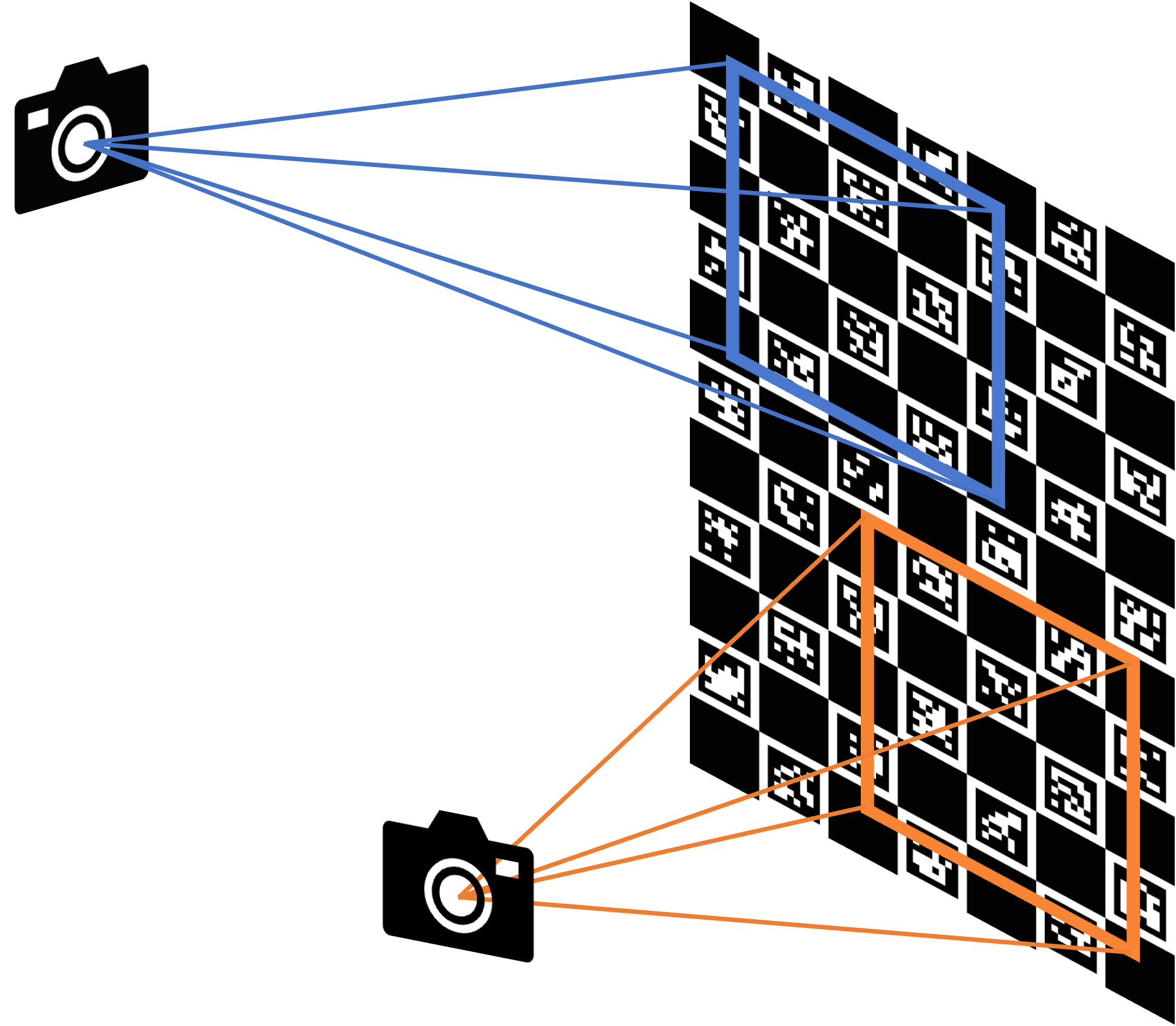
The above illustration shows an example where such a case may become relevant. Additionally, it supports a camera pair with the mixed model (pinhole / fisheye). Similarly to calibrateCamera, the function minimizes the total re-projection error for all the points in all the available views from both cameras.
- Returns
- the final value of the re-projection error.
- See also
- calibrateCamera, stereoCalibrate
◆ registerCamerasExtended() [2/5]
|
static |
Calibrates a camera pair set up. This function finds the extrinsic parameters between the two cameras.
- Parameters
-
objectPoints1 Vector of vectors of the calibration pattern points for camera 1. A similar structure as objectPoints in calibrateCamera and for each pattern view, both cameras do not need to see the same object points. objectPoints1.size(), imagePoints1.size() nees to be equal,as well as objectPoints1[i].size(), imagePoints1[i].size() need to be equal for each i. objectPoints2 Vector of vectors of the calibration pattern points for camera 2. A similar structure as objectPoints1. objectPoints2.size(), and imagePoints2.size() nees to be equal, as well as objectPoints2[i].size(), imagePoints2[i].size() need to be equal for each i. However, objectPoints1[i].size() and objectPoints2[i].size() are not required to be equal. imagePoints1 Vector of vectors of the projections of the calibration pattern points, observed by the first camera. The same structure as in calibrateCamera. imagePoints2 Vector of vectors of the projections of the calibration pattern points, observed by the second camera. The same structure as in calibrateCamera. cameraMatrix1 Input/output camera intrinsic matrix for the first camera, the same as in calibrateCamera. Furthermore, for the stereo case, additional flags may be used, see below. distCoeffs1 Input/output vector of distortion coefficients, the same as in calibrateCamera. cameraModel1 Flag reflecting the type of model for camera 1 (pinhole / fisheye): - CALIB_MODEL_PINHOLE pinhole camera model
- CALIB_MODEL_FISHEYE fisheye camera model
cameraMatrix2 Input/output second camera intrinsic matrix for the second camera. See description for cameraMatrix1. distCoeffs2 Input/output lens distortion coefficients for the second camera. See description for distCoeffs1. cameraModel2 Flag reflecting the type of model for camera 2 (pinhole / fisheye). See description for cameraModel1. R Output rotation matrix. Together with the translation vector T, this matrix brings points given in the first camera's coordinate system to points in the second camera's coordinate system. In more technical terms, the tuple of R and T performs a change of basis from the first camera's coordinate system to the second camera's coordinate system. Due to its duality, this tuple is equivalent to the position of the first camera with respect to the second camera coordinate system. T Output translation vector, see description above. E Output essential matrix. F Output fundamental matrix. rvecs Output vector of rotation vectors ( Rodrigues ) estimated for each pattern view in the coordinate system of the first camera of the stereo pair (e.g. std::vector<cv::Mat>). More in detail, each i-th rotation vector together with the corresponding i-th translation vector (see the next output parameter description) brings the calibration pattern from the object coordinate space (in which object points are specified) to the camera coordinate space of the first camera of the stereo pair. In more technical terms, the tuple of the i-th rotation and translation vector performs a change of basis from object coordinate space to the camera coordinate space of the first camera of the stereo pair. tvecs Output vector of translation vectors estimated for each pattern view, see parameter description of previous output parameter ( rvecs ). perViewErrors Output vector of the RMS re-projection error estimated for each pattern view. flags Different flags that may be zero or a combination of the following values: - CALIB_USE_EXTRINSIC_GUESS R and T contain valid initial values that are optimized further.
criteria Termination criteria for the iterative optimization algorithm.
The function estimates the transformation between two cameras similar to stereo pair calibration. The principle follows closely to stereoCalibrate. To understand the problem of estimating the relative pose between a camera pair, please refer to the description there. The difference for this function is that, camera intrinsics are not optimized and two cameras are not required to have overlapping fields of view as long as they are observing the same calibration target and the absolute positions of each object point are known.
The above illustration shows an example where such a case may become relevant. Additionally, it supports a camera pair with the mixed model (pinhole / fisheye). Similarly to calibrateCamera, the function minimizes the total re-projection error for all the points in all the available views from both cameras.
- Returns
- the final value of the re-projection error.
- See also
- calibrateCamera, stereoCalibrate
◆ registerCamerasExtended() [3/5]
|
static |
Calibrates a camera pair set up. This function finds the extrinsic parameters between the two cameras.
- Parameters
-
objectPoints1 Vector of vectors of the calibration pattern points for camera 1. A similar structure as objectPoints in calibrateCamera and for each pattern view, both cameras do not need to see the same object points. objectPoints1.size(), imagePoints1.size() nees to be equal,as well as objectPoints1[i].size(), imagePoints1[i].size() need to be equal for each i. objectPoints2 Vector of vectors of the calibration pattern points for camera 2. A similar structure as objectPoints1. objectPoints2.size(), and imagePoints2.size() nees to be equal, as well as objectPoints2[i].size(), imagePoints2[i].size() need to be equal for each i. However, objectPoints1[i].size() and objectPoints2[i].size() are not required to be equal. imagePoints1 Vector of vectors of the projections of the calibration pattern points, observed by the first camera. The same structure as in calibrateCamera. imagePoints2 Vector of vectors of the projections of the calibration pattern points, observed by the second camera. The same structure as in calibrateCamera. cameraMatrix1 Input/output camera intrinsic matrix for the first camera, the same as in calibrateCamera. Furthermore, for the stereo case, additional flags may be used, see below. distCoeffs1 Input/output vector of distortion coefficients, the same as in calibrateCamera. cameraModel1 Flag reflecting the type of model for camera 1 (pinhole / fisheye): - CALIB_MODEL_PINHOLE pinhole camera model
- CALIB_MODEL_FISHEYE fisheye camera model
cameraMatrix2 Input/output second camera intrinsic matrix for the second camera. See description for cameraMatrix1. distCoeffs2 Input/output lens distortion coefficients for the second camera. See description for distCoeffs1. cameraModel2 Flag reflecting the type of model for camera 2 (pinhole / fisheye). See description for cameraModel1. R Output rotation matrix. Together with the translation vector T, this matrix brings points given in the first camera's coordinate system to points in the second camera's coordinate system. In more technical terms, the tuple of R and T performs a change of basis from the first camera's coordinate system to the second camera's coordinate system. Due to its duality, this tuple is equivalent to the position of the first camera with respect to the second camera coordinate system. T Output translation vector, see description above. E Output essential matrix. F Output fundamental matrix. rvecs Output vector of rotation vectors ( Rodrigues ) estimated for each pattern view in the coordinate system of the first camera of the stereo pair (e.g. std::vector<cv::Mat>). More in detail, each i-th rotation vector together with the corresponding i-th translation vector (see the next output parameter description) brings the calibration pattern from the object coordinate space (in which object points are specified) to the camera coordinate space of the first camera of the stereo pair. In more technical terms, the tuple of the i-th rotation and translation vector performs a change of basis from object coordinate space to the camera coordinate space of the first camera of the stereo pair. tvecs Output vector of translation vectors estimated for each pattern view, see parameter description of previous output parameter ( rvecs ). perViewErrors Output vector of the RMS re-projection error estimated for each pattern view. flags Different flags that may be zero or a combination of the following values: - CALIB_USE_EXTRINSIC_GUESS R and T contain valid initial values that are optimized further.
criteria Termination criteria for the iterative optimization algorithm.
The function estimates the transformation between two cameras similar to stereo pair calibration. The principle follows closely to stereoCalibrate. To understand the problem of estimating the relative pose between a camera pair, please refer to the description there. The difference for this function is that, camera intrinsics are not optimized and two cameras are not required to have overlapping fields of view as long as they are observing the same calibration target and the absolute positions of each object point are known.
The above illustration shows an example where such a case may become relevant. Additionally, it supports a camera pair with the mixed model (pinhole / fisheye). Similarly to calibrateCamera, the function minimizes the total re-projection error for all the points in all the available views from both cameras.
- Returns
- the final value of the re-projection error.
- See also
- calibrateCamera, stereoCalibrate
◆ registerCamerasExtended() [4/5]
|
static |
Calibrates a camera pair set up. This function finds the extrinsic parameters between the two cameras.
- Parameters
-
objectPoints1 Vector of vectors of the calibration pattern points for camera 1. A similar structure as objectPoints in calibrateCamera and for each pattern view, both cameras do not need to see the same object points. objectPoints1.size(), imagePoints1.size() nees to be equal,as well as objectPoints1[i].size(), imagePoints1[i].size() need to be equal for each i. objectPoints2 Vector of vectors of the calibration pattern points for camera 2. A similar structure as objectPoints1. objectPoints2.size(), and imagePoints2.size() nees to be equal, as well as objectPoints2[i].size(), imagePoints2[i].size() need to be equal for each i. However, objectPoints1[i].size() and objectPoints2[i].size() are not required to be equal. imagePoints1 Vector of vectors of the projections of the calibration pattern points, observed by the first camera. The same structure as in calibrateCamera. imagePoints2 Vector of vectors of the projections of the calibration pattern points, observed by the second camera. The same structure as in calibrateCamera. cameraMatrix1 Input/output camera intrinsic matrix for the first camera, the same as in calibrateCamera. Furthermore, for the stereo case, additional flags may be used, see below. distCoeffs1 Input/output vector of distortion coefficients, the same as in calibrateCamera. cameraModel1 Flag reflecting the type of model for camera 1 (pinhole / fisheye): - CALIB_MODEL_PINHOLE pinhole camera model
- CALIB_MODEL_FISHEYE fisheye camera model
cameraMatrix2 Input/output second camera intrinsic matrix for the second camera. See description for cameraMatrix1. distCoeffs2 Input/output lens distortion coefficients for the second camera. See description for distCoeffs1. cameraModel2 Flag reflecting the type of model for camera 2 (pinhole / fisheye). See description for cameraModel1. R Output rotation matrix. Together with the translation vector T, this matrix brings points given in the first camera's coordinate system to points in the second camera's coordinate system. In more technical terms, the tuple of R and T performs a change of basis from the first camera's coordinate system to the second camera's coordinate system. Due to its duality, this tuple is equivalent to the position of the first camera with respect to the second camera coordinate system. T Output translation vector, see description above. E Output essential matrix. F Output fundamental matrix. rvecs Output vector of rotation vectors ( Rodrigues ) estimated for each pattern view in the coordinate system of the first camera of the stereo pair (e.g. std::vector<cv::Mat>). More in detail, each i-th rotation vector together with the corresponding i-th translation vector (see the next output parameter description) brings the calibration pattern from the object coordinate space (in which object points are specified) to the camera coordinate space of the first camera of the stereo pair. In more technical terms, the tuple of the i-th rotation and translation vector performs a change of basis from object coordinate space to the camera coordinate space of the first camera of the stereo pair. tvecs Output vector of translation vectors estimated for each pattern view, see parameter description of previous output parameter ( rvecs ). perViewErrors Output vector of the RMS re-projection error estimated for each pattern view. flags Different flags that may be zero or a combination of the following values: - CALIB_USE_EXTRINSIC_GUESS R and T contain valid initial values that are optimized further.
criteria Termination criteria for the iterative optimization algorithm.
The function estimates the transformation between two cameras similar to stereo pair calibration. The principle follows closely to stereoCalibrate. To understand the problem of estimating the relative pose between a camera pair, please refer to the description there. The difference for this function is that, camera intrinsics are not optimized and two cameras are not required to have overlapping fields of view as long as they are observing the same calibration target and the absolute positions of each object point are known.
The above illustration shows an example where such a case may become relevant. Additionally, it supports a camera pair with the mixed model (pinhole / fisheye). Similarly to calibrateCamera, the function minimizes the total re-projection error for all the points in all the available views from both cameras.
- Returns
- the final value of the re-projection error.
- See also
- calibrateCamera, stereoCalibrate
◆ registerCamerasExtended() [5/5]
|
static |
Calibrates a camera pair set up. This function finds the extrinsic parameters between the two cameras.
- Parameters
-
objectPoints1 Vector of vectors of the calibration pattern points for camera 1. A similar structure as objectPoints in calibrateCamera and for each pattern view, both cameras do not need to see the same object points. objectPoints1.size(), imagePoints1.size() nees to be equal,as well as objectPoints1[i].size(), imagePoints1[i].size() need to be equal for each i. objectPoints2 Vector of vectors of the calibration pattern points for camera 2. A similar structure as objectPoints1. objectPoints2.size(), and imagePoints2.size() nees to be equal, as well as objectPoints2[i].size(), imagePoints2[i].size() need to be equal for each i. However, objectPoints1[i].size() and objectPoints2[i].size() are not required to be equal. imagePoints1 Vector of vectors of the projections of the calibration pattern points, observed by the first camera. The same structure as in calibrateCamera. imagePoints2 Vector of vectors of the projections of the calibration pattern points, observed by the second camera. The same structure as in calibrateCamera. cameraMatrix1 Input/output camera intrinsic matrix for the first camera, the same as in calibrateCamera. Furthermore, for the stereo case, additional flags may be used, see below. distCoeffs1 Input/output vector of distortion coefficients, the same as in calibrateCamera. cameraModel1 Flag reflecting the type of model for camera 1 (pinhole / fisheye): - CALIB_MODEL_PINHOLE pinhole camera model
- CALIB_MODEL_FISHEYE fisheye camera model
cameraMatrix2 Input/output second camera intrinsic matrix for the second camera. See description for cameraMatrix1. distCoeffs2 Input/output lens distortion coefficients for the second camera. See description for distCoeffs1. cameraModel2 Flag reflecting the type of model for camera 2 (pinhole / fisheye). See description for cameraModel1. R Output rotation matrix. Together with the translation vector T, this matrix brings points given in the first camera's coordinate system to points in the second camera's coordinate system. In more technical terms, the tuple of R and T performs a change of basis from the first camera's coordinate system to the second camera's coordinate system. Due to its duality, this tuple is equivalent to the position of the first camera with respect to the second camera coordinate system. T Output translation vector, see description above. E Output essential matrix. F Output fundamental matrix. rvecs Output vector of rotation vectors ( Rodrigues ) estimated for each pattern view in the coordinate system of the first camera of the stereo pair (e.g. std::vector<cv::Mat>). More in detail, each i-th rotation vector together with the corresponding i-th translation vector (see the next output parameter description) brings the calibration pattern from the object coordinate space (in which object points are specified) to the camera coordinate space of the first camera of the stereo pair. In more technical terms, the tuple of the i-th rotation and translation vector performs a change of basis from object coordinate space to the camera coordinate space of the first camera of the stereo pair. tvecs Output vector of translation vectors estimated for each pattern view, see parameter description of previous output parameter ( rvecs ). perViewErrors Output vector of the RMS re-projection error estimated for each pattern view. flags Different flags that may be zero or a combination of the following values: - CALIB_USE_EXTRINSIC_GUESS R and T contain valid initial values that are optimized further.
criteria Termination criteria for the iterative optimization algorithm.
The function estimates the transformation between two cameras similar to stereo pair calibration. The principle follows closely to stereoCalibrate. To understand the problem of estimating the relative pose between a camera pair, please refer to the description there. The difference for this function is that, camera intrinsics are not optimized and two cameras are not required to have overlapping fields of view as long as they are observing the same calibration target and the absolute positions of each object point are known.
The above illustration shows an example where such a case may become relevant. Additionally, it supports a camera pair with the mixed model (pinhole / fisheye). Similarly to calibrateCamera, the function minimizes the total re-projection error for all the points in all the available views from both cameras.
- Returns
- the final value of the re-projection error.
- See also
- calibrateCamera, stereoCalibrate
◆ stereoCalibrate() [1/18]
|
static |
◆ stereoCalibrate() [2/18]
|
static |
◆ stereoCalibrate() [3/18]
|
static |
◆ stereoCalibrate() [4/18]
|
static |
◆ stereoCalibrate() [5/18]
|
static |
◆ stereoCalibrate() [6/18]
|
static |
◆ stereoCalibrate() [7/18]
|
static |
◆ stereoCalibrate() [8/18]
|
static |
◆ stereoCalibrate() [9/18]
|
static |
◆ stereoCalibrate() [10/18]
|
static |
◆ stereoCalibrate() [11/18]
|
static |
◆ stereoCalibrate() [12/18]
|
static |
◆ stereoCalibrate() [13/18]
|
static |
◆ stereoCalibrate() [14/18]
|
static |
◆ stereoCalibrate() [15/18]
|
static |
◆ stereoCalibrate() [16/18]
|
static |
◆ stereoCalibrate() [17/18]
|
static |
◆ stereoCalibrate() [18/18]
|
static |
◆ stereoCalibrateExtended() [1/9]
|
static |
Calibrates a stereo camera set up. This function finds the intrinsic parameters for each of the two cameras and the extrinsic parameters between the two cameras.
- Parameters
-
objectPoints Vector of vectors of the calibration pattern points. The same structure as in calibrateCamera. For each pattern view, both cameras need to see the same object points. Therefore, objectPoints.size(), imagePoints1.size(), and imagePoints2.size() need to be equal as well as objectPoints[i].size(), imagePoints1[i].size(), and imagePoints2[i].size() need to be equal for each i. imagePoints1 Vector of vectors of the projections of the calibration pattern points, observed by the first camera. The same structure as in calibrateCamera. imagePoints2 Vector of vectors of the projections of the calibration pattern points, observed by the second camera. The same structure as in calibrateCamera. cameraMatrix1 Input/output camera intrinsic matrix for the first camera, the same as in calibrateCamera. Furthermore, for the stereo case, additional flags may be used, see below. distCoeffs1 Input/output vector of distortion coefficients, the same as in calibrateCamera. cameraMatrix2 Input/output second camera intrinsic matrix for the second camera. See description for cameraMatrix1. distCoeffs2 Input/output lens distortion coefficients for the second camera. See description for distCoeffs1. imageSize Size of the image used only to initialize the camera intrinsic matrices. R Output rotation matrix. Together with the translation vector T, this matrix brings points given in the first camera's coordinate system to points in the second camera's coordinate system. In more technical terms, the tuple of R and T performs a change of basis from the first camera's coordinate system to the second camera's coordinate system. Due to its duality, this tuple is equivalent to the position of the first camera with respect to the second camera coordinate system. T Output translation vector, see description above. E Output essential matrix. F Output fundamental matrix. rvecs Output vector of rotation vectors ( Rodrigues ) estimated for each pattern view in the coordinate system of the first camera of the stereo pair (e.g. std::vector<cv::Mat>). More in detail, each i-th rotation vector together with the corresponding i-th translation vector (see the next output parameter description) brings the calibration pattern from the object coordinate space (in which object points are specified) to the camera coordinate space of the first camera of the stereo pair. In more technical terms, the tuple of the i-th rotation and translation vector performs a change of basis from object coordinate space to camera coordinate space of the first camera of the stereo pair. tvecs Output vector of translation vectors estimated for each pattern view, see parameter description of previous output parameter ( rvecs ). perViewErrors Output vector of the RMS re-projection error estimated for each pattern view. flags Different flags that may be zero or a combination of the following values: - CALIB_FIX_INTRINSIC Fix cameraMatrix? and distCoeffs? so that only R, T, E, and F matrices are estimated.
- CALIB_USE_INTRINSIC_GUESS Optimize some or all of the intrinsic parameters according to the specified flags. Initial values are provided by the user.
- CALIB_USE_EXTRINSIC_GUESS R and T contain valid initial values that are optimized further. Otherwise R and T are initialized to the median value of the pattern views (each dimension separately).
- CALIB_FIX_PRINCIPAL_POINT Fix the principal points during the optimization.
- CALIB_FIX_FOCAL_LENGTH Fix \(f^{(j)}_x\) and \(f^{(j)}_y\) .
- CALIB_FIX_ASPECT_RATIO Optimize \(f^{(j)}_y\) . Fix the ratio \(f^{(j)}_x/f^{(j)}_y\)
- CALIB_SAME_FOCAL_LENGTH Enforce \(f^{(0)}_x=f^{(1)}_x\) and \(f^{(0)}_y=f^{(1)}_y\) .
- CALIB_ZERO_TANGENT_DIST Set tangential distortion coefficients for each camera to zeros and fix there.
- CALIB_FIX_K1,..., CALIB_FIX_K6 Do not change the corresponding radial distortion coefficient during the optimization. If CALIB_USE_INTRINSIC_GUESS is set, the coefficient from the supplied distCoeffs matrix is used. Otherwise, it is set to 0.
- CALIB_RATIONAL_MODEL Enable coefficients k4, k5, and k6. To provide the backward compatibility, this extra flag should be explicitly specified to make the calibration function use the rational model and return 8 coefficients. If the flag is not set, the function computes and returns only 5 distortion coefficients.
- CALIB_THIN_PRISM_MODEL Coefficients s1, s2, s3 and s4 are enabled. To provide the backward compatibility, this extra flag should be explicitly specified to make the calibration function use the thin prism model and return 12 coefficients. If the flag is not set, the function computes and returns only 5 distortion coefficients.
- CALIB_FIX_S1_S2_S3_S4 The thin prism distortion coefficients are not changed during the optimization. If CALIB_USE_INTRINSIC_GUESS is set, the coefficient from the supplied distCoeffs matrix is used. Otherwise, it is set to 0.
- CALIB_TILTED_MODEL Coefficients tauX and tauY are enabled. To provide the backward compatibility, this extra flag should be explicitly specified to make the calibration function use the tilted sensor model and return 14 coefficients. If the flag is not set, the function computes and returns only 5 distortion coefficients.
- CALIB_FIX_TAUX_TAUY The coefficients of the tilted sensor model are not changed during the optimization. If CALIB_USE_INTRINSIC_GUESS is set, the coefficient from the supplied distCoeffs matrix is used. Otherwise, it is set to 0.
criteria Termination criteria for the iterative optimization algorithm.
The function estimates the transformation between two cameras making a stereo pair. If one computes the poses of an object relative to the first camera and to the second camera, ( \(R_1\), \(T_1\) ) and ( \(R_2\), \(T_2\)), respectively, for a stereo camera where the relative position and orientation between the two cameras are fixed, then those poses definitely relate to each other. This means, if the relative position and orientation ( \(R\), \(T\)) of the two cameras is known, it is possible to compute ( \(R_2\), \(T_2\)) when ( \(R_1\), \(T_1\)) is given. This is what the described function does. It computes ( \(R\), \(T\)) such that:
\[R_2=R R_1\]
\[T_2=R T_1 + T.\]
Therefore, one can compute the coordinate representation of a 3D point for the second camera's coordinate system when given the point's coordinate representation in the first camera's coordinate system:
\[\begin{bmatrix} X_2 \\ Y_2 \\ Z_2 \\ 1 \end{bmatrix} = \begin{bmatrix} R & T \\ 0 & 1 \end{bmatrix} \begin{bmatrix} X_1 \\ Y_1 \\ Z_1 \\ 1 \end{bmatrix}.\]
Optionally, it computes the essential matrix E:
\[E= \vecthreethree{0}{-T_2}{T_1}{T_2}{0}{-T_0}{-T_1}{T_0}{0} R\]
where \(T_i\) are components of the translation vector \(T\) : \(T=[T_0, T_1, T_2]^T\) . And the function can also compute the fundamental matrix F:
\[F = cameraMatrix2^{-T}\cdot E \cdot cameraMatrix1^{-1}\]
Besides the stereo-related information, the function can also perform a full calibration of each of the two cameras. However, due to the high dimensionality of the parameter space and noise in the input data, the function can diverge from the correct solution. If the intrinsic parameters can be estimated with high accuracy for each of the cameras individually (for example, using calibrateCamera ), you are recommended to do so and then pass CALIB_FIX_INTRINSIC flag to the function along with the computed intrinsic parameters. Otherwise, if all the parameters are estimated at once, it makes sense to restrict some parameters, for example, pass CALIB_SAME_FOCAL_LENGTH and CALIB_ZERO_TANGENT_DIST flags, which is usually a reasonable assumption.
Similarly to calibrateCamera, the function minimizes the total re-projection error for all the points in all the available views from both cameras. The function returns the final value of the re-projection error.
◆ stereoCalibrateExtended() [2/9]
|
static |
Calibrates a stereo camera set up. This function finds the intrinsic parameters for each of the two cameras and the extrinsic parameters between the two cameras.
- Parameters
-
objectPoints Vector of vectors of the calibration pattern points. The same structure as in calibrateCamera. For each pattern view, both cameras need to see the same object points. Therefore, objectPoints.size(), imagePoints1.size(), and imagePoints2.size() need to be equal as well as objectPoints[i].size(), imagePoints1[i].size(), and imagePoints2[i].size() need to be equal for each i. imagePoints1 Vector of vectors of the projections of the calibration pattern points, observed by the first camera. The same structure as in calibrateCamera. imagePoints2 Vector of vectors of the projections of the calibration pattern points, observed by the second camera. The same structure as in calibrateCamera. cameraMatrix1 Input/output camera intrinsic matrix for the first camera, the same as in calibrateCamera. Furthermore, for the stereo case, additional flags may be used, see below. distCoeffs1 Input/output vector of distortion coefficients, the same as in calibrateCamera. cameraMatrix2 Input/output second camera intrinsic matrix for the second camera. See description for cameraMatrix1. distCoeffs2 Input/output lens distortion coefficients for the second camera. See description for distCoeffs1. imageSize Size of the image used only to initialize the camera intrinsic matrices. R Output rotation matrix. Together with the translation vector T, this matrix brings points given in the first camera's coordinate system to points in the second camera's coordinate system. In more technical terms, the tuple of R and T performs a change of basis from the first camera's coordinate system to the second camera's coordinate system. Due to its duality, this tuple is equivalent to the position of the first camera with respect to the second camera coordinate system. T Output translation vector, see description above. E Output essential matrix. F Output fundamental matrix. rvecs Output vector of rotation vectors ( Rodrigues ) estimated for each pattern view in the coordinate system of the first camera of the stereo pair (e.g. std::vector<cv::Mat>). More in detail, each i-th rotation vector together with the corresponding i-th translation vector (see the next output parameter description) brings the calibration pattern from the object coordinate space (in which object points are specified) to the camera coordinate space of the first camera of the stereo pair. In more technical terms, the tuple of the i-th rotation and translation vector performs a change of basis from object coordinate space to camera coordinate space of the first camera of the stereo pair. tvecs Output vector of translation vectors estimated for each pattern view, see parameter description of previous output parameter ( rvecs ). perViewErrors Output vector of the RMS re-projection error estimated for each pattern view. flags Different flags that may be zero or a combination of the following values: - CALIB_FIX_INTRINSIC Fix cameraMatrix? and distCoeffs? so that only R, T, E, and F matrices are estimated.
- CALIB_USE_INTRINSIC_GUESS Optimize some or all of the intrinsic parameters according to the specified flags. Initial values are provided by the user.
- CALIB_USE_EXTRINSIC_GUESS R and T contain valid initial values that are optimized further. Otherwise R and T are initialized to the median value of the pattern views (each dimension separately).
- CALIB_FIX_PRINCIPAL_POINT Fix the principal points during the optimization.
- CALIB_FIX_FOCAL_LENGTH Fix \(f^{(j)}_x\) and \(f^{(j)}_y\) .
- CALIB_FIX_ASPECT_RATIO Optimize \(f^{(j)}_y\) . Fix the ratio \(f^{(j)}_x/f^{(j)}_y\)
- CALIB_SAME_FOCAL_LENGTH Enforce \(f^{(0)}_x=f^{(1)}_x\) and \(f^{(0)}_y=f^{(1)}_y\) .
- CALIB_ZERO_TANGENT_DIST Set tangential distortion coefficients for each camera to zeros and fix there.
- CALIB_FIX_K1,..., CALIB_FIX_K6 Do not change the corresponding radial distortion coefficient during the optimization. If CALIB_USE_INTRINSIC_GUESS is set, the coefficient from the supplied distCoeffs matrix is used. Otherwise, it is set to 0.
- CALIB_RATIONAL_MODEL Enable coefficients k4, k5, and k6. To provide the backward compatibility, this extra flag should be explicitly specified to make the calibration function use the rational model and return 8 coefficients. If the flag is not set, the function computes and returns only 5 distortion coefficients.
- CALIB_THIN_PRISM_MODEL Coefficients s1, s2, s3 and s4 are enabled. To provide the backward compatibility, this extra flag should be explicitly specified to make the calibration function use the thin prism model and return 12 coefficients. If the flag is not set, the function computes and returns only 5 distortion coefficients.
- CALIB_FIX_S1_S2_S3_S4 The thin prism distortion coefficients are not changed during the optimization. If CALIB_USE_INTRINSIC_GUESS is set, the coefficient from the supplied distCoeffs matrix is used. Otherwise, it is set to 0.
- CALIB_TILTED_MODEL Coefficients tauX and tauY are enabled. To provide the backward compatibility, this extra flag should be explicitly specified to make the calibration function use the tilted sensor model and return 14 coefficients. If the flag is not set, the function computes and returns only 5 distortion coefficients.
- CALIB_FIX_TAUX_TAUY The coefficients of the tilted sensor model are not changed during the optimization. If CALIB_USE_INTRINSIC_GUESS is set, the coefficient from the supplied distCoeffs matrix is used. Otherwise, it is set to 0.
criteria Termination criteria for the iterative optimization algorithm.
The function estimates the transformation between two cameras making a stereo pair. If one computes the poses of an object relative to the first camera and to the second camera, ( \(R_1\), \(T_1\) ) and ( \(R_2\), \(T_2\)), respectively, for a stereo camera where the relative position and orientation between the two cameras are fixed, then those poses definitely relate to each other. This means, if the relative position and orientation ( \(R\), \(T\)) of the two cameras is known, it is possible to compute ( \(R_2\), \(T_2\)) when ( \(R_1\), \(T_1\)) is given. This is what the described function does. It computes ( \(R\), \(T\)) such that:
\[R_2=R R_1\]
\[T_2=R T_1 + T.\]
Therefore, one can compute the coordinate representation of a 3D point for the second camera's coordinate system when given the point's coordinate representation in the first camera's coordinate system:
\[\begin{bmatrix} X_2 \\ Y_2 \\ Z_2 \\ 1 \end{bmatrix} = \begin{bmatrix} R & T \\ 0 & 1 \end{bmatrix} \begin{bmatrix} X_1 \\ Y_1 \\ Z_1 \\ 1 \end{bmatrix}.\]
Optionally, it computes the essential matrix E:
\[E= \vecthreethree{0}{-T_2}{T_1}{T_2}{0}{-T_0}{-T_1}{T_0}{0} R\]
where \(T_i\) are components of the translation vector \(T\) : \(T=[T_0, T_1, T_2]^T\) . And the function can also compute the fundamental matrix F:
\[F = cameraMatrix2^{-T}\cdot E \cdot cameraMatrix1^{-1}\]
Besides the stereo-related information, the function can also perform a full calibration of each of the two cameras. However, due to the high dimensionality of the parameter space and noise in the input data, the function can diverge from the correct solution. If the intrinsic parameters can be estimated with high accuracy for each of the cameras individually (for example, using calibrateCamera ), you are recommended to do so and then pass CALIB_FIX_INTRINSIC flag to the function along with the computed intrinsic parameters. Otherwise, if all the parameters are estimated at once, it makes sense to restrict some parameters, for example, pass CALIB_SAME_FOCAL_LENGTH and CALIB_ZERO_TANGENT_DIST flags, which is usually a reasonable assumption.
Similarly to calibrateCamera, the function minimizes the total re-projection error for all the points in all the available views from both cameras. The function returns the final value of the re-projection error.
◆ stereoCalibrateExtended() [3/9]
|
static |
Calibrates a stereo camera set up. This function finds the intrinsic parameters for each of the two cameras and the extrinsic parameters between the two cameras.
- Parameters
-
objectPoints Vector of vectors of the calibration pattern points. The same structure as in calibrateCamera. For each pattern view, both cameras need to see the same object points. Therefore, objectPoints.size(), imagePoints1.size(), and imagePoints2.size() need to be equal as well as objectPoints[i].size(), imagePoints1[i].size(), and imagePoints2[i].size() need to be equal for each i. imagePoints1 Vector of vectors of the projections of the calibration pattern points, observed by the first camera. The same structure as in calibrateCamera. imagePoints2 Vector of vectors of the projections of the calibration pattern points, observed by the second camera. The same structure as in calibrateCamera. cameraMatrix1 Input/output camera intrinsic matrix for the first camera, the same as in calibrateCamera. Furthermore, for the stereo case, additional flags may be used, see below. distCoeffs1 Input/output vector of distortion coefficients, the same as in calibrateCamera. cameraMatrix2 Input/output second camera intrinsic matrix for the second camera. See description for cameraMatrix1. distCoeffs2 Input/output lens distortion coefficients for the second camera. See description for distCoeffs1. imageSize Size of the image used only to initialize the camera intrinsic matrices. R Output rotation matrix. Together with the translation vector T, this matrix brings points given in the first camera's coordinate system to points in the second camera's coordinate system. In more technical terms, the tuple of R and T performs a change of basis from the first camera's coordinate system to the second camera's coordinate system. Due to its duality, this tuple is equivalent to the position of the first camera with respect to the second camera coordinate system. T Output translation vector, see description above. E Output essential matrix. F Output fundamental matrix. rvecs Output vector of rotation vectors ( Rodrigues ) estimated for each pattern view in the coordinate system of the first camera of the stereo pair (e.g. std::vector<cv::Mat>). More in detail, each i-th rotation vector together with the corresponding i-th translation vector (see the next output parameter description) brings the calibration pattern from the object coordinate space (in which object points are specified) to the camera coordinate space of the first camera of the stereo pair. In more technical terms, the tuple of the i-th rotation and translation vector performs a change of basis from object coordinate space to camera coordinate space of the first camera of the stereo pair. tvecs Output vector of translation vectors estimated for each pattern view, see parameter description of previous output parameter ( rvecs ). perViewErrors Output vector of the RMS re-projection error estimated for each pattern view. flags Different flags that may be zero or a combination of the following values: - CALIB_FIX_INTRINSIC Fix cameraMatrix? and distCoeffs? so that only R, T, E, and F matrices are estimated.
- CALIB_USE_INTRINSIC_GUESS Optimize some or all of the intrinsic parameters according to the specified flags. Initial values are provided by the user.
- CALIB_USE_EXTRINSIC_GUESS R and T contain valid initial values that are optimized further. Otherwise R and T are initialized to the median value of the pattern views (each dimension separately).
- CALIB_FIX_PRINCIPAL_POINT Fix the principal points during the optimization.
- CALIB_FIX_FOCAL_LENGTH Fix \(f^{(j)}_x\) and \(f^{(j)}_y\) .
- CALIB_FIX_ASPECT_RATIO Optimize \(f^{(j)}_y\) . Fix the ratio \(f^{(j)}_x/f^{(j)}_y\)
- CALIB_SAME_FOCAL_LENGTH Enforce \(f^{(0)}_x=f^{(1)}_x\) and \(f^{(0)}_y=f^{(1)}_y\) .
- CALIB_ZERO_TANGENT_DIST Set tangential distortion coefficients for each camera to zeros and fix there.
- CALIB_FIX_K1,..., CALIB_FIX_K6 Do not change the corresponding radial distortion coefficient during the optimization. If CALIB_USE_INTRINSIC_GUESS is set, the coefficient from the supplied distCoeffs matrix is used. Otherwise, it is set to 0.
- CALIB_RATIONAL_MODEL Enable coefficients k4, k5, and k6. To provide the backward compatibility, this extra flag should be explicitly specified to make the calibration function use the rational model and return 8 coefficients. If the flag is not set, the function computes and returns only 5 distortion coefficients.
- CALIB_THIN_PRISM_MODEL Coefficients s1, s2, s3 and s4 are enabled. To provide the backward compatibility, this extra flag should be explicitly specified to make the calibration function use the thin prism model and return 12 coefficients. If the flag is not set, the function computes and returns only 5 distortion coefficients.
- CALIB_FIX_S1_S2_S3_S4 The thin prism distortion coefficients are not changed during the optimization. If CALIB_USE_INTRINSIC_GUESS is set, the coefficient from the supplied distCoeffs matrix is used. Otherwise, it is set to 0.
- CALIB_TILTED_MODEL Coefficients tauX and tauY are enabled. To provide the backward compatibility, this extra flag should be explicitly specified to make the calibration function use the tilted sensor model and return 14 coefficients. If the flag is not set, the function computes and returns only 5 distortion coefficients.
- CALIB_FIX_TAUX_TAUY The coefficients of the tilted sensor model are not changed during the optimization. If CALIB_USE_INTRINSIC_GUESS is set, the coefficient from the supplied distCoeffs matrix is used. Otherwise, it is set to 0.
criteria Termination criteria for the iterative optimization algorithm.
The function estimates the transformation between two cameras making a stereo pair. If one computes the poses of an object relative to the first camera and to the second camera, ( \(R_1\), \(T_1\) ) and ( \(R_2\), \(T_2\)), respectively, for a stereo camera where the relative position and orientation between the two cameras are fixed, then those poses definitely relate to each other. This means, if the relative position and orientation ( \(R\), \(T\)) of the two cameras is known, it is possible to compute ( \(R_2\), \(T_2\)) when ( \(R_1\), \(T_1\)) is given. This is what the described function does. It computes ( \(R\), \(T\)) such that:
\[R_2=R R_1\]
\[T_2=R T_1 + T.\]
Therefore, one can compute the coordinate representation of a 3D point for the second camera's coordinate system when given the point's coordinate representation in the first camera's coordinate system:
\[\begin{bmatrix} X_2 \\ Y_2 \\ Z_2 \\ 1 \end{bmatrix} = \begin{bmatrix} R & T \\ 0 & 1 \end{bmatrix} \begin{bmatrix} X_1 \\ Y_1 \\ Z_1 \\ 1 \end{bmatrix}.\]
Optionally, it computes the essential matrix E:
\[E= \vecthreethree{0}{-T_2}{T_1}{T_2}{0}{-T_0}{-T_1}{T_0}{0} R\]
where \(T_i\) are components of the translation vector \(T\) : \(T=[T_0, T_1, T_2]^T\) . And the function can also compute the fundamental matrix F:
\[F = cameraMatrix2^{-T}\cdot E \cdot cameraMatrix1^{-1}\]
Besides the stereo-related information, the function can also perform a full calibration of each of the two cameras. However, due to the high dimensionality of the parameter space and noise in the input data, the function can diverge from the correct solution. If the intrinsic parameters can be estimated with high accuracy for each of the cameras individually (for example, using calibrateCamera ), you are recommended to do so and then pass CALIB_FIX_INTRINSIC flag to the function along with the computed intrinsic parameters. Otherwise, if all the parameters are estimated at once, it makes sense to restrict some parameters, for example, pass CALIB_SAME_FOCAL_LENGTH and CALIB_ZERO_TANGENT_DIST flags, which is usually a reasonable assumption.
Similarly to calibrateCamera, the function minimizes the total re-projection error for all the points in all the available views from both cameras. The function returns the final value of the re-projection error.
◆ stereoCalibrateExtended() [4/9]
|
static |
Calibrates a stereo camera set up. This function finds the intrinsic parameters for each of the two cameras and the extrinsic parameters between the two cameras.
- Parameters
-
objectPoints Vector of vectors of the calibration pattern points. The same structure as in calibrateCamera. For each pattern view, both cameras need to see the same object points. Therefore, objectPoints.size(), imagePoints1.size(), and imagePoints2.size() need to be equal as well as objectPoints[i].size(), imagePoints1[i].size(), and imagePoints2[i].size() need to be equal for each i. imagePoints1 Vector of vectors of the projections of the calibration pattern points, observed by the first camera. The same structure as in calibrateCamera. imagePoints2 Vector of vectors of the projections of the calibration pattern points, observed by the second camera. The same structure as in calibrateCamera. cameraMatrix1 Input/output camera intrinsic matrix for the first camera, the same as in calibrateCamera. Furthermore, for the stereo case, additional flags may be used, see below. distCoeffs1 Input/output vector of distortion coefficients, the same as in calibrateCamera. cameraMatrix2 Input/output second camera intrinsic matrix for the second camera. See description for cameraMatrix1. distCoeffs2 Input/output lens distortion coefficients for the second camera. See description for distCoeffs1. imageSize Size of the image used only to initialize the camera intrinsic matrices. R Output rotation matrix. Together with the translation vector T, this matrix brings points given in the first camera's coordinate system to points in the second camera's coordinate system. In more technical terms, the tuple of R and T performs a change of basis from the first camera's coordinate system to the second camera's coordinate system. Due to its duality, this tuple is equivalent to the position of the first camera with respect to the second camera coordinate system. T Output translation vector, see description above. E Output essential matrix. F Output fundamental matrix. rvecs Output vector of rotation vectors ( Rodrigues ) estimated for each pattern view in the coordinate system of the first camera of the stereo pair (e.g. std::vector<cv::Mat>). More in detail, each i-th rotation vector together with the corresponding i-th translation vector (see the next output parameter description) brings the calibration pattern from the object coordinate space (in which object points are specified) to the camera coordinate space of the first camera of the stereo pair. In more technical terms, the tuple of the i-th rotation and translation vector performs a change of basis from object coordinate space to camera coordinate space of the first camera of the stereo pair. tvecs Output vector of translation vectors estimated for each pattern view, see parameter description of previous output parameter ( rvecs ). perViewErrors Output vector of the RMS re-projection error estimated for each pattern view. flags Different flags that may be zero or a combination of the following values: - CALIB_FIX_INTRINSIC Fix cameraMatrix? and distCoeffs? so that only R, T, E, and F matrices are estimated.
- CALIB_USE_INTRINSIC_GUESS Optimize some or all of the intrinsic parameters according to the specified flags. Initial values are provided by the user.
- CALIB_USE_EXTRINSIC_GUESS R and T contain valid initial values that are optimized further. Otherwise R and T are initialized to the median value of the pattern views (each dimension separately).
- CALIB_FIX_PRINCIPAL_POINT Fix the principal points during the optimization.
- CALIB_FIX_FOCAL_LENGTH Fix \(f^{(j)}_x\) and \(f^{(j)}_y\) .
- CALIB_FIX_ASPECT_RATIO Optimize \(f^{(j)}_y\) . Fix the ratio \(f^{(j)}_x/f^{(j)}_y\)
- CALIB_SAME_FOCAL_LENGTH Enforce \(f^{(0)}_x=f^{(1)}_x\) and \(f^{(0)}_y=f^{(1)}_y\) .
- CALIB_ZERO_TANGENT_DIST Set tangential distortion coefficients for each camera to zeros and fix there.
- CALIB_FIX_K1,..., CALIB_FIX_K6 Do not change the corresponding radial distortion coefficient during the optimization. If CALIB_USE_INTRINSIC_GUESS is set, the coefficient from the supplied distCoeffs matrix is used. Otherwise, it is set to 0.
- CALIB_RATIONAL_MODEL Enable coefficients k4, k5, and k6. To provide the backward compatibility, this extra flag should be explicitly specified to make the calibration function use the rational model and return 8 coefficients. If the flag is not set, the function computes and returns only 5 distortion coefficients.
- CALIB_THIN_PRISM_MODEL Coefficients s1, s2, s3 and s4 are enabled. To provide the backward compatibility, this extra flag should be explicitly specified to make the calibration function use the thin prism model and return 12 coefficients. If the flag is not set, the function computes and returns only 5 distortion coefficients.
- CALIB_FIX_S1_S2_S3_S4 The thin prism distortion coefficients are not changed during the optimization. If CALIB_USE_INTRINSIC_GUESS is set, the coefficient from the supplied distCoeffs matrix is used. Otherwise, it is set to 0.
- CALIB_TILTED_MODEL Coefficients tauX and tauY are enabled. To provide the backward compatibility, this extra flag should be explicitly specified to make the calibration function use the tilted sensor model and return 14 coefficients. If the flag is not set, the function computes and returns only 5 distortion coefficients.
- CALIB_FIX_TAUX_TAUY The coefficients of the tilted sensor model are not changed during the optimization. If CALIB_USE_INTRINSIC_GUESS is set, the coefficient from the supplied distCoeffs matrix is used. Otherwise, it is set to 0.
criteria Termination criteria for the iterative optimization algorithm.
The function estimates the transformation between two cameras making a stereo pair. If one computes the poses of an object relative to the first camera and to the second camera, ( \(R_1\), \(T_1\) ) and ( \(R_2\), \(T_2\)), respectively, for a stereo camera where the relative position and orientation between the two cameras are fixed, then those poses definitely relate to each other. This means, if the relative position and orientation ( \(R\), \(T\)) of the two cameras is known, it is possible to compute ( \(R_2\), \(T_2\)) when ( \(R_1\), \(T_1\)) is given. This is what the described function does. It computes ( \(R\), \(T\)) such that:
\[R_2=R R_1\]
\[T_2=R T_1 + T.\]
Therefore, one can compute the coordinate representation of a 3D point for the second camera's coordinate system when given the point's coordinate representation in the first camera's coordinate system:
\[\begin{bmatrix} X_2 \\ Y_2 \\ Z_2 \\ 1 \end{bmatrix} = \begin{bmatrix} R & T \\ 0 & 1 \end{bmatrix} \begin{bmatrix} X_1 \\ Y_1 \\ Z_1 \\ 1 \end{bmatrix}.\]
Optionally, it computes the essential matrix E:
\[E= \vecthreethree{0}{-T_2}{T_1}{T_2}{0}{-T_0}{-T_1}{T_0}{0} R\]
where \(T_i\) are components of the translation vector \(T\) : \(T=[T_0, T_1, T_2]^T\) . And the function can also compute the fundamental matrix F:
\[F = cameraMatrix2^{-T}\cdot E \cdot cameraMatrix1^{-1}\]
Besides the stereo-related information, the function can also perform a full calibration of each of the two cameras. However, due to the high dimensionality of the parameter space and noise in the input data, the function can diverge from the correct solution. If the intrinsic parameters can be estimated with high accuracy for each of the cameras individually (for example, using calibrateCamera ), you are recommended to do so and then pass CALIB_FIX_INTRINSIC flag to the function along with the computed intrinsic parameters. Otherwise, if all the parameters are estimated at once, it makes sense to restrict some parameters, for example, pass CALIB_SAME_FOCAL_LENGTH and CALIB_ZERO_TANGENT_DIST flags, which is usually a reasonable assumption.
Similarly to calibrateCamera, the function minimizes the total re-projection error for all the points in all the available views from both cameras. The function returns the final value of the re-projection error.
◆ stereoCalibrateExtended() [5/9]
|
static |
Calibrates a stereo camera set up. This function finds the intrinsic parameters for each of the two cameras and the extrinsic parameters between the two cameras.
- Parameters
-
objectPoints Vector of vectors of the calibration pattern points. The same structure as in calibrateCamera. For each pattern view, both cameras need to see the same object points. Therefore, objectPoints.size(), imagePoints1.size(), and imagePoints2.size() need to be equal as well as objectPoints[i].size(), imagePoints1[i].size(), and imagePoints2[i].size() need to be equal for each i. imagePoints1 Vector of vectors of the projections of the calibration pattern points, observed by the first camera. The same structure as in calibrateCamera. imagePoints2 Vector of vectors of the projections of the calibration pattern points, observed by the second camera. The same structure as in calibrateCamera. cameraMatrix1 Input/output camera intrinsic matrix for the first camera, the same as in calibrateCamera. Furthermore, for the stereo case, additional flags may be used, see below. distCoeffs1 Input/output vector of distortion coefficients, the same as in calibrateCamera. cameraMatrix2 Input/output second camera intrinsic matrix for the second camera. See description for cameraMatrix1. distCoeffs2 Input/output lens distortion coefficients for the second camera. See description for distCoeffs1. imageSize Size of the image used only to initialize the camera intrinsic matrices. R Output rotation matrix. Together with the translation vector T, this matrix brings points given in the first camera's coordinate system to points in the second camera's coordinate system. In more technical terms, the tuple of R and T performs a change of basis from the first camera's coordinate system to the second camera's coordinate system. Due to its duality, this tuple is equivalent to the position of the first camera with respect to the second camera coordinate system. T Output translation vector, see description above. E Output essential matrix. F Output fundamental matrix. rvecs Output vector of rotation vectors ( Rodrigues ) estimated for each pattern view in the coordinate system of the first camera of the stereo pair (e.g. std::vector<cv::Mat>). More in detail, each i-th rotation vector together with the corresponding i-th translation vector (see the next output parameter description) brings the calibration pattern from the object coordinate space (in which object points are specified) to the camera coordinate space of the first camera of the stereo pair. In more technical terms, the tuple of the i-th rotation and translation vector performs a change of basis from object coordinate space to camera coordinate space of the first camera of the stereo pair. tvecs Output vector of translation vectors estimated for each pattern view, see parameter description of previous output parameter ( rvecs ). perViewErrors Output vector of the RMS re-projection error estimated for each pattern view. flags Different flags that may be zero or a combination of the following values: - CALIB_FIX_INTRINSIC Fix cameraMatrix? and distCoeffs? so that only R, T, E, and F matrices are estimated.
- CALIB_USE_INTRINSIC_GUESS Optimize some or all of the intrinsic parameters according to the specified flags. Initial values are provided by the user.
- CALIB_USE_EXTRINSIC_GUESS R and T contain valid initial values that are optimized further. Otherwise R and T are initialized to the median value of the pattern views (each dimension separately).
- CALIB_FIX_PRINCIPAL_POINT Fix the principal points during the optimization.
- CALIB_FIX_FOCAL_LENGTH Fix \(f^{(j)}_x\) and \(f^{(j)}_y\) .
- CALIB_FIX_ASPECT_RATIO Optimize \(f^{(j)}_y\) . Fix the ratio \(f^{(j)}_x/f^{(j)}_y\)
- CALIB_SAME_FOCAL_LENGTH Enforce \(f^{(0)}_x=f^{(1)}_x\) and \(f^{(0)}_y=f^{(1)}_y\) .
- CALIB_ZERO_TANGENT_DIST Set tangential distortion coefficients for each camera to zeros and fix there.
- CALIB_FIX_K1,..., CALIB_FIX_K6 Do not change the corresponding radial distortion coefficient during the optimization. If CALIB_USE_INTRINSIC_GUESS is set, the coefficient from the supplied distCoeffs matrix is used. Otherwise, it is set to 0.
- CALIB_RATIONAL_MODEL Enable coefficients k4, k5, and k6. To provide the backward compatibility, this extra flag should be explicitly specified to make the calibration function use the rational model and return 8 coefficients. If the flag is not set, the function computes and returns only 5 distortion coefficients.
- CALIB_THIN_PRISM_MODEL Coefficients s1, s2, s3 and s4 are enabled. To provide the backward compatibility, this extra flag should be explicitly specified to make the calibration function use the thin prism model and return 12 coefficients. If the flag is not set, the function computes and returns only 5 distortion coefficients.
- CALIB_FIX_S1_S2_S3_S4 The thin prism distortion coefficients are not changed during the optimization. If CALIB_USE_INTRINSIC_GUESS is set, the coefficient from the supplied distCoeffs matrix is used. Otherwise, it is set to 0.
- CALIB_TILTED_MODEL Coefficients tauX and tauY are enabled. To provide the backward compatibility, this extra flag should be explicitly specified to make the calibration function use the tilted sensor model and return 14 coefficients. If the flag is not set, the function computes and returns only 5 distortion coefficients.
- CALIB_FIX_TAUX_TAUY The coefficients of the tilted sensor model are not changed during the optimization. If CALIB_USE_INTRINSIC_GUESS is set, the coefficient from the supplied distCoeffs matrix is used. Otherwise, it is set to 0.
criteria Termination criteria for the iterative optimization algorithm.
The function estimates the transformation between two cameras making a stereo pair. If one computes the poses of an object relative to the first camera and to the second camera, ( \(R_1\), \(T_1\) ) and ( \(R_2\), \(T_2\)), respectively, for a stereo camera where the relative position and orientation between the two cameras are fixed, then those poses definitely relate to each other. This means, if the relative position and orientation ( \(R\), \(T\)) of the two cameras is known, it is possible to compute ( \(R_2\), \(T_2\)) when ( \(R_1\), \(T_1\)) is given. This is what the described function does. It computes ( \(R\), \(T\)) such that:
\[R_2=R R_1\]
\[T_2=R T_1 + T.\]
Therefore, one can compute the coordinate representation of a 3D point for the second camera's coordinate system when given the point's coordinate representation in the first camera's coordinate system:
\[\begin{bmatrix} X_2 \\ Y_2 \\ Z_2 \\ 1 \end{bmatrix} = \begin{bmatrix} R & T \\ 0 & 1 \end{bmatrix} \begin{bmatrix} X_1 \\ Y_1 \\ Z_1 \\ 1 \end{bmatrix}.\]
Optionally, it computes the essential matrix E:
\[E= \vecthreethree{0}{-T_2}{T_1}{T_2}{0}{-T_0}{-T_1}{T_0}{0} R\]
where \(T_i\) are components of the translation vector \(T\) : \(T=[T_0, T_1, T_2]^T\) . And the function can also compute the fundamental matrix F:
\[F = cameraMatrix2^{-T}\cdot E \cdot cameraMatrix1^{-1}\]
Besides the stereo-related information, the function can also perform a full calibration of each of the two cameras. However, due to the high dimensionality of the parameter space and noise in the input data, the function can diverge from the correct solution. If the intrinsic parameters can be estimated with high accuracy for each of the cameras individually (for example, using calibrateCamera ), you are recommended to do so and then pass CALIB_FIX_INTRINSIC flag to the function along with the computed intrinsic parameters. Otherwise, if all the parameters are estimated at once, it makes sense to restrict some parameters, for example, pass CALIB_SAME_FOCAL_LENGTH and CALIB_ZERO_TANGENT_DIST flags, which is usually a reasonable assumption.
Similarly to calibrateCamera, the function minimizes the total re-projection error for all the points in all the available views from both cameras. The function returns the final value of the re-projection error.
◆ stereoCalibrateExtended() [6/9]
|
static |
Calibrates a stereo camera set up. This function finds the intrinsic parameters for each of the two cameras and the extrinsic parameters between the two cameras.
- Parameters
-
objectPoints Vector of vectors of the calibration pattern points. The same structure as in calibrateCamera. For each pattern view, both cameras need to see the same object points. Therefore, objectPoints.size(), imagePoints1.size(), and imagePoints2.size() need to be equal as well as objectPoints[i].size(), imagePoints1[i].size(), and imagePoints2[i].size() need to be equal for each i. imagePoints1 Vector of vectors of the projections of the calibration pattern points, observed by the first camera. The same structure as in calibrateCamera. imagePoints2 Vector of vectors of the projections of the calibration pattern points, observed by the second camera. The same structure as in calibrateCamera. cameraMatrix1 Input/output camera intrinsic matrix for the first camera, the same as in calibrateCamera. Furthermore, for the stereo case, additional flags may be used, see below. distCoeffs1 Input/output vector of distortion coefficients, the same as in calibrateCamera. cameraMatrix2 Input/output second camera intrinsic matrix for the second camera. See description for cameraMatrix1. distCoeffs2 Input/output lens distortion coefficients for the second camera. See description for distCoeffs1. imageSize Size of the image used only to initialize the camera intrinsic matrices. R Output rotation matrix. Together with the translation vector T, this matrix brings points given in the first camera's coordinate system to points in the second camera's coordinate system. In more technical terms, the tuple of R and T performs a change of basis from the first camera's coordinate system to the second camera's coordinate system. Due to its duality, this tuple is equivalent to the position of the first camera with respect to the second camera coordinate system. T Output translation vector, see description above. E Output essential matrix. F Output fundamental matrix. rvecs Output vector of rotation vectors ( Rodrigues ) estimated for each pattern view in the coordinate system of the first camera of the stereo pair (e.g. std::vector<cv::Mat>). More in detail, each i-th rotation vector together with the corresponding i-th translation vector (see the next output parameter description) brings the calibration pattern from the object coordinate space (in which object points are specified) to the camera coordinate space of the first camera of the stereo pair. In more technical terms, the tuple of the i-th rotation and translation vector performs a change of basis from object coordinate space to camera coordinate space of the first camera of the stereo pair. tvecs Output vector of translation vectors estimated for each pattern view, see parameter description of previous output parameter ( rvecs ). perViewErrors Output vector of the RMS re-projection error estimated for each pattern view. flags Different flags that may be zero or a combination of the following values: - CALIB_FIX_INTRINSIC Fix cameraMatrix? and distCoeffs? so that only R, T, E, and F matrices are estimated.
- CALIB_USE_INTRINSIC_GUESS Optimize some or all of the intrinsic parameters according to the specified flags. Initial values are provided by the user.
- CALIB_USE_EXTRINSIC_GUESS R and T contain valid initial values that are optimized further. Otherwise R and T are initialized to the median value of the pattern views (each dimension separately).
- CALIB_FIX_PRINCIPAL_POINT Fix the principal points during the optimization.
- CALIB_FIX_FOCAL_LENGTH Fix \(f^{(j)}_x\) and \(f^{(j)}_y\) .
- CALIB_FIX_ASPECT_RATIO Optimize \(f^{(j)}_y\) . Fix the ratio \(f^{(j)}_x/f^{(j)}_y\)
- CALIB_SAME_FOCAL_LENGTH Enforce \(f^{(0)}_x=f^{(1)}_x\) and \(f^{(0)}_y=f^{(1)}_y\) .
- CALIB_ZERO_TANGENT_DIST Set tangential distortion coefficients for each camera to zeros and fix there.
- CALIB_FIX_K1,..., CALIB_FIX_K6 Do not change the corresponding radial distortion coefficient during the optimization. If CALIB_USE_INTRINSIC_GUESS is set, the coefficient from the supplied distCoeffs matrix is used. Otherwise, it is set to 0.
- CALIB_RATIONAL_MODEL Enable coefficients k4, k5, and k6. To provide the backward compatibility, this extra flag should be explicitly specified to make the calibration function use the rational model and return 8 coefficients. If the flag is not set, the function computes and returns only 5 distortion coefficients.
- CALIB_THIN_PRISM_MODEL Coefficients s1, s2, s3 and s4 are enabled. To provide the backward compatibility, this extra flag should be explicitly specified to make the calibration function use the thin prism model and return 12 coefficients. If the flag is not set, the function computes and returns only 5 distortion coefficients.
- CALIB_FIX_S1_S2_S3_S4 The thin prism distortion coefficients are not changed during the optimization. If CALIB_USE_INTRINSIC_GUESS is set, the coefficient from the supplied distCoeffs matrix is used. Otherwise, it is set to 0.
- CALIB_TILTED_MODEL Coefficients tauX and tauY are enabled. To provide the backward compatibility, this extra flag should be explicitly specified to make the calibration function use the tilted sensor model and return 14 coefficients. If the flag is not set, the function computes and returns only 5 distortion coefficients.
- CALIB_FIX_TAUX_TAUY The coefficients of the tilted sensor model are not changed during the optimization. If CALIB_USE_INTRINSIC_GUESS is set, the coefficient from the supplied distCoeffs matrix is used. Otherwise, it is set to 0.
criteria Termination criteria for the iterative optimization algorithm.
The function estimates the transformation between two cameras making a stereo pair. If one computes the poses of an object relative to the first camera and to the second camera, ( \(R_1\), \(T_1\) ) and ( \(R_2\), \(T_2\)), respectively, for a stereo camera where the relative position and orientation between the two cameras are fixed, then those poses definitely relate to each other. This means, if the relative position and orientation ( \(R\), \(T\)) of the two cameras is known, it is possible to compute ( \(R_2\), \(T_2\)) when ( \(R_1\), \(T_1\)) is given. This is what the described function does. It computes ( \(R\), \(T\)) such that:
\[R_2=R R_1\]
\[T_2=R T_1 + T.\]
Therefore, one can compute the coordinate representation of a 3D point for the second camera's coordinate system when given the point's coordinate representation in the first camera's coordinate system:
\[\begin{bmatrix} X_2 \\ Y_2 \\ Z_2 \\ 1 \end{bmatrix} = \begin{bmatrix} R & T \\ 0 & 1 \end{bmatrix} \begin{bmatrix} X_1 \\ Y_1 \\ Z_1 \\ 1 \end{bmatrix}.\]
Optionally, it computes the essential matrix E:
\[E= \vecthreethree{0}{-T_2}{T_1}{T_2}{0}{-T_0}{-T_1}{T_0}{0} R\]
where \(T_i\) are components of the translation vector \(T\) : \(T=[T_0, T_1, T_2]^T\) . And the function can also compute the fundamental matrix F:
\[F = cameraMatrix2^{-T}\cdot E \cdot cameraMatrix1^{-1}\]
Besides the stereo-related information, the function can also perform a full calibration of each of the two cameras. However, due to the high dimensionality of the parameter space and noise in the input data, the function can diverge from the correct solution. If the intrinsic parameters can be estimated with high accuracy for each of the cameras individually (for example, using calibrateCamera ), you are recommended to do so and then pass CALIB_FIX_INTRINSIC flag to the function along with the computed intrinsic parameters. Otherwise, if all the parameters are estimated at once, it makes sense to restrict some parameters, for example, pass CALIB_SAME_FOCAL_LENGTH and CALIB_ZERO_TANGENT_DIST flags, which is usually a reasonable assumption.
Similarly to calibrateCamera, the function minimizes the total re-projection error for all the points in all the available views from both cameras. The function returns the final value of the re-projection error.
◆ stereoCalibrateExtended() [7/9]
|
static |
Calibrates a stereo camera set up. This function finds the intrinsic parameters for each of the two cameras and the extrinsic parameters between the two cameras.
- Parameters
-
objectPoints Vector of vectors of the calibration pattern points. The same structure as in calibrateCamera. For each pattern view, both cameras need to see the same object points. Therefore, objectPoints.size(), imagePoints1.size(), and imagePoints2.size() need to be equal as well as objectPoints[i].size(), imagePoints1[i].size(), and imagePoints2[i].size() need to be equal for each i. imagePoints1 Vector of vectors of the projections of the calibration pattern points, observed by the first camera. The same structure as in calibrateCamera. imagePoints2 Vector of vectors of the projections of the calibration pattern points, observed by the second camera. The same structure as in calibrateCamera. cameraMatrix1 Input/output camera intrinsic matrix for the first camera, the same as in calibrateCamera. Furthermore, for the stereo case, additional flags may be used, see below. distCoeffs1 Input/output vector of distortion coefficients, the same as in calibrateCamera. cameraMatrix2 Input/output second camera intrinsic matrix for the second camera. See description for cameraMatrix1. distCoeffs2 Input/output lens distortion coefficients for the second camera. See description for distCoeffs1. imageSize Size of the image used only to initialize the camera intrinsic matrices. R Output rotation matrix. Together with the translation vector T, this matrix brings points given in the first camera's coordinate system to points in the second camera's coordinate system. In more technical terms, the tuple of R and T performs a change of basis from the first camera's coordinate system to the second camera's coordinate system. Due to its duality, this tuple is equivalent to the position of the first camera with respect to the second camera coordinate system. T Output translation vector, see description above. E Output essential matrix. F Output fundamental matrix. rvecs Output vector of rotation vectors ( Rodrigues ) estimated for each pattern view in the coordinate system of the first camera of the stereo pair (e.g. std::vector<cv::Mat>). More in detail, each i-th rotation vector together with the corresponding i-th translation vector (see the next output parameter description) brings the calibration pattern from the object coordinate space (in which object points are specified) to the camera coordinate space of the first camera of the stereo pair. In more technical terms, the tuple of the i-th rotation and translation vector performs a change of basis from object coordinate space to camera coordinate space of the first camera of the stereo pair. tvecs Output vector of translation vectors estimated for each pattern view, see parameter description of previous output parameter ( rvecs ). perViewErrors Output vector of the RMS re-projection error estimated for each pattern view. flags Different flags that may be zero or a combination of the following values: - CALIB_FIX_INTRINSIC Fix cameraMatrix? and distCoeffs? so that only R, T, E, and F matrices are estimated.
- CALIB_USE_INTRINSIC_GUESS Optimize some or all of the intrinsic parameters according to the specified flags. Initial values are provided by the user.
- CALIB_USE_EXTRINSIC_GUESS R and T contain valid initial values that are optimized further. Otherwise R and T are initialized to the median value of the pattern views (each dimension separately).
- CALIB_FIX_PRINCIPAL_POINT Fix the principal points during the optimization.
- CALIB_FIX_FOCAL_LENGTH Fix \(f^{(j)}_x\) and \(f^{(j)}_y\) .
- CALIB_FIX_ASPECT_RATIO Optimize \(f^{(j)}_y\) . Fix the ratio \(f^{(j)}_x/f^{(j)}_y\)
- CALIB_SAME_FOCAL_LENGTH Enforce \(f^{(0)}_x=f^{(1)}_x\) and \(f^{(0)}_y=f^{(1)}_y\) .
- CALIB_ZERO_TANGENT_DIST Set tangential distortion coefficients for each camera to zeros and fix there.
- CALIB_FIX_K1,..., CALIB_FIX_K6 Do not change the corresponding radial distortion coefficient during the optimization. If CALIB_USE_INTRINSIC_GUESS is set, the coefficient from the supplied distCoeffs matrix is used. Otherwise, it is set to 0.
- CALIB_RATIONAL_MODEL Enable coefficients k4, k5, and k6. To provide the backward compatibility, this extra flag should be explicitly specified to make the calibration function use the rational model and return 8 coefficients. If the flag is not set, the function computes and returns only 5 distortion coefficients.
- CALIB_THIN_PRISM_MODEL Coefficients s1, s2, s3 and s4 are enabled. To provide the backward compatibility, this extra flag should be explicitly specified to make the calibration function use the thin prism model and return 12 coefficients. If the flag is not set, the function computes and returns only 5 distortion coefficients.
- CALIB_FIX_S1_S2_S3_S4 The thin prism distortion coefficients are not changed during the optimization. If CALIB_USE_INTRINSIC_GUESS is set, the coefficient from the supplied distCoeffs matrix is used. Otherwise, it is set to 0.
- CALIB_TILTED_MODEL Coefficients tauX and tauY are enabled. To provide the backward compatibility, this extra flag should be explicitly specified to make the calibration function use the tilted sensor model and return 14 coefficients. If the flag is not set, the function computes and returns only 5 distortion coefficients.
- CALIB_FIX_TAUX_TAUY The coefficients of the tilted sensor model are not changed during the optimization. If CALIB_USE_INTRINSIC_GUESS is set, the coefficient from the supplied distCoeffs matrix is used. Otherwise, it is set to 0.
criteria Termination criteria for the iterative optimization algorithm.
The function estimates the transformation between two cameras making a stereo pair. If one computes the poses of an object relative to the first camera and to the second camera, ( \(R_1\), \(T_1\) ) and ( \(R_2\), \(T_2\)), respectively, for a stereo camera where the relative position and orientation between the two cameras are fixed, then those poses definitely relate to each other. This means, if the relative position and orientation ( \(R\), \(T\)) of the two cameras is known, it is possible to compute ( \(R_2\), \(T_2\)) when ( \(R_1\), \(T_1\)) is given. This is what the described function does. It computes ( \(R\), \(T\)) such that:
\[R_2=R R_1\]
\[T_2=R T_1 + T.\]
Therefore, one can compute the coordinate representation of a 3D point for the second camera's coordinate system when given the point's coordinate representation in the first camera's coordinate system:
\[\begin{bmatrix} X_2 \\ Y_2 \\ Z_2 \\ 1 \end{bmatrix} = \begin{bmatrix} R & T \\ 0 & 1 \end{bmatrix} \begin{bmatrix} X_1 \\ Y_1 \\ Z_1 \\ 1 \end{bmatrix}.\]
Optionally, it computes the essential matrix E:
\[E= \vecthreethree{0}{-T_2}{T_1}{T_2}{0}{-T_0}{-T_1}{T_0}{0} R\]
where \(T_i\) are components of the translation vector \(T\) : \(T=[T_0, T_1, T_2]^T\) . And the function can also compute the fundamental matrix F:
\[F = cameraMatrix2^{-T}\cdot E \cdot cameraMatrix1^{-1}\]
Besides the stereo-related information, the function can also perform a full calibration of each of the two cameras. However, due to the high dimensionality of the parameter space and noise in the input data, the function can diverge from the correct solution. If the intrinsic parameters can be estimated with high accuracy for each of the cameras individually (for example, using calibrateCamera ), you are recommended to do so and then pass CALIB_FIX_INTRINSIC flag to the function along with the computed intrinsic parameters. Otherwise, if all the parameters are estimated at once, it makes sense to restrict some parameters, for example, pass CALIB_SAME_FOCAL_LENGTH and CALIB_ZERO_TANGENT_DIST flags, which is usually a reasonable assumption.
Similarly to calibrateCamera, the function minimizes the total re-projection error for all the points in all the available views from both cameras. The function returns the final value of the re-projection error.
◆ stereoCalibrateExtended() [8/9]
|
static |
Calibrates a stereo camera set up. This function finds the intrinsic parameters for each of the two cameras and the extrinsic parameters between the two cameras.
- Parameters
-
objectPoints Vector of vectors of the calibration pattern points. The same structure as in calibrateCamera. For each pattern view, both cameras need to see the same object points. Therefore, objectPoints.size(), imagePoints1.size(), and imagePoints2.size() need to be equal as well as objectPoints[i].size(), imagePoints1[i].size(), and imagePoints2[i].size() need to be equal for each i. imagePoints1 Vector of vectors of the projections of the calibration pattern points, observed by the first camera. The same structure as in calibrateCamera. imagePoints2 Vector of vectors of the projections of the calibration pattern points, observed by the second camera. The same structure as in calibrateCamera. cameraMatrix1 Input/output camera intrinsic matrix for the first camera, the same as in calibrateCamera. Furthermore, for the stereo case, additional flags may be used, see below. distCoeffs1 Input/output vector of distortion coefficients, the same as in calibrateCamera. cameraMatrix2 Input/output second camera intrinsic matrix for the second camera. See description for cameraMatrix1. distCoeffs2 Input/output lens distortion coefficients for the second camera. See description for distCoeffs1. imageSize Size of the image used only to initialize the camera intrinsic matrices. R Output rotation matrix. Together with the translation vector T, this matrix brings points given in the first camera's coordinate system to points in the second camera's coordinate system. In more technical terms, the tuple of R and T performs a change of basis from the first camera's coordinate system to the second camera's coordinate system. Due to its duality, this tuple is equivalent to the position of the first camera with respect to the second camera coordinate system. T Output translation vector, see description above. E Output essential matrix. F Output fundamental matrix. rvecs Output vector of rotation vectors ( Rodrigues ) estimated for each pattern view in the coordinate system of the first camera of the stereo pair (e.g. std::vector<cv::Mat>). More in detail, each i-th rotation vector together with the corresponding i-th translation vector (see the next output parameter description) brings the calibration pattern from the object coordinate space (in which object points are specified) to the camera coordinate space of the first camera of the stereo pair. In more technical terms, the tuple of the i-th rotation and translation vector performs a change of basis from object coordinate space to camera coordinate space of the first camera of the stereo pair. tvecs Output vector of translation vectors estimated for each pattern view, see parameter description of previous output parameter ( rvecs ). perViewErrors Output vector of the RMS re-projection error estimated for each pattern view. flags Different flags that may be zero or a combination of the following values: - CALIB_FIX_INTRINSIC Fix cameraMatrix? and distCoeffs? so that only R, T, E, and F matrices are estimated.
- CALIB_USE_INTRINSIC_GUESS Optimize some or all of the intrinsic parameters according to the specified flags. Initial values are provided by the user.
- CALIB_USE_EXTRINSIC_GUESS R and T contain valid initial values that are optimized further. Otherwise R and T are initialized to the median value of the pattern views (each dimension separately).
- CALIB_FIX_PRINCIPAL_POINT Fix the principal points during the optimization.
- CALIB_FIX_FOCAL_LENGTH Fix \(f^{(j)}_x\) and \(f^{(j)}_y\) .
- CALIB_FIX_ASPECT_RATIO Optimize \(f^{(j)}_y\) . Fix the ratio \(f^{(j)}_x/f^{(j)}_y\)
- CALIB_SAME_FOCAL_LENGTH Enforce \(f^{(0)}_x=f^{(1)}_x\) and \(f^{(0)}_y=f^{(1)}_y\) .
- CALIB_ZERO_TANGENT_DIST Set tangential distortion coefficients for each camera to zeros and fix there.
- CALIB_FIX_K1,..., CALIB_FIX_K6 Do not change the corresponding radial distortion coefficient during the optimization. If CALIB_USE_INTRINSIC_GUESS is set, the coefficient from the supplied distCoeffs matrix is used. Otherwise, it is set to 0.
- CALIB_RATIONAL_MODEL Enable coefficients k4, k5, and k6. To provide the backward compatibility, this extra flag should be explicitly specified to make the calibration function use the rational model and return 8 coefficients. If the flag is not set, the function computes and returns only 5 distortion coefficients.
- CALIB_THIN_PRISM_MODEL Coefficients s1, s2, s3 and s4 are enabled. To provide the backward compatibility, this extra flag should be explicitly specified to make the calibration function use the thin prism model and return 12 coefficients. If the flag is not set, the function computes and returns only 5 distortion coefficients.
- CALIB_FIX_S1_S2_S3_S4 The thin prism distortion coefficients are not changed during the optimization. If CALIB_USE_INTRINSIC_GUESS is set, the coefficient from the supplied distCoeffs matrix is used. Otherwise, it is set to 0.
- CALIB_TILTED_MODEL Coefficients tauX and tauY are enabled. To provide the backward compatibility, this extra flag should be explicitly specified to make the calibration function use the tilted sensor model and return 14 coefficients. If the flag is not set, the function computes and returns only 5 distortion coefficients.
- CALIB_FIX_TAUX_TAUY The coefficients of the tilted sensor model are not changed during the optimization. If CALIB_USE_INTRINSIC_GUESS is set, the coefficient from the supplied distCoeffs matrix is used. Otherwise, it is set to 0.
criteria Termination criteria for the iterative optimization algorithm.
The function estimates the transformation between two cameras making a stereo pair. If one computes the poses of an object relative to the first camera and to the second camera, ( \(R_1\), \(T_1\) ) and ( \(R_2\), \(T_2\)), respectively, for a stereo camera where the relative position and orientation between the two cameras are fixed, then those poses definitely relate to each other. This means, if the relative position and orientation ( \(R\), \(T\)) of the two cameras is known, it is possible to compute ( \(R_2\), \(T_2\)) when ( \(R_1\), \(T_1\)) is given. This is what the described function does. It computes ( \(R\), \(T\)) such that:
\[R_2=R R_1\]
\[T_2=R T_1 + T.\]
Therefore, one can compute the coordinate representation of a 3D point for the second camera's coordinate system when given the point's coordinate representation in the first camera's coordinate system:
\[\begin{bmatrix} X_2 \\ Y_2 \\ Z_2 \\ 1 \end{bmatrix} = \begin{bmatrix} R & T \\ 0 & 1 \end{bmatrix} \begin{bmatrix} X_1 \\ Y_1 \\ Z_1 \\ 1 \end{bmatrix}.\]
Optionally, it computes the essential matrix E:
\[E= \vecthreethree{0}{-T_2}{T_1}{T_2}{0}{-T_0}{-T_1}{T_0}{0} R\]
where \(T_i\) are components of the translation vector \(T\) : \(T=[T_0, T_1, T_2]^T\) . And the function can also compute the fundamental matrix F:
\[F = cameraMatrix2^{-T}\cdot E \cdot cameraMatrix1^{-1}\]
Besides the stereo-related information, the function can also perform a full calibration of each of the two cameras. However, due to the high dimensionality of the parameter space and noise in the input data, the function can diverge from the correct solution. If the intrinsic parameters can be estimated with high accuracy for each of the cameras individually (for example, using calibrateCamera ), you are recommended to do so and then pass CALIB_FIX_INTRINSIC flag to the function along with the computed intrinsic parameters. Otherwise, if all the parameters are estimated at once, it makes sense to restrict some parameters, for example, pass CALIB_SAME_FOCAL_LENGTH and CALIB_ZERO_TANGENT_DIST flags, which is usually a reasonable assumption.
Similarly to calibrateCamera, the function minimizes the total re-projection error for all the points in all the available views from both cameras. The function returns the final value of the re-projection error.
◆ stereoCalibrateExtended() [9/9]
|
static |
Calibrates a stereo camera set up. This function finds the intrinsic parameters for each of the two cameras and the extrinsic parameters between the two cameras.
- Parameters
-
objectPoints Vector of vectors of the calibration pattern points. The same structure as in calibrateCamera. For each pattern view, both cameras need to see the same object points. Therefore, objectPoints.size(), imagePoints1.size(), and imagePoints2.size() need to be equal as well as objectPoints[i].size(), imagePoints1[i].size(), and imagePoints2[i].size() need to be equal for each i. imagePoints1 Vector of vectors of the projections of the calibration pattern points, observed by the first camera. The same structure as in calibrateCamera. imagePoints2 Vector of vectors of the projections of the calibration pattern points, observed by the second camera. The same structure as in calibrateCamera. cameraMatrix1 Input/output camera intrinsic matrix for the first camera, the same as in calibrateCamera. Furthermore, for the stereo case, additional flags may be used, see below. distCoeffs1 Input/output vector of distortion coefficients, the same as in calibrateCamera. cameraMatrix2 Input/output second camera intrinsic matrix for the second camera. See description for cameraMatrix1. distCoeffs2 Input/output lens distortion coefficients for the second camera. See description for distCoeffs1. imageSize Size of the image used only to initialize the camera intrinsic matrices. R Output rotation matrix. Together with the translation vector T, this matrix brings points given in the first camera's coordinate system to points in the second camera's coordinate system. In more technical terms, the tuple of R and T performs a change of basis from the first camera's coordinate system to the second camera's coordinate system. Due to its duality, this tuple is equivalent to the position of the first camera with respect to the second camera coordinate system. T Output translation vector, see description above. E Output essential matrix. F Output fundamental matrix. rvecs Output vector of rotation vectors ( Rodrigues ) estimated for each pattern view in the coordinate system of the first camera of the stereo pair (e.g. std::vector<cv::Mat>). More in detail, each i-th rotation vector together with the corresponding i-th translation vector (see the next output parameter description) brings the calibration pattern from the object coordinate space (in which object points are specified) to the camera coordinate space of the first camera of the stereo pair. In more technical terms, the tuple of the i-th rotation and translation vector performs a change of basis from object coordinate space to camera coordinate space of the first camera of the stereo pair. tvecs Output vector of translation vectors estimated for each pattern view, see parameter description of previous output parameter ( rvecs ). perViewErrors Output vector of the RMS re-projection error estimated for each pattern view. flags Different flags that may be zero or a combination of the following values: - CALIB_FIX_INTRINSIC Fix cameraMatrix? and distCoeffs? so that only R, T, E, and F matrices are estimated.
- CALIB_USE_INTRINSIC_GUESS Optimize some or all of the intrinsic parameters according to the specified flags. Initial values are provided by the user.
- CALIB_USE_EXTRINSIC_GUESS R and T contain valid initial values that are optimized further. Otherwise R and T are initialized to the median value of the pattern views (each dimension separately).
- CALIB_FIX_PRINCIPAL_POINT Fix the principal points during the optimization.
- CALIB_FIX_FOCAL_LENGTH Fix \(f^{(j)}_x\) and \(f^{(j)}_y\) .
- CALIB_FIX_ASPECT_RATIO Optimize \(f^{(j)}_y\) . Fix the ratio \(f^{(j)}_x/f^{(j)}_y\)
- CALIB_SAME_FOCAL_LENGTH Enforce \(f^{(0)}_x=f^{(1)}_x\) and \(f^{(0)}_y=f^{(1)}_y\) .
- CALIB_ZERO_TANGENT_DIST Set tangential distortion coefficients for each camera to zeros and fix there.
- CALIB_FIX_K1,..., CALIB_FIX_K6 Do not change the corresponding radial distortion coefficient during the optimization. If CALIB_USE_INTRINSIC_GUESS is set, the coefficient from the supplied distCoeffs matrix is used. Otherwise, it is set to 0.
- CALIB_RATIONAL_MODEL Enable coefficients k4, k5, and k6. To provide the backward compatibility, this extra flag should be explicitly specified to make the calibration function use the rational model and return 8 coefficients. If the flag is not set, the function computes and returns only 5 distortion coefficients.
- CALIB_THIN_PRISM_MODEL Coefficients s1, s2, s3 and s4 are enabled. To provide the backward compatibility, this extra flag should be explicitly specified to make the calibration function use the thin prism model and return 12 coefficients. If the flag is not set, the function computes and returns only 5 distortion coefficients.
- CALIB_FIX_S1_S2_S3_S4 The thin prism distortion coefficients are not changed during the optimization. If CALIB_USE_INTRINSIC_GUESS is set, the coefficient from the supplied distCoeffs matrix is used. Otherwise, it is set to 0.
- CALIB_TILTED_MODEL Coefficients tauX and tauY are enabled. To provide the backward compatibility, this extra flag should be explicitly specified to make the calibration function use the tilted sensor model and return 14 coefficients. If the flag is not set, the function computes and returns only 5 distortion coefficients.
- CALIB_FIX_TAUX_TAUY The coefficients of the tilted sensor model are not changed during the optimization. If CALIB_USE_INTRINSIC_GUESS is set, the coefficient from the supplied distCoeffs matrix is used. Otherwise, it is set to 0.
criteria Termination criteria for the iterative optimization algorithm.
The function estimates the transformation between two cameras making a stereo pair. If one computes the poses of an object relative to the first camera and to the second camera, ( \(R_1\), \(T_1\) ) and ( \(R_2\), \(T_2\)), respectively, for a stereo camera where the relative position and orientation between the two cameras are fixed, then those poses definitely relate to each other. This means, if the relative position and orientation ( \(R\), \(T\)) of the two cameras is known, it is possible to compute ( \(R_2\), \(T_2\)) when ( \(R_1\), \(T_1\)) is given. This is what the described function does. It computes ( \(R\), \(T\)) such that:
\[R_2=R R_1\]
\[T_2=R T_1 + T.\]
Therefore, one can compute the coordinate representation of a 3D point for the second camera's coordinate system when given the point's coordinate representation in the first camera's coordinate system:
\[\begin{bmatrix} X_2 \\ Y_2 \\ Z_2 \\ 1 \end{bmatrix} = \begin{bmatrix} R & T \\ 0 & 1 \end{bmatrix} \begin{bmatrix} X_1 \\ Y_1 \\ Z_1 \\ 1 \end{bmatrix}.\]
Optionally, it computes the essential matrix E:
\[E= \vecthreethree{0}{-T_2}{T_1}{T_2}{0}{-T_0}{-T_1}{T_0}{0} R\]
where \(T_i\) are components of the translation vector \(T\) : \(T=[T_0, T_1, T_2]^T\) . And the function can also compute the fundamental matrix F:
\[F = cameraMatrix2^{-T}\cdot E \cdot cameraMatrix1^{-1}\]
Besides the stereo-related information, the function can also perform a full calibration of each of the two cameras. However, due to the high dimensionality of the parameter space and noise in the input data, the function can diverge from the correct solution. If the intrinsic parameters can be estimated with high accuracy for each of the cameras individually (for example, using calibrateCamera ), you are recommended to do so and then pass CALIB_FIX_INTRINSIC flag to the function along with the computed intrinsic parameters. Otherwise, if all the parameters are estimated at once, it makes sense to restrict some parameters, for example, pass CALIB_SAME_FOCAL_LENGTH and CALIB_ZERO_TANGENT_DIST flags, which is usually a reasonable assumption.
Similarly to calibrateCamera, the function minimizes the total re-projection error for all the points in all the available views from both cameras. The function returns the final value of the re-projection error.
Member Data Documentation
◆ CALIB_CHECK_COND
|
static |
C++: enum <unnamed>
◆ CALIB_DISABLE_SCHUR_COMPLEMENT
|
static |
C++: enum <unnamed>
◆ CALIB_FIX_ASPECT_RATIO
|
static |
C++: enum <unnamed>
◆ CALIB_FIX_FOCAL_LENGTH
|
static |
C++: enum <unnamed>
◆ CALIB_FIX_INTRINSIC
|
static |
C++: enum <unnamed>
◆ CALIB_FIX_K1
|
static |
C++: enum <unnamed>
◆ CALIB_FIX_K2
|
static |
C++: enum <unnamed>
◆ CALIB_FIX_K3
|
static |
C++: enum <unnamed>
◆ CALIB_FIX_K4
|
static |
C++: enum <unnamed>
◆ CALIB_FIX_K5
|
static |
C++: enum <unnamed>
◆ CALIB_FIX_K6
|
static |
C++: enum <unnamed>
◆ CALIB_FIX_PRINCIPAL_POINT
|
static |
C++: enum <unnamed>
◆ CALIB_FIX_S1_S2_S3_S4
|
static |
C++: enum <unnamed>
◆ CALIB_FIX_SKEW
|
static |
C++: enum <unnamed>
◆ CALIB_FIX_TANGENT_DIST
|
static |
C++: enum <unnamed>
◆ CALIB_FIX_TAUX_TAUY
|
static |
C++: enum <unnamed>
◆ CALIB_HAND_EYE_ANDREFF
|
static |
C++: enum HandEyeCalibrationMethod (cv.HandEyeCalibrationMethod)
◆ CALIB_HAND_EYE_DANIILIDIS
|
static |
C++: enum HandEyeCalibrationMethod (cv.HandEyeCalibrationMethod)
◆ CALIB_HAND_EYE_HORAUD
|
static |
C++: enum HandEyeCalibrationMethod (cv.HandEyeCalibrationMethod)
◆ CALIB_HAND_EYE_PARK
|
static |
C++: enum HandEyeCalibrationMethod (cv.HandEyeCalibrationMethod)
◆ CALIB_HAND_EYE_TSAI
|
static |
C++: enum HandEyeCalibrationMethod (cv.HandEyeCalibrationMethod)
◆ CALIB_MODEL_FISHEYE
|
static |
C++: enum CameraModel (cv.CameraModel)
◆ CALIB_MODEL_PINHOLE
|
static |
C++: enum CameraModel (cv.CameraModel)
◆ CALIB_RATIONAL_MODEL
|
static |
C++: enum <unnamed>
◆ CALIB_RECOMPUTE_EXTRINSIC
|
static |
C++: enum <unnamed>
◆ CALIB_ROBOT_WORLD_HAND_EYE_LI
|
static |
C++: enum RobotWorldHandEyeCalibrationMethod (cv.RobotWorldHandEyeCalibrationMethod)
◆ CALIB_ROBOT_WORLD_HAND_EYE_SHAH
|
static |
C++: enum RobotWorldHandEyeCalibrationMethod (cv.RobotWorldHandEyeCalibrationMethod)
◆ CALIB_SAME_FOCAL_LENGTH
|
static |
C++: enum <unnamed>
◆ CALIB_STEREO_REGISTRATION
|
static |
C++: enum <unnamed>
◆ CALIB_THIN_PRISM_MODEL
|
static |
C++: enum <unnamed>
◆ CALIB_TILTED_MODEL
|
static |
C++: enum <unnamed>
◆ CALIB_USE_EXTRINSIC_GUESS
|
static |
C++: enum <unnamed>
◆ CALIB_USE_INTRINSIC_GUESS
|
static |
C++: enum <unnamed>
◆ CALIB_USE_LU
|
static |
C++: enum <unnamed>
◆ CALIB_USE_QR
|
static |
C++: enum <unnamed>
◆ CALIB_ZERO_DISPARITY
|
static |
C++: enum <unnamed>
◆ CALIB_ZERO_TANGENT_DIST
|
static |
C++: enum <unnamed>
The documentation for this class was generated from the following files:
- OpenCVForUnity/Assets/OpenCVForUnity/Scripts/Core/org/opencv/calib/Calib.cs
- OpenCVForUnity/Assets/OpenCVForUnity/Scripts/Extensions/org/opencv/calib/Calib_Struct.cs
- OpenCVForUnity/Assets/OpenCVForUnity/Scripts/Extensions/org/opencv/calib/Calib_ValueTuple.cs
Generated by
 1.12.0