Static Public Member Functions | |
| static void | approxPolyDP (MatOfPoint2f curve, MatOfPoint2f approxCurve, double epsilon, bool closed) |
| Approximates a polygonal curve(s) with the specified precision. | |
| static void | approxPolyN (Mat curve, Mat approxCurve, int nsides) |
| Approximates a polygon with a convex hull with a specified accuracy and number of sides. | |
| static void | approxPolyN (Mat curve, Mat approxCurve, int nsides, float epsilon_percentage) |
| Approximates a polygon with a convex hull with a specified accuracy and number of sides. | |
| static void | approxPolyN (Mat curve, Mat approxCurve, int nsides, float epsilon_percentage, bool ensure_convex) |
| Approximates a polygon with a convex hull with a specified accuracy and number of sides. | |
| static double | arcLength (MatOfPoint2f curve, bool closed) |
| Calculates a contour perimeter or a curve length. | |
| static Rect | boundingRect (Mat array) |
| Calculates the up-right bounding rectangle of a point set or non-zero pixels of gray-scale image. | |
| static int int int int height | boundingRectAsValueTuple (Mat array) |
| static Vec4i | boundingRectAsVec4i (Mat array) |
| Calculates the up-right bounding rectangle of a point set or non-zero pixels of gray-scale image. | |
| static void | boxPoints (in Vec5d box, Mat points) |
| Finds the four vertices of a rotated rect. Useful to draw the rotated rectangle. | |
| static void | boxPoints (in(double x, double y, double width, double height, double angle) box, Mat points) |
| Finds the four vertices of a rotated rect. Useful to draw the rotated rectangle. | |
| static void | boxPoints (RotatedRect box, Mat points) |
| Finds the four vertices of a rotated rect. Useful to draw the rotated rectangle. | |
| static void | calibrationMatrixValues (Mat cameraMatrix, in Vec2d imageSize, double apertureWidth, double apertureHeight, double[] fovx, double[] fovy, double[] focalLength, out Vec2d principalPoint, double[] aspectRatio) |
| Computes useful camera characteristics from the camera intrinsic matrix. | |
| static void | calibrationMatrixValues (Mat cameraMatrix, in(double width, double height) imageSize, double apertureWidth, double apertureHeight, double[] fovx, double[] fovy, double[] focalLength, out(double x, double y) principalPoint, double[] aspectRatio) |
| Computes useful camera characteristics from the camera intrinsic matrix. | |
| static void | calibrationMatrixValues (Mat cameraMatrix, Size imageSize, double apertureWidth, double apertureHeight, double[] fovx, double[] fovy, double[] focalLength, Point principalPoint, double[] aspectRatio) |
| Computes useful camera characteristics from the camera intrinsic matrix. | |
| static void | composeRT (Mat rvec1, Mat tvec1, Mat rvec2, Mat tvec2, Mat rvec3, Mat tvec3) |
| Combines two rotation-and-shift transformations. | |
| static void | composeRT (Mat rvec1, Mat tvec1, Mat rvec2, Mat tvec2, Mat rvec3, Mat tvec3, Mat dr3dr1) |
| Combines two rotation-and-shift transformations. | |
| static void | composeRT (Mat rvec1, Mat tvec1, Mat rvec2, Mat tvec2, Mat rvec3, Mat tvec3, Mat dr3dr1, Mat dr3dt1) |
| Combines two rotation-and-shift transformations. | |
| static void | composeRT (Mat rvec1, Mat tvec1, Mat rvec2, Mat tvec2, Mat rvec3, Mat tvec3, Mat dr3dr1, Mat dr3dt1, Mat dr3dr2) |
| Combines two rotation-and-shift transformations. | |
| static void | composeRT (Mat rvec1, Mat tvec1, Mat rvec2, Mat tvec2, Mat rvec3, Mat tvec3, Mat dr3dr1, Mat dr3dt1, Mat dr3dr2, Mat dr3dt2) |
| Combines two rotation-and-shift transformations. | |
| static void | composeRT (Mat rvec1, Mat tvec1, Mat rvec2, Mat tvec2, Mat rvec3, Mat tvec3, Mat dr3dr1, Mat dr3dt1, Mat dr3dr2, Mat dr3dt2, Mat dt3dr1) |
| Combines two rotation-and-shift transformations. | |
| static void | composeRT (Mat rvec1, Mat tvec1, Mat rvec2, Mat tvec2, Mat rvec3, Mat tvec3, Mat dr3dr1, Mat dr3dt1, Mat dr3dr2, Mat dr3dt2, Mat dt3dr1, Mat dt3dt1) |
| Combines two rotation-and-shift transformations. | |
| static void | composeRT (Mat rvec1, Mat tvec1, Mat rvec2, Mat tvec2, Mat rvec3, Mat tvec3, Mat dr3dr1, Mat dr3dt1, Mat dr3dr2, Mat dr3dt2, Mat dt3dr1, Mat dt3dt1, Mat dt3dr2) |
| Combines two rotation-and-shift transformations. | |
| static void | composeRT (Mat rvec1, Mat tvec1, Mat rvec2, Mat tvec2, Mat rvec3, Mat tvec3, Mat dr3dr1, Mat dr3dt1, Mat dr3dr2, Mat dr3dt2, Mat dt3dr1, Mat dt3dt1, Mat dt3dr2, Mat dt3dt2) |
| Combines two rotation-and-shift transformations. | |
| static void | computeCorrespondEpilines (Mat points, int whichImage, Mat F, Mat lines) |
| For points in an image of a stereo pair, computes the corresponding epilines in the other image. | |
| static double | contourArea (Mat contour) |
| Calculates a contour area. | |
| static double | contourArea (Mat contour, bool oriented) |
| Calculates a contour area. | |
| static void | convertPointsFromHomogeneous (Mat src, Mat dst) |
| Converts points from homogeneous to Euclidean space. | |
| static void | convertPointsFromHomogeneous (Mat src, Mat dst, int dtype) |
| Converts points from homogeneous to Euclidean space. | |
| static void | convertPointsToHomogeneous (Mat src, Mat dst) |
| Converts points from Euclidean to homogeneous space. | |
| static void | convertPointsToHomogeneous (Mat src, Mat dst, int dtype) |
| Converts points from Euclidean to homogeneous space. | |
| static void | convexHull (MatOfPoint points, MatOfInt hull) |
| Finds the convex hull of a point set. | |
| static void | convexHull (MatOfPoint points, MatOfInt hull, bool clockwise) |
| Finds the convex hull of a point set. | |
| static void | convexityDefects (MatOfPoint contour, MatOfInt convexhull, MatOfInt4 convexityDefects) |
| Finds the convexity defects of a contour. | |
| static void | correctMatches (Mat F, Mat points1, Mat points2, Mat newPoints1, Mat newPoints2) |
| Refines coordinates of corresponding points. | |
| static void | decomposeEssentialMat (Mat E, Mat R1, Mat R2, Mat t) |
| Decompose an essential matrix to possible rotations and translation. | |
| static int | decomposeHomographyMat (Mat H, Mat K, List< Mat > rotations, List< Mat > translations, List< Mat > normals) |
| Decompose a homography matrix to rotation(s), translation(s) and plane normal(s). | |
| static void | decomposeProjectionMatrix (Mat projMatrix, Mat cameraMatrix, Mat rotMatrix, Mat transVect) |
| Decomposes a projection matrix into a rotation matrix and a camera intrinsic matrix. | |
| static void | decomposeProjectionMatrix (Mat projMatrix, Mat cameraMatrix, Mat rotMatrix, Mat transVect, Mat rotMatrixX) |
| Decomposes a projection matrix into a rotation matrix and a camera intrinsic matrix. | |
| static void | decomposeProjectionMatrix (Mat projMatrix, Mat cameraMatrix, Mat rotMatrix, Mat transVect, Mat rotMatrixX, Mat rotMatrixY) |
| Decomposes a projection matrix into a rotation matrix and a camera intrinsic matrix. | |
| static void | decomposeProjectionMatrix (Mat projMatrix, Mat cameraMatrix, Mat rotMatrix, Mat transVect, Mat rotMatrixX, Mat rotMatrixY, Mat rotMatrixZ) |
| Decomposes a projection matrix into a rotation matrix and a camera intrinsic matrix. | |
| static void | decomposeProjectionMatrix (Mat projMatrix, Mat cameraMatrix, Mat rotMatrix, Mat transVect, Mat rotMatrixX, Mat rotMatrixY, Mat rotMatrixZ, Mat eulerAngles) |
| Decomposes a projection matrix into a rotation matrix and a camera intrinsic matrix. | |
| static Mat | estimateAffine2D (Mat from, Mat to) |
| Computes an optimal affine transformation between two 2D point sets. | |
| static Mat | estimateAffine2D (Mat from, Mat to, Mat inliers) |
| Computes an optimal affine transformation between two 2D point sets. | |
| static Mat | estimateAffine2D (Mat from, Mat to, Mat inliers, int method) |
| Computes an optimal affine transformation between two 2D point sets. | |
| static Mat | estimateAffine2D (Mat from, Mat to, Mat inliers, int method, double ransacReprojThreshold) |
| Computes an optimal affine transformation between two 2D point sets. | |
| static Mat | estimateAffine2D (Mat from, Mat to, Mat inliers, int method, double ransacReprojThreshold, long maxIters) |
| Computes an optimal affine transformation between two 2D point sets. | |
| static Mat | estimateAffine2D (Mat from, Mat to, Mat inliers, int method, double ransacReprojThreshold, long maxIters, double confidence) |
| Computes an optimal affine transformation between two 2D point sets. | |
| static Mat | estimateAffine2D (Mat from, Mat to, Mat inliers, int method, double ransacReprojThreshold, long maxIters, double confidence, long refineIters) |
| Computes an optimal affine transformation between two 2D point sets. | |
| static Mat | estimateAffine2D (Mat pts1, Mat pts2, Mat inliers, UsacParams _params) |
| static Mat | estimateAffine3D (Mat src, Mat dst) |
| Computes an optimal affine transformation between two 3D point sets. | |
| static Mat | estimateAffine3D (Mat src, Mat dst, double[] scale) |
| Computes an optimal affine transformation between two 3D point sets. | |
| static Mat | estimateAffine3D (Mat src, Mat dst, double[] scale, bool force_rotation) |
| Computes an optimal affine transformation between two 3D point sets. | |
| static bool | estimateAffine3D (Mat src, Mat dst, Mat _out, Mat inliers) |
| Computes an optimal affine transformation between two 3D point sets. | |
| static bool | estimateAffine3D (Mat src, Mat dst, Mat _out, Mat inliers, double ransacThreshold) |
| Computes an optimal affine transformation between two 3D point sets. | |
| static bool | estimateAffine3D (Mat src, Mat dst, Mat _out, Mat inliers, double ransacThreshold, double confidence) |
| Computes an optimal affine transformation between two 3D point sets. | |
| static Mat | estimateAffinePartial2D (Mat from, Mat to) |
| Computes an optimal limited affine transformation with 4 degrees of freedom between two 2D point sets. | |
| static Mat | estimateAffinePartial2D (Mat from, Mat to, Mat inliers) |
| Computes an optimal limited affine transformation with 4 degrees of freedom between two 2D point sets. | |
| static Mat | estimateAffinePartial2D (Mat from, Mat to, Mat inliers, int method) |
| Computes an optimal limited affine transformation with 4 degrees of freedom between two 2D point sets. | |
| static Mat | estimateAffinePartial2D (Mat from, Mat to, Mat inliers, int method, double ransacReprojThreshold) |
| Computes an optimal limited affine transformation with 4 degrees of freedom between two 2D point sets. | |
| static Mat | estimateAffinePartial2D (Mat from, Mat to, Mat inliers, int method, double ransacReprojThreshold, long maxIters) |
| Computes an optimal limited affine transformation with 4 degrees of freedom between two 2D point sets. | |
| static Mat | estimateAffinePartial2D (Mat from, Mat to, Mat inliers, int method, double ransacReprojThreshold, long maxIters, double confidence) |
| Computes an optimal limited affine transformation with 4 degrees of freedom between two 2D point sets. | |
| static Mat | estimateAffinePartial2D (Mat from, Mat to, Mat inliers, int method, double ransacReprojThreshold, long maxIters, double confidence, long refineIters) |
| Computes an optimal limited affine transformation with 4 degrees of freedom between two 2D point sets. | |
| static double[] | estimateTranslation2D (Mat from, Mat to) |
| Computes a pure 2D translation between two 2D point sets. | |
| static double[] | estimateTranslation2D (Mat from, Mat to, Mat inliers) |
| Computes a pure 2D translation between two 2D point sets. | |
| static double[] | estimateTranslation2D (Mat from, Mat to, Mat inliers, int method) |
| Computes a pure 2D translation between two 2D point sets. | |
| static double[] | estimateTranslation2D (Mat from, Mat to, Mat inliers, int method, double ransacReprojThreshold) |
| Computes a pure 2D translation between two 2D point sets. | |
| static double[] | estimateTranslation2D (Mat from, Mat to, Mat inliers, int method, double ransacReprojThreshold, long maxIters) |
| Computes a pure 2D translation between two 2D point sets. | |
| static double[] | estimateTranslation2D (Mat from, Mat to, Mat inliers, int method, double ransacReprojThreshold, long maxIters, double confidence) |
| Computes a pure 2D translation between two 2D point sets. | |
| static double[] | estimateTranslation2D (Mat from, Mat to, Mat inliers, int method, double ransacReprojThreshold, long maxIters, double confidence, long refineIters) |
| Computes a pure 2D translation between two 2D point sets. | |
| static bool | estimateTranslation3D (Mat src, Mat dst, Mat _out, Mat inliers) |
| Computes an optimal translation between two 3D point sets. | |
| static bool | estimateTranslation3D (Mat src, Mat dst, Mat _out, Mat inliers, double ransacThreshold) |
| Computes an optimal translation between two 3D point sets. | |
| static bool | estimateTranslation3D (Mat src, Mat dst, Mat _out, Mat inliers, double ransacThreshold, double confidence) |
| Computes an optimal translation between two 3D point sets. | |
| static void | filterHomographyDecompByVisibleRefpoints (List< Mat > rotations, List< Mat > normals, Mat beforePoints, Mat afterPoints, Mat possibleSolutions) |
| Filters homography decompositions based on additional information. | |
| static void | filterHomographyDecompByVisibleRefpoints (List< Mat > rotations, List< Mat > normals, Mat beforePoints, Mat afterPoints, Mat possibleSolutions, Mat pointsMask) |
| Filters homography decompositions based on additional information. | |
| static Mat | findEssentialMat (Mat points1, Mat points2) |
| static Mat | findEssentialMat (Mat points1, Mat points2, double focal) |
| static Mat | findEssentialMat (Mat points1, Mat points2, double focal, in Vec2d pp) |
| static Mat | findEssentialMat (Mat points1, Mat points2, double focal, in Vec2d pp, int method) |
| static Mat | findEssentialMat (Mat points1, Mat points2, double focal, in Vec2d pp, int method, double prob) |
| static Mat | findEssentialMat (Mat points1, Mat points2, double focal, in Vec2d pp, int method, double prob, double threshold) |
| static Mat | findEssentialMat (Mat points1, Mat points2, double focal, in Vec2d pp, int method, double prob, double threshold, int maxIters) |
| static Mat | findEssentialMat (Mat points1, Mat points2, double focal, in Vec2d pp, int method, double prob, double threshold, int maxIters, Mat mask) |
| static Mat | findEssentialMat (Mat points1, Mat points2, double focal, in(double x, double y) pp) |
| static Mat | findEssentialMat (Mat points1, Mat points2, double focal, in(double x, double y) pp, int method) |
| static Mat | findEssentialMat (Mat points1, Mat points2, double focal, in(double x, double y) pp, int method, double prob) |
| static Mat | findEssentialMat (Mat points1, Mat points2, double focal, in(double x, double y) pp, int method, double prob, double threshold) |
| static Mat | findEssentialMat (Mat points1, Mat points2, double focal, in(double x, double y) pp, int method, double prob, double threshold, int maxIters) |
| static Mat | findEssentialMat (Mat points1, Mat points2, double focal, in(double x, double y) pp, int method, double prob, double threshold, int maxIters, Mat mask) |
| static Mat | findEssentialMat (Mat points1, Mat points2, double focal, Point pp) |
| static Mat | findEssentialMat (Mat points1, Mat points2, double focal, Point pp, int method) |
| static Mat | findEssentialMat (Mat points1, Mat points2, double focal, Point pp, int method, double prob) |
| static Mat | findEssentialMat (Mat points1, Mat points2, double focal, Point pp, int method, double prob, double threshold) |
| static Mat | findEssentialMat (Mat points1, Mat points2, double focal, Point pp, int method, double prob, double threshold, int maxIters) |
| static Mat | findEssentialMat (Mat points1, Mat points2, double focal, Point pp, int method, double prob, double threshold, int maxIters, Mat mask) |
| static Mat | findEssentialMat (Mat points1, Mat points2, Mat cameraMatrix) |
| Calculates an essential matrix from the corresponding points in two images. | |
| static Mat | findEssentialMat (Mat points1, Mat points2, Mat cameraMatrix, int method) |
| Calculates an essential matrix from the corresponding points in two images. | |
| static Mat | findEssentialMat (Mat points1, Mat points2, Mat cameraMatrix, int method, double prob) |
| Calculates an essential matrix from the corresponding points in two images. | |
| static Mat | findEssentialMat (Mat points1, Mat points2, Mat cameraMatrix, int method, double prob, double threshold) |
| Calculates an essential matrix from the corresponding points in two images. | |
| static Mat | findEssentialMat (Mat points1, Mat points2, Mat cameraMatrix, int method, double prob, double threshold, int maxIters) |
| Calculates an essential matrix from the corresponding points in two images. | |
| static Mat | findEssentialMat (Mat points1, Mat points2, Mat cameraMatrix, int method, double prob, double threshold, int maxIters, Mat mask) |
| Calculates an essential matrix from the corresponding points in two images. | |
| static Mat | findEssentialMat (Mat points1, Mat points2, Mat cameraMatrix1, Mat cameraMatrix2, Mat dist_coeff1, Mat dist_coeff2, Mat mask, UsacParams _params) |
| static Mat | findEssentialMat (Mat points1, Mat points2, Mat cameraMatrix1, Mat distCoeffs1, Mat cameraMatrix2, Mat distCoeffs2) |
| Calculates an essential matrix from the corresponding points in two images from potentially two different cameras. | |
| static Mat | findEssentialMat (Mat points1, Mat points2, Mat cameraMatrix1, Mat distCoeffs1, Mat cameraMatrix2, Mat distCoeffs2, int method) |
| Calculates an essential matrix from the corresponding points in two images from potentially two different cameras. | |
| static Mat | findEssentialMat (Mat points1, Mat points2, Mat cameraMatrix1, Mat distCoeffs1, Mat cameraMatrix2, Mat distCoeffs2, int method, double prob) |
| Calculates an essential matrix from the corresponding points in two images from potentially two different cameras. | |
| static Mat | findEssentialMat (Mat points1, Mat points2, Mat cameraMatrix1, Mat distCoeffs1, Mat cameraMatrix2, Mat distCoeffs2, int method, double prob, double threshold) |
| Calculates an essential matrix from the corresponding points in two images from potentially two different cameras. | |
| static Mat | findEssentialMat (Mat points1, Mat points2, Mat cameraMatrix1, Mat distCoeffs1, Mat cameraMatrix2, Mat distCoeffs2, int method, double prob, double threshold, Mat mask) |
| Calculates an essential matrix from the corresponding points in two images from potentially two different cameras. | |
| static Mat | findFundamentalMat (MatOfPoint2f points1, MatOfPoint2f points2) |
| static Mat | findFundamentalMat (MatOfPoint2f points1, MatOfPoint2f points2, int method) |
| static Mat | findFundamentalMat (MatOfPoint2f points1, MatOfPoint2f points2, int method, double ransacReprojThreshold) |
| static Mat | findFundamentalMat (MatOfPoint2f points1, MatOfPoint2f points2, int method, double ransacReprojThreshold, double confidence) |
| static Mat | findFundamentalMat (MatOfPoint2f points1, MatOfPoint2f points2, int method, double ransacReprojThreshold, double confidence, int maxIters) |
| Calculates a fundamental matrix from the corresponding points in two images. | |
| static Mat | findFundamentalMat (MatOfPoint2f points1, MatOfPoint2f points2, int method, double ransacReprojThreshold, double confidence, int maxIters, Mat mask) |
| Calculates a fundamental matrix from the corresponding points in two images. | |
| static Mat | findFundamentalMat (MatOfPoint2f points1, MatOfPoint2f points2, int method, double ransacReprojThreshold, double confidence, Mat mask) |
| static Mat | findFundamentalMat (MatOfPoint2f points1, MatOfPoint2f points2, Mat mask, UsacParams _params) |
| static Mat | findHomography (MatOfPoint2f srcPoints, MatOfPoint2f dstPoints) |
| Finds a perspective transformation between two planes. | |
| static Mat | findHomography (MatOfPoint2f srcPoints, MatOfPoint2f dstPoints, int method) |
| Finds a perspective transformation between two planes. | |
| static Mat | findHomography (MatOfPoint2f srcPoints, MatOfPoint2f dstPoints, int method, double ransacReprojThreshold) |
| Finds a perspective transformation between two planes. | |
| static Mat | findHomography (MatOfPoint2f srcPoints, MatOfPoint2f dstPoints, int method, double ransacReprojThreshold, Mat mask) |
| Finds a perspective transformation between two planes. | |
| static Mat | findHomography (MatOfPoint2f srcPoints, MatOfPoint2f dstPoints, int method, double ransacReprojThreshold, Mat mask, int maxIters) |
| Finds a perspective transformation between two planes. | |
| static Mat | findHomography (MatOfPoint2f srcPoints, MatOfPoint2f dstPoints, int method, double ransacReprojThreshold, Mat mask, int maxIters, double confidence) |
| Finds a perspective transformation between two planes. | |
| static Mat | findHomography (MatOfPoint2f srcPoints, MatOfPoint2f dstPoints, Mat mask, UsacParams _params) |
| static void | fisheye_distortPoints (Mat undistorted, Mat distorted, Mat K, Mat D) |
| Distorts 2D points using fisheye model. | |
| static void | fisheye_distortPoints (Mat undistorted, Mat distorted, Mat K, Mat D, double alpha) |
| Distorts 2D points using fisheye model. | |
| static void | fisheye_distortPoints (Mat undistorted, Mat distorted, Mat Kundistorted, Mat K, Mat D) |
| static void | fisheye_distortPoints (Mat undistorted, Mat distorted, Mat Kundistorted, Mat K, Mat D, double alpha) |
| static void | fisheye_estimateNewCameraMatrixForUndistortRectify (Mat K, Mat D, in Vec2d image_size, Mat R, Mat P) |
| Estimates new camera intrinsic matrix for undistortion or rectification. | |
| static void | fisheye_estimateNewCameraMatrixForUndistortRectify (Mat K, Mat D, in Vec2d image_size, Mat R, Mat P, double balance) |
| Estimates new camera intrinsic matrix for undistortion or rectification. | |
| static void | fisheye_estimateNewCameraMatrixForUndistortRectify (Mat K, Mat D, in Vec2d image_size, Mat R, Mat P, double balance, in Vec2d new_size) |
| Estimates new camera intrinsic matrix for undistortion or rectification. | |
| static void | fisheye_estimateNewCameraMatrixForUndistortRectify (Mat K, Mat D, in Vec2d image_size, Mat R, Mat P, double balance, in Vec2d new_size, double fov_scale) |
| Estimates new camera intrinsic matrix for undistortion or rectification. | |
| static void | fisheye_estimateNewCameraMatrixForUndistortRectify (Mat K, Mat D, in(double width, double height) image_size, Mat R, Mat P) |
| Estimates new camera intrinsic matrix for undistortion or rectification. | |
| static void | fisheye_estimateNewCameraMatrixForUndistortRectify (Mat K, Mat D, in(double width, double height) image_size, Mat R, Mat P, double balance) |
| Estimates new camera intrinsic matrix for undistortion or rectification. | |
| static void | fisheye_estimateNewCameraMatrixForUndistortRectify (Mat K, Mat D, in(double width, double height) image_size, Mat R, Mat P, double balance, in(double width, double height) new_size) |
| Estimates new camera intrinsic matrix for undistortion or rectification. | |
| static void | fisheye_estimateNewCameraMatrixForUndistortRectify (Mat K, Mat D, in(double width, double height) image_size, Mat R, Mat P, double balance, in(double width, double height) new_size, double fov_scale) |
| Estimates new camera intrinsic matrix for undistortion or rectification. | |
| static void | fisheye_estimateNewCameraMatrixForUndistortRectify (Mat K, Mat D, Size image_size, Mat R, Mat P) |
| Estimates new camera intrinsic matrix for undistortion or rectification. | |
| static void | fisheye_estimateNewCameraMatrixForUndistortRectify (Mat K, Mat D, Size image_size, Mat R, Mat P, double balance) |
| Estimates new camera intrinsic matrix for undistortion or rectification. | |
| static void | fisheye_estimateNewCameraMatrixForUndistortRectify (Mat K, Mat D, Size image_size, Mat R, Mat P, double balance, Size new_size) |
| Estimates new camera intrinsic matrix for undistortion or rectification. | |
| static void | fisheye_estimateNewCameraMatrixForUndistortRectify (Mat K, Mat D, Size image_size, Mat R, Mat P, double balance, Size new_size, double fov_scale) |
| Estimates new camera intrinsic matrix for undistortion or rectification. | |
| static void | fisheye_projectPoints (Mat objectPoints, Mat imagePoints, Mat rvec, Mat tvec, Mat K, Mat D) |
| static void | fisheye_projectPoints (Mat objectPoints, Mat imagePoints, Mat rvec, Mat tvec, Mat K, Mat D, double alpha) |
| static void | fisheye_projectPoints (Mat objectPoints, Mat imagePoints, Mat rvec, Mat tvec, Mat K, Mat D, double alpha, Mat jacobian) |
| static bool | fisheye_solvePnP (Mat objectPoints, Mat imagePoints, Mat cameraMatrix, Mat distCoeffs, Mat rvec, Mat tvec) |
| Finds an object pose from 3D-2D point correspondences for fisheye camera model. | |
| static bool | fisheye_solvePnP (Mat objectPoints, Mat imagePoints, Mat cameraMatrix, Mat distCoeffs, Mat rvec, Mat tvec, bool useExtrinsicGuess) |
| Finds an object pose from 3D-2D point correspondences for fisheye camera model. | |
| static bool | fisheye_solvePnP (Mat objectPoints, Mat imagePoints, Mat cameraMatrix, Mat distCoeffs, Mat rvec, Mat tvec, bool useExtrinsicGuess, int flags) |
| Finds an object pose from 3D-2D point correspondences for fisheye camera model. | |
| static bool | fisheye_solvePnP (Mat objectPoints, Mat imagePoints, Mat cameraMatrix, Mat distCoeffs, Mat rvec, Mat tvec, bool useExtrinsicGuess, int flags, in Vec3d criteria) |
| Finds an object pose from 3D-2D point correspondences for fisheye camera model. | |
| static bool | fisheye_solvePnP (Mat objectPoints, Mat imagePoints, Mat cameraMatrix, Mat distCoeffs, Mat rvec, Mat tvec, bool useExtrinsicGuess, int flags, in(double type, double maxCount, double epsilon) criteria) |
| Finds an object pose from 3D-2D point correspondences for fisheye camera model. | |
| static bool | fisheye_solvePnP (Mat objectPoints, Mat imagePoints, Mat cameraMatrix, Mat distCoeffs, Mat rvec, Mat tvec, bool useExtrinsicGuess, int flags, TermCriteria criteria) |
| Finds an object pose from 3D-2D point correspondences for fisheye camera model. | |
| static bool | fisheye_solvePnPRansac (Mat objectPoints, Mat imagePoints, Mat cameraMatrix, Mat distCoeffs, Mat rvec, Mat tvec) |
| Finds an object pose from 3D-2D point correspondences using the RANSAC scheme for fisheye camera moodel. | |
| static bool | fisheye_solvePnPRansac (Mat objectPoints, Mat imagePoints, Mat cameraMatrix, Mat distCoeffs, Mat rvec, Mat tvec, bool useExtrinsicGuess) |
| Finds an object pose from 3D-2D point correspondences using the RANSAC scheme for fisheye camera moodel. | |
| static bool | fisheye_solvePnPRansac (Mat objectPoints, Mat imagePoints, Mat cameraMatrix, Mat distCoeffs, Mat rvec, Mat tvec, bool useExtrinsicGuess, int iterationsCount) |
| Finds an object pose from 3D-2D point correspondences using the RANSAC scheme for fisheye camera moodel. | |
| static bool | fisheye_solvePnPRansac (Mat objectPoints, Mat imagePoints, Mat cameraMatrix, Mat distCoeffs, Mat rvec, Mat tvec, bool useExtrinsicGuess, int iterationsCount, float reprojectionError) |
| Finds an object pose from 3D-2D point correspondences using the RANSAC scheme for fisheye camera moodel. | |
| static bool | fisheye_solvePnPRansac (Mat objectPoints, Mat imagePoints, Mat cameraMatrix, Mat distCoeffs, Mat rvec, Mat tvec, bool useExtrinsicGuess, int iterationsCount, float reprojectionError, double confidence) |
| Finds an object pose from 3D-2D point correspondences using the RANSAC scheme for fisheye camera moodel. | |
| static bool | fisheye_solvePnPRansac (Mat objectPoints, Mat imagePoints, Mat cameraMatrix, Mat distCoeffs, Mat rvec, Mat tvec, bool useExtrinsicGuess, int iterationsCount, float reprojectionError, double confidence, Mat inliers) |
| Finds an object pose from 3D-2D point correspondences using the RANSAC scheme for fisheye camera moodel. | |
| static bool | fisheye_solvePnPRansac (Mat objectPoints, Mat imagePoints, Mat cameraMatrix, Mat distCoeffs, Mat rvec, Mat tvec, bool useExtrinsicGuess, int iterationsCount, float reprojectionError, double confidence, Mat inliers, int flags) |
| Finds an object pose from 3D-2D point correspondences using the RANSAC scheme for fisheye camera moodel. | |
| static bool | fisheye_solvePnPRansac (Mat objectPoints, Mat imagePoints, Mat cameraMatrix, Mat distCoeffs, Mat rvec, Mat tvec, bool useExtrinsicGuess, int iterationsCount, float reprojectionError, double confidence, Mat inliers, int flags, in Vec3d criteria) |
| Finds an object pose from 3D-2D point correspondences using the RANSAC scheme for fisheye camera moodel. | |
| static bool | fisheye_solvePnPRansac (Mat objectPoints, Mat imagePoints, Mat cameraMatrix, Mat distCoeffs, Mat rvec, Mat tvec, bool useExtrinsicGuess, int iterationsCount, float reprojectionError, double confidence, Mat inliers, int flags, in(double type, double maxCount, double epsilon) criteria) |
| Finds an object pose from 3D-2D point correspondences using the RANSAC scheme for fisheye camera moodel. | |
| static bool | fisheye_solvePnPRansac (Mat objectPoints, Mat imagePoints, Mat cameraMatrix, Mat distCoeffs, Mat rvec, Mat tvec, bool useExtrinsicGuess, int iterationsCount, float reprojectionError, double confidence, Mat inliers, int flags, TermCriteria criteria) |
| Finds an object pose from 3D-2D point correspondences using the RANSAC scheme for fisheye camera moodel. | |
| static void | fisheye_undistortPoints (Mat distorted, Mat undistorted, Mat K, Mat D) |
| Undistorts 2D points using fisheye camera model. | |
| static void | fisheye_undistortPoints (Mat distorted, Mat undistorted, Mat K, Mat D, Mat R) |
| Undistorts 2D points using fisheye camera model. | |
| static void | fisheye_undistortPoints (Mat distorted, Mat undistorted, Mat K, Mat D, Mat R, Mat P) |
| Undistorts 2D points using fisheye camera model. | |
| static void | fisheye_undistortPoints (Mat distorted, Mat undistorted, Mat K, Mat D, Mat R, Mat P, in Vec3d criteria) |
| Undistorts 2D points using fisheye camera model. | |
| static void | fisheye_undistortPoints (Mat distorted, Mat undistorted, Mat K, Mat D, Mat R, Mat P, in(double type, double maxCount, double epsilon) criteria) |
| Undistorts 2D points using fisheye camera model. | |
| static void | fisheye_undistortPoints (Mat distorted, Mat undistorted, Mat K, Mat D, Mat R, Mat P, TermCriteria criteria) |
| Undistorts 2D points using fisheye camera model. | |
| static RotatedRect | fitEllipse (MatOfPoint2f points) |
| Fits an ellipse around a set of 2D points. | |
| static RotatedRect | fitEllipseAMS (Mat points) |
| Fits an ellipse around a set of 2D points. | |
| static double double double double double angle | fitEllipseAMSAsValueTuple (Mat points) |
| static Vec5d | fitEllipseAMSAsVec5d (Mat points) |
| Fits an ellipse around a set of 2D points. | |
| static double double double double double angle | fitEllipseAsValueTuple (MatOfPoint2f points) |
| static Vec5d | fitEllipseAsVec5d (MatOfPoint2f points) |
| Fits an ellipse around a set of 2D points. | |
| static RotatedRect | fitEllipseDirect (Mat points) |
| Fits an ellipse around a set of 2D points. | |
| static double double double double double angle | fitEllipseDirectAsValueTuple (Mat points) |
| static Vec5d | fitEllipseDirectAsVec5d (Mat points) |
| Fits an ellipse around a set of 2D points. | |
| static void | fitLine (Mat points, Mat line, int distType, double param, double reps, double aeps) |
| Fits a line to a 2D or 3D point set. | |
| static Mat | getAffineTransform (MatOfPoint2f src, MatOfPoint2f dst) |
| static void | getClosestEllipsePoints (in Vec5d ellipse_params, Mat points, Mat closest_pts) |
| Compute for each 2d point the nearest 2d point located on a given ellipse. | |
| static void | getClosestEllipsePoints (in(double x, double y, double width, double height, double angle) ellipse_params, Mat points, Mat closest_pts) |
| Compute for each 2d point the nearest 2d point located on a given ellipse. | |
| static void | getClosestEllipsePoints (RotatedRect ellipse_params, Mat points, Mat closest_pts) |
| Compute for each 2d point the nearest 2d point located on a given ellipse. | |
| static Mat | getDefaultNewCameraMatrix (Mat cameraMatrix) |
| Returns the default new camera matrix. | |
| static Mat | getDefaultNewCameraMatrix (Mat cameraMatrix, in Vec2d imgsize) |
| Returns the default new camera matrix. | |
| static Mat | getDefaultNewCameraMatrix (Mat cameraMatrix, in Vec2d imgsize, bool centerPrincipalPoint) |
| Returns the default new camera matrix. | |
| static Mat | getDefaultNewCameraMatrix (Mat cameraMatrix, in(double width, double height) imgsize) |
| Returns the default new camera matrix. | |
| static Mat | getDefaultNewCameraMatrix (Mat cameraMatrix, in(double width, double height) imgsize, bool centerPrincipalPoint) |
| Returns the default new camera matrix. | |
| static Mat | getDefaultNewCameraMatrix (Mat cameraMatrix, Size imgsize) |
| Returns the default new camera matrix. | |
| static Mat | getDefaultNewCameraMatrix (Mat cameraMatrix, Size imgsize, bool centerPrincipalPoint) |
| Returns the default new camera matrix. | |
| static Mat | getOptimalNewCameraMatrix (Mat cameraMatrix, Mat distCoeffs, in Vec2d imageSize, double alpha) |
| Returns the new camera intrinsic matrix based on the free scaling parameter. | |
| static Mat | getOptimalNewCameraMatrix (Mat cameraMatrix, Mat distCoeffs, in Vec2d imageSize, double alpha, in Vec2d newImgSize) |
| Returns the new camera intrinsic matrix based on the free scaling parameter. | |
| static Mat | getOptimalNewCameraMatrix (Mat cameraMatrix, Mat distCoeffs, in Vec2d imageSize, double alpha, in Vec2d newImgSize, out Vec4i validPixROI) |
| Returns the new camera intrinsic matrix based on the free scaling parameter. | |
| static Mat | getOptimalNewCameraMatrix (Mat cameraMatrix, Mat distCoeffs, in Vec2d imageSize, double alpha, in Vec2d newImgSize, out Vec4i validPixROI, bool centerPrincipalPoint) |
| Returns the new camera intrinsic matrix based on the free scaling parameter. | |
| static Mat | getOptimalNewCameraMatrix (Mat cameraMatrix, Mat distCoeffs, in(double width, double height) imageSize, double alpha) |
| Returns the new camera intrinsic matrix based on the free scaling parameter. | |
| static Mat | getOptimalNewCameraMatrix (Mat cameraMatrix, Mat distCoeffs, in(double width, double height) imageSize, double alpha, in(double width, double height) newImgSize) |
| Returns the new camera intrinsic matrix based on the free scaling parameter. | |
| static Mat | getOptimalNewCameraMatrix (Mat cameraMatrix, Mat distCoeffs, in(double width, double height) imageSize, double alpha, in(double width, double height) newImgSize, out(int x, int y, int width, int height) validPixROI) |
| Returns the new camera intrinsic matrix based on the free scaling parameter. | |
| static Mat | getOptimalNewCameraMatrix (Mat cameraMatrix, Mat distCoeffs, in(double width, double height) imageSize, double alpha, in(double width, double height) newImgSize, out(int x, int y, int width, int height) validPixROI, bool centerPrincipalPoint) |
| Returns the new camera intrinsic matrix based on the free scaling parameter. | |
| static Mat | getOptimalNewCameraMatrix (Mat cameraMatrix, Mat distCoeffs, Size imageSize, double alpha) |
| Returns the new camera intrinsic matrix based on the free scaling parameter. | |
| static Mat | getOptimalNewCameraMatrix (Mat cameraMatrix, Mat distCoeffs, Size imageSize, double alpha, Size newImgSize) |
| Returns the new camera intrinsic matrix based on the free scaling parameter. | |
| static Mat | getOptimalNewCameraMatrix (Mat cameraMatrix, Mat distCoeffs, Size imageSize, double alpha, Size newImgSize, Rect validPixROI) |
| Returns the new camera intrinsic matrix based on the free scaling parameter. | |
| static Mat | getOptimalNewCameraMatrix (Mat cameraMatrix, Mat distCoeffs, Size imageSize, double alpha, Size newImgSize, Rect validPixROI, bool centerPrincipalPoint) |
| Returns the new camera intrinsic matrix based on the free scaling parameter. | |
| static Mat | getPerspectiveTransform (Mat src, Mat dst) |
| Calculates a perspective transform from four pairs of the corresponding points. | |
| static Mat | getPerspectiveTransform (Mat src, Mat dst, int solveMethod) |
| Calculates a perspective transform from four pairs of the corresponding points. | |
| static Mat | getRotationMatrix2D (in Vec2d center, double angle, double scale) |
| Calculates an affine matrix of 2D rotation. | |
| static Mat | getRotationMatrix2D (in(double x, double y) center, double angle, double scale) |
| Calculates an affine matrix of 2D rotation. | |
| static Mat | getRotationMatrix2D (Point center, double angle, double scale) |
| Calculates an affine matrix of 2D rotation. | |
| static void | HuMoments (in Vec10d m, Mat hu) |
| static void | HuMoments (in(double m00, double m10, double m01, double m20, double m11, double m02, double m30, double m21, double m12, double m03) m, Mat hu) |
| static void | HuMoments (Moments m, Mat hu) |
| static float | intersectConvexConvex (Mat p1, Mat p2, Mat p12) |
| Finds intersection of two convex polygons. | |
| static float | intersectConvexConvex (Mat p1, Mat p2, Mat p12, bool handleNested) |
| Finds intersection of two convex polygons. | |
| static void | invertAffineTransform (Mat M, Mat iM) |
| Inverts an affine transformation. | |
| static bool | isContourConvex (MatOfPoint contour) |
| Tests a contour convexity. | |
| static double | matchShapes (Mat contour1, Mat contour2, int method, double parameter) |
| Compares two shapes. | |
| static void | matMulDeriv (Mat A, Mat B, Mat dABdA, Mat dABdB) |
| Computes partial derivatives of the matrix product for each multiplied matrix. | |
| static RotatedRect | minAreaRect (MatOfPoint2f points) |
| Finds a rotated rectangle of the minimum area enclosing the input 2D point set. | |
| static double double double double double angle | minAreaRectAsValueTuple (MatOfPoint2f points) |
| static Vec5d | minAreaRectAsVec5d (MatOfPoint2f points) |
| Finds a rotated rectangle of the minimum area enclosing the input 2D point set. | |
| static void | minEnclosingCircle (MatOfPoint2f points, out Vec2d center, float[] radius) |
| Finds a circle of the minimum area enclosing a 2D point set. | |
| static void | minEnclosingCircle (MatOfPoint2f points, out(double x, double y) center, float[] radius) |
| Finds a circle of the minimum area enclosing a 2D point set. | |
| static void | minEnclosingCircle (MatOfPoint2f points, Point center, float[] radius) |
| Finds a circle of the minimum area enclosing a 2D point set. | |
| static double | minEnclosingConvexPolygon (Mat points, Mat polygon, int k) |
| Finds a convex polygon of minimum area enclosing a 2D point set and returns its area. | |
| static double | minEnclosingTriangle (Mat points, Mat triangle) |
| Finds a triangle of minimum area enclosing a 2D point set and returns its area. | |
| static Moments | moments (Mat array) |
| Calculates all of the moments up to the third order of a polygon or rasterized shape. | |
| static Moments | moments (Mat array, bool binaryImage) |
| Calculates all of the moments up to the third order of a polygon or rasterized shape. | |
| static double double double double double double double double double double m03 | momentsAsValueTuple (Mat array) |
| static double double double double double double double double double double m03 | momentsAsValueTuple (Mat array, bool binaryImage) |
| static Vec10d | momentsAsVec10d (Mat array) |
| Calculates all of the moments up to the third order of a polygon or rasterized shape. | |
| static Vec10d | momentsAsVec10d (Mat array, bool binaryImage) |
| Calculates all of the moments up to the third order of a polygon or rasterized shape. | |
| static double | pointPolygonTest (MatOfPoint2f contour, in Vec2d pt, bool measureDist) |
| Performs a point-in-contour test. | |
| static double | pointPolygonTest (MatOfPoint2f contour, in(double x, double y) pt, bool measureDist) |
| Performs a point-in-contour test. | |
| static double | pointPolygonTest (MatOfPoint2f contour, Point pt, bool measureDist) |
| Performs a point-in-contour test. | |
| static void | projectPoints (MatOfPoint3f objectPoints, Mat rvec, Mat tvec, Mat cameraMatrix, MatOfDouble distCoeffs, MatOfPoint2f imagePoints) |
| Projects 3D points to an image plane. | |
| static void | projectPoints (MatOfPoint3f objectPoints, Mat rvec, Mat tvec, Mat cameraMatrix, MatOfDouble distCoeffs, MatOfPoint2f imagePoints, Mat jacobian) |
| Projects 3D points to an image plane. | |
| static void | projectPoints (MatOfPoint3f objectPoints, Mat rvec, Mat tvec, Mat cameraMatrix, MatOfDouble distCoeffs, MatOfPoint2f imagePoints, Mat jacobian, double aspectRatio) |
| Projects 3D points to an image plane. | |
| static void | projectPointsSepJ (Mat objectPoints, Mat rvec, Mat tvec, Mat cameraMatrix, Mat distCoeffs, Mat imagePoints, Mat dpdr, Mat dpdt) |
| static void | projectPointsSepJ (Mat objectPoints, Mat rvec, Mat tvec, Mat cameraMatrix, Mat distCoeffs, Mat imagePoints, Mat dpdr, Mat dpdt, Mat dpdf) |
| static void | projectPointsSepJ (Mat objectPoints, Mat rvec, Mat tvec, Mat cameraMatrix, Mat distCoeffs, Mat imagePoints, Mat dpdr, Mat dpdt, Mat dpdf, Mat dpdc) |
| static void | projectPointsSepJ (Mat objectPoints, Mat rvec, Mat tvec, Mat cameraMatrix, Mat distCoeffs, Mat imagePoints, Mat dpdr, Mat dpdt, Mat dpdf, Mat dpdc, Mat dpdk) |
| static void | projectPointsSepJ (Mat objectPoints, Mat rvec, Mat tvec, Mat cameraMatrix, Mat distCoeffs, Mat imagePoints, Mat dpdr, Mat dpdt, Mat dpdf, Mat dpdc, Mat dpdk, Mat dpdo) |
| static void | projectPointsSepJ (Mat objectPoints, Mat rvec, Mat tvec, Mat cameraMatrix, Mat distCoeffs, Mat imagePoints, Mat dpdr, Mat dpdt, Mat dpdf, Mat dpdc, Mat dpdk, Mat dpdo, double aspectRatio) |
| static int | recoverPose (Mat E, Mat points1, Mat points2, Mat cameraMatrix, Mat R, Mat t) |
| Recovers the relative camera rotation and the translation from an estimated essential matrix and the corresponding points in two images, using chirality check. Returns the number of inliers that pass the check. | |
| static int | recoverPose (Mat E, Mat points1, Mat points2, Mat cameraMatrix, Mat R, Mat t, double distanceThresh) |
| static int | recoverPose (Mat E, Mat points1, Mat points2, Mat cameraMatrix, Mat R, Mat t, double distanceThresh, Mat mask) |
| static int | recoverPose (Mat E, Mat points1, Mat points2, Mat cameraMatrix, Mat R, Mat t, double distanceThresh, Mat mask, Mat triangulatedPoints) |
| static int | recoverPose (Mat E, Mat points1, Mat points2, Mat cameraMatrix, Mat R, Mat t, Mat mask) |
| Recovers the relative camera rotation and the translation from an estimated essential matrix and the corresponding points in two images, using chirality check. Returns the number of inliers that pass the check. | |
| static int | recoverPose (Mat E, Mat points1, Mat points2, Mat R, Mat t) |
| static int | recoverPose (Mat E, Mat points1, Mat points2, Mat R, Mat t, double focal) |
| static int | recoverPose (Mat E, Mat points1, Mat points2, Mat R, Mat t, double focal, in Vec2d pp) |
| static int | recoverPose (Mat E, Mat points1, Mat points2, Mat R, Mat t, double focal, in Vec2d pp, Mat mask) |
| static int | recoverPose (Mat E, Mat points1, Mat points2, Mat R, Mat t, double focal, in(double x, double y) pp) |
| static int | recoverPose (Mat E, Mat points1, Mat points2, Mat R, Mat t, double focal, in(double x, double y) pp, Mat mask) |
| static int | recoverPose (Mat E, Mat points1, Mat points2, Mat R, Mat t, double focal, Point pp) |
| static int | recoverPose (Mat E, Mat points1, Mat points2, Mat R, Mat t, double focal, Point pp, Mat mask) |
| static int | recoverPose (Mat points1, Mat points2, Mat cameraMatrix1, Mat distCoeffs1, Mat cameraMatrix2, Mat distCoeffs2, Mat E, Mat R, Mat t) |
| Recovers the relative camera rotation and the translation from corresponding points in two images from two different cameras, using chirality check. Returns the number of inliers that pass the check. | |
| static int | recoverPose (Mat points1, Mat points2, Mat cameraMatrix1, Mat distCoeffs1, Mat cameraMatrix2, Mat distCoeffs2, Mat E, Mat R, Mat t, int method) |
| Recovers the relative camera rotation and the translation from corresponding points in two images from two different cameras, using chirality check. Returns the number of inliers that pass the check. | |
| static int | recoverPose (Mat points1, Mat points2, Mat cameraMatrix1, Mat distCoeffs1, Mat cameraMatrix2, Mat distCoeffs2, Mat E, Mat R, Mat t, int method, double prob) |
| Recovers the relative camera rotation and the translation from corresponding points in two images from two different cameras, using chirality check. Returns the number of inliers that pass the check. | |
| static int | recoverPose (Mat points1, Mat points2, Mat cameraMatrix1, Mat distCoeffs1, Mat cameraMatrix2, Mat distCoeffs2, Mat E, Mat R, Mat t, int method, double prob, double threshold) |
| Recovers the relative camera rotation and the translation from corresponding points in two images from two different cameras, using chirality check. Returns the number of inliers that pass the check. | |
| static int | recoverPose (Mat points1, Mat points2, Mat cameraMatrix1, Mat distCoeffs1, Mat cameraMatrix2, Mat distCoeffs2, Mat E, Mat R, Mat t, int method, double prob, double threshold, Mat mask) |
| Recovers the relative camera rotation and the translation from corresponding points in two images from two different cameras, using chirality check. Returns the number of inliers that pass the check. | |
| static void | Rodrigues (Mat src, Mat dst) |
| Converts a rotation matrix to a rotation vector or vice versa. | |
| static void | Rodrigues (Mat src, Mat dst, Mat jacobian) |
| Converts a rotation matrix to a rotation vector or vice versa. | |
| static int | rotatedRectangleIntersection (in Vec5d rect1, in Vec5d rect2, Mat intersectingRegion) |
| Finds out if there is any intersection between two rotated rectangles. | |
| static int | rotatedRectangleIntersection (in(double x, double y, double width, double height, double angle) rect1, in(double x, double y, double width, double height, double angle) rect2, Mat intersectingRegion) |
| Finds out if there is any intersection between two rotated rectangles. | |
| static int | rotatedRectangleIntersection (RotatedRect rect1, RotatedRect rect2, Mat intersectingRegion) |
| Finds out if there is any intersection between two rotated rectangles. | |
| static double[] | RQDecomp3x3 (Mat src, Mat mtxR, Mat mtxQ) |
| Computes an RQ decomposition of 3x3 matrices. | |
| static double[] | RQDecomp3x3 (Mat src, Mat mtxR, Mat mtxQ, Mat Qx) |
| Computes an RQ decomposition of 3x3 matrices. | |
| static double[] | RQDecomp3x3 (Mat src, Mat mtxR, Mat mtxQ, Mat Qx, Mat Qy) |
| Computes an RQ decomposition of 3x3 matrices. | |
| static double[] | RQDecomp3x3 (Mat src, Mat mtxR, Mat mtxQ, Mat Qx, Mat Qy, Mat Qz) |
| Computes an RQ decomposition of 3x3 matrices. | |
| static double | sampsonDistance (Mat pt1, Mat pt2, Mat F) |
| Calculates the Sampson Distance between two points. | |
| static int | solveP3P (Mat objectPoints, Mat imagePoints, Mat cameraMatrix, Mat distCoeffs, List< Mat > rvecs, List< Mat > tvecs, int flags) |
| Finds an object pose \( {}^{c}\mathbf{T}_o \) from 3 3D-2D point correspondences. | |
| static bool | solvePnP (MatOfPoint3f objectPoints, MatOfPoint2f imagePoints, Mat cameraMatrix, MatOfDouble distCoeffs, Mat rvec, Mat tvec) |
| Finds an object pose \( {}^{c}\mathbf{T}_o \) from 3D-2D point correspondences: | |
| static bool | solvePnP (MatOfPoint3f objectPoints, MatOfPoint2f imagePoints, Mat cameraMatrix, MatOfDouble distCoeffs, Mat rvec, Mat tvec, bool useExtrinsicGuess) |
| Finds an object pose \( {}^{c}\mathbf{T}_o \) from 3D-2D point correspondences: | |
| static bool | solvePnP (MatOfPoint3f objectPoints, MatOfPoint2f imagePoints, Mat cameraMatrix, MatOfDouble distCoeffs, Mat rvec, Mat tvec, bool useExtrinsicGuess, int flags) |
| Finds an object pose \( {}^{c}\mathbf{T}_o \) from 3D-2D point correspondences: | |
| static int | solvePnPGeneric (Mat objectPoints, Mat imagePoints, Mat cameraMatrix, Mat distCoeffs, List< Mat > rvecs, List< Mat > tvecs) |
| Finds an object pose \( {}^{c}\mathbf{T}_o \) from 3D-2D point correspondences. | |
| static int | solvePnPGeneric (Mat objectPoints, Mat imagePoints, Mat cameraMatrix, Mat distCoeffs, List< Mat > rvecs, List< Mat > tvecs, bool useExtrinsicGuess) |
| Finds an object pose \( {}^{c}\mathbf{T}_o \) from 3D-2D point correspondences. | |
| static int | solvePnPGeneric (Mat objectPoints, Mat imagePoints, Mat cameraMatrix, Mat distCoeffs, List< Mat > rvecs, List< Mat > tvecs, bool useExtrinsicGuess, int flags) |
| Finds an object pose \( {}^{c}\mathbf{T}_o \) from 3D-2D point correspondences. | |
| static int | solvePnPGeneric (Mat objectPoints, Mat imagePoints, Mat cameraMatrix, Mat distCoeffs, List< Mat > rvecs, List< Mat > tvecs, bool useExtrinsicGuess, int flags, Mat rvec) |
| Finds an object pose \( {}^{c}\mathbf{T}_o \) from 3D-2D point correspondences. | |
| static int | solvePnPGeneric (Mat objectPoints, Mat imagePoints, Mat cameraMatrix, Mat distCoeffs, List< Mat > rvecs, List< Mat > tvecs, bool useExtrinsicGuess, int flags, Mat rvec, Mat tvec) |
| Finds an object pose \( {}^{c}\mathbf{T}_o \) from 3D-2D point correspondences. | |
| static int | solvePnPGeneric (Mat objectPoints, Mat imagePoints, Mat cameraMatrix, Mat distCoeffs, List< Mat > rvecs, List< Mat > tvecs, bool useExtrinsicGuess, int flags, Mat rvec, Mat tvec, Mat reprojectionError) |
| Finds an object pose \( {}^{c}\mathbf{T}_o \) from 3D-2D point correspondences. | |
| static bool | solvePnPRansac (MatOfPoint3f objectPoints, MatOfPoint2f imagePoints, Mat cameraMatrix, MatOfDouble distCoeffs, Mat rvec, Mat tvec) |
| Finds an object pose \( {}^{c}\mathbf{T}_o \) from 3D-2D point correspondences using the RANSAC scheme to deal with bad matches. | |
| static bool | solvePnPRansac (MatOfPoint3f objectPoints, MatOfPoint2f imagePoints, Mat cameraMatrix, MatOfDouble distCoeffs, Mat rvec, Mat tvec, bool useExtrinsicGuess) |
| Finds an object pose \( {}^{c}\mathbf{T}_o \) from 3D-2D point correspondences using the RANSAC scheme to deal with bad matches. | |
| static bool | solvePnPRansac (MatOfPoint3f objectPoints, MatOfPoint2f imagePoints, Mat cameraMatrix, MatOfDouble distCoeffs, Mat rvec, Mat tvec, bool useExtrinsicGuess, int iterationsCount) |
| Finds an object pose \( {}^{c}\mathbf{T}_o \) from 3D-2D point correspondences using the RANSAC scheme to deal with bad matches. | |
| static bool | solvePnPRansac (MatOfPoint3f objectPoints, MatOfPoint2f imagePoints, Mat cameraMatrix, MatOfDouble distCoeffs, Mat rvec, Mat tvec, bool useExtrinsicGuess, int iterationsCount, float reprojectionError) |
| Finds an object pose \( {}^{c}\mathbf{T}_o \) from 3D-2D point correspondences using the RANSAC scheme to deal with bad matches. | |
| static bool | solvePnPRansac (MatOfPoint3f objectPoints, MatOfPoint2f imagePoints, Mat cameraMatrix, MatOfDouble distCoeffs, Mat rvec, Mat tvec, bool useExtrinsicGuess, int iterationsCount, float reprojectionError, double confidence) |
| Finds an object pose \( {}^{c}\mathbf{T}_o \) from 3D-2D point correspondences using the RANSAC scheme to deal with bad matches. | |
| static bool | solvePnPRansac (MatOfPoint3f objectPoints, MatOfPoint2f imagePoints, Mat cameraMatrix, MatOfDouble distCoeffs, Mat rvec, Mat tvec, bool useExtrinsicGuess, int iterationsCount, float reprojectionError, double confidence, Mat inliers) |
| Finds an object pose \( {}^{c}\mathbf{T}_o \) from 3D-2D point correspondences using the RANSAC scheme to deal with bad matches. | |
| static bool | solvePnPRansac (MatOfPoint3f objectPoints, MatOfPoint2f imagePoints, Mat cameraMatrix, MatOfDouble distCoeffs, Mat rvec, Mat tvec, bool useExtrinsicGuess, int iterationsCount, float reprojectionError, double confidence, Mat inliers, int flags) |
| Finds an object pose \( {}^{c}\mathbf{T}_o \) from 3D-2D point correspondences using the RANSAC scheme to deal with bad matches. | |
| static bool | solvePnPRansac (MatOfPoint3f objectPoints, MatOfPoint2f imagePoints, Mat cameraMatrix, MatOfDouble distCoeffs, Mat rvec, Mat tvec, Mat inliers) |
| static bool | solvePnPRansac (MatOfPoint3f objectPoints, MatOfPoint2f imagePoints, Mat cameraMatrix, MatOfDouble distCoeffs, Mat rvec, Mat tvec, Mat inliers, UsacParams _params) |
| static void | solvePnPRefineLM (Mat objectPoints, Mat imagePoints, Mat cameraMatrix, Mat distCoeffs, Mat rvec, Mat tvec) |
| Refine a pose (the translation and the rotation that transform a 3D point expressed in the object coordinate frame to the camera coordinate frame) from a 3D-2D point correspondences and starting from an initial solution. | |
| static void | solvePnPRefineLM (Mat objectPoints, Mat imagePoints, Mat cameraMatrix, Mat distCoeffs, Mat rvec, Mat tvec, in Vec3d criteria) |
| Refine a pose (the translation and the rotation that transform a 3D point expressed in the object coordinate frame to the camera coordinate frame) from a 3D-2D point correspondences and starting from an initial solution. | |
| static void | solvePnPRefineLM (Mat objectPoints, Mat imagePoints, Mat cameraMatrix, Mat distCoeffs, Mat rvec, Mat tvec, in(double type, double maxCount, double epsilon) criteria) |
| Refine a pose (the translation and the rotation that transform a 3D point expressed in the object coordinate frame to the camera coordinate frame) from a 3D-2D point correspondences and starting from an initial solution. | |
| static void | solvePnPRefineLM (Mat objectPoints, Mat imagePoints, Mat cameraMatrix, Mat distCoeffs, Mat rvec, Mat tvec, TermCriteria criteria) |
| Refine a pose (the translation and the rotation that transform a 3D point expressed in the object coordinate frame to the camera coordinate frame) from a 3D-2D point correspondences and starting from an initial solution. | |
| static void | solvePnPRefineVVS (Mat objectPoints, Mat imagePoints, Mat cameraMatrix, Mat distCoeffs, Mat rvec, Mat tvec) |
| Refine a pose (the translation and the rotation that transform a 3D point expressed in the object coordinate frame to the camera coordinate frame) from a 3D-2D point correspondences and starting from an initial solution. | |
| static void | solvePnPRefineVVS (Mat objectPoints, Mat imagePoints, Mat cameraMatrix, Mat distCoeffs, Mat rvec, Mat tvec, in Vec3d criteria) |
| Refine a pose (the translation and the rotation that transform a 3D point expressed in the object coordinate frame to the camera coordinate frame) from a 3D-2D point correspondences and starting from an initial solution. | |
| static void | solvePnPRefineVVS (Mat objectPoints, Mat imagePoints, Mat cameraMatrix, Mat distCoeffs, Mat rvec, Mat tvec, in Vec3d criteria, double VVSlambda) |
| Refine a pose (the translation and the rotation that transform a 3D point expressed in the object coordinate frame to the camera coordinate frame) from a 3D-2D point correspondences and starting from an initial solution. | |
| static void | solvePnPRefineVVS (Mat objectPoints, Mat imagePoints, Mat cameraMatrix, Mat distCoeffs, Mat rvec, Mat tvec, in(double type, double maxCount, double epsilon) criteria) |
| Refine a pose (the translation and the rotation that transform a 3D point expressed in the object coordinate frame to the camera coordinate frame) from a 3D-2D point correspondences and starting from an initial solution. | |
| static void | solvePnPRefineVVS (Mat objectPoints, Mat imagePoints, Mat cameraMatrix, Mat distCoeffs, Mat rvec, Mat tvec, in(double type, double maxCount, double epsilon) criteria, double VVSlambda) |
| Refine a pose (the translation and the rotation that transform a 3D point expressed in the object coordinate frame to the camera coordinate frame) from a 3D-2D point correspondences and starting from an initial solution. | |
| static void | solvePnPRefineVVS (Mat objectPoints, Mat imagePoints, Mat cameraMatrix, Mat distCoeffs, Mat rvec, Mat tvec, TermCriteria criteria) |
| Refine a pose (the translation and the rotation that transform a 3D point expressed in the object coordinate frame to the camera coordinate frame) from a 3D-2D point correspondences and starting from an initial solution. | |
| static void | solvePnPRefineVVS (Mat objectPoints, Mat imagePoints, Mat cameraMatrix, Mat distCoeffs, Mat rvec, Mat tvec, TermCriteria criteria, double VVSlambda) |
| Refine a pose (the translation and the rotation that transform a 3D point expressed in the object coordinate frame to the camera coordinate frame) from a 3D-2D point correspondences and starting from an initial solution. | |
| static void | triangulatePoints (Mat projMatr1, Mat projMatr2, Mat projPoints1, Mat projPoints2, Mat points4D) |
| This function reconstructs 3-dimensional points (in homogeneous coordinates) by using their observations with a stereo camera. | |
| static void | undistortImagePoints (Mat src, Mat dst, Mat cameraMatrix, Mat distCoeffs) |
| Compute undistorted image points position. | |
| static void | undistortImagePoints (Mat src, Mat dst, Mat cameraMatrix, Mat distCoeffs, in Vec3d arg1) |
| Compute undistorted image points position. | |
| static void | undistortImagePoints (Mat src, Mat dst, Mat cameraMatrix, Mat distCoeffs, in(double type, double maxCount, double epsilon) arg1) |
| Compute undistorted image points position. | |
| static void | undistortImagePoints (Mat src, Mat dst, Mat cameraMatrix, Mat distCoeffs, TermCriteria arg1) |
| Compute undistorted image points position. | |
| static void | undistortPoints (MatOfPoint2f src, MatOfPoint2f dst, Mat cameraMatrix, Mat distCoeffs) |
| Computes the ideal point coordinates from the observed point coordinates. | |
| static void | undistortPoints (MatOfPoint2f src, MatOfPoint2f dst, Mat cameraMatrix, Mat distCoeffs, Mat R) |
| Computes the ideal point coordinates from the observed point coordinates. | |
| static void | undistortPoints (MatOfPoint2f src, MatOfPoint2f dst, Mat cameraMatrix, Mat distCoeffs, Mat R, Mat P) |
| Computes the ideal point coordinates from the observed point coordinates. | |
| static void | undistortPoints (MatOfPoint2f src, MatOfPoint2f dst, Mat cameraMatrix, Mat distCoeffs, Mat R, Mat P, in Vec3d criteria) |
| Computes the ideal point coordinates from the observed point coordinates. | |
| static void | undistortPoints (MatOfPoint2f src, MatOfPoint2f dst, Mat cameraMatrix, Mat distCoeffs, Mat R, Mat P, in(double type, double maxCount, double epsilon) criteria) |
| Computes the ideal point coordinates from the observed point coordinates. | |
| static void | undistortPoints (MatOfPoint2f src, MatOfPoint2f dst, Mat cameraMatrix, Mat distCoeffs, Mat R, Mat P, TermCriteria criteria) |
| Computes the ideal point coordinates from the observed point coordinates. | |
Static Public Attributes | |
| const int | COV_POLISHER = 3 |
| C++: enum PolishingMethod (cv.PolishingMethod) | |
| const int | DIST_C = 3 |
| C++: enum DistanceTypes (cv.DistanceTypes) | |
| const int | DIST_FAIR = 5 |
| C++: enum DistanceTypes (cv.DistanceTypes) | |
| const int | DIST_HUBER = 7 |
| C++: enum DistanceTypes (cv.DistanceTypes) | |
| const int | DIST_L1 = 1 |
| C++: enum DistanceTypes (cv.DistanceTypes) | |
| const int | DIST_L12 = 4 |
| C++: enum DistanceTypes (cv.DistanceTypes) | |
| const int | DIST_L2 = 2 |
| C++: enum DistanceTypes (cv.DistanceTypes) | |
| const int | DIST_USER = -1 |
| C++: enum DistanceTypes (cv.DistanceTypes) | |
| const int | DIST_WELSCH = 6 |
| C++: enum DistanceTypes (cv.DistanceTypes) | |
| const int | FM_7POINT = 1 |
| C++: enum <unnamed> | |
| const int | FM_8POINT = 2 |
| C++: enum <unnamed> | |
| const int | FM_LMEDS = 4 |
| C++: enum <unnamed> | |
| const int | FM_RANSAC = 8 |
| C++: enum <unnamed> | |
| static double double double double | height |
| const int | INTERSECT_FULL = 2 |
| C++: enum RectanglesIntersectTypes (cv.RectanglesIntersectTypes) | |
| const int | INTERSECT_NONE = 0 |
| C++: enum RectanglesIntersectTypes (cv.RectanglesIntersectTypes) | |
| const int | INTERSECT_PARTIAL = 1 |
| C++: enum RectanglesIntersectTypes (cv.RectanglesIntersectTypes) | |
| const int | LMEDS = 4 |
| C++: enum <unnamed> | |
| const int | LOCAL_OPTIM_GC = 3 |
| C++: enum LocalOptimMethod (cv.LocalOptimMethod) | |
| const int | LOCAL_OPTIM_INNER_AND_ITER_LO = 2 |
| C++: enum LocalOptimMethod (cv.LocalOptimMethod) | |
| const int | LOCAL_OPTIM_INNER_LO = 1 |
| C++: enum LocalOptimMethod (cv.LocalOptimMethod) | |
| const int | LOCAL_OPTIM_NULL = 0 |
| C++: enum LocalOptimMethod (cv.LocalOptimMethod) | |
| const int | LOCAL_OPTIM_SIGMA = 4 |
| C++: enum LocalOptimMethod (cv.LocalOptimMethod) | |
| const int | LSQ_POLISHER = 1 |
| C++: enum PolishingMethod (cv.PolishingMethod) | |
| static double | m00 |
| Calculates all of the moments up to the third order of a polygon or rasterized shape. | |
| static double double double | m01 |
| static double double double double double double | m02 |
| static double double | m10 |
| static double double double double double | m11 |
| static double double double double double double double double double | m12 |
| static double double double double | m20 |
| static double double double double double double double double | m21 |
| static double double double double double double double | m30 |
| const int | MAGSAC = 2 |
| C++: enum PolishingMethod (cv.PolishingMethod) | |
| const int | MatrixType_AUTO = 0 |
| C++: enum MatrixType (cv.MatrixType) | |
| const int | MatrixType_DENSE = 1 |
| C++: enum MatrixType (cv.MatrixType) | |
| const int | MatrixType_SPARSE = 2 |
| C++: enum MatrixType (cv.MatrixType) | |
| const int | MST_KRUSKAL = 1 |
| C++: enum MSTAlgorithm (cv.MSTAlgorithm) | |
| const int | MST_PRIM = 0 |
| C++: enum MSTAlgorithm (cv.MSTAlgorithm) | |
| const int | NEIGH_FLANN_KNN = 0 |
| C++: enum NeighborSearchMethod (cv.NeighborSearchMethod) | |
| const int | NEIGH_FLANN_RADIUS = 2 |
| C++: enum NeighborSearchMethod (cv.NeighborSearchMethod) | |
| const int | NEIGH_GRID = 1 |
| C++: enum NeighborSearchMethod (cv.NeighborSearchMethod) | |
| const int | NONE_POLISHER = 0 |
| C++: enum PolishingMethod (cv.PolishingMethod) | |
| const int | RANSAC = 8 |
| C++: enum <unnamed> | |
| const int | RHO = 16 |
| C++: enum <unnamed> | |
| const int | SAC_METHOD_RANSAC = 0 |
| C++: enum SacMethod (cv.SacMethod) | |
| const int | SAC_MODEL_PLANE = 0 |
| C++: enum SacModelType (cv.SacModelType) | |
| const int | SAC_MODEL_SPHERE = 1 |
| C++: enum SacModelType (cv.SacModelType) | |
| const int | SAMPLING_NAPSAC = 2 |
| C++: enum SamplingMethod (cv.SamplingMethod) | |
| const int | SAMPLING_PROGRESSIVE_NAPSAC = 1 |
| C++: enum SamplingMethod (cv.SamplingMethod) | |
| const int | SAMPLING_PROSAC = 3 |
| C++: enum SamplingMethod (cv.SamplingMethod) | |
| const int | SAMPLING_UNIFORM = 0 |
| C++: enum SamplingMethod (cv.SamplingMethod) | |
| const int | SCORE_METHOD_LMEDS = 3 |
| C++: enum ScoreMethod (cv.ScoreMethod) | |
| const int | SCORE_METHOD_MAGSAC = 2 |
| C++: enum ScoreMethod (cv.ScoreMethod) | |
| const int | SCORE_METHOD_MSAC = 1 |
| C++: enum ScoreMethod (cv.ScoreMethod) | |
| const int | SCORE_METHOD_RANSAC = 0 |
| C++: enum ScoreMethod (cv.ScoreMethod) | |
| const int | SOLVEPNP_AP3P = 3 |
| C++: enum SolvePnPMethod (cv.SolvePnPMethod) | |
| const int | SOLVEPNP_EPNP = 1 |
| C++: enum SolvePnPMethod (cv.SolvePnPMethod) | |
| const int | SOLVEPNP_IPPE = 4 |
| C++: enum SolvePnPMethod (cv.SolvePnPMethod) | |
| const int | SOLVEPNP_IPPE_SQUARE = 5 |
| C++: enum SolvePnPMethod (cv.SolvePnPMethod) | |
| const int | SOLVEPNP_ITERATIVE = 0 |
| C++: enum SolvePnPMethod (cv.SolvePnPMethod) | |
| const int | SOLVEPNP_MAX_COUNT = 6 + 1 |
| C++: enum SolvePnPMethod (cv.SolvePnPMethod) | |
| const int | SOLVEPNP_P3P = 2 |
| C++: enum SolvePnPMethod (cv.SolvePnPMethod) | |
| const int | SOLVEPNP_SQPNP = 6 |
| C++: enum SolvePnPMethod (cv.SolvePnPMethod) | |
| const int | USAC_ACCURATE = 36 |
| C++: enum <unnamed> | |
| const int | USAC_DEFAULT = 32 |
| C++: enum <unnamed> | |
| const int | USAC_FAST = 35 |
| C++: enum <unnamed> | |
| const int | USAC_FM_8PTS = 34 |
| C++: enum <unnamed> | |
| const int | USAC_MAGSAC = 38 |
| C++: enum <unnamed> | |
| const int | USAC_PARALLEL = 33 |
| C++: enum <unnamed> | |
| const int | USAC_PROSAC = 37 |
| C++: enum <unnamed> | |
| const int | VariableType_LINEAR = 0 |
| C++: enum VariableType (cv.VariableType) | |
| const int | VariableType_SE3 = 2 |
| C++: enum VariableType (cv.VariableType) | |
| const int | VariableType_SO3 = 1 |
| C++: enum VariableType (cv.VariableType) | |
| static double double double | width |
| static int int int | width |
| static double | x |
| Finds a rotated rectangle of the minimum area enclosing the input 2D point set. | |
| static int | x |
| Calculates the up-right bounding rectangle of a point set or non-zero pixels of gray-scale image. | |
| static double double | y |
| static int int | y |
Member Function Documentation
◆ approxPolyDP()
|
static |
Approximates a polygonal curve(s) with the specified precision.
T he function cv::approxPolyDP approximates a curve or a p*olygon with another curve/polygon with less vertices so that the distance between them is less or equal to the specified precision. It uses the Douglas-Peucker algorithm <https://en.wikipedia.org/wiki/Ramer-Douglas-Peucker_algorithm>
- Parameters
-
curve Input vector of a 2D point stored in std::vector or Mat approxCurve Result of the approximation. The type should match the type of the input curve. epsilon Parameter specifying the approximation accuracy. This is the maximum distance between the original curve and its approximation. closed If true, the approximated curve is closed (its first and last vertices are connected). Otherwise, it is not closed.
◆ approxPolyN() [1/3]
|
static |
Approximates a polygon with a convex hull with a specified accuracy and number of sides.
T he cv::approxPolyN function approximates a polygon with *a convex hull so that the difference between the contour area of the original contour and the new polygon is minimal. It uses a greedy algorithm for contracting two vertices into one in such a way that the additional area is minimal. Straight lines formed by each edge of the convex contour are drawn and the areas of the resulting triangles are considered. Each vertex will lie either on the original contour or outside it.
The algorithm based on the paper [LowIlie2003] .
- Parameters
-
curve Input vector of a 2D points stored in std::vector or Mat, points must be float or integer. approxCurve Result of the approximation. The type is vector of a 2D point (Point2f or Point) in std::vector or Mat. nsides The parameter defines the number of sides of the result polygon. epsilon_percentage defines the percentage of the maximum of additional area. If it equals -1, it is not used. Otherwise algorithm stops if additional area is greater than contourArea(_curve) * percentage. If additional area exceeds the limit, algorithm returns as many vertices as there were at the moment the limit was exceeded. ensure_convex If it is true, algorithm creates a convex hull of input contour. Otherwise input vector should be convex.
◆ approxPolyN() [2/3]
|
static |
Approximates a polygon with a convex hull with a specified accuracy and number of sides.
T he cv::approxPolyN function approximates a polygon with *a convex hull so that the difference between the contour area of the original contour and the new polygon is minimal. It uses a greedy algorithm for contracting two vertices into one in such a way that the additional area is minimal. Straight lines formed by each edge of the convex contour are drawn and the areas of the resulting triangles are considered. Each vertex will lie either on the original contour or outside it.
The algorithm based on the paper [LowIlie2003] .
- Parameters
-
curve Input vector of a 2D points stored in std::vector or Mat, points must be float or integer. approxCurve Result of the approximation. The type is vector of a 2D point (Point2f or Point) in std::vector or Mat. nsides The parameter defines the number of sides of the result polygon. epsilon_percentage defines the percentage of the maximum of additional area. If it equals -1, it is not used. Otherwise algorithm stops if additional area is greater than contourArea(_curve) * percentage. If additional area exceeds the limit, algorithm returns as many vertices as there were at the moment the limit was exceeded. ensure_convex If it is true, algorithm creates a convex hull of input contour. Otherwise input vector should be convex.
◆ approxPolyN() [3/3]
|
static |
Approximates a polygon with a convex hull with a specified accuracy and number of sides.
T he cv::approxPolyN function approximates a polygon with *a convex hull so that the difference between the contour area of the original contour and the new polygon is minimal. It uses a greedy algorithm for contracting two vertices into one in such a way that the additional area is minimal. Straight lines formed by each edge of the convex contour are drawn and the areas of the resulting triangles are considered. Each vertex will lie either on the original contour or outside it.
The algorithm based on the paper [LowIlie2003] .
- Parameters
-
curve Input vector of a 2D points stored in std::vector or Mat, points must be float or integer. approxCurve Result of the approximation. The type is vector of a 2D point (Point2f or Point) in std::vector or Mat. nsides The parameter defines the number of sides of the result polygon. epsilon_percentage defines the percentage of the maximum of additional area. If it equals -1, it is not used. Otherwise algorithm stops if additional area is greater than contourArea(_curve) * percentage. If additional area exceeds the limit, algorithm returns as many vertices as there were at the moment the limit was exceeded. ensure_convex If it is true, algorithm creates a convex hull of input contour. Otherwise input vector should be convex.
◆ arcLength()
|
static |
Calculates a contour perimeter or a curve length.
The function computes a curve length or a closed contour perimeter.
- Parameters
-
curve Input vector of 2D points, stored in std::vector or Mat. closed Flag indicating whether the curve is closed or not.
◆ boundingRect()
Calculates the up-right bounding rectangle of a point set or non-zero pixels of gray-scale image.
The function calculates and returns the minimal up-right bounding rectangle for the specified point set or non-zero pixels of gray-scale image.
- Parameters
-
array Input gray-scale image or 2D point set, stored in std::vector or Mat.
◆ boundingRectAsValueTuple()
|
static |
◆ boundingRectAsVec4i()
Calculates the up-right bounding rectangle of a point set or non-zero pixels of gray-scale image.
The function calculates and returns the minimal up-right bounding rectangle for the specified point set or non-zero pixels of gray-scale image.
- Parameters
-
array Input gray-scale image or 2D point set, stored in std::vector or Mat.
◆ boxPoints() [1/3]
Finds the four vertices of a rotated rect. Useful to draw the rotated rectangle.
The function finds the four vertices of a rotated rectangle. The four vertices are returned in clockwise order starting from the point with greatest \(y\). If two points have the same \(y\) coordinate the rightmost is the starting point. This function is useful to draw the rectangle. In C++, instead of using this function, you can directly use RotatedRect.points method. Please visit the tutorial on Creating Bounding rotated boxes and ellipses for contours" for more information. </remarks> <param name="box"> The input rotated rectangle. It may be the output of @ref minAreaRect. </param> <param name="points"> The output array of four vertices of rectangles.
◆ boxPoints() [2/3]
|
static |
Finds the four vertices of a rotated rect. Useful to draw the rotated rectangle.
The function finds the four vertices of a rotated rectangle. The four vertices are returned in clockwise order starting from the point with greatest \(y\). If two points have the same \(y\) coordinate the rightmost is the starting point. This function is useful to draw the rectangle. In C++, instead of using this function, you can directly use RotatedRect.points method. Please visit the tutorial on Creating Bounding rotated boxes and ellipses for contours" for more information. </remarks> <param name="box"> The input rotated rectangle. It may be the output of @ref minAreaRect. </param> <param name="points"> The output array of four vertices of rectangles.
◆ boxPoints() [3/3]
|
static |
Finds the four vertices of a rotated rect. Useful to draw the rotated rectangle.
The function finds the four vertices of a rotated rectangle. The four vertices are returned in clockwise order starting from the point with greatest \(y\). If two points have the same \(y\) coordinate the rightmost is the starting point. This function is useful to draw the rectangle. In C++, instead of using this function, you can directly use RotatedRect.points method. Please visit the tutorial on Creating Bounding rotated boxes and ellipses for contours" for more information. </remarks> <param name="box"> The input rotated rectangle. It may be the output of @ref minAreaRect. </param> <param name="points"> The output array of four vertices of rectangles.
◆ calibrationMatrixValues() [1/3]
|
static |
Computes useful camera characteristics from the camera intrinsic matrix.
- Parameters
-
cameraMatrix Input camera intrinsic matrix that can be estimated by #calibrateCamera or #stereoCalibrate . imageSize Input image size in pixels. apertureWidth Physical width in mm of the sensor. apertureHeight Physical height in mm of the sensor. fovx Output field of view in degrees along the horizontal sensor axis. fovy Output field of view in degrees along the vertical sensor axis. focalLength Focal length of the lens in mm. principalPoint Principal point in mm. aspectRatio \(f_y/f_x\)
The function computes various useful camera characteristics from the previously estimated camera matrix.
- Note
- Do keep in mind that the unity measure 'mm' stands for whatever unit of measure one chooses for the chessboard pitch (it can thus be any value).
◆ calibrationMatrixValues() [2/3]
|
static |
Computes useful camera characteristics from the camera intrinsic matrix.
- Parameters
-
cameraMatrix Input camera intrinsic matrix that can be estimated by #calibrateCamera or #stereoCalibrate . imageSize Input image size in pixels. apertureWidth Physical width in mm of the sensor. apertureHeight Physical height in mm of the sensor. fovx Output field of view in degrees along the horizontal sensor axis. fovy Output field of view in degrees along the vertical sensor axis. focalLength Focal length of the lens in mm. principalPoint Principal point in mm. aspectRatio \(f_y/f_x\)
The function computes various useful camera characteristics from the previously estimated camera matrix.
- Note
- Do keep in mind that the unity measure 'mm' stands for whatever unit of measure one chooses for the chessboard pitch (it can thus be any value).
◆ calibrationMatrixValues() [3/3]
|
static |
Computes useful camera characteristics from the camera intrinsic matrix.
- Parameters
-
cameraMatrix Input camera intrinsic matrix that can be estimated by #calibrateCamera or #stereoCalibrate . imageSize Input image size in pixels. apertureWidth Physical width in mm of the sensor. apertureHeight Physical height in mm of the sensor. fovx Output field of view in degrees along the horizontal sensor axis. fovy Output field of view in degrees along the vertical sensor axis. focalLength Focal length of the lens in mm. principalPoint Principal point in mm. aspectRatio \(f_y/f_x\)
The function computes various useful camera characteristics from the previously estimated camera matrix.
- Note
- Do keep in mind that the unity measure 'mm' stands for whatever unit of measure one chooses for the chessboard pitch (it can thus be any value).
◆ composeRT() [1/9]
|
static |
Combines two rotation-and-shift transformations.
- Parameters
-
rvec1 First rotation vector. tvec1 First translation vector. rvec2 Second rotation vector. tvec2 Second translation vector. rvec3 Output rotation vector of the superposition. tvec3 Output translation vector of the superposition. dr3dr1 Optional output derivative of rvec3 with regard to rvec1 dr3dt1 Optional output derivative of rvec3 with regard to tvec1 dr3dr2 Optional output derivative of rvec3 with regard to rvec2 dr3dt2 Optional output derivative of rvec3 with regard to tvec2 dt3dr1 Optional output derivative of tvec3 with regard to rvec1 dt3dt1 Optional output derivative of tvec3 with regard to tvec1 dt3dr2 Optional output derivative of tvec3 with regard to rvec2 dt3dt2 Optional output derivative of tvec3 with regard to tvec2
The functions compute:
\[\begin{array}{l} \texttt{rvec3} = \mathrm{rodrigues} ^{-1} \left ( \mathrm{rodrigues} ( \texttt{rvec2} ) \cdot \mathrm{rodrigues} ( \texttt{rvec1} ) \right ) \\ \texttt{tvec3} = \mathrm{rodrigues} ( \texttt{rvec2} ) \cdot \texttt{tvec1} + \texttt{tvec2} \end{array} ,\]
where \(\mathrm{rodrigues}\) denotes a rotation vector to a rotation matrix transformation, and \(\mathrm{rodrigues}^{-1}\) denotes the inverse transformation. See Rodrigues for details.
Also, the functions can compute the derivatives of the output vectors with regards to the input vectors (see matMulDeriv ). The functions are used inside #stereoCalibrate but can also be used in your own code where Levenberg-Marquardt or another gradient-based solver is used to optimize a function that contains a matrix multiplication.
◆ composeRT() [2/9]
|
static |
Combines two rotation-and-shift transformations.
- Parameters
-
rvec1 First rotation vector. tvec1 First translation vector. rvec2 Second rotation vector. tvec2 Second translation vector. rvec3 Output rotation vector of the superposition. tvec3 Output translation vector of the superposition. dr3dr1 Optional output derivative of rvec3 with regard to rvec1 dr3dt1 Optional output derivative of rvec3 with regard to tvec1 dr3dr2 Optional output derivative of rvec3 with regard to rvec2 dr3dt2 Optional output derivative of rvec3 with regard to tvec2 dt3dr1 Optional output derivative of tvec3 with regard to rvec1 dt3dt1 Optional output derivative of tvec3 with regard to tvec1 dt3dr2 Optional output derivative of tvec3 with regard to rvec2 dt3dt2 Optional output derivative of tvec3 with regard to tvec2
The functions compute:
\[\begin{array}{l} \texttt{rvec3} = \mathrm{rodrigues} ^{-1} \left ( \mathrm{rodrigues} ( \texttt{rvec2} ) \cdot \mathrm{rodrigues} ( \texttt{rvec1} ) \right ) \\ \texttt{tvec3} = \mathrm{rodrigues} ( \texttt{rvec2} ) \cdot \texttt{tvec1} + \texttt{tvec2} \end{array} ,\]
where \(\mathrm{rodrigues}\) denotes a rotation vector to a rotation matrix transformation, and \(\mathrm{rodrigues}^{-1}\) denotes the inverse transformation. See Rodrigues for details.
Also, the functions can compute the derivatives of the output vectors with regards to the input vectors (see matMulDeriv ). The functions are used inside #stereoCalibrate but can also be used in your own code where Levenberg-Marquardt or another gradient-based solver is used to optimize a function that contains a matrix multiplication.
◆ composeRT() [3/9]
|
static |
Combines two rotation-and-shift transformations.
- Parameters
-
rvec1 First rotation vector. tvec1 First translation vector. rvec2 Second rotation vector. tvec2 Second translation vector. rvec3 Output rotation vector of the superposition. tvec3 Output translation vector of the superposition. dr3dr1 Optional output derivative of rvec3 with regard to rvec1 dr3dt1 Optional output derivative of rvec3 with regard to tvec1 dr3dr2 Optional output derivative of rvec3 with regard to rvec2 dr3dt2 Optional output derivative of rvec3 with regard to tvec2 dt3dr1 Optional output derivative of tvec3 with regard to rvec1 dt3dt1 Optional output derivative of tvec3 with regard to tvec1 dt3dr2 Optional output derivative of tvec3 with regard to rvec2 dt3dt2 Optional output derivative of tvec3 with regard to tvec2
The functions compute:
\[\begin{array}{l} \texttt{rvec3} = \mathrm{rodrigues} ^{-1} \left ( \mathrm{rodrigues} ( \texttt{rvec2} ) \cdot \mathrm{rodrigues} ( \texttt{rvec1} ) \right ) \\ \texttt{tvec3} = \mathrm{rodrigues} ( \texttt{rvec2} ) \cdot \texttt{tvec1} + \texttt{tvec2} \end{array} ,\]
where \(\mathrm{rodrigues}\) denotes a rotation vector to a rotation matrix transformation, and \(\mathrm{rodrigues}^{-1}\) denotes the inverse transformation. See Rodrigues for details.
Also, the functions can compute the derivatives of the output vectors with regards to the input vectors (see matMulDeriv ). The functions are used inside #stereoCalibrate but can also be used in your own code where Levenberg-Marquardt or another gradient-based solver is used to optimize a function that contains a matrix multiplication.
◆ composeRT() [4/9]
|
static |
Combines two rotation-and-shift transformations.
- Parameters
-
rvec1 First rotation vector. tvec1 First translation vector. rvec2 Second rotation vector. tvec2 Second translation vector. rvec3 Output rotation vector of the superposition. tvec3 Output translation vector of the superposition. dr3dr1 Optional output derivative of rvec3 with regard to rvec1 dr3dt1 Optional output derivative of rvec3 with regard to tvec1 dr3dr2 Optional output derivative of rvec3 with regard to rvec2 dr3dt2 Optional output derivative of rvec3 with regard to tvec2 dt3dr1 Optional output derivative of tvec3 with regard to rvec1 dt3dt1 Optional output derivative of tvec3 with regard to tvec1 dt3dr2 Optional output derivative of tvec3 with regard to rvec2 dt3dt2 Optional output derivative of tvec3 with regard to tvec2
The functions compute:
\[\begin{array}{l} \texttt{rvec3} = \mathrm{rodrigues} ^{-1} \left ( \mathrm{rodrigues} ( \texttt{rvec2} ) \cdot \mathrm{rodrigues} ( \texttt{rvec1} ) \right ) \\ \texttt{tvec3} = \mathrm{rodrigues} ( \texttt{rvec2} ) \cdot \texttt{tvec1} + \texttt{tvec2} \end{array} ,\]
where \(\mathrm{rodrigues}\) denotes a rotation vector to a rotation matrix transformation, and \(\mathrm{rodrigues}^{-1}\) denotes the inverse transformation. See Rodrigues for details.
Also, the functions can compute the derivatives of the output vectors with regards to the input vectors (see matMulDeriv ). The functions are used inside #stereoCalibrate but can also be used in your own code where Levenberg-Marquardt or another gradient-based solver is used to optimize a function that contains a matrix multiplication.
◆ composeRT() [5/9]
|
static |
Combines two rotation-and-shift transformations.
- Parameters
-
rvec1 First rotation vector. tvec1 First translation vector. rvec2 Second rotation vector. tvec2 Second translation vector. rvec3 Output rotation vector of the superposition. tvec3 Output translation vector of the superposition. dr3dr1 Optional output derivative of rvec3 with regard to rvec1 dr3dt1 Optional output derivative of rvec3 with regard to tvec1 dr3dr2 Optional output derivative of rvec3 with regard to rvec2 dr3dt2 Optional output derivative of rvec3 with regard to tvec2 dt3dr1 Optional output derivative of tvec3 with regard to rvec1 dt3dt1 Optional output derivative of tvec3 with regard to tvec1 dt3dr2 Optional output derivative of tvec3 with regard to rvec2 dt3dt2 Optional output derivative of tvec3 with regard to tvec2
The functions compute:
\[\begin{array}{l} \texttt{rvec3} = \mathrm{rodrigues} ^{-1} \left ( \mathrm{rodrigues} ( \texttt{rvec2} ) \cdot \mathrm{rodrigues} ( \texttt{rvec1} ) \right ) \\ \texttt{tvec3} = \mathrm{rodrigues} ( \texttt{rvec2} ) \cdot \texttt{tvec1} + \texttt{tvec2} \end{array} ,\]
where \(\mathrm{rodrigues}\) denotes a rotation vector to a rotation matrix transformation, and \(\mathrm{rodrigues}^{-1}\) denotes the inverse transformation. See Rodrigues for details.
Also, the functions can compute the derivatives of the output vectors with regards to the input vectors (see matMulDeriv ). The functions are used inside #stereoCalibrate but can also be used in your own code where Levenberg-Marquardt or another gradient-based solver is used to optimize a function that contains a matrix multiplication.
◆ composeRT() [6/9]
|
static |
Combines two rotation-and-shift transformations.
- Parameters
-
rvec1 First rotation vector. tvec1 First translation vector. rvec2 Second rotation vector. tvec2 Second translation vector. rvec3 Output rotation vector of the superposition. tvec3 Output translation vector of the superposition. dr3dr1 Optional output derivative of rvec3 with regard to rvec1 dr3dt1 Optional output derivative of rvec3 with regard to tvec1 dr3dr2 Optional output derivative of rvec3 with regard to rvec2 dr3dt2 Optional output derivative of rvec3 with regard to tvec2 dt3dr1 Optional output derivative of tvec3 with regard to rvec1 dt3dt1 Optional output derivative of tvec3 with regard to tvec1 dt3dr2 Optional output derivative of tvec3 with regard to rvec2 dt3dt2 Optional output derivative of tvec3 with regard to tvec2
The functions compute:
\[\begin{array}{l} \texttt{rvec3} = \mathrm{rodrigues} ^{-1} \left ( \mathrm{rodrigues} ( \texttt{rvec2} ) \cdot \mathrm{rodrigues} ( \texttt{rvec1} ) \right ) \\ \texttt{tvec3} = \mathrm{rodrigues} ( \texttt{rvec2} ) \cdot \texttt{tvec1} + \texttt{tvec2} \end{array} ,\]
where \(\mathrm{rodrigues}\) denotes a rotation vector to a rotation matrix transformation, and \(\mathrm{rodrigues}^{-1}\) denotes the inverse transformation. See Rodrigues for details.
Also, the functions can compute the derivatives of the output vectors with regards to the input vectors (see matMulDeriv ). The functions are used inside #stereoCalibrate but can also be used in your own code where Levenberg-Marquardt or another gradient-based solver is used to optimize a function that contains a matrix multiplication.
◆ composeRT() [7/9]
|
static |
Combines two rotation-and-shift transformations.
- Parameters
-
rvec1 First rotation vector. tvec1 First translation vector. rvec2 Second rotation vector. tvec2 Second translation vector. rvec3 Output rotation vector of the superposition. tvec3 Output translation vector of the superposition. dr3dr1 Optional output derivative of rvec3 with regard to rvec1 dr3dt1 Optional output derivative of rvec3 with regard to tvec1 dr3dr2 Optional output derivative of rvec3 with regard to rvec2 dr3dt2 Optional output derivative of rvec3 with regard to tvec2 dt3dr1 Optional output derivative of tvec3 with regard to rvec1 dt3dt1 Optional output derivative of tvec3 with regard to tvec1 dt3dr2 Optional output derivative of tvec3 with regard to rvec2 dt3dt2 Optional output derivative of tvec3 with regard to tvec2
The functions compute:
\[\begin{array}{l} \texttt{rvec3} = \mathrm{rodrigues} ^{-1} \left ( \mathrm{rodrigues} ( \texttt{rvec2} ) \cdot \mathrm{rodrigues} ( \texttt{rvec1} ) \right ) \\ \texttt{tvec3} = \mathrm{rodrigues} ( \texttt{rvec2} ) \cdot \texttt{tvec1} + \texttt{tvec2} \end{array} ,\]
where \(\mathrm{rodrigues}\) denotes a rotation vector to a rotation matrix transformation, and \(\mathrm{rodrigues}^{-1}\) denotes the inverse transformation. See Rodrigues for details.
Also, the functions can compute the derivatives of the output vectors with regards to the input vectors (see matMulDeriv ). The functions are used inside #stereoCalibrate but can also be used in your own code where Levenberg-Marquardt or another gradient-based solver is used to optimize a function that contains a matrix multiplication.
◆ composeRT() [8/9]
|
static |
Combines two rotation-and-shift transformations.
- Parameters
-
rvec1 First rotation vector. tvec1 First translation vector. rvec2 Second rotation vector. tvec2 Second translation vector. rvec3 Output rotation vector of the superposition. tvec3 Output translation vector of the superposition. dr3dr1 Optional output derivative of rvec3 with regard to rvec1 dr3dt1 Optional output derivative of rvec3 with regard to tvec1 dr3dr2 Optional output derivative of rvec3 with regard to rvec2 dr3dt2 Optional output derivative of rvec3 with regard to tvec2 dt3dr1 Optional output derivative of tvec3 with regard to rvec1 dt3dt1 Optional output derivative of tvec3 with regard to tvec1 dt3dr2 Optional output derivative of tvec3 with regard to rvec2 dt3dt2 Optional output derivative of tvec3 with regard to tvec2
The functions compute:
\[\begin{array}{l} \texttt{rvec3} = \mathrm{rodrigues} ^{-1} \left ( \mathrm{rodrigues} ( \texttt{rvec2} ) \cdot \mathrm{rodrigues} ( \texttt{rvec1} ) \right ) \\ \texttt{tvec3} = \mathrm{rodrigues} ( \texttt{rvec2} ) \cdot \texttt{tvec1} + \texttt{tvec2} \end{array} ,\]
where \(\mathrm{rodrigues}\) denotes a rotation vector to a rotation matrix transformation, and \(\mathrm{rodrigues}^{-1}\) denotes the inverse transformation. See Rodrigues for details.
Also, the functions can compute the derivatives of the output vectors with regards to the input vectors (see matMulDeriv ). The functions are used inside #stereoCalibrate but can also be used in your own code where Levenberg-Marquardt or another gradient-based solver is used to optimize a function that contains a matrix multiplication.
◆ composeRT() [9/9]
|
static |
Combines two rotation-and-shift transformations.
- Parameters
-
rvec1 First rotation vector. tvec1 First translation vector. rvec2 Second rotation vector. tvec2 Second translation vector. rvec3 Output rotation vector of the superposition. tvec3 Output translation vector of the superposition. dr3dr1 Optional output derivative of rvec3 with regard to rvec1 dr3dt1 Optional output derivative of rvec3 with regard to tvec1 dr3dr2 Optional output derivative of rvec3 with regard to rvec2 dr3dt2 Optional output derivative of rvec3 with regard to tvec2 dt3dr1 Optional output derivative of tvec3 with regard to rvec1 dt3dt1 Optional output derivative of tvec3 with regard to tvec1 dt3dr2 Optional output derivative of tvec3 with regard to rvec2 dt3dt2 Optional output derivative of tvec3 with regard to tvec2
The functions compute:
\[\begin{array}{l} \texttt{rvec3} = \mathrm{rodrigues} ^{-1} \left ( \mathrm{rodrigues} ( \texttt{rvec2} ) \cdot \mathrm{rodrigues} ( \texttt{rvec1} ) \right ) \\ \texttt{tvec3} = \mathrm{rodrigues} ( \texttt{rvec2} ) \cdot \texttt{tvec1} + \texttt{tvec2} \end{array} ,\]
where \(\mathrm{rodrigues}\) denotes a rotation vector to a rotation matrix transformation, and \(\mathrm{rodrigues}^{-1}\) denotes the inverse transformation. See Rodrigues for details.
Also, the functions can compute the derivatives of the output vectors with regards to the input vectors (see matMulDeriv ). The functions are used inside #stereoCalibrate but can also be used in your own code where Levenberg-Marquardt or another gradient-based solver is used to optimize a function that contains a matrix multiplication.
◆ computeCorrespondEpilines()
|
static |
For points in an image of a stereo pair, computes the corresponding epilines in the other image.
- Parameters
-
points Input points. \(N \times 1\) or \(1 \times N\) matrix of type CV_32FC2 or vector<Point2f> . whichImage Index of the image (1 or 2) that contains the points . F Fundamental matrix that can be estimated using findFundamentalMat or #stereoRectify . lines Output vector of the epipolar lines corresponding to the points in the other image. Each line \(ax + by + c=0\) is encoded by 3 numbers \((a, b, c)\) .
For every point in one of the two images of a stereo pair, the function finds the equation of the corresponding epipolar line in the other image.
From the fundamental matrix definition (see findFundamentalMat ), line \(l^{(2)}_i\) in the second image for the point \(p^{(1)}_i\) in the first image (when whichImage=1 ) is computed as:
\[l^{(2)}_i = F p^{(1)}_i\]
And vice versa, when whichImage=2, \(l^{(1)}_i\) is computed from \(p^{(2)}_i\) as:
\[l^{(1)}_i = F^T p^{(2)}_i\]
Line coefficients are defined up to a scale. They are normalized so that \(a_i^2+b_i^2=1\) .
◆ contourArea() [1/2]
|
static |
Calculates a contour area.
The function computes a contour area. Similarly to moments , the area is computed using the Green formula. Thus, the returned area and the number of non-zero pixels, if you draw the contour using #drawContours or #fillPoly , can be different. Also, the function will most certainly give a wrong results for contours with self-intersections.
Example:
- Parameters
-
contour Input vector of 2D points (contour vertices), stored in std::vector or Mat. oriented Oriented area flag. If it is true, the function returns a signed area value, depending on the contour orientation (clockwise or counter-clockwise). Using this feature you can determine orientation of a contour by taking the sign of an area. By default, the parameter is false, which means that the absolute value is returned.
◆ contourArea() [2/2]
|
static |
Calculates a contour area.
The function computes a contour area. Similarly to moments , the area is computed using the Green formula. Thus, the returned area and the number of non-zero pixels, if you draw the contour using #drawContours or #fillPoly , can be different. Also, the function will most certainly give a wrong results for contours with self-intersections.
Example:
- Parameters
-
contour Input vector of 2D points (contour vertices), stored in std::vector or Mat. oriented Oriented area flag. If it is true, the function returns a signed area value, depending on the contour orientation (clockwise or counter-clockwise). Using this feature you can determine orientation of a contour by taking the sign of an area. By default, the parameter is false, which means that the absolute value is returned.
◆ convertPointsFromHomogeneous() [1/2]
|
static |
Converts points from homogeneous to Euclidean space.
- Parameters
-
src Input vector of N-dimensional points. dst Output vector of N-1-dimensional points. dtype The desired output array depth (either CV_32F or CV_64F are currently supported). If it's -1, then it's set automatically to CV_32F or CV_64F, depending on the input depth.
The function converts points homogeneous to Euclidean space using perspective projection. That is, each point (x1, x2, ... x(n-1), xn) is converted to (x1/xn, x2/xn, ..., x(n-1)/xn). When xn=0, the output point coordinates will be (0,0,0,...).
◆ convertPointsFromHomogeneous() [2/2]
|
static |
Converts points from homogeneous to Euclidean space.
- Parameters
-
src Input vector of N-dimensional points. dst Output vector of N-1-dimensional points. dtype The desired output array depth (either CV_32F or CV_64F are currently supported). If it's -1, then it's set automatically to CV_32F or CV_64F, depending on the input depth.
The function converts points homogeneous to Euclidean space using perspective projection. That is, each point (x1, x2, ... x(n-1), xn) is converted to (x1/xn, x2/xn, ..., x(n-1)/xn). When xn=0, the output point coordinates will be (0,0,0,...).
◆ convertPointsToHomogeneous() [1/2]
|
static |
Converts points from Euclidean to homogeneous space.
- Parameters
-
src Input vector of N-dimensional points. dst Output vector of N+1-dimensional points. dtype The desired output array depth (either CV_32F or CV_64F are currently supported). If it's -1, then it's set automatically to CV_32F or CV_64F, depending on the input depth.
The function converts points from Euclidean to homogeneous space by appending 1's to the tuple of point coordinates. That is, each point (x1, x2, ..., xn) is converted to (x1, x2, ..., xn, 1).
◆ convertPointsToHomogeneous() [2/2]
|
static |
Converts points from Euclidean to homogeneous space.
- Parameters
-
src Input vector of N-dimensional points. dst Output vector of N+1-dimensional points. dtype The desired output array depth (either CV_32F or CV_64F are currently supported). If it's -1, then it's set automatically to CV_32F or CV_64F, depending on the input depth.
The function converts points from Euclidean to homogeneous space by appending 1's to the tuple of point coordinates. That is, each point (x1, x2, ..., xn) is converted to (x1, x2, ..., xn, 1).
◆ convexHull() [1/2]
|
static |
Finds the convex hull of a point set.
The function cv::convexHull finds the convex hull of a 2D point set using the Sklansky's algorithm [Sklansky82] that has O(N logN) complexity in the current implementation.
- Parameters
-
points Input 2D point set, stored in std::vector or Mat. hull Output convex hull. It is either an integer vector of indices or vector of points. In the first case, the hull elements are 0-based indices of the convex hull points in the original array (since the set of convex hull points is a subset of the original point set). In the second case, hull elements are the convex hull points themselves. clockwise Orientation flag. If it is true, the output convex hull is oriented clockwise. Otherwise, it is oriented counter-clockwise. The assumed coordinate system has its X axis pointing to the right, and its Y axis pointing upwards. returnPoints Operation flag. In case of a matrix, when the flag is true, the function returns convex hull points. Otherwise, it returns indices of the convex hull points. When the output array is std::vector, the flag is ignored, and the output depends on the type of the vector: std::vector<int> implies returnPoints=false, std::vector<Point> implies returnPoints=true.
- Note
pointsandhullshould be different arrays, inplace processing isn't supported.
Check the corresponding tutorial for more details.
useful links:
https://www.learnopencv.com/convex-hull-using-opencv-in-python-and-c/
◆ convexHull() [2/2]
|
static |
Finds the convex hull of a point set.
The function cv::convexHull finds the convex hull of a 2D point set using the Sklansky's algorithm [Sklansky82] that has O(N logN) complexity in the current implementation.
- Parameters
-
points Input 2D point set, stored in std::vector or Mat. hull Output convex hull. It is either an integer vector of indices or vector of points. In the first case, the hull elements are 0-based indices of the convex hull points in the original array (since the set of convex hull points is a subset of the original point set). In the second case, hull elements are the convex hull points themselves. clockwise Orientation flag. If it is true, the output convex hull is oriented clockwise. Otherwise, it is oriented counter-clockwise. The assumed coordinate system has its X axis pointing to the right, and its Y axis pointing upwards. returnPoints Operation flag. In case of a matrix, when the flag is true, the function returns convex hull points. Otherwise, it returns indices of the convex hull points. When the output array is std::vector, the flag is ignored, and the output depends on the type of the vector: std::vector<int> implies returnPoints=false, std::vector<Point> implies returnPoints=true.
- Note
pointsandhullshould be different arrays, inplace processing isn't supported.
Check the corresponding tutorial for more details.
useful links:
https://www.learnopencv.com/convex-hull-using-opencv-in-python-and-c/
◆ convexityDefects()
|
static |
Finds the convexity defects of a contour.
The figure below displays convexity defects of a hand contour:
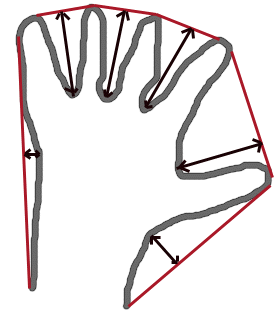
- Parameters
-
contour Input contour. convexhull Convex hull obtained using convexHull that should contain indices of the contour points that make the hull. convexityDefects The output vector of convexity defects. In C++ and the new Python/Java interface each convexity defect is represented as 4-element integer vector (a.k.a. #Vec4i): (start_index, end_index, farthest_pt_index, fixpt_depth), where indices are 0-based indices in the original contour of the convexity defect beginning, end and the farthest point, and fixpt_depth is fixed-point approximation (with 8 fractional bits) of the distance between the farthest contour point and the hull. That is, to get the floating-point value of the depth will be fixpt_depth/256.0.
◆ correctMatches()
|
static |
Refines coordinates of corresponding points.
- Parameters
-
F 3x3 fundamental matrix. points1 1xN array containing the first set of points. points2 1xN array containing the second set of points. newPoints1 The optimized points1. newPoints2 The optimized points2.
The function implements the Optimal Triangulation Method (see Multiple View Geometry [HartleyZ00] for details). For each given point correspondence points1[i] <-> points2[i], and a fundamental matrix F, it computes the corrected correspondences newPoints1[i] <-> newPoints2[i] that minimize the geometric error \(d(points1[i], newPoints1[i])^2 + d(points2[i],newPoints2[i])^2\) (where \(d(a,b)\) is the geometric distance between points \(a\) and \(b\) ) subject to the epipolar constraint \(newPoints2^T \cdot F \cdot newPoints1 = 0\) .
◆ decomposeEssentialMat()
|
static |
Decompose an essential matrix to possible rotations and translation.
- Parameters
-
E The input essential matrix. R1 One possible rotation matrix. R2 Another possible rotation matrix. t One possible translation.
This function decomposes the essential matrix E using svd decomposition [HartleyZ00]. In general, four possible poses exist for the decomposition of E. They are \([R_1, t]\), \([R_1, -t]\), \([R_2, t]\), \([R_2, -t]\).
If E gives the epipolar constraint \([p_2; 1]^T A^{-T} E A^{-1} [p_1; 1] = 0\) between the image points \(p_1\) in the first image and \(p_2\) in second image, then any of the tuples \([R_1, t]\), \([R_1, -t]\), \([R_2, t]\), \([R_2, -t]\) is a change of basis from the first camera's coordinate system to the second camera's coordinate system. However, by decomposing E, one can only get the direction of the translation. For this reason, the translation t is returned with unit length.
◆ decomposeHomographyMat()
|
static |
Decompose a homography matrix to rotation(s), translation(s) and plane normal(s).
- Parameters
-
H The input homography matrix between two images. K The input camera intrinsic matrix. rotations Array of rotation matrices. translations Array of translation matrices. normals Array of plane normal matrices.
This function extracts relative camera motion between two views of a planar object and returns up to four mathematical solution tuples of rotation, translation, and plane normal. The decomposition of the homography matrix H is described in detail in [Malis2007].
If the homography H, induced by the plane, gives the constraint
\[s_i \vecthree{x'_i}{y'_i}{1} \sim H \vecthree{x_i}{y_i}{1}\]
on the source image points \(p_i\) and the destination image points \(p'_i\), then the tuple of rotations[k] and translations[k] is a change of basis from the source camera's coordinate system to the destination camera's coordinate system. However, by decomposing H, one can only get the translation normalized by the (typically unknown) depth of the scene, i.e. its direction but with normalized length.
If point correspondences are available, at least two solutions may further be invalidated, by applying positive depth constraint, i.e. all points must be in front of the camera.
◆ decomposeProjectionMatrix() [1/5]
|
static |
Decomposes a projection matrix into a rotation matrix and a camera intrinsic matrix.
- Parameters
-
projMatrix 3x4 input projection matrix P. cameraMatrix Output 3x3 camera intrinsic matrix \(\cameramatrix{A}\). rotMatrix Output 3x3 external rotation matrix R. transVect Output 4x1 translation vector T. rotMatrixX Optional 3x3 rotation matrix around x-axis. rotMatrixY Optional 3x3 rotation matrix around y-axis. rotMatrixZ Optional 3x3 rotation matrix around z-axis. eulerAngles Optional three-element vector containing three Euler angles of rotation in degrees.
The function computes a decomposition of a projection matrix into a calibration and a rotation matrix and the position of a camera.
It optionally returns three rotation matrices, one for each axis, and three Euler angles that could be used in OpenGL. Note, there is always more than one sequence of rotations about the three principal axes that results in the same orientation of an object, e.g. see [Slabaugh] . Returned three rotation matrices and corresponding three Euler angles are only one of the possible solutions.
The function is based on RQDecomp3x3 .
◆ decomposeProjectionMatrix() [2/5]
|
static |
Decomposes a projection matrix into a rotation matrix and a camera intrinsic matrix.
- Parameters
-
projMatrix 3x4 input projection matrix P. cameraMatrix Output 3x3 camera intrinsic matrix \(\cameramatrix{A}\). rotMatrix Output 3x3 external rotation matrix R. transVect Output 4x1 translation vector T. rotMatrixX Optional 3x3 rotation matrix around x-axis. rotMatrixY Optional 3x3 rotation matrix around y-axis. rotMatrixZ Optional 3x3 rotation matrix around z-axis. eulerAngles Optional three-element vector containing three Euler angles of rotation in degrees.
The function computes a decomposition of a projection matrix into a calibration and a rotation matrix and the position of a camera.
It optionally returns three rotation matrices, one for each axis, and three Euler angles that could be used in OpenGL. Note, there is always more than one sequence of rotations about the three principal axes that results in the same orientation of an object, e.g. see [Slabaugh] . Returned three rotation matrices and corresponding three Euler angles are only one of the possible solutions.
The function is based on RQDecomp3x3 .
◆ decomposeProjectionMatrix() [3/5]
|
static |
Decomposes a projection matrix into a rotation matrix and a camera intrinsic matrix.
- Parameters
-
projMatrix 3x4 input projection matrix P. cameraMatrix Output 3x3 camera intrinsic matrix \(\cameramatrix{A}\). rotMatrix Output 3x3 external rotation matrix R. transVect Output 4x1 translation vector T. rotMatrixX Optional 3x3 rotation matrix around x-axis. rotMatrixY Optional 3x3 rotation matrix around y-axis. rotMatrixZ Optional 3x3 rotation matrix around z-axis. eulerAngles Optional three-element vector containing three Euler angles of rotation in degrees.
The function computes a decomposition of a projection matrix into a calibration and a rotation matrix and the position of a camera.
It optionally returns three rotation matrices, one for each axis, and three Euler angles that could be used in OpenGL. Note, there is always more than one sequence of rotations about the three principal axes that results in the same orientation of an object, e.g. see [Slabaugh] . Returned three rotation matrices and corresponding three Euler angles are only one of the possible solutions.
The function is based on RQDecomp3x3 .
◆ decomposeProjectionMatrix() [4/5]
|
static |
Decomposes a projection matrix into a rotation matrix and a camera intrinsic matrix.
- Parameters
-
projMatrix 3x4 input projection matrix P. cameraMatrix Output 3x3 camera intrinsic matrix \(\cameramatrix{A}\). rotMatrix Output 3x3 external rotation matrix R. transVect Output 4x1 translation vector T. rotMatrixX Optional 3x3 rotation matrix around x-axis. rotMatrixY Optional 3x3 rotation matrix around y-axis. rotMatrixZ Optional 3x3 rotation matrix around z-axis. eulerAngles Optional three-element vector containing three Euler angles of rotation in degrees.
The function computes a decomposition of a projection matrix into a calibration and a rotation matrix and the position of a camera.
It optionally returns three rotation matrices, one for each axis, and three Euler angles that could be used in OpenGL. Note, there is always more than one sequence of rotations about the three principal axes that results in the same orientation of an object, e.g. see [Slabaugh] . Returned three rotation matrices and corresponding three Euler angles are only one of the possible solutions.
The function is based on RQDecomp3x3 .
◆ decomposeProjectionMatrix() [5/5]
|
static |
Decomposes a projection matrix into a rotation matrix and a camera intrinsic matrix.
- Parameters
-
projMatrix 3x4 input projection matrix P. cameraMatrix Output 3x3 camera intrinsic matrix \(\cameramatrix{A}\). rotMatrix Output 3x3 external rotation matrix R. transVect Output 4x1 translation vector T. rotMatrixX Optional 3x3 rotation matrix around x-axis. rotMatrixY Optional 3x3 rotation matrix around y-axis. rotMatrixZ Optional 3x3 rotation matrix around z-axis. eulerAngles Optional three-element vector containing three Euler angles of rotation in degrees.
The function computes a decomposition of a projection matrix into a calibration and a rotation matrix and the position of a camera.
It optionally returns three rotation matrices, one for each axis, and three Euler angles that could be used in OpenGL. Note, there is always more than one sequence of rotations about the three principal axes that results in the same orientation of an object, e.g. see [Slabaugh] . Returned three rotation matrices and corresponding three Euler angles are only one of the possible solutions.
The function is based on RQDecomp3x3 .
◆ estimateAffine2D() [1/8]
Computes an optimal affine transformation between two 2D point sets.
It computes
\[ \begin{bmatrix} x\\ y\\ \end{bmatrix} = \begin{bmatrix} a_{11} & a_{12}\\ a_{21} & a_{22}\\ \end{bmatrix} \begin{bmatrix} X\\ Y\\ \end{bmatrix} + \begin{bmatrix} b_1\\ b_2\\ \end{bmatrix} \]
- Parameters
-
from First input 2D point set containing \((X,Y)\). to Second input 2D point set containing \((x,y)\). inliers Output vector indicating which points are inliers (1-inlier, 0-outlier). method Robust method used to compute transformation. The following methods are possible: ransacReprojThreshold Maximum reprojection error in the RANSAC algorithm to consider a point as an inlier. Applies only to RANSAC. maxIters The maximum number of robust method iterations. confidence Confidence level, between 0 and 1, for the estimated transformation. Anything between 0.95 and 0.99 is usually good enough. Values too close to 1 can slow down the estimation significantly. Values lower than 0.8-0.9 can result in an incorrectly estimated transformation. refineIters Maximum number of iterations of refining algorithm (Levenberg-Marquardt). Passing 0 will disable refining, so the output matrix will be output of robust method.
- Returns
- Output 2D affine transformation matrix \(2 \times 3\) or empty matrix if transformation could not be estimated. The returned matrix has the following form:
\[ \begin{bmatrix} a_{11} & a_{12} & b_1\\ a_{21} & a_{22} & b_2\\ \end{bmatrix} \]
The function estimates an optimal 2D affine transformation between two 2D point sets using the selected robust algorithm.
The computed transformation is then refined further (using only inliers) with the Levenberg-Marquardt method to reduce the re-projection error even more.
- Note
- The RANSAC method can handle practically any ratio of outliers but needs a threshold to distinguish inliers from outliers. The method LMeDS does not need any threshold but it works correctly only when there are more than 50% of inliers.
◆ estimateAffine2D() [2/8]
|
static |
Computes an optimal affine transformation between two 2D point sets.
It computes
\[ \begin{bmatrix} x\\ y\\ \end{bmatrix} = \begin{bmatrix} a_{11} & a_{12}\\ a_{21} & a_{22}\\ \end{bmatrix} \begin{bmatrix} X\\ Y\\ \end{bmatrix} + \begin{bmatrix} b_1\\ b_2\\ \end{bmatrix} \]
- Parameters
-
from First input 2D point set containing \((X,Y)\). to Second input 2D point set containing \((x,y)\). inliers Output vector indicating which points are inliers (1-inlier, 0-outlier). method Robust method used to compute transformation. The following methods are possible: ransacReprojThreshold Maximum reprojection error in the RANSAC algorithm to consider a point as an inlier. Applies only to RANSAC. maxIters The maximum number of robust method iterations. confidence Confidence level, between 0 and 1, for the estimated transformation. Anything between 0.95 and 0.99 is usually good enough. Values too close to 1 can slow down the estimation significantly. Values lower than 0.8-0.9 can result in an incorrectly estimated transformation. refineIters Maximum number of iterations of refining algorithm (Levenberg-Marquardt). Passing 0 will disable refining, so the output matrix will be output of robust method.
- Returns
- Output 2D affine transformation matrix \(2 \times 3\) or empty matrix if transformation could not be estimated. The returned matrix has the following form:
\[ \begin{bmatrix} a_{11} & a_{12} & b_1\\ a_{21} & a_{22} & b_2\\ \end{bmatrix} \]
The function estimates an optimal 2D affine transformation between two 2D point sets using the selected robust algorithm.
The computed transformation is then refined further (using only inliers) with the Levenberg-Marquardt method to reduce the re-projection error even more.
- Note
- The RANSAC method can handle practically any ratio of outliers but needs a threshold to distinguish inliers from outliers. The method LMeDS does not need any threshold but it works correctly only when there are more than 50% of inliers.
◆ estimateAffine2D() [3/8]
|
static |
Computes an optimal affine transformation between two 2D point sets.
It computes
\[ \begin{bmatrix} x\\ y\\ \end{bmatrix} = \begin{bmatrix} a_{11} & a_{12}\\ a_{21} & a_{22}\\ \end{bmatrix} \begin{bmatrix} X\\ Y\\ \end{bmatrix} + \begin{bmatrix} b_1\\ b_2\\ \end{bmatrix} \]
- Parameters
-
from First input 2D point set containing \((X,Y)\). to Second input 2D point set containing \((x,y)\). inliers Output vector indicating which points are inliers (1-inlier, 0-outlier). method Robust method used to compute transformation. The following methods are possible: ransacReprojThreshold Maximum reprojection error in the RANSAC algorithm to consider a point as an inlier. Applies only to RANSAC. maxIters The maximum number of robust method iterations. confidence Confidence level, between 0 and 1, for the estimated transformation. Anything between 0.95 and 0.99 is usually good enough. Values too close to 1 can slow down the estimation significantly. Values lower than 0.8-0.9 can result in an incorrectly estimated transformation. refineIters Maximum number of iterations of refining algorithm (Levenberg-Marquardt). Passing 0 will disable refining, so the output matrix will be output of robust method.
- Returns
- Output 2D affine transformation matrix \(2 \times 3\) or empty matrix if transformation could not be estimated. The returned matrix has the following form:
\[ \begin{bmatrix} a_{11} & a_{12} & b_1\\ a_{21} & a_{22} & b_2\\ \end{bmatrix} \]
The function estimates an optimal 2D affine transformation between two 2D point sets using the selected robust algorithm.
The computed transformation is then refined further (using only inliers) with the Levenberg-Marquardt method to reduce the re-projection error even more.
- Note
- The RANSAC method can handle practically any ratio of outliers but needs a threshold to distinguish inliers from outliers. The method LMeDS does not need any threshold but it works correctly only when there are more than 50% of inliers.
◆ estimateAffine2D() [4/8]
|
static |
Computes an optimal affine transformation between two 2D point sets.
It computes
\[ \begin{bmatrix} x\\ y\\ \end{bmatrix} = \begin{bmatrix} a_{11} & a_{12}\\ a_{21} & a_{22}\\ \end{bmatrix} \begin{bmatrix} X\\ Y\\ \end{bmatrix} + \begin{bmatrix} b_1\\ b_2\\ \end{bmatrix} \]
- Parameters
-
from First input 2D point set containing \((X,Y)\). to Second input 2D point set containing \((x,y)\). inliers Output vector indicating which points are inliers (1-inlier, 0-outlier). method Robust method used to compute transformation. The following methods are possible: ransacReprojThreshold Maximum reprojection error in the RANSAC algorithm to consider a point as an inlier. Applies only to RANSAC. maxIters The maximum number of robust method iterations. confidence Confidence level, between 0 and 1, for the estimated transformation. Anything between 0.95 and 0.99 is usually good enough. Values too close to 1 can slow down the estimation significantly. Values lower than 0.8-0.9 can result in an incorrectly estimated transformation. refineIters Maximum number of iterations of refining algorithm (Levenberg-Marquardt). Passing 0 will disable refining, so the output matrix will be output of robust method.
- Returns
- Output 2D affine transformation matrix \(2 \times 3\) or empty matrix if transformation could not be estimated. The returned matrix has the following form:
\[ \begin{bmatrix} a_{11} & a_{12} & b_1\\ a_{21} & a_{22} & b_2\\ \end{bmatrix} \]
The function estimates an optimal 2D affine transformation between two 2D point sets using the selected robust algorithm.
The computed transformation is then refined further (using only inliers) with the Levenberg-Marquardt method to reduce the re-projection error even more.
- Note
- The RANSAC method can handle practically any ratio of outliers but needs a threshold to distinguish inliers from outliers. The method LMeDS does not need any threshold but it works correctly only when there are more than 50% of inliers.
◆ estimateAffine2D() [5/8]
|
static |
Computes an optimal affine transformation between two 2D point sets.
It computes
\[ \begin{bmatrix} x\\ y\\ \end{bmatrix} = \begin{bmatrix} a_{11} & a_{12}\\ a_{21} & a_{22}\\ \end{bmatrix} \begin{bmatrix} X\\ Y\\ \end{bmatrix} + \begin{bmatrix} b_1\\ b_2\\ \end{bmatrix} \]
- Parameters
-
from First input 2D point set containing \((X,Y)\). to Second input 2D point set containing \((x,y)\). inliers Output vector indicating which points are inliers (1-inlier, 0-outlier). method Robust method used to compute transformation. The following methods are possible: ransacReprojThreshold Maximum reprojection error in the RANSAC algorithm to consider a point as an inlier. Applies only to RANSAC. maxIters The maximum number of robust method iterations. confidence Confidence level, between 0 and 1, for the estimated transformation. Anything between 0.95 and 0.99 is usually good enough. Values too close to 1 can slow down the estimation significantly. Values lower than 0.8-0.9 can result in an incorrectly estimated transformation. refineIters Maximum number of iterations of refining algorithm (Levenberg-Marquardt). Passing 0 will disable refining, so the output matrix will be output of robust method.
- Returns
- Output 2D affine transformation matrix \(2 \times 3\) or empty matrix if transformation could not be estimated. The returned matrix has the following form:
\[ \begin{bmatrix} a_{11} & a_{12} & b_1\\ a_{21} & a_{22} & b_2\\ \end{bmatrix} \]
The function estimates an optimal 2D affine transformation between two 2D point sets using the selected robust algorithm.
The computed transformation is then refined further (using only inliers) with the Levenberg-Marquardt method to reduce the re-projection error even more.
- Note
- The RANSAC method can handle practically any ratio of outliers but needs a threshold to distinguish inliers from outliers. The method LMeDS does not need any threshold but it works correctly only when there are more than 50% of inliers.
◆ estimateAffine2D() [6/8]
|
static |
Computes an optimal affine transformation between two 2D point sets.
It computes
\[ \begin{bmatrix} x\\ y\\ \end{bmatrix} = \begin{bmatrix} a_{11} & a_{12}\\ a_{21} & a_{22}\\ \end{bmatrix} \begin{bmatrix} X\\ Y\\ \end{bmatrix} + \begin{bmatrix} b_1\\ b_2\\ \end{bmatrix} \]
- Parameters
-
from First input 2D point set containing \((X,Y)\). to Second input 2D point set containing \((x,y)\). inliers Output vector indicating which points are inliers (1-inlier, 0-outlier). method Robust method used to compute transformation. The following methods are possible: ransacReprojThreshold Maximum reprojection error in the RANSAC algorithm to consider a point as an inlier. Applies only to RANSAC. maxIters The maximum number of robust method iterations. confidence Confidence level, between 0 and 1, for the estimated transformation. Anything between 0.95 and 0.99 is usually good enough. Values too close to 1 can slow down the estimation significantly. Values lower than 0.8-0.9 can result in an incorrectly estimated transformation. refineIters Maximum number of iterations of refining algorithm (Levenberg-Marquardt). Passing 0 will disable refining, so the output matrix will be output of robust method.
- Returns
- Output 2D affine transformation matrix \(2 \times 3\) or empty matrix if transformation could not be estimated. The returned matrix has the following form:
\[ \begin{bmatrix} a_{11} & a_{12} & b_1\\ a_{21} & a_{22} & b_2\\ \end{bmatrix} \]
The function estimates an optimal 2D affine transformation between two 2D point sets using the selected robust algorithm.
The computed transformation is then refined further (using only inliers) with the Levenberg-Marquardt method to reduce the re-projection error even more.
- Note
- The RANSAC method can handle practically any ratio of outliers but needs a threshold to distinguish inliers from outliers. The method LMeDS does not need any threshold but it works correctly only when there are more than 50% of inliers.
◆ estimateAffine2D() [7/8]
|
static |
Computes an optimal affine transformation between two 2D point sets.
It computes
\[ \begin{bmatrix} x\\ y\\ \end{bmatrix} = \begin{bmatrix} a_{11} & a_{12}\\ a_{21} & a_{22}\\ \end{bmatrix} \begin{bmatrix} X\\ Y\\ \end{bmatrix} + \begin{bmatrix} b_1\\ b_2\\ \end{bmatrix} \]
- Parameters
-
from First input 2D point set containing \((X,Y)\). to Second input 2D point set containing \((x,y)\). inliers Output vector indicating which points are inliers (1-inlier, 0-outlier). method Robust method used to compute transformation. The following methods are possible: ransacReprojThreshold Maximum reprojection error in the RANSAC algorithm to consider a point as an inlier. Applies only to RANSAC. maxIters The maximum number of robust method iterations. confidence Confidence level, between 0 and 1, for the estimated transformation. Anything between 0.95 and 0.99 is usually good enough. Values too close to 1 can slow down the estimation significantly. Values lower than 0.8-0.9 can result in an incorrectly estimated transformation. refineIters Maximum number of iterations of refining algorithm (Levenberg-Marquardt). Passing 0 will disable refining, so the output matrix will be output of robust method.
- Returns
- Output 2D affine transformation matrix \(2 \times 3\) or empty matrix if transformation could not be estimated. The returned matrix has the following form:
\[ \begin{bmatrix} a_{11} & a_{12} & b_1\\ a_{21} & a_{22} & b_2\\ \end{bmatrix} \]
The function estimates an optimal 2D affine transformation between two 2D point sets using the selected robust algorithm.
The computed transformation is then refined further (using only inliers) with the Levenberg-Marquardt method to reduce the re-projection error even more.
- Note
- The RANSAC method can handle practically any ratio of outliers but needs a threshold to distinguish inliers from outliers. The method LMeDS does not need any threshold but it works correctly only when there are more than 50% of inliers.
◆ estimateAffine2D() [8/8]
|
static |
◆ estimateAffine3D() [1/6]
Computes an optimal affine transformation between two 3D point sets.
It computes \(R,s,t\) minimizing \(\sum{i} dst_i - c \cdot R \cdot src_i \) where \(R\) is a 3x3 rotation matrix, \(t\) is a 3x1 translation vector and \(s\) is a scalar size value. This is an implementation of the algorithm by Umeyama [umeyama1991least] . The estimated affine transform has a homogeneous scale which is a subclass of affine transformations with 7 degrees of freedom. The paired point sets need to comprise at least 3 points each.
- Parameters
-
src First input 3D point set. dst Second input 3D point set. scale If null is passed, the scale parameter c will be assumed to be 1.0. Else the pointed-to variable will be set to the optimal scale. force_rotation If true, the returned rotation will never be a reflection. This might be unwanted, e.g. when optimizing a transform between a right- and a left-handed coordinate system.
- Returns
- 3D affine transformation matrix \(3 \times 4\) of the form
\[T = \begin{bmatrix} R & t\\ \end{bmatrix} \]
◆ estimateAffine3D() [2/6]
|
static |
Computes an optimal affine transformation between two 3D point sets.
It computes \(R,s,t\) minimizing \(\sum{i} dst_i - c \cdot R \cdot src_i \) where \(R\) is a 3x3 rotation matrix, \(t\) is a 3x1 translation vector and \(s\) is a scalar size value. This is an implementation of the algorithm by Umeyama [umeyama1991least] . The estimated affine transform has a homogeneous scale which is a subclass of affine transformations with 7 degrees of freedom. The paired point sets need to comprise at least 3 points each.
- Parameters
-
src First input 3D point set. dst Second input 3D point set. scale If null is passed, the scale parameter c will be assumed to be 1.0. Else the pointed-to variable will be set to the optimal scale. force_rotation If true, the returned rotation will never be a reflection. This might be unwanted, e.g. when optimizing a transform between a right- and a left-handed coordinate system.
- Returns
- 3D affine transformation matrix \(3 \times 4\) of the form
\[T = \begin{bmatrix} R & t\\ \end{bmatrix} \]
◆ estimateAffine3D() [3/6]
|
static |
Computes an optimal affine transformation between two 3D point sets.
It computes \(R,s,t\) minimizing \(\sum{i} dst_i - c \cdot R \cdot src_i \) where \(R\) is a 3x3 rotation matrix, \(t\) is a 3x1 translation vector and \(s\) is a scalar size value. This is an implementation of the algorithm by Umeyama [umeyama1991least] . The estimated affine transform has a homogeneous scale which is a subclass of affine transformations with 7 degrees of freedom. The paired point sets need to comprise at least 3 points each.
- Parameters
-
src First input 3D point set. dst Second input 3D point set. scale If null is passed, the scale parameter c will be assumed to be 1.0. Else the pointed-to variable will be set to the optimal scale. force_rotation If true, the returned rotation will never be a reflection. This might be unwanted, e.g. when optimizing a transform between a right- and a left-handed coordinate system.
- Returns
- 3D affine transformation matrix \(3 \times 4\) of the form
\[T = \begin{bmatrix} R & t\\ \end{bmatrix} \]
◆ estimateAffine3D() [4/6]
|
static |
Computes an optimal affine transformation between two 3D point sets.
It computes
\[ \begin{bmatrix} x\\ y\\ z\\ \end{bmatrix} = \begin{bmatrix} a_{11} & a_{12} & a_{13}\\ a_{21} & a_{22} & a_{23}\\ a_{31} & a_{32} & a_{33}\\ \end{bmatrix} \begin{bmatrix} X\\ Y\\ Z\\ \end{bmatrix} + \begin{bmatrix} b_1\\ b_2\\ b_3\\ \end{bmatrix} \]
- Parameters
-
src First input 3D point set containing \((X,Y,Z)\). dst Second input 3D point set containing \((x,y,z)\). out Output 3D affine transformation matrix \(3 \times 4\) of the form \[ \begin{bmatrix} a_{11} & a_{12} & a_{13} & b_1\\ a_{21} & a_{22} & a_{23} & b_2\\ a_{31} & a_{32} & a_{33} & b_3\\ \end{bmatrix} \]
inliers Output vector indicating which points are inliers (1-inlier, 0-outlier). ransacThreshold Maximum reprojection error in the RANSAC algorithm to consider a point as an inlier. confidence Confidence level, between 0 and 1, for the estimated transformation. Anything between 0.95 and 0.99 is usually good enough. Values too close to 1 can slow down the estimation significantly. Values lower than 0.8-0.9 can result in an incorrectly estimated transformation.
- Returns
- Whether a solution was found.
The function estimates an optimal 3D affine transformation between two 3D point sets using the RANSAC algorithm.
◆ estimateAffine3D() [5/6]
|
static |
Computes an optimal affine transformation between two 3D point sets.
It computes
\[ \begin{bmatrix} x\\ y\\ z\\ \end{bmatrix} = \begin{bmatrix} a_{11} & a_{12} & a_{13}\\ a_{21} & a_{22} & a_{23}\\ a_{31} & a_{32} & a_{33}\\ \end{bmatrix} \begin{bmatrix} X\\ Y\\ Z\\ \end{bmatrix} + \begin{bmatrix} b_1\\ b_2\\ b_3\\ \end{bmatrix} \]
- Parameters
-
src First input 3D point set containing \((X,Y,Z)\). dst Second input 3D point set containing \((x,y,z)\). out Output 3D affine transformation matrix \(3 \times 4\) of the form \[ \begin{bmatrix} a_{11} & a_{12} & a_{13} & b_1\\ a_{21} & a_{22} & a_{23} & b_2\\ a_{31} & a_{32} & a_{33} & b_3\\ \end{bmatrix} \]
inliers Output vector indicating which points are inliers (1-inlier, 0-outlier). ransacThreshold Maximum reprojection error in the RANSAC algorithm to consider a point as an inlier. confidence Confidence level, between 0 and 1, for the estimated transformation. Anything between 0.95 and 0.99 is usually good enough. Values too close to 1 can slow down the estimation significantly. Values lower than 0.8-0.9 can result in an incorrectly estimated transformation.
- Returns
- Whether a solution was found.
The function estimates an optimal 3D affine transformation between two 3D point sets using the RANSAC algorithm.
◆ estimateAffine3D() [6/6]
|
static |
Computes an optimal affine transformation between two 3D point sets.
It computes
\[ \begin{bmatrix} x\\ y\\ z\\ \end{bmatrix} = \begin{bmatrix} a_{11} & a_{12} & a_{13}\\ a_{21} & a_{22} & a_{23}\\ a_{31} & a_{32} & a_{33}\\ \end{bmatrix} \begin{bmatrix} X\\ Y\\ Z\\ \end{bmatrix} + \begin{bmatrix} b_1\\ b_2\\ b_3\\ \end{bmatrix} \]
- Parameters
-
src First input 3D point set containing \((X,Y,Z)\). dst Second input 3D point set containing \((x,y,z)\). out Output 3D affine transformation matrix \(3 \times 4\) of the form \[ \begin{bmatrix} a_{11} & a_{12} & a_{13} & b_1\\ a_{21} & a_{22} & a_{23} & b_2\\ a_{31} & a_{32} & a_{33} & b_3\\ \end{bmatrix} \]
inliers Output vector indicating which points are inliers (1-inlier, 0-outlier). ransacThreshold Maximum reprojection error in the RANSAC algorithm to consider a point as an inlier. confidence Confidence level, between 0 and 1, for the estimated transformation. Anything between 0.95 and 0.99 is usually good enough. Values too close to 1 can slow down the estimation significantly. Values lower than 0.8-0.9 can result in an incorrectly estimated transformation.
- Returns
- Whether a solution was found.
The function estimates an optimal 3D affine transformation between two 3D point sets using the RANSAC algorithm.
◆ estimateAffinePartial2D() [1/7]
|
static |
Computes an optimal limited affine transformation with 4 degrees of freedom between two 2D point sets.
- Parameters
-
from First input 2D point set. to Second input 2D point set. inliers Output vector indicating which points are inliers. method Robust method used to compute transformation. The following methods are possible: ransacReprojThreshold Maximum reprojection error in the RANSAC algorithm to consider a point as an inlier. Applies only to RANSAC. maxIters The maximum number of robust method iterations. confidence Confidence level, between 0 and 1, for the estimated transformation. Anything between 0.95 and 0.99 is usually good enough. Values too close to 1 can slow down the estimation significantly. Values lower than 0.8-0.9 can result in an incorrectly estimated transformation. refineIters Maximum number of iterations of refining algorithm (Levenberg-Marquardt). Passing 0 will disable refining, so the output matrix will be output of robust method.
- Returns
- Output 2D affine transformation (4 degrees of freedom) matrix \(2 \times 3\) or empty matrix if transformation could not be estimated.
The function estimates an optimal 2D affine transformation with 4 degrees of freedom limited to combinations of translation, rotation, and uniform scaling. Uses the selected algorithm for robust estimation.
The computed transformation is then refined further (using only inliers) with the Levenberg-Marquardt method to reduce the re-projection error even more.
Estimated transformation matrix is:
\[ \begin{bmatrix} \cos(\theta) \cdot s & -\sin(\theta) \cdot s & t_x \\ \sin(\theta) \cdot s & \cos(\theta) \cdot s & t_y \end{bmatrix} \]
Where \( \theta \) is the rotation angle, \( s \) the scaling factor and \( t_x, t_y \) are translations in \( x, y \) axes respectively.
- Note
- The RANSAC method can handle practically any ratio of outliers but need a threshold to distinguish inliers from outliers. The method LMeDS does not need any threshold but it works correctly only when there are more than 50% of inliers.
- See also
- estimateAffine2D, getAffineTransform
◆ estimateAffinePartial2D() [2/7]
|
static |
Computes an optimal limited affine transformation with 4 degrees of freedom between two 2D point sets.
- Parameters
-
from First input 2D point set. to Second input 2D point set. inliers Output vector indicating which points are inliers. method Robust method used to compute transformation. The following methods are possible: ransacReprojThreshold Maximum reprojection error in the RANSAC algorithm to consider a point as an inlier. Applies only to RANSAC. maxIters The maximum number of robust method iterations. confidence Confidence level, between 0 and 1, for the estimated transformation. Anything between 0.95 and 0.99 is usually good enough. Values too close to 1 can slow down the estimation significantly. Values lower than 0.8-0.9 can result in an incorrectly estimated transformation. refineIters Maximum number of iterations of refining algorithm (Levenberg-Marquardt). Passing 0 will disable refining, so the output matrix will be output of robust method.
- Returns
- Output 2D affine transformation (4 degrees of freedom) matrix \(2 \times 3\) or empty matrix if transformation could not be estimated.
The function estimates an optimal 2D affine transformation with 4 degrees of freedom limited to combinations of translation, rotation, and uniform scaling. Uses the selected algorithm for robust estimation.
The computed transformation is then refined further (using only inliers) with the Levenberg-Marquardt method to reduce the re-projection error even more.
Estimated transformation matrix is:
\[ \begin{bmatrix} \cos(\theta) \cdot s & -\sin(\theta) \cdot s & t_x \\ \sin(\theta) \cdot s & \cos(\theta) \cdot s & t_y \end{bmatrix} \]
Where \( \theta \) is the rotation angle, \( s \) the scaling factor and \( t_x, t_y \) are translations in \( x, y \) axes respectively.
- Note
- The RANSAC method can handle practically any ratio of outliers but need a threshold to distinguish inliers from outliers. The method LMeDS does not need any threshold but it works correctly only when there are more than 50% of inliers.
- See also
- estimateAffine2D, getAffineTransform
◆ estimateAffinePartial2D() [3/7]
|
static |
Computes an optimal limited affine transformation with 4 degrees of freedom between two 2D point sets.
- Parameters
-
from First input 2D point set. to Second input 2D point set. inliers Output vector indicating which points are inliers. method Robust method used to compute transformation. The following methods are possible: ransacReprojThreshold Maximum reprojection error in the RANSAC algorithm to consider a point as an inlier. Applies only to RANSAC. maxIters The maximum number of robust method iterations. confidence Confidence level, between 0 and 1, for the estimated transformation. Anything between 0.95 and 0.99 is usually good enough. Values too close to 1 can slow down the estimation significantly. Values lower than 0.8-0.9 can result in an incorrectly estimated transformation. refineIters Maximum number of iterations of refining algorithm (Levenberg-Marquardt). Passing 0 will disable refining, so the output matrix will be output of robust method.
- Returns
- Output 2D affine transformation (4 degrees of freedom) matrix \(2 \times 3\) or empty matrix if transformation could not be estimated.
The function estimates an optimal 2D affine transformation with 4 degrees of freedom limited to combinations of translation, rotation, and uniform scaling. Uses the selected algorithm for robust estimation.
The computed transformation is then refined further (using only inliers) with the Levenberg-Marquardt method to reduce the re-projection error even more.
Estimated transformation matrix is:
\[ \begin{bmatrix} \cos(\theta) \cdot s & -\sin(\theta) \cdot s & t_x \\ \sin(\theta) \cdot s & \cos(\theta) \cdot s & t_y \end{bmatrix} \]
Where \( \theta \) is the rotation angle, \( s \) the scaling factor and \( t_x, t_y \) are translations in \( x, y \) axes respectively.
- Note
- The RANSAC method can handle practically any ratio of outliers but need a threshold to distinguish inliers from outliers. The method LMeDS does not need any threshold but it works correctly only when there are more than 50% of inliers.
- See also
- estimateAffine2D, getAffineTransform
◆ estimateAffinePartial2D() [4/7]
|
static |
Computes an optimal limited affine transformation with 4 degrees of freedom between two 2D point sets.
- Parameters
-
from First input 2D point set. to Second input 2D point set. inliers Output vector indicating which points are inliers. method Robust method used to compute transformation. The following methods are possible: ransacReprojThreshold Maximum reprojection error in the RANSAC algorithm to consider a point as an inlier. Applies only to RANSAC. maxIters The maximum number of robust method iterations. confidence Confidence level, between 0 and 1, for the estimated transformation. Anything between 0.95 and 0.99 is usually good enough. Values too close to 1 can slow down the estimation significantly. Values lower than 0.8-0.9 can result in an incorrectly estimated transformation. refineIters Maximum number of iterations of refining algorithm (Levenberg-Marquardt). Passing 0 will disable refining, so the output matrix will be output of robust method.
- Returns
- Output 2D affine transformation (4 degrees of freedom) matrix \(2 \times 3\) or empty matrix if transformation could not be estimated.
The function estimates an optimal 2D affine transformation with 4 degrees of freedom limited to combinations of translation, rotation, and uniform scaling. Uses the selected algorithm for robust estimation.
The computed transformation is then refined further (using only inliers) with the Levenberg-Marquardt method to reduce the re-projection error even more.
Estimated transformation matrix is:
\[ \begin{bmatrix} \cos(\theta) \cdot s & -\sin(\theta) \cdot s & t_x \\ \sin(\theta) \cdot s & \cos(\theta) \cdot s & t_y \end{bmatrix} \]
Where \( \theta \) is the rotation angle, \( s \) the scaling factor and \( t_x, t_y \) are translations in \( x, y \) axes respectively.
- Note
- The RANSAC method can handle practically any ratio of outliers but need a threshold to distinguish inliers from outliers. The method LMeDS does not need any threshold but it works correctly only when there are more than 50% of inliers.
- See also
- estimateAffine2D, getAffineTransform
◆ estimateAffinePartial2D() [5/7]
|
static |
Computes an optimal limited affine transformation with 4 degrees of freedom between two 2D point sets.
- Parameters
-
from First input 2D point set. to Second input 2D point set. inliers Output vector indicating which points are inliers. method Robust method used to compute transformation. The following methods are possible: ransacReprojThreshold Maximum reprojection error in the RANSAC algorithm to consider a point as an inlier. Applies only to RANSAC. maxIters The maximum number of robust method iterations. confidence Confidence level, between 0 and 1, for the estimated transformation. Anything between 0.95 and 0.99 is usually good enough. Values too close to 1 can slow down the estimation significantly. Values lower than 0.8-0.9 can result in an incorrectly estimated transformation. refineIters Maximum number of iterations of refining algorithm (Levenberg-Marquardt). Passing 0 will disable refining, so the output matrix will be output of robust method.
- Returns
- Output 2D affine transformation (4 degrees of freedom) matrix \(2 \times 3\) or empty matrix if transformation could not be estimated.
The function estimates an optimal 2D affine transformation with 4 degrees of freedom limited to combinations of translation, rotation, and uniform scaling. Uses the selected algorithm for robust estimation.
The computed transformation is then refined further (using only inliers) with the Levenberg-Marquardt method to reduce the re-projection error even more.
Estimated transformation matrix is:
\[ \begin{bmatrix} \cos(\theta) \cdot s & -\sin(\theta) \cdot s & t_x \\ \sin(\theta) \cdot s & \cos(\theta) \cdot s & t_y \end{bmatrix} \]
Where \( \theta \) is the rotation angle, \( s \) the scaling factor and \( t_x, t_y \) are translations in \( x, y \) axes respectively.
- Note
- The RANSAC method can handle practically any ratio of outliers but need a threshold to distinguish inliers from outliers. The method LMeDS does not need any threshold but it works correctly only when there are more than 50% of inliers.
- See also
- estimateAffine2D, getAffineTransform
◆ estimateAffinePartial2D() [6/7]
|
static |
Computes an optimal limited affine transformation with 4 degrees of freedom between two 2D point sets.
- Parameters
-
from First input 2D point set. to Second input 2D point set. inliers Output vector indicating which points are inliers. method Robust method used to compute transformation. The following methods are possible: ransacReprojThreshold Maximum reprojection error in the RANSAC algorithm to consider a point as an inlier. Applies only to RANSAC. maxIters The maximum number of robust method iterations. confidence Confidence level, between 0 and 1, for the estimated transformation. Anything between 0.95 and 0.99 is usually good enough. Values too close to 1 can slow down the estimation significantly. Values lower than 0.8-0.9 can result in an incorrectly estimated transformation. refineIters Maximum number of iterations of refining algorithm (Levenberg-Marquardt). Passing 0 will disable refining, so the output matrix will be output of robust method.
- Returns
- Output 2D affine transformation (4 degrees of freedom) matrix \(2 \times 3\) or empty matrix if transformation could not be estimated.
The function estimates an optimal 2D affine transformation with 4 degrees of freedom limited to combinations of translation, rotation, and uniform scaling. Uses the selected algorithm for robust estimation.
The computed transformation is then refined further (using only inliers) with the Levenberg-Marquardt method to reduce the re-projection error even more.
Estimated transformation matrix is:
\[ \begin{bmatrix} \cos(\theta) \cdot s & -\sin(\theta) \cdot s & t_x \\ \sin(\theta) \cdot s & \cos(\theta) \cdot s & t_y \end{bmatrix} \]
Where \( \theta \) is the rotation angle, \( s \) the scaling factor and \( t_x, t_y \) are translations in \( x, y \) axes respectively.
- Note
- The RANSAC method can handle practically any ratio of outliers but need a threshold to distinguish inliers from outliers. The method LMeDS does not need any threshold but it works correctly only when there are more than 50% of inliers.
- See also
- estimateAffine2D, getAffineTransform
◆ estimateAffinePartial2D() [7/7]
|
static |
Computes an optimal limited affine transformation with 4 degrees of freedom between two 2D point sets.
- Parameters
-
from First input 2D point set. to Second input 2D point set. inliers Output vector indicating which points are inliers. method Robust method used to compute transformation. The following methods are possible: ransacReprojThreshold Maximum reprojection error in the RANSAC algorithm to consider a point as an inlier. Applies only to RANSAC. maxIters The maximum number of robust method iterations. confidence Confidence level, between 0 and 1, for the estimated transformation. Anything between 0.95 and 0.99 is usually good enough. Values too close to 1 can slow down the estimation significantly. Values lower than 0.8-0.9 can result in an incorrectly estimated transformation. refineIters Maximum number of iterations of refining algorithm (Levenberg-Marquardt). Passing 0 will disable refining, so the output matrix will be output of robust method.
- Returns
- Output 2D affine transformation (4 degrees of freedom) matrix \(2 \times 3\) or empty matrix if transformation could not be estimated.
The function estimates an optimal 2D affine transformation with 4 degrees of freedom limited to combinations of translation, rotation, and uniform scaling. Uses the selected algorithm for robust estimation.
The computed transformation is then refined further (using only inliers) with the Levenberg-Marquardt method to reduce the re-projection error even more.
Estimated transformation matrix is:
\[ \begin{bmatrix} \cos(\theta) \cdot s & -\sin(\theta) \cdot s & t_x \\ \sin(\theta) \cdot s & \cos(\theta) \cdot s & t_y \end{bmatrix} \]
Where \( \theta \) is the rotation angle, \( s \) the scaling factor and \( t_x, t_y \) are translations in \( x, y \) axes respectively.
- Note
- The RANSAC method can handle practically any ratio of outliers but need a threshold to distinguish inliers from outliers. The method LMeDS does not need any threshold but it works correctly only when there are more than 50% of inliers.
- See also
- estimateAffine2D, getAffineTransform
◆ estimateTranslation2D() [1/7]
|
static |
Computes a pure 2D translation between two 2D point sets.
It computes
\[ \begin{bmatrix} x\\ y \end{bmatrix} = \begin{bmatrix} 1 & 0\\ 0 & 1 \end{bmatrix} \begin{bmatrix} X\\ Y \end{bmatrix} + \begin{bmatrix} t_x\\ t_y \end{bmatrix}. \]
- Parameters
-
from First input 2D point set containing \((X,Y)\). to Second input 2D point set containing \((x,y)\). inliers Output vector indicating which points are inliers (1-inlier, 0-outlier). method Robust method used to compute the transformation. The following methods are possible: ransacReprojThreshold Maximum reprojection error in the RANSAC algorithm to consider a point as an inlier. Applies only to RANSAC. maxIters The maximum number of robust method iterations. confidence Confidence level, between 0 and 1, for the estimated transformation. Anything between 0.95 and 0.99 is usually good enough. Values too close to 1 can slow down the estimation significantly. Values lower than 0.8–0.9 can result in an incorrectly estimated transformation. refineIters Maximum number of iterations of the refining algorithm. For pure translation the least-squares solution on inliers is closed-form, so passing 0 is recommended (no additional refine).
- Returns
- A 2D translation vector \([t_x, t_y]^T\) as
cv::Vec2d. If the translation could not be estimated, both components are set to NaN and, ifinliersis provided, the mask is filled with zeros.
- Converting to a 2x3 transformation matrix:
\[ \begin{bmatrix} 1 & 0 & t_x\\ 0 & 1 & t_y \end{bmatrix} \]
The function estimates a pure 2D translation between two 2D point sets using the selected robust algorithm. Inliers are determined by the reprojection error threshold.
- Note
- The RANSAC method can handle practically any ratio of outliers but needs a threshold to distinguish inliers from outliers. The method LMeDS does not need any threshold but works correctly only when there are more than 50% inliers.
◆ estimateTranslation2D() [2/7]
|
static |
Computes a pure 2D translation between two 2D point sets.
It computes
\[ \begin{bmatrix} x\\ y \end{bmatrix} = \begin{bmatrix} 1 & 0\\ 0 & 1 \end{bmatrix} \begin{bmatrix} X\\ Y \end{bmatrix} + \begin{bmatrix} t_x\\ t_y \end{bmatrix}. \]
- Parameters
-
from First input 2D point set containing \((X,Y)\). to Second input 2D point set containing \((x,y)\). inliers Output vector indicating which points are inliers (1-inlier, 0-outlier). method Robust method used to compute the transformation. The following methods are possible: ransacReprojThreshold Maximum reprojection error in the RANSAC algorithm to consider a point as an inlier. Applies only to RANSAC. maxIters The maximum number of robust method iterations. confidence Confidence level, between 0 and 1, for the estimated transformation. Anything between 0.95 and 0.99 is usually good enough. Values too close to 1 can slow down the estimation significantly. Values lower than 0.8–0.9 can result in an incorrectly estimated transformation. refineIters Maximum number of iterations of the refining algorithm. For pure translation the least-squares solution on inliers is closed-form, so passing 0 is recommended (no additional refine).
- Returns
- A 2D translation vector \([t_x, t_y]^T\) as
cv::Vec2d. If the translation could not be estimated, both components are set to NaN and, ifinliersis provided, the mask is filled with zeros.
- Converting to a 2x3 transformation matrix:
\[ \begin{bmatrix} 1 & 0 & t_x\\ 0 & 1 & t_y \end{bmatrix} \]
The function estimates a pure 2D translation between two 2D point sets using the selected robust algorithm. Inliers are determined by the reprojection error threshold.
- Note
- The RANSAC method can handle practically any ratio of outliers but needs a threshold to distinguish inliers from outliers. The method LMeDS does not need any threshold but works correctly only when there are more than 50% inliers.
◆ estimateTranslation2D() [3/7]
|
static |
Computes a pure 2D translation between two 2D point sets.
It computes
\[ \begin{bmatrix} x\\ y \end{bmatrix} = \begin{bmatrix} 1 & 0\\ 0 & 1 \end{bmatrix} \begin{bmatrix} X\\ Y \end{bmatrix} + \begin{bmatrix} t_x\\ t_y \end{bmatrix}. \]
- Parameters
-
from First input 2D point set containing \((X,Y)\). to Second input 2D point set containing \((x,y)\). inliers Output vector indicating which points are inliers (1-inlier, 0-outlier). method Robust method used to compute the transformation. The following methods are possible: ransacReprojThreshold Maximum reprojection error in the RANSAC algorithm to consider a point as an inlier. Applies only to RANSAC. maxIters The maximum number of robust method iterations. confidence Confidence level, between 0 and 1, for the estimated transformation. Anything between 0.95 and 0.99 is usually good enough. Values too close to 1 can slow down the estimation significantly. Values lower than 0.8–0.9 can result in an incorrectly estimated transformation. refineIters Maximum number of iterations of the refining algorithm. For pure translation the least-squares solution on inliers is closed-form, so passing 0 is recommended (no additional refine).
- Returns
- A 2D translation vector \([t_x, t_y]^T\) as
cv::Vec2d. If the translation could not be estimated, both components are set to NaN and, ifinliersis provided, the mask is filled with zeros.
- Converting to a 2x3 transformation matrix:
\[ \begin{bmatrix} 1 & 0 & t_x\\ 0 & 1 & t_y \end{bmatrix} \]
The function estimates a pure 2D translation between two 2D point sets using the selected robust algorithm. Inliers are determined by the reprojection error threshold.
- Note
- The RANSAC method can handle practically any ratio of outliers but needs a threshold to distinguish inliers from outliers. The method LMeDS does not need any threshold but works correctly only when there are more than 50% inliers.
◆ estimateTranslation2D() [4/7]
|
static |
Computes a pure 2D translation between two 2D point sets.
It computes
\[ \begin{bmatrix} x\\ y \end{bmatrix} = \begin{bmatrix} 1 & 0\\ 0 & 1 \end{bmatrix} \begin{bmatrix} X\\ Y \end{bmatrix} + \begin{bmatrix} t_x\\ t_y \end{bmatrix}. \]
- Parameters
-
from First input 2D point set containing \((X,Y)\). to Second input 2D point set containing \((x,y)\). inliers Output vector indicating which points are inliers (1-inlier, 0-outlier). method Robust method used to compute the transformation. The following methods are possible: ransacReprojThreshold Maximum reprojection error in the RANSAC algorithm to consider a point as an inlier. Applies only to RANSAC. maxIters The maximum number of robust method iterations. confidence Confidence level, between 0 and 1, for the estimated transformation. Anything between 0.95 and 0.99 is usually good enough. Values too close to 1 can slow down the estimation significantly. Values lower than 0.8–0.9 can result in an incorrectly estimated transformation. refineIters Maximum number of iterations of the refining algorithm. For pure translation the least-squares solution on inliers is closed-form, so passing 0 is recommended (no additional refine).
- Returns
- A 2D translation vector \([t_x, t_y]^T\) as
cv::Vec2d. If the translation could not be estimated, both components are set to NaN and, ifinliersis provided, the mask is filled with zeros.
- Converting to a 2x3 transformation matrix:
\[ \begin{bmatrix} 1 & 0 & t_x\\ 0 & 1 & t_y \end{bmatrix} \]
The function estimates a pure 2D translation between two 2D point sets using the selected robust algorithm. Inliers are determined by the reprojection error threshold.
- Note
- The RANSAC method can handle practically any ratio of outliers but needs a threshold to distinguish inliers from outliers. The method LMeDS does not need any threshold but works correctly only when there are more than 50% inliers.
◆ estimateTranslation2D() [5/7]
|
static |
Computes a pure 2D translation between two 2D point sets.
It computes
\[ \begin{bmatrix} x\\ y \end{bmatrix} = \begin{bmatrix} 1 & 0\\ 0 & 1 \end{bmatrix} \begin{bmatrix} X\\ Y \end{bmatrix} + \begin{bmatrix} t_x\\ t_y \end{bmatrix}. \]
- Parameters
-
from First input 2D point set containing \((X,Y)\). to Second input 2D point set containing \((x,y)\). inliers Output vector indicating which points are inliers (1-inlier, 0-outlier). method Robust method used to compute the transformation. The following methods are possible: ransacReprojThreshold Maximum reprojection error in the RANSAC algorithm to consider a point as an inlier. Applies only to RANSAC. maxIters The maximum number of robust method iterations. confidence Confidence level, between 0 and 1, for the estimated transformation. Anything between 0.95 and 0.99 is usually good enough. Values too close to 1 can slow down the estimation significantly. Values lower than 0.8–0.9 can result in an incorrectly estimated transformation. refineIters Maximum number of iterations of the refining algorithm. For pure translation the least-squares solution on inliers is closed-form, so passing 0 is recommended (no additional refine).
- Returns
- A 2D translation vector \([t_x, t_y]^T\) as
cv::Vec2d. If the translation could not be estimated, both components are set to NaN and, ifinliersis provided, the mask is filled with zeros.
- Converting to a 2x3 transformation matrix:
\[ \begin{bmatrix} 1 & 0 & t_x\\ 0 & 1 & t_y \end{bmatrix} \]
The function estimates a pure 2D translation between two 2D point sets using the selected robust algorithm. Inliers are determined by the reprojection error threshold.
- Note
- The RANSAC method can handle practically any ratio of outliers but needs a threshold to distinguish inliers from outliers. The method LMeDS does not need any threshold but works correctly only when there are more than 50% inliers.
◆ estimateTranslation2D() [6/7]
|
static |
Computes a pure 2D translation between two 2D point sets.
It computes
\[ \begin{bmatrix} x\\ y \end{bmatrix} = \begin{bmatrix} 1 & 0\\ 0 & 1 \end{bmatrix} \begin{bmatrix} X\\ Y \end{bmatrix} + \begin{bmatrix} t_x\\ t_y \end{bmatrix}. \]
- Parameters
-
from First input 2D point set containing \((X,Y)\). to Second input 2D point set containing \((x,y)\). inliers Output vector indicating which points are inliers (1-inlier, 0-outlier). method Robust method used to compute the transformation. The following methods are possible: ransacReprojThreshold Maximum reprojection error in the RANSAC algorithm to consider a point as an inlier. Applies only to RANSAC. maxIters The maximum number of robust method iterations. confidence Confidence level, between 0 and 1, for the estimated transformation. Anything between 0.95 and 0.99 is usually good enough. Values too close to 1 can slow down the estimation significantly. Values lower than 0.8–0.9 can result in an incorrectly estimated transformation. refineIters Maximum number of iterations of the refining algorithm. For pure translation the least-squares solution on inliers is closed-form, so passing 0 is recommended (no additional refine).
- Returns
- A 2D translation vector \([t_x, t_y]^T\) as
cv::Vec2d. If the translation could not be estimated, both components are set to NaN and, ifinliersis provided, the mask is filled with zeros.
- Converting to a 2x3 transformation matrix:
\[ \begin{bmatrix} 1 & 0 & t_x\\ 0 & 1 & t_y \end{bmatrix} \]
The function estimates a pure 2D translation between two 2D point sets using the selected robust algorithm. Inliers are determined by the reprojection error threshold.
- Note
- The RANSAC method can handle practically any ratio of outliers but needs a threshold to distinguish inliers from outliers. The method LMeDS does not need any threshold but works correctly only when there are more than 50% inliers.
◆ estimateTranslation2D() [7/7]
|
static |
Computes a pure 2D translation between two 2D point sets.
It computes
\[ \begin{bmatrix} x\\ y \end{bmatrix} = \begin{bmatrix} 1 & 0\\ 0 & 1 \end{bmatrix} \begin{bmatrix} X\\ Y \end{bmatrix} + \begin{bmatrix} t_x\\ t_y \end{bmatrix}. \]
- Parameters
-
from First input 2D point set containing \((X,Y)\). to Second input 2D point set containing \((x,y)\). inliers Output vector indicating which points are inliers (1-inlier, 0-outlier). method Robust method used to compute the transformation. The following methods are possible: ransacReprojThreshold Maximum reprojection error in the RANSAC algorithm to consider a point as an inlier. Applies only to RANSAC. maxIters The maximum number of robust method iterations. confidence Confidence level, between 0 and 1, for the estimated transformation. Anything between 0.95 and 0.99 is usually good enough. Values too close to 1 can slow down the estimation significantly. Values lower than 0.8–0.9 can result in an incorrectly estimated transformation. refineIters Maximum number of iterations of the refining algorithm. For pure translation the least-squares solution on inliers is closed-form, so passing 0 is recommended (no additional refine).
- Returns
- A 2D translation vector \([t_x, t_y]^T\) as
cv::Vec2d. If the translation could not be estimated, both components are set to NaN and, ifinliersis provided, the mask is filled with zeros.
- Converting to a 2x3 transformation matrix:
\[ \begin{bmatrix} 1 & 0 & t_x\\ 0 & 1 & t_y \end{bmatrix} \]
The function estimates a pure 2D translation between two 2D point sets using the selected robust algorithm. Inliers are determined by the reprojection error threshold.
- Note
- The RANSAC method can handle practically any ratio of outliers but needs a threshold to distinguish inliers from outliers. The method LMeDS does not need any threshold but works correctly only when there are more than 50% inliers.
◆ estimateTranslation3D() [1/3]
|
static |
Computes an optimal translation between two 3D point sets.
It computes
\[ \begin{bmatrix} x\\ y\\ z\\ \end{bmatrix} = \begin{bmatrix} X\\ Y\\ Z\\ \end{bmatrix} + \begin{bmatrix} b_1\\ b_2\\ b_3\\ \end{bmatrix} \]
- Parameters
-
src First input 3D point set containing \((X,Y,Z)\). dst Second input 3D point set containing \((x,y,z)\). out Output 3D translation vector \(3 \times 1\) of the form \[ \begin{bmatrix} b_1 \\ b_2 \\ b_3 \\ \end{bmatrix} \]
inliers Output vector indicating which points are inliers (1-inlier, 0-outlier). ransacThreshold Maximum reprojection error in the RANSAC algorithm to consider a point as an inlier. confidence Confidence level, between 0 and 1, for the estimated transformation. Anything between 0.95 and 0.99 is usually good enough. Values too close to 1 can slow down the estimation significantly. Values lower than 0.8-0.9 can result in an incorrectly estimated transformation.
- Returns
- Whether a translation was found.
The function estimates an optimal 3D translation between two 3D point sets using the RANSAC algorithm.
◆ estimateTranslation3D() [2/3]
|
static |
Computes an optimal translation between two 3D point sets.
It computes
\[ \begin{bmatrix} x\\ y\\ z\\ \end{bmatrix} = \begin{bmatrix} X\\ Y\\ Z\\ \end{bmatrix} + \begin{bmatrix} b_1\\ b_2\\ b_3\\ \end{bmatrix} \]
- Parameters
-
src First input 3D point set containing \((X,Y,Z)\). dst Second input 3D point set containing \((x,y,z)\). out Output 3D translation vector \(3 \times 1\) of the form \[ \begin{bmatrix} b_1 \\ b_2 \\ b_3 \\ \end{bmatrix} \]
inliers Output vector indicating which points are inliers (1-inlier, 0-outlier). ransacThreshold Maximum reprojection error in the RANSAC algorithm to consider a point as an inlier. confidence Confidence level, between 0 and 1, for the estimated transformation. Anything between 0.95 and 0.99 is usually good enough. Values too close to 1 can slow down the estimation significantly. Values lower than 0.8-0.9 can result in an incorrectly estimated transformation.
- Returns
- Whether a translation was found.
The function estimates an optimal 3D translation between two 3D point sets using the RANSAC algorithm.
◆ estimateTranslation3D() [3/3]
|
static |
Computes an optimal translation between two 3D point sets.
It computes
\[ \begin{bmatrix} x\\ y\\ z\\ \end{bmatrix} = \begin{bmatrix} X\\ Y\\ Z\\ \end{bmatrix} + \begin{bmatrix} b_1\\ b_2\\ b_3\\ \end{bmatrix} \]
- Parameters
-
src First input 3D point set containing \((X,Y,Z)\). dst Second input 3D point set containing \((x,y,z)\). out Output 3D translation vector \(3 \times 1\) of the form \[ \begin{bmatrix} b_1 \\ b_2 \\ b_3 \\ \end{bmatrix} \]
inliers Output vector indicating which points are inliers (1-inlier, 0-outlier). ransacThreshold Maximum reprojection error in the RANSAC algorithm to consider a point as an inlier. confidence Confidence level, between 0 and 1, for the estimated transformation. Anything between 0.95 and 0.99 is usually good enough. Values too close to 1 can slow down the estimation significantly. Values lower than 0.8-0.9 can result in an incorrectly estimated transformation.
- Returns
- Whether a translation was found.
The function estimates an optimal 3D translation between two 3D point sets using the RANSAC algorithm.
◆ filterHomographyDecompByVisibleRefpoints() [1/2]
|
static |
Filters homography decompositions based on additional information.
- Parameters
-
rotations Vector of rotation matrices. normals Vector of plane normal matrices. beforePoints Vector of (rectified) visible reference points before the homography is applied afterPoints Vector of (rectified) visible reference points after the homography is applied possibleSolutions Vector of int indices representing the viable solution set after filtering pointsMask optional Mat/Vector of CV_8U, CV_8S or CV_Bool type representing the mask for the inliers as given by the findHomography function
This function is intended to filter the output of the decomposeHomographyMat based on additional information as described in [Malis2007] . The summary of the method: the decomposeHomographyMat function returns 2 unique solutions and their "opposites" for a total of 4 solutions. If we have access to the sets of points visible in the camera frame before and after the homography transformation is applied, we can determine which are the true potential solutions and which are the opposites by verifying which homographies are consistent with all visible reference points being in front of the camera. The inputs are left unchanged; the filtered solution set is returned as indices into the existing one.
◆ filterHomographyDecompByVisibleRefpoints() [2/2]
|
static |
Filters homography decompositions based on additional information.
- Parameters
-
rotations Vector of rotation matrices. normals Vector of plane normal matrices. beforePoints Vector of (rectified) visible reference points before the homography is applied afterPoints Vector of (rectified) visible reference points after the homography is applied possibleSolutions Vector of int indices representing the viable solution set after filtering pointsMask optional Mat/Vector of CV_8U, CV_8S or CV_Bool type representing the mask for the inliers as given by the findHomography function
This function is intended to filter the output of the decomposeHomographyMat based on additional information as described in [Malis2007] . The summary of the method: the decomposeHomographyMat function returns 2 unique solutions and their "opposites" for a total of 4 solutions. If we have access to the sets of points visible in the camera frame before and after the homography transformation is applied, we can determine which are the true potential solutions and which are the opposites by verifying which homographies are consistent with all visible reference points being in front of the camera. The inputs are left unchanged; the filtered solution set is returned as indices into the existing one.
◆ findEssentialMat() [1/32]
|
static |
This is an overloaded member function, provided for convenience. It differs from the above function only in what argument(s) it accepts.
- Parameters
-
points1 Array of N (N >= 5) 2D points from the first image. The point coordinates should be floating-point (single or double precision). points2 Array of the second image points of the same size and format as points1 . focal focal length of the camera. Note that this function assumes that points1 and points2 are feature points from cameras with same focal length and principal point. pp principal point of the camera. method Method for computing a fundamental matrix. threshold Parameter used for RANSAC. It is the maximum distance from a point to an epipolar line in pixels, beyond which the point is considered an outlier and is not used for computing the final fundamental matrix. It can be set to something like 1-3, depending on the accuracy of the point localization, image resolution, and the image noise. prob Parameter used for the RANSAC or LMedS methods only. It specifies a desirable level of confidence (probability) that the estimated matrix is correct. mask Output array of N elements, every element of which is set to 0 for outliers and to 1 for the other points. The array is computed only in the RANSAC and LMedS methods. maxIters The maximum number of robust method iterations.
This function differs from the one above that it computes camera intrinsic matrix from focal length and principal point:
\[A = \begin{bmatrix} f & 0 & x_{pp} \\ 0 & f & y_{pp} \\ 0 & 0 & 1 \end{bmatrix}\]
◆ findEssentialMat() [2/32]
|
static |
This is an overloaded member function, provided for convenience. It differs from the above function only in what argument(s) it accepts.
- Parameters
-
points1 Array of N (N >= 5) 2D points from the first image. The point coordinates should be floating-point (single or double precision). points2 Array of the second image points of the same size and format as points1 . focal focal length of the camera. Note that this function assumes that points1 and points2 are feature points from cameras with same focal length and principal point. pp principal point of the camera. method Method for computing a fundamental matrix. threshold Parameter used for RANSAC. It is the maximum distance from a point to an epipolar line in pixels, beyond which the point is considered an outlier and is not used for computing the final fundamental matrix. It can be set to something like 1-3, depending on the accuracy of the point localization, image resolution, and the image noise. prob Parameter used for the RANSAC or LMedS methods only. It specifies a desirable level of confidence (probability) that the estimated matrix is correct. mask Output array of N elements, every element of which is set to 0 for outliers and to 1 for the other points. The array is computed only in the RANSAC and LMedS methods. maxIters The maximum number of robust method iterations.
This function differs from the one above that it computes camera intrinsic matrix from focal length and principal point:
\[A = \begin{bmatrix} f & 0 & x_{pp} \\ 0 & f & y_{pp} \\ 0 & 0 & 1 \end{bmatrix}\]
◆ findEssentialMat() [3/32]
|
static |
This is an overloaded member function, provided for convenience. It differs from the above function only in what argument(s) it accepts.
- Parameters
-
points1 Array of N (N >= 5) 2D points from the first image. The point coordinates should be floating-point (single or double precision). points2 Array of the second image points of the same size and format as points1 . focal focal length of the camera. Note that this function assumes that points1 and points2 are feature points from cameras with same focal length and principal point. pp principal point of the camera. method Method for computing a fundamental matrix. threshold Parameter used for RANSAC. It is the maximum distance from a point to an epipolar line in pixels, beyond which the point is considered an outlier and is not used for computing the final fundamental matrix. It can be set to something like 1-3, depending on the accuracy of the point localization, image resolution, and the image noise. prob Parameter used for the RANSAC or LMedS methods only. It specifies a desirable level of confidence (probability) that the estimated matrix is correct. mask Output array of N elements, every element of which is set to 0 for outliers and to 1 for the other points. The array is computed only in the RANSAC and LMedS methods. maxIters The maximum number of robust method iterations.
This function differs from the one above that it computes camera intrinsic matrix from focal length and principal point:
\[A = \begin{bmatrix} f & 0 & x_{pp} \\ 0 & f & y_{pp} \\ 0 & 0 & 1 \end{bmatrix}\]
◆ findEssentialMat() [4/32]
|
static |
This is an overloaded member function, provided for convenience. It differs from the above function only in what argument(s) it accepts.
- Parameters
-
points1 Array of N (N >= 5) 2D points from the first image. The point coordinates should be floating-point (single or double precision). points2 Array of the second image points of the same size and format as points1 . focal focal length of the camera. Note that this function assumes that points1 and points2 are feature points from cameras with same focal length and principal point. pp principal point of the camera. method Method for computing a fundamental matrix. threshold Parameter used for RANSAC. It is the maximum distance from a point to an epipolar line in pixels, beyond which the point is considered an outlier and is not used for computing the final fundamental matrix. It can be set to something like 1-3, depending on the accuracy of the point localization, image resolution, and the image noise. prob Parameter used for the RANSAC or LMedS methods only. It specifies a desirable level of confidence (probability) that the estimated matrix is correct. mask Output array of N elements, every element of which is set to 0 for outliers and to 1 for the other points. The array is computed only in the RANSAC and LMedS methods. maxIters The maximum number of robust method iterations.
This function differs from the one above that it computes camera intrinsic matrix from focal length and principal point:
\[A = \begin{bmatrix} f & 0 & x_{pp} \\ 0 & f & y_{pp} \\ 0 & 0 & 1 \end{bmatrix}\]
◆ findEssentialMat() [5/32]
|
static |
This is an overloaded member function, provided for convenience. It differs from the above function only in what argument(s) it accepts.
- Parameters
-
points1 Array of N (N >= 5) 2D points from the first image. The point coordinates should be floating-point (single or double precision). points2 Array of the second image points of the same size and format as points1 . focal focal length of the camera. Note that this function assumes that points1 and points2 are feature points from cameras with same focal length and principal point. pp principal point of the camera. method Method for computing a fundamental matrix. threshold Parameter used for RANSAC. It is the maximum distance from a point to an epipolar line in pixels, beyond which the point is considered an outlier and is not used for computing the final fundamental matrix. It can be set to something like 1-3, depending on the accuracy of the point localization, image resolution, and the image noise. prob Parameter used for the RANSAC or LMedS methods only. It specifies a desirable level of confidence (probability) that the estimated matrix is correct. mask Output array of N elements, every element of which is set to 0 for outliers and to 1 for the other points. The array is computed only in the RANSAC and LMedS methods. maxIters The maximum number of robust method iterations.
This function differs from the one above that it computes camera intrinsic matrix from focal length and principal point:
\[A = \begin{bmatrix} f & 0 & x_{pp} \\ 0 & f & y_{pp} \\ 0 & 0 & 1 \end{bmatrix}\]
◆ findEssentialMat() [6/32]
|
static |
This is an overloaded member function, provided for convenience. It differs from the above function only in what argument(s) it accepts.
- Parameters
-
points1 Array of N (N >= 5) 2D points from the first image. The point coordinates should be floating-point (single or double precision). points2 Array of the second image points of the same size and format as points1 . focal focal length of the camera. Note that this function assumes that points1 and points2 are feature points from cameras with same focal length and principal point. pp principal point of the camera. method Method for computing a fundamental matrix. threshold Parameter used for RANSAC. It is the maximum distance from a point to an epipolar line in pixels, beyond which the point is considered an outlier and is not used for computing the final fundamental matrix. It can be set to something like 1-3, depending on the accuracy of the point localization, image resolution, and the image noise. prob Parameter used for the RANSAC or LMedS methods only. It specifies a desirable level of confidence (probability) that the estimated matrix is correct. mask Output array of N elements, every element of which is set to 0 for outliers and to 1 for the other points. The array is computed only in the RANSAC and LMedS methods. maxIters The maximum number of robust method iterations.
This function differs from the one above that it computes camera intrinsic matrix from focal length and principal point:
\[A = \begin{bmatrix} f & 0 & x_{pp} \\ 0 & f & y_{pp} \\ 0 & 0 & 1 \end{bmatrix}\]
◆ findEssentialMat() [7/32]
|
static |
This is an overloaded member function, provided for convenience. It differs from the above function only in what argument(s) it accepts.
- Parameters
-
points1 Array of N (N >= 5) 2D points from the first image. The point coordinates should be floating-point (single or double precision). points2 Array of the second image points of the same size and format as points1 . focal focal length of the camera. Note that this function assumes that points1 and points2 are feature points from cameras with same focal length and principal point. pp principal point of the camera. method Method for computing a fundamental matrix. threshold Parameter used for RANSAC. It is the maximum distance from a point to an epipolar line in pixels, beyond which the point is considered an outlier and is not used for computing the final fundamental matrix. It can be set to something like 1-3, depending on the accuracy of the point localization, image resolution, and the image noise. prob Parameter used for the RANSAC or LMedS methods only. It specifies a desirable level of confidence (probability) that the estimated matrix is correct. mask Output array of N elements, every element of which is set to 0 for outliers and to 1 for the other points. The array is computed only in the RANSAC and LMedS methods. maxIters The maximum number of robust method iterations.
This function differs from the one above that it computes camera intrinsic matrix from focal length and principal point:
\[A = \begin{bmatrix} f & 0 & x_{pp} \\ 0 & f & y_{pp} \\ 0 & 0 & 1 \end{bmatrix}\]
◆ findEssentialMat() [8/32]
|
static |
This is an overloaded member function, provided for convenience. It differs from the above function only in what argument(s) it accepts.
- Parameters
-
points1 Array of N (N >= 5) 2D points from the first image. The point coordinates should be floating-point (single or double precision). points2 Array of the second image points of the same size and format as points1 . focal focal length of the camera. Note that this function assumes that points1 and points2 are feature points from cameras with same focal length and principal point. pp principal point of the camera. method Method for computing a fundamental matrix. threshold Parameter used for RANSAC. It is the maximum distance from a point to an epipolar line in pixels, beyond which the point is considered an outlier and is not used for computing the final fundamental matrix. It can be set to something like 1-3, depending on the accuracy of the point localization, image resolution, and the image noise. prob Parameter used for the RANSAC or LMedS methods only. It specifies a desirable level of confidence (probability) that the estimated matrix is correct. mask Output array of N elements, every element of which is set to 0 for outliers and to 1 for the other points. The array is computed only in the RANSAC and LMedS methods. maxIters The maximum number of robust method iterations.
This function differs from the one above that it computes camera intrinsic matrix from focal length and principal point:
\[A = \begin{bmatrix} f & 0 & x_{pp} \\ 0 & f & y_{pp} \\ 0 & 0 & 1 \end{bmatrix}\]
◆ findEssentialMat() [9/32]
|
static |
This is an overloaded member function, provided for convenience. It differs from the above function only in what argument(s) it accepts.
- Parameters
-
points1 Array of N (N >= 5) 2D points from the first image. The point coordinates should be floating-point (single or double precision). points2 Array of the second image points of the same size and format as points1 . focal focal length of the camera. Note that this function assumes that points1 and points2 are feature points from cameras with same focal length and principal point. pp principal point of the camera. method Method for computing a fundamental matrix. threshold Parameter used for RANSAC. It is the maximum distance from a point to an epipolar line in pixels, beyond which the point is considered an outlier and is not used for computing the final fundamental matrix. It can be set to something like 1-3, depending on the accuracy of the point localization, image resolution, and the image noise. prob Parameter used for the RANSAC or LMedS methods only. It specifies a desirable level of confidence (probability) that the estimated matrix is correct. mask Output array of N elements, every element of which is set to 0 for outliers and to 1 for the other points. The array is computed only in the RANSAC and LMedS methods. maxIters The maximum number of robust method iterations.
This function differs from the one above that it computes camera intrinsic matrix from focal length and principal point:
\[A = \begin{bmatrix} f & 0 & x_{pp} \\ 0 & f & y_{pp} \\ 0 & 0 & 1 \end{bmatrix}\]
◆ findEssentialMat() [10/32]
|
static |
This is an overloaded member function, provided for convenience. It differs from the above function only in what argument(s) it accepts.
- Parameters
-
points1 Array of N (N >= 5) 2D points from the first image. The point coordinates should be floating-point (single or double precision). points2 Array of the second image points of the same size and format as points1 . focal focal length of the camera. Note that this function assumes that points1 and points2 are feature points from cameras with same focal length and principal point. pp principal point of the camera. method Method for computing a fundamental matrix. threshold Parameter used for RANSAC. It is the maximum distance from a point to an epipolar line in pixels, beyond which the point is considered an outlier and is not used for computing the final fundamental matrix. It can be set to something like 1-3, depending on the accuracy of the point localization, image resolution, and the image noise. prob Parameter used for the RANSAC or LMedS methods only. It specifies a desirable level of confidence (probability) that the estimated matrix is correct. mask Output array of N elements, every element of which is set to 0 for outliers and to 1 for the other points. The array is computed only in the RANSAC and LMedS methods. maxIters The maximum number of robust method iterations.
This function differs from the one above that it computes camera intrinsic matrix from focal length and principal point:
\[A = \begin{bmatrix} f & 0 & x_{pp} \\ 0 & f & y_{pp} \\ 0 & 0 & 1 \end{bmatrix}\]
◆ findEssentialMat() [11/32]
|
static |
This is an overloaded member function, provided for convenience. It differs from the above function only in what argument(s) it accepts.
- Parameters
-
points1 Array of N (N >= 5) 2D points from the first image. The point coordinates should be floating-point (single or double precision). points2 Array of the second image points of the same size and format as points1 . focal focal length of the camera. Note that this function assumes that points1 and points2 are feature points from cameras with same focal length and principal point. pp principal point of the camera. method Method for computing a fundamental matrix. threshold Parameter used for RANSAC. It is the maximum distance from a point to an epipolar line in pixels, beyond which the point is considered an outlier and is not used for computing the final fundamental matrix. It can be set to something like 1-3, depending on the accuracy of the point localization, image resolution, and the image noise. prob Parameter used for the RANSAC or LMedS methods only. It specifies a desirable level of confidence (probability) that the estimated matrix is correct. mask Output array of N elements, every element of which is set to 0 for outliers and to 1 for the other points. The array is computed only in the RANSAC and LMedS methods. maxIters The maximum number of robust method iterations.
This function differs from the one above that it computes camera intrinsic matrix from focal length and principal point:
\[A = \begin{bmatrix} f & 0 & x_{pp} \\ 0 & f & y_{pp} \\ 0 & 0 & 1 \end{bmatrix}\]
◆ findEssentialMat() [12/32]
|
static |
This is an overloaded member function, provided for convenience. It differs from the above function only in what argument(s) it accepts.
- Parameters
-
points1 Array of N (N >= 5) 2D points from the first image. The point coordinates should be floating-point (single or double precision). points2 Array of the second image points of the same size and format as points1 . focal focal length of the camera. Note that this function assumes that points1 and points2 are feature points from cameras with same focal length and principal point. pp principal point of the camera. method Method for computing a fundamental matrix. threshold Parameter used for RANSAC. It is the maximum distance from a point to an epipolar line in pixels, beyond which the point is considered an outlier and is not used for computing the final fundamental matrix. It can be set to something like 1-3, depending on the accuracy of the point localization, image resolution, and the image noise. prob Parameter used for the RANSAC or LMedS methods only. It specifies a desirable level of confidence (probability) that the estimated matrix is correct. mask Output array of N elements, every element of which is set to 0 for outliers and to 1 for the other points. The array is computed only in the RANSAC and LMedS methods. maxIters The maximum number of robust method iterations.
This function differs from the one above that it computes camera intrinsic matrix from focal length and principal point:
\[A = \begin{bmatrix} f & 0 & x_{pp} \\ 0 & f & y_{pp} \\ 0 & 0 & 1 \end{bmatrix}\]
◆ findEssentialMat() [13/32]
|
static |
This is an overloaded member function, provided for convenience. It differs from the above function only in what argument(s) it accepts.
- Parameters
-
points1 Array of N (N >= 5) 2D points from the first image. The point coordinates should be floating-point (single or double precision). points2 Array of the second image points of the same size and format as points1 . focal focal length of the camera. Note that this function assumes that points1 and points2 are feature points from cameras with same focal length and principal point. pp principal point of the camera. method Method for computing a fundamental matrix. threshold Parameter used for RANSAC. It is the maximum distance from a point to an epipolar line in pixels, beyond which the point is considered an outlier and is not used for computing the final fundamental matrix. It can be set to something like 1-3, depending on the accuracy of the point localization, image resolution, and the image noise. prob Parameter used for the RANSAC or LMedS methods only. It specifies a desirable level of confidence (probability) that the estimated matrix is correct. mask Output array of N elements, every element of which is set to 0 for outliers and to 1 for the other points. The array is computed only in the RANSAC and LMedS methods. maxIters The maximum number of robust method iterations.
This function differs from the one above that it computes camera intrinsic matrix from focal length and principal point:
\[A = \begin{bmatrix} f & 0 & x_{pp} \\ 0 & f & y_{pp} \\ 0 & 0 & 1 \end{bmatrix}\]
◆ findEssentialMat() [14/32]
|
static |
This is an overloaded member function, provided for convenience. It differs from the above function only in what argument(s) it accepts.
- Parameters
-
points1 Array of N (N >= 5) 2D points from the first image. The point coordinates should be floating-point (single or double precision). points2 Array of the second image points of the same size and format as points1 . focal focal length of the camera. Note that this function assumes that points1 and points2 are feature points from cameras with same focal length and principal point. pp principal point of the camera. method Method for computing a fundamental matrix. threshold Parameter used for RANSAC. It is the maximum distance from a point to an epipolar line in pixels, beyond which the point is considered an outlier and is not used for computing the final fundamental matrix. It can be set to something like 1-3, depending on the accuracy of the point localization, image resolution, and the image noise. prob Parameter used for the RANSAC or LMedS methods only. It specifies a desirable level of confidence (probability) that the estimated matrix is correct. mask Output array of N elements, every element of which is set to 0 for outliers and to 1 for the other points. The array is computed only in the RANSAC and LMedS methods. maxIters The maximum number of robust method iterations.
This function differs from the one above that it computes camera intrinsic matrix from focal length and principal point:
\[A = \begin{bmatrix} f & 0 & x_{pp} \\ 0 & f & y_{pp} \\ 0 & 0 & 1 \end{bmatrix}\]
◆ findEssentialMat() [15/32]
|
static |
This is an overloaded member function, provided for convenience. It differs from the above function only in what argument(s) it accepts.
- Parameters
-
points1 Array of N (N >= 5) 2D points from the first image. The point coordinates should be floating-point (single or double precision). points2 Array of the second image points of the same size and format as points1 . focal focal length of the camera. Note that this function assumes that points1 and points2 are feature points from cameras with same focal length and principal point. pp principal point of the camera. method Method for computing a fundamental matrix. threshold Parameter used for RANSAC. It is the maximum distance from a point to an epipolar line in pixels, beyond which the point is considered an outlier and is not used for computing the final fundamental matrix. It can be set to something like 1-3, depending on the accuracy of the point localization, image resolution, and the image noise. prob Parameter used for the RANSAC or LMedS methods only. It specifies a desirable level of confidence (probability) that the estimated matrix is correct. mask Output array of N elements, every element of which is set to 0 for outliers and to 1 for the other points. The array is computed only in the RANSAC and LMedS methods. maxIters The maximum number of robust method iterations.
This function differs from the one above that it computes camera intrinsic matrix from focal length and principal point:
\[A = \begin{bmatrix} f & 0 & x_{pp} \\ 0 & f & y_{pp} \\ 0 & 0 & 1 \end{bmatrix}\]
◆ findEssentialMat() [16/32]
|
static |
This is an overloaded member function, provided for convenience. It differs from the above function only in what argument(s) it accepts.
- Parameters
-
points1 Array of N (N >= 5) 2D points from the first image. The point coordinates should be floating-point (single or double precision). points2 Array of the second image points of the same size and format as points1 . focal focal length of the camera. Note that this function assumes that points1 and points2 are feature points from cameras with same focal length and principal point. pp principal point of the camera. method Method for computing a fundamental matrix. threshold Parameter used for RANSAC. It is the maximum distance from a point to an epipolar line in pixels, beyond which the point is considered an outlier and is not used for computing the final fundamental matrix. It can be set to something like 1-3, depending on the accuracy of the point localization, image resolution, and the image noise. prob Parameter used for the RANSAC or LMedS methods only. It specifies a desirable level of confidence (probability) that the estimated matrix is correct. mask Output array of N elements, every element of which is set to 0 for outliers and to 1 for the other points. The array is computed only in the RANSAC and LMedS methods. maxIters The maximum number of robust method iterations.
This function differs from the one above that it computes camera intrinsic matrix from focal length and principal point:
\[A = \begin{bmatrix} f & 0 & x_{pp} \\ 0 & f & y_{pp} \\ 0 & 0 & 1 \end{bmatrix}\]
◆ findEssentialMat() [17/32]
|
static |
This is an overloaded member function, provided for convenience. It differs from the above function only in what argument(s) it accepts.
- Parameters
-
points1 Array of N (N >= 5) 2D points from the first image. The point coordinates should be floating-point (single or double precision). points2 Array of the second image points of the same size and format as points1 . focal focal length of the camera. Note that this function assumes that points1 and points2 are feature points from cameras with same focal length and principal point. pp principal point of the camera. method Method for computing a fundamental matrix. threshold Parameter used for RANSAC. It is the maximum distance from a point to an epipolar line in pixels, beyond which the point is considered an outlier and is not used for computing the final fundamental matrix. It can be set to something like 1-3, depending on the accuracy of the point localization, image resolution, and the image noise. prob Parameter used for the RANSAC or LMedS methods only. It specifies a desirable level of confidence (probability) that the estimated matrix is correct. mask Output array of N elements, every element of which is set to 0 for outliers and to 1 for the other points. The array is computed only in the RANSAC and LMedS methods. maxIters The maximum number of robust method iterations.
This function differs from the one above that it computes camera intrinsic matrix from focal length and principal point:
\[A = \begin{bmatrix} f & 0 & x_{pp} \\ 0 & f & y_{pp} \\ 0 & 0 & 1 \end{bmatrix}\]
◆ findEssentialMat() [18/32]
|
static |
This is an overloaded member function, provided for convenience. It differs from the above function only in what argument(s) it accepts.
- Parameters
-
points1 Array of N (N >= 5) 2D points from the first image. The point coordinates should be floating-point (single or double precision). points2 Array of the second image points of the same size and format as points1 . focal focal length of the camera. Note that this function assumes that points1 and points2 are feature points from cameras with same focal length and principal point. pp principal point of the camera. method Method for computing a fundamental matrix. threshold Parameter used for RANSAC. It is the maximum distance from a point to an epipolar line in pixels, beyond which the point is considered an outlier and is not used for computing the final fundamental matrix. It can be set to something like 1-3, depending on the accuracy of the point localization, image resolution, and the image noise. prob Parameter used for the RANSAC or LMedS methods only. It specifies a desirable level of confidence (probability) that the estimated matrix is correct. mask Output array of N elements, every element of which is set to 0 for outliers and to 1 for the other points. The array is computed only in the RANSAC and LMedS methods. maxIters The maximum number of robust method iterations.
This function differs from the one above that it computes camera intrinsic matrix from focal length and principal point:
\[A = \begin{bmatrix} f & 0 & x_{pp} \\ 0 & f & y_{pp} \\ 0 & 0 & 1 \end{bmatrix}\]
◆ findEssentialMat() [19/32]
|
static |
This is an overloaded member function, provided for convenience. It differs from the above function only in what argument(s) it accepts.
- Parameters
-
points1 Array of N (N >= 5) 2D points from the first image. The point coordinates should be floating-point (single or double precision). points2 Array of the second image points of the same size and format as points1 . focal focal length of the camera. Note that this function assumes that points1 and points2 are feature points from cameras with same focal length and principal point. pp principal point of the camera. method Method for computing a fundamental matrix. threshold Parameter used for RANSAC. It is the maximum distance from a point to an epipolar line in pixels, beyond which the point is considered an outlier and is not used for computing the final fundamental matrix. It can be set to something like 1-3, depending on the accuracy of the point localization, image resolution, and the image noise. prob Parameter used for the RANSAC or LMedS methods only. It specifies a desirable level of confidence (probability) that the estimated matrix is correct. mask Output array of N elements, every element of which is set to 0 for outliers and to 1 for the other points. The array is computed only in the RANSAC and LMedS methods. maxIters The maximum number of robust method iterations.
This function differs from the one above that it computes camera intrinsic matrix from focal length and principal point:
\[A = \begin{bmatrix} f & 0 & x_{pp} \\ 0 & f & y_{pp} \\ 0 & 0 & 1 \end{bmatrix}\]
◆ findEssentialMat() [20/32]
|
static |
This is an overloaded member function, provided for convenience. It differs from the above function only in what argument(s) it accepts.
- Parameters
-
points1 Array of N (N >= 5) 2D points from the first image. The point coordinates should be floating-point (single or double precision). points2 Array of the second image points of the same size and format as points1 . focal focal length of the camera. Note that this function assumes that points1 and points2 are feature points from cameras with same focal length and principal point. pp principal point of the camera. method Method for computing a fundamental matrix. threshold Parameter used for RANSAC. It is the maximum distance from a point to an epipolar line in pixels, beyond which the point is considered an outlier and is not used for computing the final fundamental matrix. It can be set to something like 1-3, depending on the accuracy of the point localization, image resolution, and the image noise. prob Parameter used for the RANSAC or LMedS methods only. It specifies a desirable level of confidence (probability) that the estimated matrix is correct. mask Output array of N elements, every element of which is set to 0 for outliers and to 1 for the other points. The array is computed only in the RANSAC and LMedS methods. maxIters The maximum number of robust method iterations.
This function differs from the one above that it computes camera intrinsic matrix from focal length and principal point:
\[A = \begin{bmatrix} f & 0 & x_{pp} \\ 0 & f & y_{pp} \\ 0 & 0 & 1 \end{bmatrix}\]
◆ findEssentialMat() [21/32]
|
static |
Calculates an essential matrix from the corresponding points in two images.
- Parameters
-
points1 Array of N (N >= 5) 2D points from the first image. The point coordinates should be floating-point (single or double precision). points2 Array of the second image points of the same size and format as points1. cameraMatrix Camera intrinsic matrix \(\cameramatrix{A}\) . Note that this function assumes that points1 and points2 are feature points from cameras with the same camera intrinsic matrix. If this assumption does not hold for your use case, use another function overload or undistortPoints with P = cv::NoArray()for both cameras to transform image points to normalized image coordinates, which are valid for the identity camera intrinsic matrix. When passing these coordinates, pass the identity matrix for this parameter.method Method for computing an essential matrix. prob Parameter used for the RANSAC or LMedS methods only. It specifies a desirable level of confidence (probability) that the estimated matrix is correct. threshold Parameter used for RANSAC. It is the maximum distance from a point to an epipolar line in pixels, beyond which the point is considered an outlier and is not used for computing the final fundamental matrix. It can be set to something like 1-3, depending on the accuracy of the point localization, image resolution, and the image noise. mask Output array of N elements, every element of which is set to 0 for outliers and to 1 for the other points. The array is computed only in the RANSAC and LMedS methods. maxIters The maximum number of robust method iterations.
This function estimates essential matrix based on the five-point algorithm solver in [Nister03] . [SteweniusCFS] is also a related. The epipolar geometry is described by the following equation:
\[[p_2; 1]^T K^{-T} E K^{-1} [p_1; 1] = 0\]
where \(E\) is an essential matrix, \(p_1\) and \(p_2\) are corresponding points in the first and the second images, respectively. The result of this function may be passed further to decomposeEssentialMat or recoverPose to recover the relative pose between cameras.
◆ findEssentialMat() [22/32]
|
static |
Calculates an essential matrix from the corresponding points in two images.
- Parameters
-
points1 Array of N (N >= 5) 2D points from the first image. The point coordinates should be floating-point (single or double precision). points2 Array of the second image points of the same size and format as points1. cameraMatrix Camera intrinsic matrix \(\cameramatrix{A}\) . Note that this function assumes that points1 and points2 are feature points from cameras with the same camera intrinsic matrix. If this assumption does not hold for your use case, use another function overload or undistortPoints with P = cv::NoArray()for both cameras to transform image points to normalized image coordinates, which are valid for the identity camera intrinsic matrix. When passing these coordinates, pass the identity matrix for this parameter.method Method for computing an essential matrix. prob Parameter used for the RANSAC or LMedS methods only. It specifies a desirable level of confidence (probability) that the estimated matrix is correct. threshold Parameter used for RANSAC. It is the maximum distance from a point to an epipolar line in pixels, beyond which the point is considered an outlier and is not used for computing the final fundamental matrix. It can be set to something like 1-3, depending on the accuracy of the point localization, image resolution, and the image noise. mask Output array of N elements, every element of which is set to 0 for outliers and to 1 for the other points. The array is computed only in the RANSAC and LMedS methods. maxIters The maximum number of robust method iterations.
This function estimates essential matrix based on the five-point algorithm solver in [Nister03] . [SteweniusCFS] is also a related. The epipolar geometry is described by the following equation:
\[[p_2; 1]^T K^{-T} E K^{-1} [p_1; 1] = 0\]
where \(E\) is an essential matrix, \(p_1\) and \(p_2\) are corresponding points in the first and the second images, respectively. The result of this function may be passed further to decomposeEssentialMat or recoverPose to recover the relative pose between cameras.
◆ findEssentialMat() [23/32]
|
static |
Calculates an essential matrix from the corresponding points in two images.
- Parameters
-
points1 Array of N (N >= 5) 2D points from the first image. The point coordinates should be floating-point (single or double precision). points2 Array of the second image points of the same size and format as points1. cameraMatrix Camera intrinsic matrix \(\cameramatrix{A}\) . Note that this function assumes that points1 and points2 are feature points from cameras with the same camera intrinsic matrix. If this assumption does not hold for your use case, use another function overload or undistortPoints with P = cv::NoArray()for both cameras to transform image points to normalized image coordinates, which are valid for the identity camera intrinsic matrix. When passing these coordinates, pass the identity matrix for this parameter.method Method for computing an essential matrix. prob Parameter used for the RANSAC or LMedS methods only. It specifies a desirable level of confidence (probability) that the estimated matrix is correct. threshold Parameter used for RANSAC. It is the maximum distance from a point to an epipolar line in pixels, beyond which the point is considered an outlier and is not used for computing the final fundamental matrix. It can be set to something like 1-3, depending on the accuracy of the point localization, image resolution, and the image noise. mask Output array of N elements, every element of which is set to 0 for outliers and to 1 for the other points. The array is computed only in the RANSAC and LMedS methods. maxIters The maximum number of robust method iterations.
This function estimates essential matrix based on the five-point algorithm solver in [Nister03] . [SteweniusCFS] is also a related. The epipolar geometry is described by the following equation:
\[[p_2; 1]^T K^{-T} E K^{-1} [p_1; 1] = 0\]
where \(E\) is an essential matrix, \(p_1\) and \(p_2\) are corresponding points in the first and the second images, respectively. The result of this function may be passed further to decomposeEssentialMat or recoverPose to recover the relative pose between cameras.
◆ findEssentialMat() [24/32]
|
static |
Calculates an essential matrix from the corresponding points in two images.
- Parameters
-
points1 Array of N (N >= 5) 2D points from the first image. The point coordinates should be floating-point (single or double precision). points2 Array of the second image points of the same size and format as points1. cameraMatrix Camera intrinsic matrix \(\cameramatrix{A}\) . Note that this function assumes that points1 and points2 are feature points from cameras with the same camera intrinsic matrix. If this assumption does not hold for your use case, use another function overload or undistortPoints with P = cv::NoArray()for both cameras to transform image points to normalized image coordinates, which are valid for the identity camera intrinsic matrix. When passing these coordinates, pass the identity matrix for this parameter.method Method for computing an essential matrix. prob Parameter used for the RANSAC or LMedS methods only. It specifies a desirable level of confidence (probability) that the estimated matrix is correct. threshold Parameter used for RANSAC. It is the maximum distance from a point to an epipolar line in pixels, beyond which the point is considered an outlier and is not used for computing the final fundamental matrix. It can be set to something like 1-3, depending on the accuracy of the point localization, image resolution, and the image noise. mask Output array of N elements, every element of which is set to 0 for outliers and to 1 for the other points. The array is computed only in the RANSAC and LMedS methods. maxIters The maximum number of robust method iterations.
This function estimates essential matrix based on the five-point algorithm solver in [Nister03] . [SteweniusCFS] is also a related. The epipolar geometry is described by the following equation:
\[[p_2; 1]^T K^{-T} E K^{-1} [p_1; 1] = 0\]
where \(E\) is an essential matrix, \(p_1\) and \(p_2\) are corresponding points in the first and the second images, respectively. The result of this function may be passed further to decomposeEssentialMat or recoverPose to recover the relative pose between cameras.
◆ findEssentialMat() [25/32]
|
static |
Calculates an essential matrix from the corresponding points in two images.
- Parameters
-
points1 Array of N (N >= 5) 2D points from the first image. The point coordinates should be floating-point (single or double precision). points2 Array of the second image points of the same size and format as points1. cameraMatrix Camera intrinsic matrix \(\cameramatrix{A}\) . Note that this function assumes that points1 and points2 are feature points from cameras with the same camera intrinsic matrix. If this assumption does not hold for your use case, use another function overload or undistortPoints with P = cv::NoArray()for both cameras to transform image points to normalized image coordinates, which are valid for the identity camera intrinsic matrix. When passing these coordinates, pass the identity matrix for this parameter.method Method for computing an essential matrix. prob Parameter used for the RANSAC or LMedS methods only. It specifies a desirable level of confidence (probability) that the estimated matrix is correct. threshold Parameter used for RANSAC. It is the maximum distance from a point to an epipolar line in pixels, beyond which the point is considered an outlier and is not used for computing the final fundamental matrix. It can be set to something like 1-3, depending on the accuracy of the point localization, image resolution, and the image noise. mask Output array of N elements, every element of which is set to 0 for outliers and to 1 for the other points. The array is computed only in the RANSAC and LMedS methods. maxIters The maximum number of robust method iterations.
This function estimates essential matrix based on the five-point algorithm solver in [Nister03] . [SteweniusCFS] is also a related. The epipolar geometry is described by the following equation:
\[[p_2; 1]^T K^{-T} E K^{-1} [p_1; 1] = 0\]
where \(E\) is an essential matrix, \(p_1\) and \(p_2\) are corresponding points in the first and the second images, respectively. The result of this function may be passed further to decomposeEssentialMat or recoverPose to recover the relative pose between cameras.
◆ findEssentialMat() [26/32]
|
static |
Calculates an essential matrix from the corresponding points in two images.
- Parameters
-
points1 Array of N (N >= 5) 2D points from the first image. The point coordinates should be floating-point (single or double precision). points2 Array of the second image points of the same size and format as points1. cameraMatrix Camera intrinsic matrix \(\cameramatrix{A}\) . Note that this function assumes that points1 and points2 are feature points from cameras with the same camera intrinsic matrix. If this assumption does not hold for your use case, use another function overload or undistortPoints with P = cv::NoArray()for both cameras to transform image points to normalized image coordinates, which are valid for the identity camera intrinsic matrix. When passing these coordinates, pass the identity matrix for this parameter.method Method for computing an essential matrix. prob Parameter used for the RANSAC or LMedS methods only. It specifies a desirable level of confidence (probability) that the estimated matrix is correct. threshold Parameter used for RANSAC. It is the maximum distance from a point to an epipolar line in pixels, beyond which the point is considered an outlier and is not used for computing the final fundamental matrix. It can be set to something like 1-3, depending on the accuracy of the point localization, image resolution, and the image noise. mask Output array of N elements, every element of which is set to 0 for outliers and to 1 for the other points. The array is computed only in the RANSAC and LMedS methods. maxIters The maximum number of robust method iterations.
This function estimates essential matrix based on the five-point algorithm solver in [Nister03] . [SteweniusCFS] is also a related. The epipolar geometry is described by the following equation:
\[[p_2; 1]^T K^{-T} E K^{-1} [p_1; 1] = 0\]
where \(E\) is an essential matrix, \(p_1\) and \(p_2\) are corresponding points in the first and the second images, respectively. The result of this function may be passed further to decomposeEssentialMat or recoverPose to recover the relative pose between cameras.
◆ findEssentialMat() [27/32]
|
static |
◆ findEssentialMat() [28/32]
|
static |
Calculates an essential matrix from the corresponding points in two images from potentially two different cameras.
- Parameters
-
points1 Array of N (N >= 5) 2D points from the first image. The point coordinates should be floating-point (single or double precision). points2 Array of the second image points of the same size and format as points1. cameraMatrix1 Camera matrix for the first camera \(K = \vecthreethree{f_x}{0}{c_x}{0}{f_y}{c_y}{0}{0}{1}\) . cameraMatrix2 Camera matrix for the second camera \(K = \vecthreethree{f_x}{0}{c_x}{0}{f_y}{c_y}{0}{0}{1}\) . distCoeffs1 Input vector of distortion coefficients for the first camera \((k_1, k_2, p_1, p_2[, k_3[, k_4, k_5, k_6[, s_1, s_2, s_3, s_4[, \tau_x, \tau_y]]]])\) of 4, 5, 8, 12 or 14 elements. If the vector is NULL/empty, the zero distortion coefficients are assumed. distCoeffs2 Input vector of distortion coefficients for the second camera \((k_1, k_2, p_1, p_2[, k_3[, k_4, k_5, k_6[, s_1, s_2, s_3, s_4[, \tau_x, \tau_y]]]])\) of 4, 5, 8, 12 or 14 elements. If the vector is NULL/empty, the zero distortion coefficients are assumed. method Method for computing an essential matrix. prob Parameter used for the RANSAC or LMedS methods only. It specifies a desirable level of confidence (probability) that the estimated matrix is correct. threshold Parameter used for RANSAC. It is the maximum distance from a point to an epipolar line in pixels, beyond which the point is considered an outlier and is not used for computing the final fundamental matrix. It can be set to something like 1-3, depending on the accuracy of the point localization, image resolution, and the image noise. mask Output array of N elements, every element of which is set to 0 for outliers and to 1 for the other points. The array is computed only in the RANSAC and LMedS methods.
This function estimates essential matrix based on the five-point algorithm solver in [Nister03] . [SteweniusCFS] is also a related. The epipolar geometry is described by the following equation:
\[[p_2; 1]^T K^{-T} E K^{-1} [p_1; 1] = 0\]
where \(E\) is an essential matrix, \(p_1\) and \(p_2\) are corresponding points in the first and the second images, respectively. The result of this function may be passed further to decomposeEssentialMat or recoverPose to recover the relative pose between cameras.
◆ findEssentialMat() [29/32]
|
static |
Calculates an essential matrix from the corresponding points in two images from potentially two different cameras.
- Parameters
-
points1 Array of N (N >= 5) 2D points from the first image. The point coordinates should be floating-point (single or double precision). points2 Array of the second image points of the same size and format as points1. cameraMatrix1 Camera matrix for the first camera \(K = \vecthreethree{f_x}{0}{c_x}{0}{f_y}{c_y}{0}{0}{1}\) . cameraMatrix2 Camera matrix for the second camera \(K = \vecthreethree{f_x}{0}{c_x}{0}{f_y}{c_y}{0}{0}{1}\) . distCoeffs1 Input vector of distortion coefficients for the first camera \((k_1, k_2, p_1, p_2[, k_3[, k_4, k_5, k_6[, s_1, s_2, s_3, s_4[, \tau_x, \tau_y]]]])\) of 4, 5, 8, 12 or 14 elements. If the vector is NULL/empty, the zero distortion coefficients are assumed. distCoeffs2 Input vector of distortion coefficients for the second camera \((k_1, k_2, p_1, p_2[, k_3[, k_4, k_5, k_6[, s_1, s_2, s_3, s_4[, \tau_x, \tau_y]]]])\) of 4, 5, 8, 12 or 14 elements. If the vector is NULL/empty, the zero distortion coefficients are assumed. method Method for computing an essential matrix. prob Parameter used for the RANSAC or LMedS methods only. It specifies a desirable level of confidence (probability) that the estimated matrix is correct. threshold Parameter used for RANSAC. It is the maximum distance from a point to an epipolar line in pixels, beyond which the point is considered an outlier and is not used for computing the final fundamental matrix. It can be set to something like 1-3, depending on the accuracy of the point localization, image resolution, and the image noise. mask Output array of N elements, every element of which is set to 0 for outliers and to 1 for the other points. The array is computed only in the RANSAC and LMedS methods.
This function estimates essential matrix based on the five-point algorithm solver in [Nister03] . [SteweniusCFS] is also a related. The epipolar geometry is described by the following equation:
\[[p_2; 1]^T K^{-T} E K^{-1} [p_1; 1] = 0\]
where \(E\) is an essential matrix, \(p_1\) and \(p_2\) are corresponding points in the first and the second images, respectively. The result of this function may be passed further to decomposeEssentialMat or recoverPose to recover the relative pose between cameras.
◆ findEssentialMat() [30/32]
|
static |
Calculates an essential matrix from the corresponding points in two images from potentially two different cameras.
- Parameters
-
points1 Array of N (N >= 5) 2D points from the first image. The point coordinates should be floating-point (single or double precision). points2 Array of the second image points of the same size and format as points1. cameraMatrix1 Camera matrix for the first camera \(K = \vecthreethree{f_x}{0}{c_x}{0}{f_y}{c_y}{0}{0}{1}\) . cameraMatrix2 Camera matrix for the second camera \(K = \vecthreethree{f_x}{0}{c_x}{0}{f_y}{c_y}{0}{0}{1}\) . distCoeffs1 Input vector of distortion coefficients for the first camera \((k_1, k_2, p_1, p_2[, k_3[, k_4, k_5, k_6[, s_1, s_2, s_3, s_4[, \tau_x, \tau_y]]]])\) of 4, 5, 8, 12 or 14 elements. If the vector is NULL/empty, the zero distortion coefficients are assumed. distCoeffs2 Input vector of distortion coefficients for the second camera \((k_1, k_2, p_1, p_2[, k_3[, k_4, k_5, k_6[, s_1, s_2, s_3, s_4[, \tau_x, \tau_y]]]])\) of 4, 5, 8, 12 or 14 elements. If the vector is NULL/empty, the zero distortion coefficients are assumed. method Method for computing an essential matrix. prob Parameter used for the RANSAC or LMedS methods only. It specifies a desirable level of confidence (probability) that the estimated matrix is correct. threshold Parameter used for RANSAC. It is the maximum distance from a point to an epipolar line in pixels, beyond which the point is considered an outlier and is not used for computing the final fundamental matrix. It can be set to something like 1-3, depending on the accuracy of the point localization, image resolution, and the image noise. mask Output array of N elements, every element of which is set to 0 for outliers and to 1 for the other points. The array is computed only in the RANSAC and LMedS methods.
This function estimates essential matrix based on the five-point algorithm solver in [Nister03] . [SteweniusCFS] is also a related. The epipolar geometry is described by the following equation:
\[[p_2; 1]^T K^{-T} E K^{-1} [p_1; 1] = 0\]
where \(E\) is an essential matrix, \(p_1\) and \(p_2\) are corresponding points in the first and the second images, respectively. The result of this function may be passed further to decomposeEssentialMat or recoverPose to recover the relative pose between cameras.
◆ findEssentialMat() [31/32]
|
static |
Calculates an essential matrix from the corresponding points in two images from potentially two different cameras.
- Parameters
-
points1 Array of N (N >= 5) 2D points from the first image. The point coordinates should be floating-point (single or double precision). points2 Array of the second image points of the same size and format as points1. cameraMatrix1 Camera matrix for the first camera \(K = \vecthreethree{f_x}{0}{c_x}{0}{f_y}{c_y}{0}{0}{1}\) . cameraMatrix2 Camera matrix for the second camera \(K = \vecthreethree{f_x}{0}{c_x}{0}{f_y}{c_y}{0}{0}{1}\) . distCoeffs1 Input vector of distortion coefficients for the first camera \((k_1, k_2, p_1, p_2[, k_3[, k_4, k_5, k_6[, s_1, s_2, s_3, s_4[, \tau_x, \tau_y]]]])\) of 4, 5, 8, 12 or 14 elements. If the vector is NULL/empty, the zero distortion coefficients are assumed. distCoeffs2 Input vector of distortion coefficients for the second camera \((k_1, k_2, p_1, p_2[, k_3[, k_4, k_5, k_6[, s_1, s_2, s_3, s_4[, \tau_x, \tau_y]]]])\) of 4, 5, 8, 12 or 14 elements. If the vector is NULL/empty, the zero distortion coefficients are assumed. method Method for computing an essential matrix. prob Parameter used for the RANSAC or LMedS methods only. It specifies a desirable level of confidence (probability) that the estimated matrix is correct. threshold Parameter used for RANSAC. It is the maximum distance from a point to an epipolar line in pixels, beyond which the point is considered an outlier and is not used for computing the final fundamental matrix. It can be set to something like 1-3, depending on the accuracy of the point localization, image resolution, and the image noise. mask Output array of N elements, every element of which is set to 0 for outliers and to 1 for the other points. The array is computed only in the RANSAC and LMedS methods.
This function estimates essential matrix based on the five-point algorithm solver in [Nister03] . [SteweniusCFS] is also a related. The epipolar geometry is described by the following equation:
\[[p_2; 1]^T K^{-T} E K^{-1} [p_1; 1] = 0\]
where \(E\) is an essential matrix, \(p_1\) and \(p_2\) are corresponding points in the first and the second images, respectively. The result of this function may be passed further to decomposeEssentialMat or recoverPose to recover the relative pose between cameras.
◆ findEssentialMat() [32/32]
|
static |
Calculates an essential matrix from the corresponding points in two images from potentially two different cameras.
- Parameters
-
points1 Array of N (N >= 5) 2D points from the first image. The point coordinates should be floating-point (single or double precision). points2 Array of the second image points of the same size and format as points1. cameraMatrix1 Camera matrix for the first camera \(K = \vecthreethree{f_x}{0}{c_x}{0}{f_y}{c_y}{0}{0}{1}\) . cameraMatrix2 Camera matrix for the second camera \(K = \vecthreethree{f_x}{0}{c_x}{0}{f_y}{c_y}{0}{0}{1}\) . distCoeffs1 Input vector of distortion coefficients for the first camera \((k_1, k_2, p_1, p_2[, k_3[, k_4, k_5, k_6[, s_1, s_2, s_3, s_4[, \tau_x, \tau_y]]]])\) of 4, 5, 8, 12 or 14 elements. If the vector is NULL/empty, the zero distortion coefficients are assumed. distCoeffs2 Input vector of distortion coefficients for the second camera \((k_1, k_2, p_1, p_2[, k_3[, k_4, k_5, k_6[, s_1, s_2, s_3, s_4[, \tau_x, \tau_y]]]])\) of 4, 5, 8, 12 or 14 elements. If the vector is NULL/empty, the zero distortion coefficients are assumed. method Method for computing an essential matrix. prob Parameter used for the RANSAC or LMedS methods only. It specifies a desirable level of confidence (probability) that the estimated matrix is correct. threshold Parameter used for RANSAC. It is the maximum distance from a point to an epipolar line in pixels, beyond which the point is considered an outlier and is not used for computing the final fundamental matrix. It can be set to something like 1-3, depending on the accuracy of the point localization, image resolution, and the image noise. mask Output array of N elements, every element of which is set to 0 for outliers and to 1 for the other points. The array is computed only in the RANSAC and LMedS methods.
This function estimates essential matrix based on the five-point algorithm solver in [Nister03] . [SteweniusCFS] is also a related. The epipolar geometry is described by the following equation:
\[[p_2; 1]^T K^{-T} E K^{-1} [p_1; 1] = 0\]
where \(E\) is an essential matrix, \(p_1\) and \(p_2\) are corresponding points in the first and the second images, respectively. The result of this function may be passed further to decomposeEssentialMat or recoverPose to recover the relative pose between cameras.
◆ findFundamentalMat() [1/8]
|
static |
This is an overloaded member function, provided for convenience. It differs from the above function only in what argument(s) it accepts.
◆ findFundamentalMat() [2/8]
|
static |
This is an overloaded member function, provided for convenience. It differs from the above function only in what argument(s) it accepts.
◆ findFundamentalMat() [3/8]
|
static |
This is an overloaded member function, provided for convenience. It differs from the above function only in what argument(s) it accepts.
◆ findFundamentalMat() [4/8]
|
static |
This is an overloaded member function, provided for convenience. It differs from the above function only in what argument(s) it accepts.
◆ findFundamentalMat() [5/8]
|
static |
Calculates a fundamental matrix from the corresponding points in two images.
- Parameters
-
points1 Array of N points from the first image. The point coordinates should be floating-point (single or double precision). points2 Array of the second image points of the same size and format as points1 . method Method for computing a fundamental matrix. ransacReprojThreshold Parameter used only for RANSAC. It is the maximum distance from a point to an epipolar line in pixels, beyond which the point is considered an outlier and is not used for computing the final fundamental matrix. It can be set to something like 1-3, depending on the accuracy of the point localization, image resolution, and the image noise. confidence Parameter used for the RANSAC and LMedS methods only. It specifies a desirable level of confidence (probability) that the estimated matrix is correct. mask optional output mask maxIters The maximum number of robust method iterations.
The epipolar geometry is described by the following equation:
\[[p_2; 1]^T F [p_1; 1] = 0\]
where \(F\) is a fundamental matrix, \(p_1\) and \(p_2\) are corresponding points in the first and the second images, respectively.
The function calculates the fundamental matrix using one of four methods listed above and returns the found fundamental matrix. Normally just one matrix is found. But in case of the 7-point algorithm, the function may return up to 3 solutions ( \(9 \times 3\) matrix that stores all 3 matrices sequentially).
The calculated fundamental matrix may be passed further to computeCorrespondEpilines that finds the epipolar lines corresponding to the specified points. It can also be passed to #stereoRectifyUncalibrated to compute the rectification transformation. :
◆ findFundamentalMat() [6/8]
|
static |
Calculates a fundamental matrix from the corresponding points in two images.
- Parameters
-
points1 Array of N points from the first image. The point coordinates should be floating-point (single or double precision). points2 Array of the second image points of the same size and format as points1 . method Method for computing a fundamental matrix. ransacReprojThreshold Parameter used only for RANSAC. It is the maximum distance from a point to an epipolar line in pixels, beyond which the point is considered an outlier and is not used for computing the final fundamental matrix. It can be set to something like 1-3, depending on the accuracy of the point localization, image resolution, and the image noise. confidence Parameter used for the RANSAC and LMedS methods only. It specifies a desirable level of confidence (probability) that the estimated matrix is correct. mask optional output mask maxIters The maximum number of robust method iterations.
The epipolar geometry is described by the following equation:
\[[p_2; 1]^T F [p_1; 1] = 0\]
where \(F\) is a fundamental matrix, \(p_1\) and \(p_2\) are corresponding points in the first and the second images, respectively.
The function calculates the fundamental matrix using one of four methods listed above and returns the found fundamental matrix. Normally just one matrix is found. But in case of the 7-point algorithm, the function may return up to 3 solutions ( \(9 \times 3\) matrix that stores all 3 matrices sequentially).
The calculated fundamental matrix may be passed further to computeCorrespondEpilines that finds the epipolar lines corresponding to the specified points. It can also be passed to #stereoRectifyUncalibrated to compute the rectification transformation. :
◆ findFundamentalMat() [7/8]
|
static |
This is an overloaded member function, provided for convenience. It differs from the above function only in what argument(s) it accepts.
◆ findFundamentalMat() [8/8]
|
static |
This is an overloaded member function, provided for convenience. It differs from the above function only in what argument(s) it accepts.
◆ findHomography() [1/7]
|
static |
Finds a perspective transformation between two planes.
- Parameters
-
srcPoints Coordinates of the points in the original plane, a matrix of the type CV_32FC2 or vector<Point2f> . dstPoints Coordinates of the points in the target plane, a matrix of the type CV_32FC2 or a vector<Point2f> . method Method used to compute a homography matrix. The following methods are possible: ransacReprojThreshold Maximum allowed reprojection error to treat a point pair as an inlier (used in the RANSAC and RHO methods only). That is, if \[\| \texttt{dstPoints} _i - \texttt{convertPointsHomogeneous} ( \texttt{H} \cdot \texttt{srcPoints} _i) \|_2 > \texttt{ransacReprojThreshold}\]
then the point \(i\) is considered as an outlier. If srcPoints and dstPoints are measured in pixels, it usually makes sense to set this parameter somewhere in the range of 1 to 10.mask Optional output mask set by a robust method ( RANSAC or LMeDS ). Note that the input mask values are ignored. maxIters The maximum number of RANSAC iterations. confidence Confidence level, between 0 and 1.
The function finds and returns the perspective transformation \(H\) between the source and the destination planes:
\[s_i \vecthree{x'_i}{y'_i}{1} \sim H \vecthree{x_i}{y_i}{1}\]
so that the back-projection error
\[\sum _i \left ( x'_i- \frac{h_{11} x_i + h_{12} y_i + h_{13}}{h_{31} x_i + h_{32} y_i + h_{33}} \right )^2+ \left ( y'_i- \frac{h_{21} x_i + h_{22} y_i + h_{23}}{h_{31} x_i + h_{32} y_i + h_{33}} \right )^2\]
is minimized. If the parameter method is set to the default value 0, the function uses all the point pairs to compute an initial homography estimate with a simple least-squares scheme.
However, if not all of the point pairs ( \(srcPoints_i\), \(dstPoints_i\) ) fit the rigid perspective transformation (that is, there are some outliers), this initial estimate will be poor. In this case, you can use one of the three robust methods. The methods RANSAC, LMeDS and RHO try many different random subsets of the corresponding point pairs (of four pairs each, collinear pairs are discarded), estimate the homography matrix using this subset and a simple least-squares algorithm, and then compute the quality/goodness of the computed homography (which is the number of inliers for RANSAC or the least median re-projection error for LMeDS). The best subset is then used to produce the initial estimate of the homography matrix and the mask of inliers/outliers.
Regardless of the method, robust or not, the computed homography matrix is refined further (using inliers only in case of a robust method) with the Levenberg-Marquardt method to reduce the re-projection error even more.
The methods RANSAC and RHO can handle practically any ratio of outliers but need a threshold to distinguish inliers from outliers. The method LMeDS does not need any threshold but it works correctly only when there are more than 50% of inliers. Finally, if there are no outliers and the noise is rather small, use the default method (method=0).
The function is used to find initial intrinsic and extrinsic matrices. Homography matrix is determined up to a scale. If \(h_{33}\) is non-zero, the matrix is normalized so that \(h_{33}=1\).
- Note
- Whenever an \(H\) matrix cannot be estimated, an empty one will be returned.
- See also
- getAffineTransform, estimateAffine2D, estimateAffinePartial2D, getPerspectiveTransform, warpPerspective, perspectiveTransform
◆ findHomography() [2/7]
|
static |
Finds a perspective transformation between two planes.
- Parameters
-
srcPoints Coordinates of the points in the original plane, a matrix of the type CV_32FC2 or vector<Point2f> . dstPoints Coordinates of the points in the target plane, a matrix of the type CV_32FC2 or a vector<Point2f> . method Method used to compute a homography matrix. The following methods are possible: ransacReprojThreshold Maximum allowed reprojection error to treat a point pair as an inlier (used in the RANSAC and RHO methods only). That is, if \[\| \texttt{dstPoints} _i - \texttt{convertPointsHomogeneous} ( \texttt{H} \cdot \texttt{srcPoints} _i) \|_2 > \texttt{ransacReprojThreshold}\]
then the point \(i\) is considered as an outlier. If srcPoints and dstPoints are measured in pixels, it usually makes sense to set this parameter somewhere in the range of 1 to 10.mask Optional output mask set by a robust method ( RANSAC or LMeDS ). Note that the input mask values are ignored. maxIters The maximum number of RANSAC iterations. confidence Confidence level, between 0 and 1.
The function finds and returns the perspective transformation \(H\) between the source and the destination planes:
\[s_i \vecthree{x'_i}{y'_i}{1} \sim H \vecthree{x_i}{y_i}{1}\]
so that the back-projection error
\[\sum _i \left ( x'_i- \frac{h_{11} x_i + h_{12} y_i + h_{13}}{h_{31} x_i + h_{32} y_i + h_{33}} \right )^2+ \left ( y'_i- \frac{h_{21} x_i + h_{22} y_i + h_{23}}{h_{31} x_i + h_{32} y_i + h_{33}} \right )^2\]
is minimized. If the parameter method is set to the default value 0, the function uses all the point pairs to compute an initial homography estimate with a simple least-squares scheme.
However, if not all of the point pairs ( \(srcPoints_i\), \(dstPoints_i\) ) fit the rigid perspective transformation (that is, there are some outliers), this initial estimate will be poor. In this case, you can use one of the three robust methods. The methods RANSAC, LMeDS and RHO try many different random subsets of the corresponding point pairs (of four pairs each, collinear pairs are discarded), estimate the homography matrix using this subset and a simple least-squares algorithm, and then compute the quality/goodness of the computed homography (which is the number of inliers for RANSAC or the least median re-projection error for LMeDS). The best subset is then used to produce the initial estimate of the homography matrix and the mask of inliers/outliers.
Regardless of the method, robust or not, the computed homography matrix is refined further (using inliers only in case of a robust method) with the Levenberg-Marquardt method to reduce the re-projection error even more.
The methods RANSAC and RHO can handle practically any ratio of outliers but need a threshold to distinguish inliers from outliers. The method LMeDS does not need any threshold but it works correctly only when there are more than 50% of inliers. Finally, if there are no outliers and the noise is rather small, use the default method (method=0).
The function is used to find initial intrinsic and extrinsic matrices. Homography matrix is determined up to a scale. If \(h_{33}\) is non-zero, the matrix is normalized so that \(h_{33}=1\).
- Note
- Whenever an \(H\) matrix cannot be estimated, an empty one will be returned.
- See also
- getAffineTransform, estimateAffine2D, estimateAffinePartial2D, getPerspectiveTransform, warpPerspective, perspectiveTransform
◆ findHomography() [3/7]
|
static |
Finds a perspective transformation between two planes.
- Parameters
-
srcPoints Coordinates of the points in the original plane, a matrix of the type CV_32FC2 or vector<Point2f> . dstPoints Coordinates of the points in the target plane, a matrix of the type CV_32FC2 or a vector<Point2f> . method Method used to compute a homography matrix. The following methods are possible: ransacReprojThreshold Maximum allowed reprojection error to treat a point pair as an inlier (used in the RANSAC and RHO methods only). That is, if \[\| \texttt{dstPoints} _i - \texttt{convertPointsHomogeneous} ( \texttt{H} \cdot \texttt{srcPoints} _i) \|_2 > \texttt{ransacReprojThreshold}\]
then the point \(i\) is considered as an outlier. If srcPoints and dstPoints are measured in pixels, it usually makes sense to set this parameter somewhere in the range of 1 to 10.mask Optional output mask set by a robust method ( RANSAC or LMeDS ). Note that the input mask values are ignored. maxIters The maximum number of RANSAC iterations. confidence Confidence level, between 0 and 1.
The function finds and returns the perspective transformation \(H\) between the source and the destination planes:
\[s_i \vecthree{x'_i}{y'_i}{1} \sim H \vecthree{x_i}{y_i}{1}\]
so that the back-projection error
\[\sum _i \left ( x'_i- \frac{h_{11} x_i + h_{12} y_i + h_{13}}{h_{31} x_i + h_{32} y_i + h_{33}} \right )^2+ \left ( y'_i- \frac{h_{21} x_i + h_{22} y_i + h_{23}}{h_{31} x_i + h_{32} y_i + h_{33}} \right )^2\]
is minimized. If the parameter method is set to the default value 0, the function uses all the point pairs to compute an initial homography estimate with a simple least-squares scheme.
However, if not all of the point pairs ( \(srcPoints_i\), \(dstPoints_i\) ) fit the rigid perspective transformation (that is, there are some outliers), this initial estimate will be poor. In this case, you can use one of the three robust methods. The methods RANSAC, LMeDS and RHO try many different random subsets of the corresponding point pairs (of four pairs each, collinear pairs are discarded), estimate the homography matrix using this subset and a simple least-squares algorithm, and then compute the quality/goodness of the computed homography (which is the number of inliers for RANSAC or the least median re-projection error for LMeDS). The best subset is then used to produce the initial estimate of the homography matrix and the mask of inliers/outliers.
Regardless of the method, robust or not, the computed homography matrix is refined further (using inliers only in case of a robust method) with the Levenberg-Marquardt method to reduce the re-projection error even more.
The methods RANSAC and RHO can handle practically any ratio of outliers but need a threshold to distinguish inliers from outliers. The method LMeDS does not need any threshold but it works correctly only when there are more than 50% of inliers. Finally, if there are no outliers and the noise is rather small, use the default method (method=0).
The function is used to find initial intrinsic and extrinsic matrices. Homography matrix is determined up to a scale. If \(h_{33}\) is non-zero, the matrix is normalized so that \(h_{33}=1\).
- Note
- Whenever an \(H\) matrix cannot be estimated, an empty one will be returned.
- See also
- getAffineTransform, estimateAffine2D, estimateAffinePartial2D, getPerspectiveTransform, warpPerspective, perspectiveTransform
◆ findHomography() [4/7]
|
static |
Finds a perspective transformation between two planes.
- Parameters
-
srcPoints Coordinates of the points in the original plane, a matrix of the type CV_32FC2 or vector<Point2f> . dstPoints Coordinates of the points in the target plane, a matrix of the type CV_32FC2 or a vector<Point2f> . method Method used to compute a homography matrix. The following methods are possible: ransacReprojThreshold Maximum allowed reprojection error to treat a point pair as an inlier (used in the RANSAC and RHO methods only). That is, if \[\| \texttt{dstPoints} _i - \texttt{convertPointsHomogeneous} ( \texttt{H} \cdot \texttt{srcPoints} _i) \|_2 > \texttt{ransacReprojThreshold}\]
then the point \(i\) is considered as an outlier. If srcPoints and dstPoints are measured in pixels, it usually makes sense to set this parameter somewhere in the range of 1 to 10.mask Optional output mask set by a robust method ( RANSAC or LMeDS ). Note that the input mask values are ignored. maxIters The maximum number of RANSAC iterations. confidence Confidence level, between 0 and 1.
The function finds and returns the perspective transformation \(H\) between the source and the destination planes:
\[s_i \vecthree{x'_i}{y'_i}{1} \sim H \vecthree{x_i}{y_i}{1}\]
so that the back-projection error
\[\sum _i \left ( x'_i- \frac{h_{11} x_i + h_{12} y_i + h_{13}}{h_{31} x_i + h_{32} y_i + h_{33}} \right )^2+ \left ( y'_i- \frac{h_{21} x_i + h_{22} y_i + h_{23}}{h_{31} x_i + h_{32} y_i + h_{33}} \right )^2\]
is minimized. If the parameter method is set to the default value 0, the function uses all the point pairs to compute an initial homography estimate with a simple least-squares scheme.
However, if not all of the point pairs ( \(srcPoints_i\), \(dstPoints_i\) ) fit the rigid perspective transformation (that is, there are some outliers), this initial estimate will be poor. In this case, you can use one of the three robust methods. The methods RANSAC, LMeDS and RHO try many different random subsets of the corresponding point pairs (of four pairs each, collinear pairs are discarded), estimate the homography matrix using this subset and a simple least-squares algorithm, and then compute the quality/goodness of the computed homography (which is the number of inliers for RANSAC or the least median re-projection error for LMeDS). The best subset is then used to produce the initial estimate of the homography matrix and the mask of inliers/outliers.
Regardless of the method, robust or not, the computed homography matrix is refined further (using inliers only in case of a robust method) with the Levenberg-Marquardt method to reduce the re-projection error even more.
The methods RANSAC and RHO can handle practically any ratio of outliers but need a threshold to distinguish inliers from outliers. The method LMeDS does not need any threshold but it works correctly only when there are more than 50% of inliers. Finally, if there are no outliers and the noise is rather small, use the default method (method=0).
The function is used to find initial intrinsic and extrinsic matrices. Homography matrix is determined up to a scale. If \(h_{33}\) is non-zero, the matrix is normalized so that \(h_{33}=1\).
- Note
- Whenever an \(H\) matrix cannot be estimated, an empty one will be returned.
- See also
- getAffineTransform, estimateAffine2D, estimateAffinePartial2D, getPerspectiveTransform, warpPerspective, perspectiveTransform
◆ findHomography() [5/7]
|
static |
Finds a perspective transformation between two planes.
- Parameters
-
srcPoints Coordinates of the points in the original plane, a matrix of the type CV_32FC2 or vector<Point2f> . dstPoints Coordinates of the points in the target plane, a matrix of the type CV_32FC2 or a vector<Point2f> . method Method used to compute a homography matrix. The following methods are possible: ransacReprojThreshold Maximum allowed reprojection error to treat a point pair as an inlier (used in the RANSAC and RHO methods only). That is, if \[\| \texttt{dstPoints} _i - \texttt{convertPointsHomogeneous} ( \texttt{H} \cdot \texttt{srcPoints} _i) \|_2 > \texttt{ransacReprojThreshold}\]
then the point \(i\) is considered as an outlier. If srcPoints and dstPoints are measured in pixels, it usually makes sense to set this parameter somewhere in the range of 1 to 10.mask Optional output mask set by a robust method ( RANSAC or LMeDS ). Note that the input mask values are ignored. maxIters The maximum number of RANSAC iterations. confidence Confidence level, between 0 and 1.
The function finds and returns the perspective transformation \(H\) between the source and the destination planes:
\[s_i \vecthree{x'_i}{y'_i}{1} \sim H \vecthree{x_i}{y_i}{1}\]
so that the back-projection error
\[\sum _i \left ( x'_i- \frac{h_{11} x_i + h_{12} y_i + h_{13}}{h_{31} x_i + h_{32} y_i + h_{33}} \right )^2+ \left ( y'_i- \frac{h_{21} x_i + h_{22} y_i + h_{23}}{h_{31} x_i + h_{32} y_i + h_{33}} \right )^2\]
is minimized. If the parameter method is set to the default value 0, the function uses all the point pairs to compute an initial homography estimate with a simple least-squares scheme.
However, if not all of the point pairs ( \(srcPoints_i\), \(dstPoints_i\) ) fit the rigid perspective transformation (that is, there are some outliers), this initial estimate will be poor. In this case, you can use one of the three robust methods. The methods RANSAC, LMeDS and RHO try many different random subsets of the corresponding point pairs (of four pairs each, collinear pairs are discarded), estimate the homography matrix using this subset and a simple least-squares algorithm, and then compute the quality/goodness of the computed homography (which is the number of inliers for RANSAC or the least median re-projection error for LMeDS). The best subset is then used to produce the initial estimate of the homography matrix and the mask of inliers/outliers.
Regardless of the method, robust or not, the computed homography matrix is refined further (using inliers only in case of a robust method) with the Levenberg-Marquardt method to reduce the re-projection error even more.
The methods RANSAC and RHO can handle practically any ratio of outliers but need a threshold to distinguish inliers from outliers. The method LMeDS does not need any threshold but it works correctly only when there are more than 50% of inliers. Finally, if there are no outliers and the noise is rather small, use the default method (method=0).
The function is used to find initial intrinsic and extrinsic matrices. Homography matrix is determined up to a scale. If \(h_{33}\) is non-zero, the matrix is normalized so that \(h_{33}=1\).
- Note
- Whenever an \(H\) matrix cannot be estimated, an empty one will be returned.
- See also
- getAffineTransform, estimateAffine2D, estimateAffinePartial2D, getPerspectiveTransform, warpPerspective, perspectiveTransform
◆ findHomography() [6/7]
|
static |
Finds a perspective transformation between two planes.
- Parameters
-
srcPoints Coordinates of the points in the original plane, a matrix of the type CV_32FC2 or vector<Point2f> . dstPoints Coordinates of the points in the target plane, a matrix of the type CV_32FC2 or a vector<Point2f> . method Method used to compute a homography matrix. The following methods are possible: ransacReprojThreshold Maximum allowed reprojection error to treat a point pair as an inlier (used in the RANSAC and RHO methods only). That is, if \[\| \texttt{dstPoints} _i - \texttt{convertPointsHomogeneous} ( \texttt{H} \cdot \texttt{srcPoints} _i) \|_2 > \texttt{ransacReprojThreshold}\]
then the point \(i\) is considered as an outlier. If srcPoints and dstPoints are measured in pixels, it usually makes sense to set this parameter somewhere in the range of 1 to 10.mask Optional output mask set by a robust method ( RANSAC or LMeDS ). Note that the input mask values are ignored. maxIters The maximum number of RANSAC iterations. confidence Confidence level, between 0 and 1.
The function finds and returns the perspective transformation \(H\) between the source and the destination planes:
\[s_i \vecthree{x'_i}{y'_i}{1} \sim H \vecthree{x_i}{y_i}{1}\]
so that the back-projection error
\[\sum _i \left ( x'_i- \frac{h_{11} x_i + h_{12} y_i + h_{13}}{h_{31} x_i + h_{32} y_i + h_{33}} \right )^2+ \left ( y'_i- \frac{h_{21} x_i + h_{22} y_i + h_{23}}{h_{31} x_i + h_{32} y_i + h_{33}} \right )^2\]
is minimized. If the parameter method is set to the default value 0, the function uses all the point pairs to compute an initial homography estimate with a simple least-squares scheme.
However, if not all of the point pairs ( \(srcPoints_i\), \(dstPoints_i\) ) fit the rigid perspective transformation (that is, there are some outliers), this initial estimate will be poor. In this case, you can use one of the three robust methods. The methods RANSAC, LMeDS and RHO try many different random subsets of the corresponding point pairs (of four pairs each, collinear pairs are discarded), estimate the homography matrix using this subset and a simple least-squares algorithm, and then compute the quality/goodness of the computed homography (which is the number of inliers for RANSAC or the least median re-projection error for LMeDS). The best subset is then used to produce the initial estimate of the homography matrix and the mask of inliers/outliers.
Regardless of the method, robust or not, the computed homography matrix is refined further (using inliers only in case of a robust method) with the Levenberg-Marquardt method to reduce the re-projection error even more.
The methods RANSAC and RHO can handle practically any ratio of outliers but need a threshold to distinguish inliers from outliers. The method LMeDS does not need any threshold but it works correctly only when there are more than 50% of inliers. Finally, if there are no outliers and the noise is rather small, use the default method (method=0).
The function is used to find initial intrinsic and extrinsic matrices. Homography matrix is determined up to a scale. If \(h_{33}\) is non-zero, the matrix is normalized so that \(h_{33}=1\).
- Note
- Whenever an \(H\) matrix cannot be estimated, an empty one will be returned.
- See also
- getAffineTransform, estimateAffine2D, estimateAffinePartial2D, getPerspectiveTransform, warpPerspective, perspectiveTransform
◆ findHomography() [7/7]
|
static |
This is an overloaded member function, provided for convenience. It differs from the above function only in what argument(s) it accepts.
◆ fisheye_distortPoints() [1/4]
|
static |
Distorts 2D points using fisheye model.
- Parameters
-
undistorted Array of object points, 1xN/Nx1 2-channel (or vector<Point2f> ), where N is the number of points in the view. K Camera intrinsic matrix \(cameramatrix{K}\). D Input vector of distortion coefficients \(\distcoeffsfisheye\). alpha The skew coefficient. distorted Output array of image points, 1xN/Nx1 2-channel, or vector<Point2f> .
Note that the function assumes the camera intrinsic matrix of the undistorted points to be identity. This means if you want to distort image points you have to multiply them with \(K^{-1}\) or use another function overload.
◆ fisheye_distortPoints() [2/4]
|
static |
Distorts 2D points using fisheye model.
- Parameters
-
undistorted Array of object points, 1xN/Nx1 2-channel (or vector<Point2f> ), where N is the number of points in the view. K Camera intrinsic matrix \(cameramatrix{K}\). D Input vector of distortion coefficients \(\distcoeffsfisheye\). alpha The skew coefficient. distorted Output array of image points, 1xN/Nx1 2-channel, or vector<Point2f> .
Note that the function assumes the camera intrinsic matrix of the undistorted points to be identity. This means if you want to distort image points you have to multiply them with \(K^{-1}\) or use another function overload.
◆ fisheye_distortPoints() [3/4]
|
static |
This is an overloaded member function, provided for convenience. It differs from the above function only in what argument(s) it accepts. Overload of distortPoints function to handle cases when undistorted points are got with non-identity camera matrix, e.g. output of #estimateNewCameraMatrixForUndistortRectify.
- Parameters
-
undistorted Array of object points, 1xN/Nx1 2-channel (or vector<Point2f> ), where N is the number of points in the view. Kundistorted Camera intrinsic matrix used as new camera matrix for undistortion. K Camera intrinsic matrix \(cameramatrix{K}\). D Input vector of distortion coefficients \(\distcoeffsfisheye\). alpha The skew coefficient. distorted Output array of image points, 1xN/Nx1 2-channel, or vector<Point2f> .
estimateNewCameraMatrixForUndistortRectify
◆ fisheye_distortPoints() [4/4]
|
static |
This is an overloaded member function, provided for convenience. It differs from the above function only in what argument(s) it accepts. Overload of distortPoints function to handle cases when undistorted points are got with non-identity camera matrix, e.g. output of #estimateNewCameraMatrixForUndistortRectify.
- Parameters
-
undistorted Array of object points, 1xN/Nx1 2-channel (or vector<Point2f> ), where N is the number of points in the view. Kundistorted Camera intrinsic matrix used as new camera matrix for undistortion. K Camera intrinsic matrix \(cameramatrix{K}\). D Input vector of distortion coefficients \(\distcoeffsfisheye\). alpha The skew coefficient. distorted Output array of image points, 1xN/Nx1 2-channel, or vector<Point2f> .
estimateNewCameraMatrixForUndistortRectify
◆ fisheye_estimateNewCameraMatrixForUndistortRectify() [1/12]
|
static |
Estimates new camera intrinsic matrix for undistortion or rectification.
- Parameters
-
K Camera intrinsic matrix \(cameramatrix{K}\). image_size Size of the image D Input vector of distortion coefficients \(\distcoeffsfisheye\). R Rectification transformation in the object space: 3x3 1-channel, or vector: 3x1/1x3 1-channel or 1x1 3-channel P New camera intrinsic matrix (3x3) or new projection matrix (3x4) balance Sets the new focal length in range between the min focal length and the max focal length. Balance is in range of [0, 1]. new_size the new size fov_scale Divisor for new focal length.
◆ fisheye_estimateNewCameraMatrixForUndistortRectify() [2/12]
|
static |
Estimates new camera intrinsic matrix for undistortion or rectification.
- Parameters
-
K Camera intrinsic matrix \(cameramatrix{K}\). image_size Size of the image D Input vector of distortion coefficients \(\distcoeffsfisheye\). R Rectification transformation in the object space: 3x3 1-channel, or vector: 3x1/1x3 1-channel or 1x1 3-channel P New camera intrinsic matrix (3x3) or new projection matrix (3x4) balance Sets the new focal length in range between the min focal length and the max focal length. Balance is in range of [0, 1]. new_size the new size fov_scale Divisor for new focal length.
◆ fisheye_estimateNewCameraMatrixForUndistortRectify() [3/12]
|
static |
Estimates new camera intrinsic matrix for undistortion or rectification.
- Parameters
-
K Camera intrinsic matrix \(cameramatrix{K}\). image_size Size of the image D Input vector of distortion coefficients \(\distcoeffsfisheye\). R Rectification transformation in the object space: 3x3 1-channel, or vector: 3x1/1x3 1-channel or 1x1 3-channel P New camera intrinsic matrix (3x3) or new projection matrix (3x4) balance Sets the new focal length in range between the min focal length and the max focal length. Balance is in range of [0, 1]. new_size the new size fov_scale Divisor for new focal length.
◆ fisheye_estimateNewCameraMatrixForUndistortRectify() [4/12]
|
static |
Estimates new camera intrinsic matrix for undistortion or rectification.
- Parameters
-
K Camera intrinsic matrix \(cameramatrix{K}\). image_size Size of the image D Input vector of distortion coefficients \(\distcoeffsfisheye\). R Rectification transformation in the object space: 3x3 1-channel, or vector: 3x1/1x3 1-channel or 1x1 3-channel P New camera intrinsic matrix (3x3) or new projection matrix (3x4) balance Sets the new focal length in range between the min focal length and the max focal length. Balance is in range of [0, 1]. new_size the new size fov_scale Divisor for new focal length.
◆ fisheye_estimateNewCameraMatrixForUndistortRectify() [5/12]
|
static |
Estimates new camera intrinsic matrix for undistortion or rectification.
- Parameters
-
K Camera intrinsic matrix \(cameramatrix{K}\). image_size Size of the image D Input vector of distortion coefficients \(\distcoeffsfisheye\). R Rectification transformation in the object space: 3x3 1-channel, or vector: 3x1/1x3 1-channel or 1x1 3-channel P New camera intrinsic matrix (3x3) or new projection matrix (3x4) balance Sets the new focal length in range between the min focal length and the max focal length. Balance is in range of [0, 1]. new_size the new size fov_scale Divisor for new focal length.
◆ fisheye_estimateNewCameraMatrixForUndistortRectify() [6/12]
|
static |
Estimates new camera intrinsic matrix for undistortion or rectification.
- Parameters
-
K Camera intrinsic matrix \(cameramatrix{K}\). image_size Size of the image D Input vector of distortion coefficients \(\distcoeffsfisheye\). R Rectification transformation in the object space: 3x3 1-channel, or vector: 3x1/1x3 1-channel or 1x1 3-channel P New camera intrinsic matrix (3x3) or new projection matrix (3x4) balance Sets the new focal length in range between the min focal length and the max focal length. Balance is in range of [0, 1]. new_size the new size fov_scale Divisor for new focal length.
◆ fisheye_estimateNewCameraMatrixForUndistortRectify() [7/12]
|
static |
Estimates new camera intrinsic matrix for undistortion or rectification.
- Parameters
-
K Camera intrinsic matrix \(cameramatrix{K}\). image_size Size of the image D Input vector of distortion coefficients \(\distcoeffsfisheye\). R Rectification transformation in the object space: 3x3 1-channel, or vector: 3x1/1x3 1-channel or 1x1 3-channel P New camera intrinsic matrix (3x3) or new projection matrix (3x4) balance Sets the new focal length in range between the min focal length and the max focal length. Balance is in range of [0, 1]. new_size the new size fov_scale Divisor for new focal length.
◆ fisheye_estimateNewCameraMatrixForUndistortRectify() [8/12]
|
static |
Estimates new camera intrinsic matrix for undistortion or rectification.
- Parameters
-
K Camera intrinsic matrix \(cameramatrix{K}\). image_size Size of the image D Input vector of distortion coefficients \(\distcoeffsfisheye\). R Rectification transformation in the object space: 3x3 1-channel, or vector: 3x1/1x3 1-channel or 1x1 3-channel P New camera intrinsic matrix (3x3) or new projection matrix (3x4) balance Sets the new focal length in range between the min focal length and the max focal length. Balance is in range of [0, 1]. new_size the new size fov_scale Divisor for new focal length.
◆ fisheye_estimateNewCameraMatrixForUndistortRectify() [9/12]
|
static |
Estimates new camera intrinsic matrix for undistortion or rectification.
- Parameters
-
K Camera intrinsic matrix \(cameramatrix{K}\). image_size Size of the image D Input vector of distortion coefficients \(\distcoeffsfisheye\). R Rectification transformation in the object space: 3x3 1-channel, or vector: 3x1/1x3 1-channel or 1x1 3-channel P New camera intrinsic matrix (3x3) or new projection matrix (3x4) balance Sets the new focal length in range between the min focal length and the max focal length. Balance is in range of [0, 1]. new_size the new size fov_scale Divisor for new focal length.
◆ fisheye_estimateNewCameraMatrixForUndistortRectify() [10/12]
|
static |
Estimates new camera intrinsic matrix for undistortion or rectification.
- Parameters
-
K Camera intrinsic matrix \(cameramatrix{K}\). image_size Size of the image D Input vector of distortion coefficients \(\distcoeffsfisheye\). R Rectification transformation in the object space: 3x3 1-channel, or vector: 3x1/1x3 1-channel or 1x1 3-channel P New camera intrinsic matrix (3x3) or new projection matrix (3x4) balance Sets the new focal length in range between the min focal length and the max focal length. Balance is in range of [0, 1]. new_size the new size fov_scale Divisor for new focal length.
◆ fisheye_estimateNewCameraMatrixForUndistortRectify() [11/12]
|
static |
Estimates new camera intrinsic matrix for undistortion or rectification.
- Parameters
-
K Camera intrinsic matrix \(cameramatrix{K}\). image_size Size of the image D Input vector of distortion coefficients \(\distcoeffsfisheye\). R Rectification transformation in the object space: 3x3 1-channel, or vector: 3x1/1x3 1-channel or 1x1 3-channel P New camera intrinsic matrix (3x3) or new projection matrix (3x4) balance Sets the new focal length in range between the min focal length and the max focal length. Balance is in range of [0, 1]. new_size the new size fov_scale Divisor for new focal length.
◆ fisheye_estimateNewCameraMatrixForUndistortRectify() [12/12]
|
static |
Estimates new camera intrinsic matrix for undistortion or rectification.
- Parameters
-
K Camera intrinsic matrix \(cameramatrix{K}\). image_size Size of the image D Input vector of distortion coefficients \(\distcoeffsfisheye\). R Rectification transformation in the object space: 3x3 1-channel, or vector: 3x1/1x3 1-channel or 1x1 3-channel P New camera intrinsic matrix (3x3) or new projection matrix (3x4) balance Sets the new focal length in range between the min focal length and the max focal length. Balance is in range of [0, 1]. new_size the new size fov_scale Divisor for new focal length.
◆ fisheye_projectPoints() [1/3]
|
static |
This is an overloaded member function, provided for convenience. It differs from the above function only in what argument(s) it accepts.
◆ fisheye_projectPoints() [2/3]
|
static |
This is an overloaded member function, provided for convenience. It differs from the above function only in what argument(s) it accepts.
◆ fisheye_projectPoints() [3/3]
|
static |
This is an overloaded member function, provided for convenience. It differs from the above function only in what argument(s) it accepts.
◆ fisheye_solvePnP() [1/6]
|
static |
Finds an object pose from 3D-2D point correspondences for fisheye camera model.
- Parameters
-
objectPoints Array of object points in the object coordinate space, Nx3 1-channel or 1xN/Nx1 3-channel, where N is the number of points. vector<Point3d> can also be passed here. imagePoints Array of corresponding image points, Nx2 1-channel or 1xN/Nx1 2-channel, where N is the number of points. vector<Point2d> can also be passed here. cameraMatrix Input camera intrinsic matrix \(\cameramatrix{A}\) . distCoeffs Input vector of distortion coefficients (4x1/1x4). rvec Output rotation vector (see Rodrigues ) that, together with tvec, brings points from the model coordinate system to the camera coordinate system. tvec Output translation vector. useExtrinsicGuess Parameter used for SOLVEPNP_ITERATIVE. If true (1), the function uses the provided rvec and tvec values as initial approximations of the rotation and translation vectors, respectively, and further optimizes them. flags Method for solving a PnP problem: see calib3d_solvePnP_flags This function returns the rotation and the translation vectors that transform a 3D point expressed in the object coordinate frame to the camera coordinate frame, using different methods: - P3P methods (SOLVEPNP_P3P, SOLVEPNP_AP3P): need 4 input points to return a unique solution.
- SOLVEPNP_IPPE Input points must be >= 4 and object points must be coplanar.
- SOLVEPNP_IPPE_SQUARE Special case suitable for marker pose estimation. Number of input points must be 4. Object points must be defined in the following order:
- point 0: [-squareLength / 2, squareLength / 2, 0]
- point 1: [ squareLength / 2, squareLength / 2, 0]
- point 2: [ squareLength / 2, -squareLength / 2, 0]
- point 3: [-squareLength / 2, -squareLength / 2, 0]
- for all the other flags, number of input points must be >= 4 and object points can be in any configuration.
criteria Termination criteria for internal undistortPoints call. The function internally undistorts points with undistortPoints and call cv::solvePnP, thus the input are very similar. Check there and Perspective-n-Points is described in calib3d_solvePnP for more information.
◆ fisheye_solvePnP() [2/6]
|
static |
Finds an object pose from 3D-2D point correspondences for fisheye camera model.
- Parameters
-
objectPoints Array of object points in the object coordinate space, Nx3 1-channel or 1xN/Nx1 3-channel, where N is the number of points. vector<Point3d> can also be passed here. imagePoints Array of corresponding image points, Nx2 1-channel or 1xN/Nx1 2-channel, where N is the number of points. vector<Point2d> can also be passed here. cameraMatrix Input camera intrinsic matrix \(\cameramatrix{A}\) . distCoeffs Input vector of distortion coefficients (4x1/1x4). rvec Output rotation vector (see Rodrigues ) that, together with tvec, brings points from the model coordinate system to the camera coordinate system. tvec Output translation vector. useExtrinsicGuess Parameter used for SOLVEPNP_ITERATIVE. If true (1), the function uses the provided rvec and tvec values as initial approximations of the rotation and translation vectors, respectively, and further optimizes them. flags Method for solving a PnP problem: see calib3d_solvePnP_flags This function returns the rotation and the translation vectors that transform a 3D point expressed in the object coordinate frame to the camera coordinate frame, using different methods: - P3P methods (SOLVEPNP_P3P, SOLVEPNP_AP3P): need 4 input points to return a unique solution.
- SOLVEPNP_IPPE Input points must be >= 4 and object points must be coplanar.
- SOLVEPNP_IPPE_SQUARE Special case suitable for marker pose estimation. Number of input points must be 4. Object points must be defined in the following order:
- point 0: [-squareLength / 2, squareLength / 2, 0]
- point 1: [ squareLength / 2, squareLength / 2, 0]
- point 2: [ squareLength / 2, -squareLength / 2, 0]
- point 3: [-squareLength / 2, -squareLength / 2, 0]
- for all the other flags, number of input points must be >= 4 and object points can be in any configuration.
criteria Termination criteria for internal undistortPoints call. The function internally undistorts points with undistortPoints and call cv::solvePnP, thus the input are very similar. Check there and Perspective-n-Points is described in calib3d_solvePnP for more information.
◆ fisheye_solvePnP() [3/6]
|
static |
Finds an object pose from 3D-2D point correspondences for fisheye camera model.
- Parameters
-
objectPoints Array of object points in the object coordinate space, Nx3 1-channel or 1xN/Nx1 3-channel, where N is the number of points. vector<Point3d> can also be passed here. imagePoints Array of corresponding image points, Nx2 1-channel or 1xN/Nx1 2-channel, where N is the number of points. vector<Point2d> can also be passed here. cameraMatrix Input camera intrinsic matrix \(\cameramatrix{A}\) . distCoeffs Input vector of distortion coefficients (4x1/1x4). rvec Output rotation vector (see Rodrigues ) that, together with tvec, brings points from the model coordinate system to the camera coordinate system. tvec Output translation vector. useExtrinsicGuess Parameter used for SOLVEPNP_ITERATIVE. If true (1), the function uses the provided rvec and tvec values as initial approximations of the rotation and translation vectors, respectively, and further optimizes them. flags Method for solving a PnP problem: see calib3d_solvePnP_flags This function returns the rotation and the translation vectors that transform a 3D point expressed in the object coordinate frame to the camera coordinate frame, using different methods: - P3P methods (SOLVEPNP_P3P, SOLVEPNP_AP3P): need 4 input points to return a unique solution.
- SOLVEPNP_IPPE Input points must be >= 4 and object points must be coplanar.
- SOLVEPNP_IPPE_SQUARE Special case suitable for marker pose estimation. Number of input points must be 4. Object points must be defined in the following order:
- point 0: [-squareLength / 2, squareLength / 2, 0]
- point 1: [ squareLength / 2, squareLength / 2, 0]
- point 2: [ squareLength / 2, -squareLength / 2, 0]
- point 3: [-squareLength / 2, -squareLength / 2, 0]
- for all the other flags, number of input points must be >= 4 and object points can be in any configuration.
criteria Termination criteria for internal undistortPoints call. The function internally undistorts points with undistortPoints and call cv::solvePnP, thus the input are very similar. Check there and Perspective-n-Points is described in calib3d_solvePnP for more information.
◆ fisheye_solvePnP() [4/6]
|
static |
Finds an object pose from 3D-2D point correspondences for fisheye camera model.
- Parameters
-
objectPoints Array of object points in the object coordinate space, Nx3 1-channel or 1xN/Nx1 3-channel, where N is the number of points. vector<Point3d> can also be passed here. imagePoints Array of corresponding image points, Nx2 1-channel or 1xN/Nx1 2-channel, where N is the number of points. vector<Point2d> can also be passed here. cameraMatrix Input camera intrinsic matrix \(\cameramatrix{A}\) . distCoeffs Input vector of distortion coefficients (4x1/1x4). rvec Output rotation vector (see Rodrigues ) that, together with tvec, brings points from the model coordinate system to the camera coordinate system. tvec Output translation vector. useExtrinsicGuess Parameter used for SOLVEPNP_ITERATIVE. If true (1), the function uses the provided rvec and tvec values as initial approximations of the rotation and translation vectors, respectively, and further optimizes them. flags Method for solving a PnP problem: see calib3d_solvePnP_flags This function returns the rotation and the translation vectors that transform a 3D point expressed in the object coordinate frame to the camera coordinate frame, using different methods: - P3P methods (SOLVEPNP_P3P, SOLVEPNP_AP3P): need 4 input points to return a unique solution.
- SOLVEPNP_IPPE Input points must be >= 4 and object points must be coplanar.
- SOLVEPNP_IPPE_SQUARE Special case suitable for marker pose estimation. Number of input points must be 4. Object points must be defined in the following order:
- point 0: [-squareLength / 2, squareLength / 2, 0]
- point 1: [ squareLength / 2, squareLength / 2, 0]
- point 2: [ squareLength / 2, -squareLength / 2, 0]
- point 3: [-squareLength / 2, -squareLength / 2, 0]
- for all the other flags, number of input points must be >= 4 and object points can be in any configuration.
criteria Termination criteria for internal undistortPoints call. The function internally undistorts points with undistortPoints and call cv::solvePnP, thus the input are very similar. Check there and Perspective-n-Points is described in calib3d_solvePnP for more information.
◆ fisheye_solvePnP() [5/6]
|
static |
Finds an object pose from 3D-2D point correspondences for fisheye camera model.
- Parameters
-
objectPoints Array of object points in the object coordinate space, Nx3 1-channel or 1xN/Nx1 3-channel, where N is the number of points. vector<Point3d> can also be passed here. imagePoints Array of corresponding image points, Nx2 1-channel or 1xN/Nx1 2-channel, where N is the number of points. vector<Point2d> can also be passed here. cameraMatrix Input camera intrinsic matrix \(\cameramatrix{A}\) . distCoeffs Input vector of distortion coefficients (4x1/1x4). rvec Output rotation vector (see Rodrigues ) that, together with tvec, brings points from the model coordinate system to the camera coordinate system. tvec Output translation vector. useExtrinsicGuess Parameter used for SOLVEPNP_ITERATIVE. If true (1), the function uses the provided rvec and tvec values as initial approximations of the rotation and translation vectors, respectively, and further optimizes them. flags Method for solving a PnP problem: see calib3d_solvePnP_flags This function returns the rotation and the translation vectors that transform a 3D point expressed in the object coordinate frame to the camera coordinate frame, using different methods: - P3P methods (SOLVEPNP_P3P, SOLVEPNP_AP3P): need 4 input points to return a unique solution.
- SOLVEPNP_IPPE Input points must be >= 4 and object points must be coplanar.
- SOLVEPNP_IPPE_SQUARE Special case suitable for marker pose estimation. Number of input points must be 4. Object points must be defined in the following order:
- point 0: [-squareLength / 2, squareLength / 2, 0]
- point 1: [ squareLength / 2, squareLength / 2, 0]
- point 2: [ squareLength / 2, -squareLength / 2, 0]
- point 3: [-squareLength / 2, -squareLength / 2, 0]
- for all the other flags, number of input points must be >= 4 and object points can be in any configuration.
criteria Termination criteria for internal undistortPoints call. The function internally undistorts points with undistortPoints and call cv::solvePnP, thus the input are very similar. Check there and Perspective-n-Points is described in calib3d_solvePnP for more information.
◆ fisheye_solvePnP() [6/6]
|
static |
Finds an object pose from 3D-2D point correspondences for fisheye camera model.
- Parameters
-
objectPoints Array of object points in the object coordinate space, Nx3 1-channel or 1xN/Nx1 3-channel, where N is the number of points. vector<Point3d> can also be passed here. imagePoints Array of corresponding image points, Nx2 1-channel or 1xN/Nx1 2-channel, where N is the number of points. vector<Point2d> can also be passed here. cameraMatrix Input camera intrinsic matrix \(\cameramatrix{A}\) . distCoeffs Input vector of distortion coefficients (4x1/1x4). rvec Output rotation vector (see Rodrigues ) that, together with tvec, brings points from the model coordinate system to the camera coordinate system. tvec Output translation vector. useExtrinsicGuess Parameter used for SOLVEPNP_ITERATIVE. If true (1), the function uses the provided rvec and tvec values as initial approximations of the rotation and translation vectors, respectively, and further optimizes them. flags Method for solving a PnP problem: see calib3d_solvePnP_flags This function returns the rotation and the translation vectors that transform a 3D point expressed in the object coordinate frame to the camera coordinate frame, using different methods: - P3P methods (SOLVEPNP_P3P, SOLVEPNP_AP3P): need 4 input points to return a unique solution.
- SOLVEPNP_IPPE Input points must be >= 4 and object points must be coplanar.
- SOLVEPNP_IPPE_SQUARE Special case suitable for marker pose estimation. Number of input points must be 4. Object points must be defined in the following order:
- point 0: [-squareLength / 2, squareLength / 2, 0]
- point 1: [ squareLength / 2, squareLength / 2, 0]
- point 2: [ squareLength / 2, -squareLength / 2, 0]
- point 3: [-squareLength / 2, -squareLength / 2, 0]
- for all the other flags, number of input points must be >= 4 and object points can be in any configuration.
criteria Termination criteria for internal undistortPoints call. The function internally undistorts points with undistortPoints and call cv::solvePnP, thus the input are very similar. Check there and Perspective-n-Points is described in calib3d_solvePnP for more information.
◆ fisheye_solvePnPRansac() [1/10]
|
static |
Finds an object pose from 3D-2D point correspondences using the RANSAC scheme for fisheye camera moodel.
- Parameters
-
objectPoints Array of object points in the object coordinate space, Nx3 1-channel or 1xN/Nx1 3-channel, where N is the number of points. vector<Point3d> can be also passed here. imagePoints Array of corresponding image points, Nx2 1-channel or 1xN/Nx1 2-channel, where N is the number of points. vector<Point2d> can be also passed here. cameraMatrix Input camera intrinsic matrix \(\cameramatrix{A}\) . distCoeffs Input vector of distortion coefficients (4x1/1x4). rvec Output rotation vector (see Rodrigues ) that, together with tvec, brings points from the model coordinate system to the camera coordinate system. tvec Output translation vector. useExtrinsicGuess Parameter used for SOLVEPNP_ITERATIVE. If true (1), the function uses the provided rvec and tvec values as initial approximations of the rotation and translation vectors, respectively, and further optimizes them. iterationsCount Number of iterations. reprojectionError Inlier threshold value used by the RANSAC procedure. The parameter value is the maximum allowed distance between the observed and computed point projections to consider it an inlier. confidence The probability that the algorithm produces a useful result. inliers Output vector that contains indices of inliers in objectPoints and imagePoints . flags Method for solving a PnP problem: see calib3d_solvePnP_flags criteria Termination criteria for internal undistortPoints call. The function interally undistorts points with undistortPoints and call cv::solvePnP, thus the input are very similar. More information about Perspective-n-Points is described in calib3d_solvePnP for more information.
◆ fisheye_solvePnPRansac() [2/10]
|
static |
Finds an object pose from 3D-2D point correspondences using the RANSAC scheme for fisheye camera moodel.
- Parameters
-
objectPoints Array of object points in the object coordinate space, Nx3 1-channel or 1xN/Nx1 3-channel, where N is the number of points. vector<Point3d> can be also passed here. imagePoints Array of corresponding image points, Nx2 1-channel or 1xN/Nx1 2-channel, where N is the number of points. vector<Point2d> can be also passed here. cameraMatrix Input camera intrinsic matrix \(\cameramatrix{A}\) . distCoeffs Input vector of distortion coefficients (4x1/1x4). rvec Output rotation vector (see Rodrigues ) that, together with tvec, brings points from the model coordinate system to the camera coordinate system. tvec Output translation vector. useExtrinsicGuess Parameter used for SOLVEPNP_ITERATIVE. If true (1), the function uses the provided rvec and tvec values as initial approximations of the rotation and translation vectors, respectively, and further optimizes them. iterationsCount Number of iterations. reprojectionError Inlier threshold value used by the RANSAC procedure. The parameter value is the maximum allowed distance between the observed and computed point projections to consider it an inlier. confidence The probability that the algorithm produces a useful result. inliers Output vector that contains indices of inliers in objectPoints and imagePoints . flags Method for solving a PnP problem: see calib3d_solvePnP_flags criteria Termination criteria for internal undistortPoints call. The function interally undistorts points with undistortPoints and call cv::solvePnP, thus the input are very similar. More information about Perspective-n-Points is described in calib3d_solvePnP for more information.
◆ fisheye_solvePnPRansac() [3/10]
|
static |
Finds an object pose from 3D-2D point correspondences using the RANSAC scheme for fisheye camera moodel.
- Parameters
-
objectPoints Array of object points in the object coordinate space, Nx3 1-channel or 1xN/Nx1 3-channel, where N is the number of points. vector<Point3d> can be also passed here. imagePoints Array of corresponding image points, Nx2 1-channel or 1xN/Nx1 2-channel, where N is the number of points. vector<Point2d> can be also passed here. cameraMatrix Input camera intrinsic matrix \(\cameramatrix{A}\) . distCoeffs Input vector of distortion coefficients (4x1/1x4). rvec Output rotation vector (see Rodrigues ) that, together with tvec, brings points from the model coordinate system to the camera coordinate system. tvec Output translation vector. useExtrinsicGuess Parameter used for SOLVEPNP_ITERATIVE. If true (1), the function uses the provided rvec and tvec values as initial approximations of the rotation and translation vectors, respectively, and further optimizes them. iterationsCount Number of iterations. reprojectionError Inlier threshold value used by the RANSAC procedure. The parameter value is the maximum allowed distance between the observed and computed point projections to consider it an inlier. confidence The probability that the algorithm produces a useful result. inliers Output vector that contains indices of inliers in objectPoints and imagePoints . flags Method for solving a PnP problem: see calib3d_solvePnP_flags criteria Termination criteria for internal undistortPoints call. The function interally undistorts points with undistortPoints and call cv::solvePnP, thus the input are very similar. More information about Perspective-n-Points is described in calib3d_solvePnP for more information.
◆ fisheye_solvePnPRansac() [4/10]
|
static |
Finds an object pose from 3D-2D point correspondences using the RANSAC scheme for fisheye camera moodel.
- Parameters
-
objectPoints Array of object points in the object coordinate space, Nx3 1-channel or 1xN/Nx1 3-channel, where N is the number of points. vector<Point3d> can be also passed here. imagePoints Array of corresponding image points, Nx2 1-channel or 1xN/Nx1 2-channel, where N is the number of points. vector<Point2d> can be also passed here. cameraMatrix Input camera intrinsic matrix \(\cameramatrix{A}\) . distCoeffs Input vector of distortion coefficients (4x1/1x4). rvec Output rotation vector (see Rodrigues ) that, together with tvec, brings points from the model coordinate system to the camera coordinate system. tvec Output translation vector. useExtrinsicGuess Parameter used for SOLVEPNP_ITERATIVE. If true (1), the function uses the provided rvec and tvec values as initial approximations of the rotation and translation vectors, respectively, and further optimizes them. iterationsCount Number of iterations. reprojectionError Inlier threshold value used by the RANSAC procedure. The parameter value is the maximum allowed distance between the observed and computed point projections to consider it an inlier. confidence The probability that the algorithm produces a useful result. inliers Output vector that contains indices of inliers in objectPoints and imagePoints . flags Method for solving a PnP problem: see calib3d_solvePnP_flags criteria Termination criteria for internal undistortPoints call. The function interally undistorts points with undistortPoints and call cv::solvePnP, thus the input are very similar. More information about Perspective-n-Points is described in calib3d_solvePnP for more information.
◆ fisheye_solvePnPRansac() [5/10]
|
static |
Finds an object pose from 3D-2D point correspondences using the RANSAC scheme for fisheye camera moodel.
- Parameters
-
objectPoints Array of object points in the object coordinate space, Nx3 1-channel or 1xN/Nx1 3-channel, where N is the number of points. vector<Point3d> can be also passed here. imagePoints Array of corresponding image points, Nx2 1-channel or 1xN/Nx1 2-channel, where N is the number of points. vector<Point2d> can be also passed here. cameraMatrix Input camera intrinsic matrix \(\cameramatrix{A}\) . distCoeffs Input vector of distortion coefficients (4x1/1x4). rvec Output rotation vector (see Rodrigues ) that, together with tvec, brings points from the model coordinate system to the camera coordinate system. tvec Output translation vector. useExtrinsicGuess Parameter used for SOLVEPNP_ITERATIVE. If true (1), the function uses the provided rvec and tvec values as initial approximations of the rotation and translation vectors, respectively, and further optimizes them. iterationsCount Number of iterations. reprojectionError Inlier threshold value used by the RANSAC procedure. The parameter value is the maximum allowed distance between the observed and computed point projections to consider it an inlier. confidence The probability that the algorithm produces a useful result. inliers Output vector that contains indices of inliers in objectPoints and imagePoints . flags Method for solving a PnP problem: see calib3d_solvePnP_flags criteria Termination criteria for internal undistortPoints call. The function interally undistorts points with undistortPoints and call cv::solvePnP, thus the input are very similar. More information about Perspective-n-Points is described in calib3d_solvePnP for more information.
◆ fisheye_solvePnPRansac() [6/10]
|
static |
Finds an object pose from 3D-2D point correspondences using the RANSAC scheme for fisheye camera moodel.
- Parameters
-
objectPoints Array of object points in the object coordinate space, Nx3 1-channel or 1xN/Nx1 3-channel, where N is the number of points. vector<Point3d> can be also passed here. imagePoints Array of corresponding image points, Nx2 1-channel or 1xN/Nx1 2-channel, where N is the number of points. vector<Point2d> can be also passed here. cameraMatrix Input camera intrinsic matrix \(\cameramatrix{A}\) . distCoeffs Input vector of distortion coefficients (4x1/1x4). rvec Output rotation vector (see Rodrigues ) that, together with tvec, brings points from the model coordinate system to the camera coordinate system. tvec Output translation vector. useExtrinsicGuess Parameter used for SOLVEPNP_ITERATIVE. If true (1), the function uses the provided rvec and tvec values as initial approximations of the rotation and translation vectors, respectively, and further optimizes them. iterationsCount Number of iterations. reprojectionError Inlier threshold value used by the RANSAC procedure. The parameter value is the maximum allowed distance between the observed and computed point projections to consider it an inlier. confidence The probability that the algorithm produces a useful result. inliers Output vector that contains indices of inliers in objectPoints and imagePoints . flags Method for solving a PnP problem: see calib3d_solvePnP_flags criteria Termination criteria for internal undistortPoints call. The function interally undistorts points with undistortPoints and call cv::solvePnP, thus the input are very similar. More information about Perspective-n-Points is described in calib3d_solvePnP for more information.
◆ fisheye_solvePnPRansac() [7/10]
|
static |
Finds an object pose from 3D-2D point correspondences using the RANSAC scheme for fisheye camera moodel.
- Parameters
-
objectPoints Array of object points in the object coordinate space, Nx3 1-channel or 1xN/Nx1 3-channel, where N is the number of points. vector<Point3d> can be also passed here. imagePoints Array of corresponding image points, Nx2 1-channel or 1xN/Nx1 2-channel, where N is the number of points. vector<Point2d> can be also passed here. cameraMatrix Input camera intrinsic matrix \(\cameramatrix{A}\) . distCoeffs Input vector of distortion coefficients (4x1/1x4). rvec Output rotation vector (see Rodrigues ) that, together with tvec, brings points from the model coordinate system to the camera coordinate system. tvec Output translation vector. useExtrinsicGuess Parameter used for SOLVEPNP_ITERATIVE. If true (1), the function uses the provided rvec and tvec values as initial approximations of the rotation and translation vectors, respectively, and further optimizes them. iterationsCount Number of iterations. reprojectionError Inlier threshold value used by the RANSAC procedure. The parameter value is the maximum allowed distance between the observed and computed point projections to consider it an inlier. confidence The probability that the algorithm produces a useful result. inliers Output vector that contains indices of inliers in objectPoints and imagePoints . flags Method for solving a PnP problem: see calib3d_solvePnP_flags criteria Termination criteria for internal undistortPoints call. The function interally undistorts points with undistortPoints and call cv::solvePnP, thus the input are very similar. More information about Perspective-n-Points is described in calib3d_solvePnP for more information.
◆ fisheye_solvePnPRansac() [8/10]
|
static |
Finds an object pose from 3D-2D point correspondences using the RANSAC scheme for fisheye camera moodel.
- Parameters
-
objectPoints Array of object points in the object coordinate space, Nx3 1-channel or 1xN/Nx1 3-channel, where N is the number of points. vector<Point3d> can be also passed here. imagePoints Array of corresponding image points, Nx2 1-channel or 1xN/Nx1 2-channel, where N is the number of points. vector<Point2d> can be also passed here. cameraMatrix Input camera intrinsic matrix \(\cameramatrix{A}\) . distCoeffs Input vector of distortion coefficients (4x1/1x4). rvec Output rotation vector (see Rodrigues ) that, together with tvec, brings points from the model coordinate system to the camera coordinate system. tvec Output translation vector. useExtrinsicGuess Parameter used for SOLVEPNP_ITERATIVE. If true (1), the function uses the provided rvec and tvec values as initial approximations of the rotation and translation vectors, respectively, and further optimizes them. iterationsCount Number of iterations. reprojectionError Inlier threshold value used by the RANSAC procedure. The parameter value is the maximum allowed distance between the observed and computed point projections to consider it an inlier. confidence The probability that the algorithm produces a useful result. inliers Output vector that contains indices of inliers in objectPoints and imagePoints . flags Method for solving a PnP problem: see calib3d_solvePnP_flags criteria Termination criteria for internal undistortPoints call. The function interally undistorts points with undistortPoints and call cv::solvePnP, thus the input are very similar. More information about Perspective-n-Points is described in calib3d_solvePnP for more information.
◆ fisheye_solvePnPRansac() [9/10]
|
static |
Finds an object pose from 3D-2D point correspondences using the RANSAC scheme for fisheye camera moodel.
- Parameters
-
objectPoints Array of object points in the object coordinate space, Nx3 1-channel or 1xN/Nx1 3-channel, where N is the number of points. vector<Point3d> can be also passed here. imagePoints Array of corresponding image points, Nx2 1-channel or 1xN/Nx1 2-channel, where N is the number of points. vector<Point2d> can be also passed here. cameraMatrix Input camera intrinsic matrix \(\cameramatrix{A}\) . distCoeffs Input vector of distortion coefficients (4x1/1x4). rvec Output rotation vector (see Rodrigues ) that, together with tvec, brings points from the model coordinate system to the camera coordinate system. tvec Output translation vector. useExtrinsicGuess Parameter used for SOLVEPNP_ITERATIVE. If true (1), the function uses the provided rvec and tvec values as initial approximations of the rotation and translation vectors, respectively, and further optimizes them. iterationsCount Number of iterations. reprojectionError Inlier threshold value used by the RANSAC procedure. The parameter value is the maximum allowed distance between the observed and computed point projections to consider it an inlier. confidence The probability that the algorithm produces a useful result. inliers Output vector that contains indices of inliers in objectPoints and imagePoints . flags Method for solving a PnP problem: see calib3d_solvePnP_flags criteria Termination criteria for internal undistortPoints call. The function interally undistorts points with undistortPoints and call cv::solvePnP, thus the input are very similar. More information about Perspective-n-Points is described in calib3d_solvePnP for more information.
◆ fisheye_solvePnPRansac() [10/10]
|
static |
Finds an object pose from 3D-2D point correspondences using the RANSAC scheme for fisheye camera moodel.
- Parameters
-
objectPoints Array of object points in the object coordinate space, Nx3 1-channel or 1xN/Nx1 3-channel, where N is the number of points. vector<Point3d> can be also passed here. imagePoints Array of corresponding image points, Nx2 1-channel or 1xN/Nx1 2-channel, where N is the number of points. vector<Point2d> can be also passed here. cameraMatrix Input camera intrinsic matrix \(\cameramatrix{A}\) . distCoeffs Input vector of distortion coefficients (4x1/1x4). rvec Output rotation vector (see Rodrigues ) that, together with tvec, brings points from the model coordinate system to the camera coordinate system. tvec Output translation vector. useExtrinsicGuess Parameter used for SOLVEPNP_ITERATIVE. If true (1), the function uses the provided rvec and tvec values as initial approximations of the rotation and translation vectors, respectively, and further optimizes them. iterationsCount Number of iterations. reprojectionError Inlier threshold value used by the RANSAC procedure. The parameter value is the maximum allowed distance between the observed and computed point projections to consider it an inlier. confidence The probability that the algorithm produces a useful result. inliers Output vector that contains indices of inliers in objectPoints and imagePoints . flags Method for solving a PnP problem: see calib3d_solvePnP_flags criteria Termination criteria for internal undistortPoints call. The function interally undistorts points with undistortPoints and call cv::solvePnP, thus the input are very similar. More information about Perspective-n-Points is described in calib3d_solvePnP for more information.
◆ fisheye_undistortPoints() [1/6]
|
static |
Undistorts 2D points using fisheye camera model.
This function performs undistortion for fisheye camera models, which use a different distortion model compared to the standard pinhole camera model used by undistortPoints. The fisheye model is suitable for wide-angle cameras.
The function transforms points from the distorted fisheye image to undistorted coordinates, optionally applying a rectification transformation (R) and projecting to a new image plane (P).
- Note
- Coordinate Systems:
- Input (
distorted): Points are expected in pixel coordinates of the distorted fisheye image, i.e., coordinates measured in pixels from the top-left corner of the image. - Output (
undistorted): The coordinate system depends on parameterP:- If
Pis provided (not empty): Output points are in pixel coordinates of the rectified/undistorted image plane, using the camera matrixP. - If
Pis empty or identity: Output points are in normalized camera coordinates (normalized image coordinates), which are dimensionless coordinates in the camera's focal plane, independent of intrinsic parameters.
- If
- Input (
- Fisheye vs. Standard Model: Use this function (#cv::fisheye::undistortPoints) for fisheye cameras (wide-angle lenses). For standard pinhole cameras, use undistortPoints instead. The fisheye model uses a different distortion parameterization (4 coefficients) compared to the standard model (4-14 coefficients).
- Parameters
-
distorted Array of distorted point coordinates in pixel coordinates of the fisheye image, 1xN/Nx1 2-channel (or vector<Point2f> ), where N is the number of points in the view. K Camera intrinsic matrix \(\cameramatrix{K}\) of the fisheye camera. D Input vector of fisheye distortion coefficients \(\distcoeffsfisheye\) (must contain exactly 4 coefficients). R Rectification transformation in the object space: 3x3 1-channel, or vector: 3x1/1x3 1-channel or 1x1 3-channel. If empty, the identity transformation is used. P New camera intrinsic matrix (3x3) or new projection matrix (3x4). If empty or identity, output will be in normalized camera coordinates. criteria Termination criteria for the iterative undistortion algorithm. undistorted Output array of undistorted image points, 1xN/Nx1 2-channel, or vector<Point2f> . The coordinate system depends on parameter P (see above).
◆ fisheye_undistortPoints() [2/6]
|
static |
Undistorts 2D points using fisheye camera model.
This function performs undistortion for fisheye camera models, which use a different distortion model compared to the standard pinhole camera model used by undistortPoints. The fisheye model is suitable for wide-angle cameras.
The function transforms points from the distorted fisheye image to undistorted coordinates, optionally applying a rectification transformation (R) and projecting to a new image plane (P).
- Note
- Coordinate Systems:
- Input (
distorted): Points are expected in pixel coordinates of the distorted fisheye image, i.e., coordinates measured in pixels from the top-left corner of the image. - Output (
undistorted): The coordinate system depends on parameterP:- If
Pis provided (not empty): Output points are in pixel coordinates of the rectified/undistorted image plane, using the camera matrixP. - If
Pis empty or identity: Output points are in normalized camera coordinates (normalized image coordinates), which are dimensionless coordinates in the camera's focal plane, independent of intrinsic parameters.
- If
- Input (
- Fisheye vs. Standard Model: Use this function (#cv::fisheye::undistortPoints) for fisheye cameras (wide-angle lenses). For standard pinhole cameras, use undistortPoints instead. The fisheye model uses a different distortion parameterization (4 coefficients) compared to the standard model (4-14 coefficients).
- Parameters
-
distorted Array of distorted point coordinates in pixel coordinates of the fisheye image, 1xN/Nx1 2-channel (or vector<Point2f> ), where N is the number of points in the view. K Camera intrinsic matrix \(\cameramatrix{K}\) of the fisheye camera. D Input vector of fisheye distortion coefficients \(\distcoeffsfisheye\) (must contain exactly 4 coefficients). R Rectification transformation in the object space: 3x3 1-channel, or vector: 3x1/1x3 1-channel or 1x1 3-channel. If empty, the identity transformation is used. P New camera intrinsic matrix (3x3) or new projection matrix (3x4). If empty or identity, output will be in normalized camera coordinates. criteria Termination criteria for the iterative undistortion algorithm. undistorted Output array of undistorted image points, 1xN/Nx1 2-channel, or vector<Point2f> . The coordinate system depends on parameter P (see above).
◆ fisheye_undistortPoints() [3/6]
|
static |
Undistorts 2D points using fisheye camera model.
This function performs undistortion for fisheye camera models, which use a different distortion model compared to the standard pinhole camera model used by undistortPoints. The fisheye model is suitable for wide-angle cameras.
The function transforms points from the distorted fisheye image to undistorted coordinates, optionally applying a rectification transformation (R) and projecting to a new image plane (P).
- Note
- Coordinate Systems:
- Input (
distorted): Points are expected in pixel coordinates of the distorted fisheye image, i.e., coordinates measured in pixels from the top-left corner of the image. - Output (
undistorted): The coordinate system depends on parameterP:- If
Pis provided (not empty): Output points are in pixel coordinates of the rectified/undistorted image plane, using the camera matrixP. - If
Pis empty or identity: Output points are in normalized camera coordinates (normalized image coordinates), which are dimensionless coordinates in the camera's focal plane, independent of intrinsic parameters.
- If
- Input (
- Fisheye vs. Standard Model: Use this function (#cv::fisheye::undistortPoints) for fisheye cameras (wide-angle lenses). For standard pinhole cameras, use undistortPoints instead. The fisheye model uses a different distortion parameterization (4 coefficients) compared to the standard model (4-14 coefficients).
- Parameters
-
distorted Array of distorted point coordinates in pixel coordinates of the fisheye image, 1xN/Nx1 2-channel (or vector<Point2f> ), where N is the number of points in the view. K Camera intrinsic matrix \(\cameramatrix{K}\) of the fisheye camera. D Input vector of fisheye distortion coefficients \(\distcoeffsfisheye\) (must contain exactly 4 coefficients). R Rectification transformation in the object space: 3x3 1-channel, or vector: 3x1/1x3 1-channel or 1x1 3-channel. If empty, the identity transformation is used. P New camera intrinsic matrix (3x3) or new projection matrix (3x4). If empty or identity, output will be in normalized camera coordinates. criteria Termination criteria for the iterative undistortion algorithm. undistorted Output array of undistorted image points, 1xN/Nx1 2-channel, or vector<Point2f> . The coordinate system depends on parameter P (see above).
◆ fisheye_undistortPoints() [4/6]
|
static |
Undistorts 2D points using fisheye camera model.
This function performs undistortion for fisheye camera models, which use a different distortion model compared to the standard pinhole camera model used by undistortPoints. The fisheye model is suitable for wide-angle cameras.
The function transforms points from the distorted fisheye image to undistorted coordinates, optionally applying a rectification transformation (R) and projecting to a new image plane (P).
- Note
- Coordinate Systems:
- Input (
distorted): Points are expected in pixel coordinates of the distorted fisheye image, i.e., coordinates measured in pixels from the top-left corner of the image. - Output (
undistorted): The coordinate system depends on parameterP:- If
Pis provided (not empty): Output points are in pixel coordinates of the rectified/undistorted image plane, using the camera matrixP. - If
Pis empty or identity: Output points are in normalized camera coordinates (normalized image coordinates), which are dimensionless coordinates in the camera's focal plane, independent of intrinsic parameters.
- If
- Input (
- Fisheye vs. Standard Model: Use this function (#cv::fisheye::undistortPoints) for fisheye cameras (wide-angle lenses). For standard pinhole cameras, use undistortPoints instead. The fisheye model uses a different distortion parameterization (4 coefficients) compared to the standard model (4-14 coefficients).
- Parameters
-
distorted Array of distorted point coordinates in pixel coordinates of the fisheye image, 1xN/Nx1 2-channel (or vector<Point2f> ), where N is the number of points in the view. K Camera intrinsic matrix \(\cameramatrix{K}\) of the fisheye camera. D Input vector of fisheye distortion coefficients \(\distcoeffsfisheye\) (must contain exactly 4 coefficients). R Rectification transformation in the object space: 3x3 1-channel, or vector: 3x1/1x3 1-channel or 1x1 3-channel. If empty, the identity transformation is used. P New camera intrinsic matrix (3x3) or new projection matrix (3x4). If empty or identity, output will be in normalized camera coordinates. criteria Termination criteria for the iterative undistortion algorithm. undistorted Output array of undistorted image points, 1xN/Nx1 2-channel, or vector<Point2f> . The coordinate system depends on parameter P (see above).
◆ fisheye_undistortPoints() [5/6]
|
static |
Undistorts 2D points using fisheye camera model.
This function performs undistortion for fisheye camera models, which use a different distortion model compared to the standard pinhole camera model used by undistortPoints. The fisheye model is suitable for wide-angle cameras.
The function transforms points from the distorted fisheye image to undistorted coordinates, optionally applying a rectification transformation (R) and projecting to a new image plane (P).
- Note
- Coordinate Systems:
- Input (
distorted): Points are expected in pixel coordinates of the distorted fisheye image, i.e., coordinates measured in pixels from the top-left corner of the image. - Output (
undistorted): The coordinate system depends on parameterP:- If
Pis provided (not empty): Output points are in pixel coordinates of the rectified/undistorted image plane, using the camera matrixP. - If
Pis empty or identity: Output points are in normalized camera coordinates (normalized image coordinates), which are dimensionless coordinates in the camera's focal plane, independent of intrinsic parameters.
- If
- Input (
- Fisheye vs. Standard Model: Use this function (#cv::fisheye::undistortPoints) for fisheye cameras (wide-angle lenses). For standard pinhole cameras, use undistortPoints instead. The fisheye model uses a different distortion parameterization (4 coefficients) compared to the standard model (4-14 coefficients).
- Parameters
-
distorted Array of distorted point coordinates in pixel coordinates of the fisheye image, 1xN/Nx1 2-channel (or vector<Point2f> ), where N is the number of points in the view. K Camera intrinsic matrix \(\cameramatrix{K}\) of the fisheye camera. D Input vector of fisheye distortion coefficients \(\distcoeffsfisheye\) (must contain exactly 4 coefficients). R Rectification transformation in the object space: 3x3 1-channel, or vector: 3x1/1x3 1-channel or 1x1 3-channel. If empty, the identity transformation is used. P New camera intrinsic matrix (3x3) or new projection matrix (3x4). If empty or identity, output will be in normalized camera coordinates. criteria Termination criteria for the iterative undistortion algorithm. undistorted Output array of undistorted image points, 1xN/Nx1 2-channel, or vector<Point2f> . The coordinate system depends on parameter P (see above).
◆ fisheye_undistortPoints() [6/6]
|
static |
Undistorts 2D points using fisheye camera model.
This function performs undistortion for fisheye camera models, which use a different distortion model compared to the standard pinhole camera model used by undistortPoints. The fisheye model is suitable for wide-angle cameras.
The function transforms points from the distorted fisheye image to undistorted coordinates, optionally applying a rectification transformation (R) and projecting to a new image plane (P).
- Note
- Coordinate Systems:
- Input (
distorted): Points are expected in pixel coordinates of the distorted fisheye image, i.e., coordinates measured in pixels from the top-left corner of the image. - Output (
undistorted): The coordinate system depends on parameterP:- If
Pis provided (not empty): Output points are in pixel coordinates of the rectified/undistorted image plane, using the camera matrixP. - If
Pis empty or identity: Output points are in normalized camera coordinates (normalized image coordinates), which are dimensionless coordinates in the camera's focal plane, independent of intrinsic parameters.
- If
- Input (
- Fisheye vs. Standard Model: Use this function (#cv::fisheye::undistortPoints) for fisheye cameras (wide-angle lenses). For standard pinhole cameras, use undistortPoints instead. The fisheye model uses a different distortion parameterization (4 coefficients) compared to the standard model (4-14 coefficients).
- Parameters
-
distorted Array of distorted point coordinates in pixel coordinates of the fisheye image, 1xN/Nx1 2-channel (or vector<Point2f> ), where N is the number of points in the view. K Camera intrinsic matrix \(\cameramatrix{K}\) of the fisheye camera. D Input vector of fisheye distortion coefficients \(\distcoeffsfisheye\) (must contain exactly 4 coefficients). R Rectification transformation in the object space: 3x3 1-channel, or vector: 3x1/1x3 1-channel or 1x1 3-channel. If empty, the identity transformation is used. P New camera intrinsic matrix (3x3) or new projection matrix (3x4). If empty or identity, output will be in normalized camera coordinates. criteria Termination criteria for the iterative undistortion algorithm. undistorted Output array of undistorted image points, 1xN/Nx1 2-channel, or vector<Point2f> . The coordinate system depends on parameter P (see above).
◆ fitEllipse()
|
static |
Fits an ellipse around a set of 2D points.
The function calculates the ellipse that fits (in a least-squares sense) a set of 2D points best of all. It returns the rotated rectangle in which the ellipse is inscribed. The first algorithm described by [Fitzgibbon95] is used. Developer should keep in mind that it is possible that the returned ellipse/rotatedRect data contains negative indices, due to the data points being close to the border of the containing Mat element.
- Parameters
-
points Input 2D point set, stored in std::vector<> or Mat
- Note
- Input point types are Point2i or Point2f and at least 5 points are required.
- getClosestEllipsePoints function can be used to compute the ellipse fitting error.
◆ fitEllipseAMS()
|
static |
Fits an ellipse around a set of 2D points.
The function calculates the ellipse that fits a set of 2D points. It returns the rotated rectangle in which the ellipse is inscribed. The Approximate Mean Square (AMS) proposed by [Taubin1991] is used.
For an ellipse, this basis set is \( \chi= \left(x^2, x y, y^2, x, y, 1\right) \), which is a set of six free coefficients \( A^T=\left\{A_{\text{xx}},A_{\text{xy}},A_{\text{yy}},A_x,A_y,A_0\right\} \). However, to specify an ellipse, all that is needed is five numbers; the major and minor axes lengths \( (a,b) \), the position \( (x_0,y_0) \), and the orientation \( \theta \). This is because the basis set includes lines, quadratics, parabolic and hyperbolic functions as well as elliptical functions as possible fits. If the fit is found to be a parabolic or hyperbolic function then the standard fitEllipse method is used. The AMS method restricts the fit to parabolic, hyperbolic and elliptical curves by imposing the condition that \( A^T ( D_x^T D_x + D_y^T D_y) A = 1 \) where the matrices \( Dx \) and \( Dy \) are the partial derivatives of the design matrix \( D \) with respect to x and y. The matrices are formed row by row applying the following to each of the points in the set:
\begin{align*} D(i,:)&=\left\{x_i^2, x_i y_i, y_i^2, x_i, y_i, 1\right\} & D_x(i,:)&=\left\{2 x_i,y_i,0,1,0,0\right\} & D_y(i,:)&=\left\{0,x_i,2 y_i,0,1,0\right\} \end{align*}
The AMS method minimizes the cost function
\begin{equation*} \epsilon ^2=\frac{ A^T D^T D A }{ A^T (D_x^T D_x + D_y^T D_y) A^T } \end{equation*}
The minimum cost is found by solving the generalized eigenvalue problem.
\begin{equation*} D^T D A = \lambda \left( D_x^T D_x + D_y^T D_y\right) A \end{equation*}
- Parameters
-
points Input 2D point set, stored in std::vector<> or Mat
- Note
- Input point types are Point2i or Point2f and at least 5 points are required.
- getClosestEllipsePoints function can be used to compute the ellipse fitting error.
◆ fitEllipseAMSAsValueTuple()
|
static |
◆ fitEllipseAMSAsVec5d()
Fits an ellipse around a set of 2D points.
The function calculates the ellipse that fits a set of 2D points. It returns the rotated rectangle in which the ellipse is inscribed. The Approximate Mean Square (AMS) proposed by [Taubin1991] is used.
For an ellipse, this basis set is \( \chi= \left(x^2, x y, y^2, x, y, 1\right) \), which is a set of six free coefficients \( A^T=\left\{A_{\text{xx}},A_{\text{xy}},A_{\text{yy}},A_x,A_y,A_0\right\} \). However, to specify an ellipse, all that is needed is five numbers; the major and minor axes lengths \( (a,b) \), the position \( (x_0,y_0) \), and the orientation \( \theta \). This is because the basis set includes lines, quadratics, parabolic and hyperbolic functions as well as elliptical functions as possible fits. If the fit is found to be a parabolic or hyperbolic function then the standard fitEllipse method is used. The AMS method restricts the fit to parabolic, hyperbolic and elliptical curves by imposing the condition that \( A^T ( D_x^T D_x + D_y^T D_y) A = 1 \) where the matrices \( Dx \) and \( Dy \) are the partial derivatives of the design matrix \( D \) with respect to x and y. The matrices are formed row by row applying the following to each of the points in the set:
\begin{align*} D(i,:)&=\left\{x_i^2, x_i y_i, y_i^2, x_i, y_i, 1\right\} & D_x(i,:)&=\left\{2 x_i,y_i,0,1,0,0\right\} & D_y(i,:)&=\left\{0,x_i,2 y_i,0,1,0\right\} \end{align*}
The AMS method minimizes the cost function
\begin{equation*} \epsilon ^2=\frac{ A^T D^T D A }{ A^T (D_x^T D_x + D_y^T D_y) A^T } \end{equation*}
The minimum cost is found by solving the generalized eigenvalue problem.
\begin{equation*} D^T D A = \lambda \left( D_x^T D_x + D_y^T D_y\right) A \end{equation*}
- Parameters
-
points Input 2D point set, stored in std::vector<> or Mat
- Note
- Input point types are Point2i or Point2f and at least 5 points are required.
- getClosestEllipsePoints function can be used to compute the ellipse fitting error.
◆ fitEllipseAsValueTuple()
|
static |
◆ fitEllipseAsVec5d()
|
static |
Fits an ellipse around a set of 2D points.
The function calculates the ellipse that fits (in a least-squares sense) a set of 2D points best of all. It returns the rotated rectangle in which the ellipse is inscribed. The first algorithm described by [Fitzgibbon95] is used. Developer should keep in mind that it is possible that the returned ellipse/rotatedRect data contains negative indices, due to the data points being close to the border of the containing Mat element.
- Parameters
-
points Input 2D point set, stored in std::vector<> or Mat
- Note
- Input point types are Point2i or Point2f and at least 5 points are required.
- getClosestEllipsePoints function can be used to compute the ellipse fitting error.
◆ fitEllipseDirect()
|
static |
Fits an ellipse around a set of 2D points.
The function calculates the ellipse that fits a set of 2D points. It returns the rotated rectangle in which the ellipse is inscribed. The Direct least square (Direct) method by [oy1998NumericallySD] is used.
For an ellipse, this basis set is \( \chi= \left(x^2, x y, y^2, x, y, 1\right) \), which is a set of six free coefficients \( A^T=\left\{A_{\text{xx}},A_{\text{xy}},A_{\text{yy}},A_x,A_y,A_0\right\} \). However, to specify an ellipse, all that is needed is five numbers; the major and minor axes lengths \( (a,b) \), the position \( (x_0,y_0) \), and the orientation \( \theta \). This is because the basis set includes lines, quadratics, parabolic and hyperbolic functions as well as elliptical functions as possible fits. The Direct method confines the fit to ellipses by ensuring that \( 4 A_{xx} A_{yy}- A_{xy}^2 > 0 \). The condition imposed is that \( 4 A_{xx} A_{yy}- A_{xy}^2=1 \) which satisfies the inequality and as the coefficients can be arbitrarily scaled is not overly restrictive.
\begin{equation*} \epsilon ^2= A^T D^T D A \quad \text{with} \quad A^T C A =1 \quad \text{and} \quad C=\left(\begin{matrix} 0 & 0 & 2 & 0 & 0 & 0 \\ 0 & -1 & 0 & 0 & 0 & 0 \\ 2 & 0 & 0 & 0 & 0 & 0 \\ 0 & 0 & 0 & 0 & 0 & 0 \\ 0 & 0 & 0 & 0 & 0 & 0 \\ 0 & 0 & 0 & 0 & 0 & 0 \end{matrix} \right) \end{equation*}
The minimum cost is found by solving the generalized eigenvalue problem.
\begin{equation*} D^T D A = \lambda \left( C\right) A \end{equation*}
The system produces only one positive eigenvalue \( \lambda\) which is chosen as the solution with its eigenvector \(\mathbf{u}\). These are used to find the coefficients
\begin{equation*} A = \sqrt{\frac{1}{\mathbf{u}^T C \mathbf{u}}} \mathbf{u} \end{equation*}
The scaling factor guarantees that \(A^T C A =1\).
- Parameters
-
points Input 2D point set, stored in std::vector<> or Mat
- Note
- Input point types are Point2i or Point2f and at least 5 points are required.
- getClosestEllipsePoints function can be used to compute the ellipse fitting error.
◆ fitEllipseDirectAsValueTuple()
|
static |
◆ fitEllipseDirectAsVec5d()
Fits an ellipse around a set of 2D points.
The function calculates the ellipse that fits a set of 2D points. It returns the rotated rectangle in which the ellipse is inscribed. The Direct least square (Direct) method by [oy1998NumericallySD] is used.
For an ellipse, this basis set is \( \chi= \left(x^2, x y, y^2, x, y, 1\right) \), which is a set of six free coefficients \( A^T=\left\{A_{\text{xx}},A_{\text{xy}},A_{\text{yy}},A_x,A_y,A_0\right\} \). However, to specify an ellipse, all that is needed is five numbers; the major and minor axes lengths \( (a,b) \), the position \( (x_0,y_0) \), and the orientation \( \theta \). This is because the basis set includes lines, quadratics, parabolic and hyperbolic functions as well as elliptical functions as possible fits. The Direct method confines the fit to ellipses by ensuring that \( 4 A_{xx} A_{yy}- A_{xy}^2 > 0 \). The condition imposed is that \( 4 A_{xx} A_{yy}- A_{xy}^2=1 \) which satisfies the inequality and as the coefficients can be arbitrarily scaled is not overly restrictive.
\begin{equation*} \epsilon ^2= A^T D^T D A \quad \text{with} \quad A^T C A =1 \quad \text{and} \quad C=\left(\begin{matrix} 0 & 0 & 2 & 0 & 0 & 0 \\ 0 & -1 & 0 & 0 & 0 & 0 \\ 2 & 0 & 0 & 0 & 0 & 0 \\ 0 & 0 & 0 & 0 & 0 & 0 \\ 0 & 0 & 0 & 0 & 0 & 0 \\ 0 & 0 & 0 & 0 & 0 & 0 \end{matrix} \right) \end{equation*}
The minimum cost is found by solving the generalized eigenvalue problem.
\begin{equation*} D^T D A = \lambda \left( C\right) A \end{equation*}
The system produces only one positive eigenvalue \( \lambda\) which is chosen as the solution with its eigenvector \(\mathbf{u}\). These are used to find the coefficients
\begin{equation*} A = \sqrt{\frac{1}{\mathbf{u}^T C \mathbf{u}}} \mathbf{u} \end{equation*}
The scaling factor guarantees that \(A^T C A =1\).
- Parameters
-
points Input 2D point set, stored in std::vector<> or Mat
- Note
- Input point types are Point2i or Point2f and at least 5 points are required.
- getClosestEllipsePoints function can be used to compute the ellipse fitting error.
◆ fitLine()
|
static |
Fits a line to a 2D or 3D point set.
The function fitLine fits a line to a 2D or 3D point set by minimizing \(\sum_i \rho(r_i)\) where \(r_i\) is a distance between the \(i^{th}\) point, the line and \(\rho(r)\) is a distance function, one of the following:
- DIST_L2
\[\rho (r) = r^2/2 \quad \text{(the simplest and the fastest least-squares method)}\]
- DIST_L1
\[\rho (r) = r\]
- DIST_L12
\[\rho (r) = 2 \cdot ( \sqrt{1 + \frac{r^2}{2}} - 1)\]
- DIST_FAIR
\[\rho \left (r \right ) = C^2 \cdot \left ( \frac{r}{C} - \log{\left(1 + \frac{r}{C}\right)} \right ) \quad \text{where} \quad C=1.3998\]
- DIST_WELSCH
\[\rho \left (r \right ) = \frac{C^2}{2} \cdot \left ( 1 - \exp{\left(-\left(\frac{r}{C}\right)^2\right)} \right ) \quad \text{where} \quad C=2.9846\]
- DIST_HUBER
\[\rho (r) = \fork{r^2/2}{if \(r < C\)}{C \cdot (r-C/2)}{otherwise} \quad \text{where} \quad C=1.345\]
The algorithm is based on the M-estimator ( <https://en.wikipedia.org/wiki/M-estimator> ) technique that iteratively fits the line using the weighted least-squares algorithm. After each iteration the weights \(w_i\) are adjusted to be inversely proportional to \(\rho(r_i)\) .
- Parameters
-
points Input vector of 2D or 3D points, stored in std::vector<> or Mat. line Output line parameters. In case of 2D fitting, it should be a vector of 4 elements (like Vec4f) - (vx, vy, x0, y0), where (vx, vy) is a normalized vector collinear to the line and (x0, y0) is a point on the line. In case of 3D fitting, it should be a vector of 6 elements (like Vec6f) - (vx, vy, vz, x0, y0, z0), where (vx, vy, vz) is a normalized vector collinear to the line and (x0, y0, z0) is a point on the line. distType Distance used by the M-estimator, see #DistanceTypes param Numerical parameter ( C ) for some types of distances. If it is 0, an optimal value is chosen. reps Sufficient accuracy for the radius (distance between the coordinate origin and the line). aeps Sufficient accuracy for the angle. 0.01 would be a good default value for reps and aeps.
◆ getAffineTransform()
|
static |
This is an overloaded member function, provided for convenience. It differs from the above function only in what argument(s) it accepts.
◆ getClosestEllipsePoints() [1/3]
|
static |
Compute for each 2d point the nearest 2d point located on a given ellipse.
The function computes the nearest 2d location on a given ellipse for a vector of 2d points and is based on [Chatfield2017] code. This function can be used to compute for instance the ellipse fitting error.
- Parameters
-
ellipse_params Ellipse parameters points Input 2d points closest_pts For each 2d point, their corresponding closest 2d point located on a given ellipse
- Note
- Input point types are Point2i or Point2f
- See also
- fitEllipse, fitEllipseAMS, fitEllipseDirect
◆ getClosestEllipsePoints() [2/3]
|
static |
Compute for each 2d point the nearest 2d point located on a given ellipse.
The function computes the nearest 2d location on a given ellipse for a vector of 2d points and is based on [Chatfield2017] code. This function can be used to compute for instance the ellipse fitting error.
- Parameters
-
ellipse_params Ellipse parameters points Input 2d points closest_pts For each 2d point, their corresponding closest 2d point located on a given ellipse
- Note
- Input point types are Point2i or Point2f
- See also
- fitEllipse, fitEllipseAMS, fitEllipseDirect
◆ getClosestEllipsePoints() [3/3]
|
static |
Compute for each 2d point the nearest 2d point located on a given ellipse.
The function computes the nearest 2d location on a given ellipse for a vector of 2d points and is based on [Chatfield2017] code. This function can be used to compute for instance the ellipse fitting error.
- Parameters
-
ellipse_params Ellipse parameters points Input 2d points closest_pts For each 2d point, their corresponding closest 2d point located on a given ellipse
- Note
- Input point types are Point2i or Point2f
- See also
- fitEllipse, fitEllipseAMS, fitEllipseDirect
◆ getDefaultNewCameraMatrix() [1/7]
|
static |
Returns the default new camera matrix.
The function returns the camera matrix that is either an exact copy of the input cameraMatrix (when centerPrinicipalPoint=false ), or the modified one (when centerPrincipalPoint=true).
In the latter case, the new camera matrix will be:
\[\begin{bmatrix} f_x && 0 && ( \texttt{imgSize.width} -1)*0.5 \\ 0 && f_y && ( \texttt{imgSize.height} -1)*0.5 \\ 0 && 0 && 1 \end{bmatrix} ,\]
where \(f_x\) and \(f_y\) are \((0,0)\) and \((1,1)\) elements of cameraMatrix, respectively.
By default, the undistortion functions in OpenCV (see #initUndistortRectifyMap, #undistort) do not move the principal point. However, when you work with stereo, it is important to move the principal points in both views to the same y-coordinate (which is required by most of stereo correspondence algorithms), and may be to the same x-coordinate too. So, you can form the new camera matrix for each view where the principal points are located at the center.
- Parameters
-
cameraMatrix Input camera matrix. imgsize Camera view image size in pixels. centerPrincipalPoint Location of the principal point in the new camera matrix. The parameter indicates whether this location should be at the image center or not.
◆ getDefaultNewCameraMatrix() [2/7]
|
static |
Returns the default new camera matrix.
The function returns the camera matrix that is either an exact copy of the input cameraMatrix (when centerPrinicipalPoint=false ), or the modified one (when centerPrincipalPoint=true).
In the latter case, the new camera matrix will be:
\[\begin{bmatrix} f_x && 0 && ( \texttt{imgSize.width} -1)*0.5 \\ 0 && f_y && ( \texttt{imgSize.height} -1)*0.5 \\ 0 && 0 && 1 \end{bmatrix} ,\]
where \(f_x\) and \(f_y\) are \((0,0)\) and \((1,1)\) elements of cameraMatrix, respectively.
By default, the undistortion functions in OpenCV (see #initUndistortRectifyMap, #undistort) do not move the principal point. However, when you work with stereo, it is important to move the principal points in both views to the same y-coordinate (which is required by most of stereo correspondence algorithms), and may be to the same x-coordinate too. So, you can form the new camera matrix for each view where the principal points are located at the center.
- Parameters
-
cameraMatrix Input camera matrix. imgsize Camera view image size in pixels. centerPrincipalPoint Location of the principal point in the new camera matrix. The parameter indicates whether this location should be at the image center or not.
◆ getDefaultNewCameraMatrix() [3/7]
|
static |
Returns the default new camera matrix.
The function returns the camera matrix that is either an exact copy of the input cameraMatrix (when centerPrinicipalPoint=false ), or the modified one (when centerPrincipalPoint=true).
In the latter case, the new camera matrix will be:
\[\begin{bmatrix} f_x && 0 && ( \texttt{imgSize.width} -1)*0.5 \\ 0 && f_y && ( \texttt{imgSize.height} -1)*0.5 \\ 0 && 0 && 1 \end{bmatrix} ,\]
where \(f_x\) and \(f_y\) are \((0,0)\) and \((1,1)\) elements of cameraMatrix, respectively.
By default, the undistortion functions in OpenCV (see #initUndistortRectifyMap, #undistort) do not move the principal point. However, when you work with stereo, it is important to move the principal points in both views to the same y-coordinate (which is required by most of stereo correspondence algorithms), and may be to the same x-coordinate too. So, you can form the new camera matrix for each view where the principal points are located at the center.
- Parameters
-
cameraMatrix Input camera matrix. imgsize Camera view image size in pixels. centerPrincipalPoint Location of the principal point in the new camera matrix. The parameter indicates whether this location should be at the image center or not.
◆ getDefaultNewCameraMatrix() [4/7]
|
static |
Returns the default new camera matrix.
The function returns the camera matrix that is either an exact copy of the input cameraMatrix (when centerPrinicipalPoint=false ), or the modified one (when centerPrincipalPoint=true).
In the latter case, the new camera matrix will be:
\[\begin{bmatrix} f_x && 0 && ( \texttt{imgSize.width} -1)*0.5 \\ 0 && f_y && ( \texttt{imgSize.height} -1)*0.5 \\ 0 && 0 && 1 \end{bmatrix} ,\]
where \(f_x\) and \(f_y\) are \((0,0)\) and \((1,1)\) elements of cameraMatrix, respectively.
By default, the undistortion functions in OpenCV (see #initUndistortRectifyMap, #undistort) do not move the principal point. However, when you work with stereo, it is important to move the principal points in both views to the same y-coordinate (which is required by most of stereo correspondence algorithms), and may be to the same x-coordinate too. So, you can form the new camera matrix for each view where the principal points are located at the center.
- Parameters
-
cameraMatrix Input camera matrix. imgsize Camera view image size in pixels. centerPrincipalPoint Location of the principal point in the new camera matrix. The parameter indicates whether this location should be at the image center or not.
◆ getDefaultNewCameraMatrix() [5/7]
|
static |
Returns the default new camera matrix.
The function returns the camera matrix that is either an exact copy of the input cameraMatrix (when centerPrinicipalPoint=false ), or the modified one (when centerPrincipalPoint=true).
In the latter case, the new camera matrix will be:
\[\begin{bmatrix} f_x && 0 && ( \texttt{imgSize.width} -1)*0.5 \\ 0 && f_y && ( \texttt{imgSize.height} -1)*0.5 \\ 0 && 0 && 1 \end{bmatrix} ,\]
where \(f_x\) and \(f_y\) are \((0,0)\) and \((1,1)\) elements of cameraMatrix, respectively.
By default, the undistortion functions in OpenCV (see #initUndistortRectifyMap, #undistort) do not move the principal point. However, when you work with stereo, it is important to move the principal points in both views to the same y-coordinate (which is required by most of stereo correspondence algorithms), and may be to the same x-coordinate too. So, you can form the new camera matrix for each view where the principal points are located at the center.
- Parameters
-
cameraMatrix Input camera matrix. imgsize Camera view image size in pixels. centerPrincipalPoint Location of the principal point in the new camera matrix. The parameter indicates whether this location should be at the image center or not.
◆ getDefaultNewCameraMatrix() [6/7]
|
static |
Returns the default new camera matrix.
The function returns the camera matrix that is either an exact copy of the input cameraMatrix (when centerPrinicipalPoint=false ), or the modified one (when centerPrincipalPoint=true).
In the latter case, the new camera matrix will be:
\[\begin{bmatrix} f_x && 0 && ( \texttt{imgSize.width} -1)*0.5 \\ 0 && f_y && ( \texttt{imgSize.height} -1)*0.5 \\ 0 && 0 && 1 \end{bmatrix} ,\]
where \(f_x\) and \(f_y\) are \((0,0)\) and \((1,1)\) elements of cameraMatrix, respectively.
By default, the undistortion functions in OpenCV (see #initUndistortRectifyMap, #undistort) do not move the principal point. However, when you work with stereo, it is important to move the principal points in both views to the same y-coordinate (which is required by most of stereo correspondence algorithms), and may be to the same x-coordinate too. So, you can form the new camera matrix for each view where the principal points are located at the center.
- Parameters
-
cameraMatrix Input camera matrix. imgsize Camera view image size in pixels. centerPrincipalPoint Location of the principal point in the new camera matrix. The parameter indicates whether this location should be at the image center or not.
◆ getDefaultNewCameraMatrix() [7/7]
|
static |
Returns the default new camera matrix.
The function returns the camera matrix that is either an exact copy of the input cameraMatrix (when centerPrinicipalPoint=false ), or the modified one (when centerPrincipalPoint=true).
In the latter case, the new camera matrix will be:
\[\begin{bmatrix} f_x && 0 && ( \texttt{imgSize.width} -1)*0.5 \\ 0 && f_y && ( \texttt{imgSize.height} -1)*0.5 \\ 0 && 0 && 1 \end{bmatrix} ,\]
where \(f_x\) and \(f_y\) are \((0,0)\) and \((1,1)\) elements of cameraMatrix, respectively.
By default, the undistortion functions in OpenCV (see #initUndistortRectifyMap, #undistort) do not move the principal point. However, when you work with stereo, it is important to move the principal points in both views to the same y-coordinate (which is required by most of stereo correspondence algorithms), and may be to the same x-coordinate too. So, you can form the new camera matrix for each view where the principal points are located at the center.
- Parameters
-
cameraMatrix Input camera matrix. imgsize Camera view image size in pixels. centerPrincipalPoint Location of the principal point in the new camera matrix. The parameter indicates whether this location should be at the image center or not.
◆ getOptimalNewCameraMatrix() [1/12]
|
static |
Returns the new camera intrinsic matrix based on the free scaling parameter.
- Parameters
-
cameraMatrix Input camera intrinsic matrix. distCoeffs Input vector of distortion coefficients \(\distcoeffs\). If the vector is NULL/empty, the zero distortion coefficients are assumed. imageSize Original image size. alpha Free scaling parameter between 0 (when all the pixels in the undistorted image are valid) and 1 (when all the source image pixels are retained in the undistorted image). See #stereoRectify for details. newImgSize Image size after rectification. By default, it is set to imageSize . validPixROI Optional output rectangle that outlines all-good-pixels region in the undistorted image. See roi1, roi2 description in #stereoRectify . centerPrincipalPoint Optional flag that indicates whether in the new camera intrinsic matrix the principal point should be at the image center or not. By default, the principal point is chosen to best fit a subset of the source image (determined by alpha) to the corrected image.
- Returns
- new_camera_matrix Output new camera intrinsic matrix.
The function computes and returns the optimal new camera intrinsic matrix based on the free scaling parameter. By varying this parameter, you may retrieve only sensible pixels alpha=0 , keep all the original image pixels if there is valuable information in the corners alpha=1 , or get something in between. When alpha>0 , the undistorted result is likely to have some black pixels corresponding to "virtual" pixels outside of the captured distorted image. The original camera intrinsic matrix, distortion coefficients, the computed new camera intrinsic matrix, and newImageSize should be passed to #initUndistortRectifyMap to produce the maps for #remap .
◆ getOptimalNewCameraMatrix() [2/12]
|
static |
Returns the new camera intrinsic matrix based on the free scaling parameter.
- Parameters
-
cameraMatrix Input camera intrinsic matrix. distCoeffs Input vector of distortion coefficients \(\distcoeffs\). If the vector is NULL/empty, the zero distortion coefficients are assumed. imageSize Original image size. alpha Free scaling parameter between 0 (when all the pixels in the undistorted image are valid) and 1 (when all the source image pixels are retained in the undistorted image). See #stereoRectify for details. newImgSize Image size after rectification. By default, it is set to imageSize . validPixROI Optional output rectangle that outlines all-good-pixels region in the undistorted image. See roi1, roi2 description in #stereoRectify . centerPrincipalPoint Optional flag that indicates whether in the new camera intrinsic matrix the principal point should be at the image center or not. By default, the principal point is chosen to best fit a subset of the source image (determined by alpha) to the corrected image.
- Returns
- new_camera_matrix Output new camera intrinsic matrix.
The function computes and returns the optimal new camera intrinsic matrix based on the free scaling parameter. By varying this parameter, you may retrieve only sensible pixels alpha=0 , keep all the original image pixels if there is valuable information in the corners alpha=1 , or get something in between. When alpha>0 , the undistorted result is likely to have some black pixels corresponding to "virtual" pixels outside of the captured distorted image. The original camera intrinsic matrix, distortion coefficients, the computed new camera intrinsic matrix, and newImageSize should be passed to #initUndistortRectifyMap to produce the maps for #remap .
◆ getOptimalNewCameraMatrix() [3/12]
|
static |
Returns the new camera intrinsic matrix based on the free scaling parameter.
- Parameters
-
cameraMatrix Input camera intrinsic matrix. distCoeffs Input vector of distortion coefficients \(\distcoeffs\). If the vector is NULL/empty, the zero distortion coefficients are assumed. imageSize Original image size. alpha Free scaling parameter between 0 (when all the pixels in the undistorted image are valid) and 1 (when all the source image pixels are retained in the undistorted image). See #stereoRectify for details. newImgSize Image size after rectification. By default, it is set to imageSize . validPixROI Optional output rectangle that outlines all-good-pixels region in the undistorted image. See roi1, roi2 description in #stereoRectify . centerPrincipalPoint Optional flag that indicates whether in the new camera intrinsic matrix the principal point should be at the image center or not. By default, the principal point is chosen to best fit a subset of the source image (determined by alpha) to the corrected image.
- Returns
- new_camera_matrix Output new camera intrinsic matrix.
The function computes and returns the optimal new camera intrinsic matrix based on the free scaling parameter. By varying this parameter, you may retrieve only sensible pixels alpha=0 , keep all the original image pixels if there is valuable information in the corners alpha=1 , or get something in between. When alpha>0 , the undistorted result is likely to have some black pixels corresponding to "virtual" pixels outside of the captured distorted image. The original camera intrinsic matrix, distortion coefficients, the computed new camera intrinsic matrix, and newImageSize should be passed to #initUndistortRectifyMap to produce the maps for #remap .
◆ getOptimalNewCameraMatrix() [4/12]
|
static |
Returns the new camera intrinsic matrix based on the free scaling parameter.
- Parameters
-
cameraMatrix Input camera intrinsic matrix. distCoeffs Input vector of distortion coefficients \(\distcoeffs\). If the vector is NULL/empty, the zero distortion coefficients are assumed. imageSize Original image size. alpha Free scaling parameter between 0 (when all the pixels in the undistorted image are valid) and 1 (when all the source image pixels are retained in the undistorted image). See #stereoRectify for details. newImgSize Image size after rectification. By default, it is set to imageSize . validPixROI Optional output rectangle that outlines all-good-pixels region in the undistorted image. See roi1, roi2 description in #stereoRectify . centerPrincipalPoint Optional flag that indicates whether in the new camera intrinsic matrix the principal point should be at the image center or not. By default, the principal point is chosen to best fit a subset of the source image (determined by alpha) to the corrected image.
- Returns
- new_camera_matrix Output new camera intrinsic matrix.
The function computes and returns the optimal new camera intrinsic matrix based on the free scaling parameter. By varying this parameter, you may retrieve only sensible pixels alpha=0 , keep all the original image pixels if there is valuable information in the corners alpha=1 , or get something in between. When alpha>0 , the undistorted result is likely to have some black pixels corresponding to "virtual" pixels outside of the captured distorted image. The original camera intrinsic matrix, distortion coefficients, the computed new camera intrinsic matrix, and newImageSize should be passed to #initUndistortRectifyMap to produce the maps for #remap .
◆ getOptimalNewCameraMatrix() [5/12]
|
static |
Returns the new camera intrinsic matrix based on the free scaling parameter.
- Parameters
-
cameraMatrix Input camera intrinsic matrix. distCoeffs Input vector of distortion coefficients \(\distcoeffs\). If the vector is NULL/empty, the zero distortion coefficients are assumed. imageSize Original image size. alpha Free scaling parameter between 0 (when all the pixels in the undistorted image are valid) and 1 (when all the source image pixels are retained in the undistorted image). See #stereoRectify for details. newImgSize Image size after rectification. By default, it is set to imageSize . validPixROI Optional output rectangle that outlines all-good-pixels region in the undistorted image. See roi1, roi2 description in #stereoRectify . centerPrincipalPoint Optional flag that indicates whether in the new camera intrinsic matrix the principal point should be at the image center or not. By default, the principal point is chosen to best fit a subset of the source image (determined by alpha) to the corrected image.
- Returns
- new_camera_matrix Output new camera intrinsic matrix.
The function computes and returns the optimal new camera intrinsic matrix based on the free scaling parameter. By varying this parameter, you may retrieve only sensible pixels alpha=0 , keep all the original image pixels if there is valuable information in the corners alpha=1 , or get something in between. When alpha>0 , the undistorted result is likely to have some black pixels corresponding to "virtual" pixels outside of the captured distorted image. The original camera intrinsic matrix, distortion coefficients, the computed new camera intrinsic matrix, and newImageSize should be passed to #initUndistortRectifyMap to produce the maps for #remap .
◆ getOptimalNewCameraMatrix() [6/12]
|
static |
Returns the new camera intrinsic matrix based on the free scaling parameter.
- Parameters
-
cameraMatrix Input camera intrinsic matrix. distCoeffs Input vector of distortion coefficients \(\distcoeffs\). If the vector is NULL/empty, the zero distortion coefficients are assumed. imageSize Original image size. alpha Free scaling parameter between 0 (when all the pixels in the undistorted image are valid) and 1 (when all the source image pixels are retained in the undistorted image). See #stereoRectify for details. newImgSize Image size after rectification. By default, it is set to imageSize . validPixROI Optional output rectangle that outlines all-good-pixels region in the undistorted image. See roi1, roi2 description in #stereoRectify . centerPrincipalPoint Optional flag that indicates whether in the new camera intrinsic matrix the principal point should be at the image center or not. By default, the principal point is chosen to best fit a subset of the source image (determined by alpha) to the corrected image.
- Returns
- new_camera_matrix Output new camera intrinsic matrix.
The function computes and returns the optimal new camera intrinsic matrix based on the free scaling parameter. By varying this parameter, you may retrieve only sensible pixels alpha=0 , keep all the original image pixels if there is valuable information in the corners alpha=1 , or get something in between. When alpha>0 , the undistorted result is likely to have some black pixels corresponding to "virtual" pixels outside of the captured distorted image. The original camera intrinsic matrix, distortion coefficients, the computed new camera intrinsic matrix, and newImageSize should be passed to #initUndistortRectifyMap to produce the maps for #remap .
◆ getOptimalNewCameraMatrix() [7/12]
|
static |
Returns the new camera intrinsic matrix based on the free scaling parameter.
- Parameters
-
cameraMatrix Input camera intrinsic matrix. distCoeffs Input vector of distortion coefficients \(\distcoeffs\). If the vector is NULL/empty, the zero distortion coefficients are assumed. imageSize Original image size. alpha Free scaling parameter between 0 (when all the pixels in the undistorted image are valid) and 1 (when all the source image pixels are retained in the undistorted image). See #stereoRectify for details. newImgSize Image size after rectification. By default, it is set to imageSize . validPixROI Optional output rectangle that outlines all-good-pixels region in the undistorted image. See roi1, roi2 description in #stereoRectify . centerPrincipalPoint Optional flag that indicates whether in the new camera intrinsic matrix the principal point should be at the image center or not. By default, the principal point is chosen to best fit a subset of the source image (determined by alpha) to the corrected image.
- Returns
- new_camera_matrix Output new camera intrinsic matrix.
The function computes and returns the optimal new camera intrinsic matrix based on the free scaling parameter. By varying this parameter, you may retrieve only sensible pixels alpha=0 , keep all the original image pixels if there is valuable information in the corners alpha=1 , or get something in between. When alpha>0 , the undistorted result is likely to have some black pixels corresponding to "virtual" pixels outside of the captured distorted image. The original camera intrinsic matrix, distortion coefficients, the computed new camera intrinsic matrix, and newImageSize should be passed to #initUndistortRectifyMap to produce the maps for #remap .
◆ getOptimalNewCameraMatrix() [8/12]
|
static |
Returns the new camera intrinsic matrix based on the free scaling parameter.
- Parameters
-
cameraMatrix Input camera intrinsic matrix. distCoeffs Input vector of distortion coefficients \(\distcoeffs\). If the vector is NULL/empty, the zero distortion coefficients are assumed. imageSize Original image size. alpha Free scaling parameter between 0 (when all the pixels in the undistorted image are valid) and 1 (when all the source image pixels are retained in the undistorted image). See #stereoRectify for details. newImgSize Image size after rectification. By default, it is set to imageSize . validPixROI Optional output rectangle that outlines all-good-pixels region in the undistorted image. See roi1, roi2 description in #stereoRectify . centerPrincipalPoint Optional flag that indicates whether in the new camera intrinsic matrix the principal point should be at the image center or not. By default, the principal point is chosen to best fit a subset of the source image (determined by alpha) to the corrected image.
- Returns
- new_camera_matrix Output new camera intrinsic matrix.
The function computes and returns the optimal new camera intrinsic matrix based on the free scaling parameter. By varying this parameter, you may retrieve only sensible pixels alpha=0 , keep all the original image pixels if there is valuable information in the corners alpha=1 , or get something in between. When alpha>0 , the undistorted result is likely to have some black pixels corresponding to "virtual" pixels outside of the captured distorted image. The original camera intrinsic matrix, distortion coefficients, the computed new camera intrinsic matrix, and newImageSize should be passed to #initUndistortRectifyMap to produce the maps for #remap .
◆ getOptimalNewCameraMatrix() [9/12]
|
static |
Returns the new camera intrinsic matrix based on the free scaling parameter.
- Parameters
-
cameraMatrix Input camera intrinsic matrix. distCoeffs Input vector of distortion coefficients \(\distcoeffs\). If the vector is NULL/empty, the zero distortion coefficients are assumed. imageSize Original image size. alpha Free scaling parameter between 0 (when all the pixels in the undistorted image are valid) and 1 (when all the source image pixels are retained in the undistorted image). See #stereoRectify for details. newImgSize Image size after rectification. By default, it is set to imageSize . validPixROI Optional output rectangle that outlines all-good-pixels region in the undistorted image. See roi1, roi2 description in #stereoRectify . centerPrincipalPoint Optional flag that indicates whether in the new camera intrinsic matrix the principal point should be at the image center or not. By default, the principal point is chosen to best fit a subset of the source image (determined by alpha) to the corrected image.
- Returns
- new_camera_matrix Output new camera intrinsic matrix.
The function computes and returns the optimal new camera intrinsic matrix based on the free scaling parameter. By varying this parameter, you may retrieve only sensible pixels alpha=0 , keep all the original image pixels if there is valuable information in the corners alpha=1 , or get something in between. When alpha>0 , the undistorted result is likely to have some black pixels corresponding to "virtual" pixels outside of the captured distorted image. The original camera intrinsic matrix, distortion coefficients, the computed new camera intrinsic matrix, and newImageSize should be passed to #initUndistortRectifyMap to produce the maps for #remap .
◆ getOptimalNewCameraMatrix() [10/12]
|
static |
Returns the new camera intrinsic matrix based on the free scaling parameter.
- Parameters
-
cameraMatrix Input camera intrinsic matrix. distCoeffs Input vector of distortion coefficients \(\distcoeffs\). If the vector is NULL/empty, the zero distortion coefficients are assumed. imageSize Original image size. alpha Free scaling parameter between 0 (when all the pixels in the undistorted image are valid) and 1 (when all the source image pixels are retained in the undistorted image). See #stereoRectify for details. newImgSize Image size after rectification. By default, it is set to imageSize . validPixROI Optional output rectangle that outlines all-good-pixels region in the undistorted image. See roi1, roi2 description in #stereoRectify . centerPrincipalPoint Optional flag that indicates whether in the new camera intrinsic matrix the principal point should be at the image center or not. By default, the principal point is chosen to best fit a subset of the source image (determined by alpha) to the corrected image.
- Returns
- new_camera_matrix Output new camera intrinsic matrix.
The function computes and returns the optimal new camera intrinsic matrix based on the free scaling parameter. By varying this parameter, you may retrieve only sensible pixels alpha=0 , keep all the original image pixels if there is valuable information in the corners alpha=1 , or get something in between. When alpha>0 , the undistorted result is likely to have some black pixels corresponding to "virtual" pixels outside of the captured distorted image. The original camera intrinsic matrix, distortion coefficients, the computed new camera intrinsic matrix, and newImageSize should be passed to #initUndistortRectifyMap to produce the maps for #remap .
◆ getOptimalNewCameraMatrix() [11/12]
|
static |
Returns the new camera intrinsic matrix based on the free scaling parameter.
- Parameters
-
cameraMatrix Input camera intrinsic matrix. distCoeffs Input vector of distortion coefficients \(\distcoeffs\). If the vector is NULL/empty, the zero distortion coefficients are assumed. imageSize Original image size. alpha Free scaling parameter between 0 (when all the pixels in the undistorted image are valid) and 1 (when all the source image pixels are retained in the undistorted image). See #stereoRectify for details. newImgSize Image size after rectification. By default, it is set to imageSize . validPixROI Optional output rectangle that outlines all-good-pixels region in the undistorted image. See roi1, roi2 description in #stereoRectify . centerPrincipalPoint Optional flag that indicates whether in the new camera intrinsic matrix the principal point should be at the image center or not. By default, the principal point is chosen to best fit a subset of the source image (determined by alpha) to the corrected image.
- Returns
- new_camera_matrix Output new camera intrinsic matrix.
The function computes and returns the optimal new camera intrinsic matrix based on the free scaling parameter. By varying this parameter, you may retrieve only sensible pixels alpha=0 , keep all the original image pixels if there is valuable information in the corners alpha=1 , or get something in between. When alpha>0 , the undistorted result is likely to have some black pixels corresponding to "virtual" pixels outside of the captured distorted image. The original camera intrinsic matrix, distortion coefficients, the computed new camera intrinsic matrix, and newImageSize should be passed to #initUndistortRectifyMap to produce the maps for #remap .
◆ getOptimalNewCameraMatrix() [12/12]
|
static |
Returns the new camera intrinsic matrix based on the free scaling parameter.
- Parameters
-
cameraMatrix Input camera intrinsic matrix. distCoeffs Input vector of distortion coefficients \(\distcoeffs\). If the vector is NULL/empty, the zero distortion coefficients are assumed. imageSize Original image size. alpha Free scaling parameter between 0 (when all the pixels in the undistorted image are valid) and 1 (when all the source image pixels are retained in the undistorted image). See #stereoRectify for details. newImgSize Image size after rectification. By default, it is set to imageSize . validPixROI Optional output rectangle that outlines all-good-pixels region in the undistorted image. See roi1, roi2 description in #stereoRectify . centerPrincipalPoint Optional flag that indicates whether in the new camera intrinsic matrix the principal point should be at the image center or not. By default, the principal point is chosen to best fit a subset of the source image (determined by alpha) to the corrected image.
- Returns
- new_camera_matrix Output new camera intrinsic matrix.
The function computes and returns the optimal new camera intrinsic matrix based on the free scaling parameter. By varying this parameter, you may retrieve only sensible pixels alpha=0 , keep all the original image pixels if there is valuable information in the corners alpha=1 , or get something in between. When alpha>0 , the undistorted result is likely to have some black pixels corresponding to "virtual" pixels outside of the captured distorted image. The original camera intrinsic matrix, distortion coefficients, the computed new camera intrinsic matrix, and newImageSize should be passed to #initUndistortRectifyMap to produce the maps for #remap .
◆ getPerspectiveTransform() [1/2]
|
static |
Calculates a perspective transform from four pairs of the corresponding points.
The function calculates the \(3 \times 3\) matrix of a perspective transform so that:
\[\begin{bmatrix} t_i x'_i \\ t_i y'_i \\ t_i \end{bmatrix} = \texttt{map_matrix} \cdot \begin{bmatrix} x_i \\ y_i \\ 1 \end{bmatrix}\]
where
\[dst(i)=(x'_i,y'_i), src(i)=(x_i, y_i), i=0,1,2,3\]
- Parameters
-
src Coordinates of quadrangle vertices in the source image. dst Coordinates of the corresponding quadrangle vertices in the destination image. solveMethod method passed to cv::solve (#DecompTypes)
- See also
- findHomography, warpPerspective, perspectiveTransform
◆ getPerspectiveTransform() [2/2]
|
static |
Calculates a perspective transform from four pairs of the corresponding points.
The function calculates the \(3 \times 3\) matrix of a perspective transform so that:
\[\begin{bmatrix} t_i x'_i \\ t_i y'_i \\ t_i \end{bmatrix} = \texttt{map_matrix} \cdot \begin{bmatrix} x_i \\ y_i \\ 1 \end{bmatrix}\]
where
\[dst(i)=(x'_i,y'_i), src(i)=(x_i, y_i), i=0,1,2,3\]
- Parameters
-
src Coordinates of quadrangle vertices in the source image. dst Coordinates of the corresponding quadrangle vertices in the destination image. solveMethod method passed to cv::solve (#DecompTypes)
- See also
- findHomography, warpPerspective, perspectiveTransform
◆ getRotationMatrix2D() [1/3]
|
static |
Calculates an affine matrix of 2D rotation.
The function calculates the following matrix:
\[\begin{bmatrix} \alpha & \beta & (1- \alpha ) \cdot \texttt{center.x} - \beta \cdot \texttt{center.y} \\ - \beta & \alpha & \beta \cdot \texttt{center.x} + (1- \alpha ) \cdot \texttt{center.y} \end{bmatrix}\]
where
\[\begin{array}{l} \alpha = \texttt{scale} \cdot \cos \texttt{angle} , \\ \beta = \texttt{scale} \cdot \sin \texttt{angle} \end{array}\]
The transformation maps the rotation center to itself. If this is not the target, adjust the shift.
- Parameters
-
center Center of the rotation in the source image. angle Rotation angle in degrees. Positive values mean counter-clockwise rotation (the coordinate origin is assumed to be the top-left corner). scale Isotropic scale factor.
- See also
- getAffineTransform, warpAffine, transform
◆ getRotationMatrix2D() [2/3]
|
static |
Calculates an affine matrix of 2D rotation.
The function calculates the following matrix:
\[\begin{bmatrix} \alpha & \beta & (1- \alpha ) \cdot \texttt{center.x} - \beta \cdot \texttt{center.y} \\ - \beta & \alpha & \beta \cdot \texttt{center.x} + (1- \alpha ) \cdot \texttt{center.y} \end{bmatrix}\]
where
\[\begin{array}{l} \alpha = \texttt{scale} \cdot \cos \texttt{angle} , \\ \beta = \texttt{scale} \cdot \sin \texttt{angle} \end{array}\]
The transformation maps the rotation center to itself. If this is not the target, adjust the shift.
- Parameters
-
center Center of the rotation in the source image. angle Rotation angle in degrees. Positive values mean counter-clockwise rotation (the coordinate origin is assumed to be the top-left corner). scale Isotropic scale factor.
- See also
- getAffineTransform, warpAffine, transform
◆ getRotationMatrix2D() [3/3]
|
static |
Calculates an affine matrix of 2D rotation.
The function calculates the following matrix:
\[\begin{bmatrix} \alpha & \beta & (1- \alpha ) \cdot \texttt{center.x} - \beta \cdot \texttt{center.y} \\ - \beta & \alpha & \beta \cdot \texttt{center.x} + (1- \alpha ) \cdot \texttt{center.y} \end{bmatrix}\]
where
\[\begin{array}{l} \alpha = \texttt{scale} \cdot \cos \texttt{angle} , \\ \beta = \texttt{scale} \cdot \sin \texttt{angle} \end{array}\]
The transformation maps the rotation center to itself. If this is not the target, adjust the shift.
- Parameters
-
center Center of the rotation in the source image. angle Rotation angle in degrees. Positive values mean counter-clockwise rotation (the coordinate origin is assumed to be the top-left corner). scale Isotropic scale factor.
- See also
- getAffineTransform, warpAffine, transform
◆ HuMoments() [1/3]
This is an overloaded member function, provided for convenience. It differs from the above function only in what argument(s) it accepts.
◆ HuMoments() [2/3]
|
static |
This is an overloaded member function, provided for convenience. It differs from the above function only in what argument(s) it accepts.
◆ HuMoments() [3/3]
This is an overloaded member function, provided for convenience. It differs from the above function only in what argument(s) it accepts.
◆ intersectConvexConvex() [1/2]
|
static |
Finds intersection of two convex polygons.
- Parameters
-
p1 First polygon p2 Second polygon p12 Output polygon describing the intersecting area handleNested When true, an intersection is found if one of the polygons is fully enclosed in the other. When false, no intersection is found. If the polygons share a side or the vertex of one polygon lies on an edge of the other, they are not considered nested and an intersection will be found regardless of the value of handleNested.
- Returns
- Area of intersecting polygon. May be negative, if algorithm has not converged, e.g. non-convex input.
- Note
- intersectConvexConvex doesn't confirm that both polygons are convex and will return invalid results if they aren't.
◆ intersectConvexConvex() [2/2]
|
static |
Finds intersection of two convex polygons.
- Parameters
-
p1 First polygon p2 Second polygon p12 Output polygon describing the intersecting area handleNested When true, an intersection is found if one of the polygons is fully enclosed in the other. When false, no intersection is found. If the polygons share a side or the vertex of one polygon lies on an edge of the other, they are not considered nested and an intersection will be found regardless of the value of handleNested.
- Returns
- Area of intersecting polygon. May be negative, if algorithm has not converged, e.g. non-convex input.
- Note
- intersectConvexConvex doesn't confirm that both polygons are convex and will return invalid results if they aren't.
◆ invertAffineTransform()
Inverts an affine transformation.
The function computes an inverse affine transformation represented by \(2 \times 3\) matrix M:
\[\begin{bmatrix} a_{11} & a_{12} & b_1 \\ a_{21} & a_{22} & b_2 \end{bmatrix}\]
The result is also a \(2 \times 3\) matrix of the same type as M.
- Parameters
-
M Original affine transformation. iM Output reverse affine transformation.
◆ isContourConvex()
|
static |
Tests a contour convexity.
The function tests whether the input contour is convex or not. The contour must be simple, that is, without self-intersections. Otherwise, the function output is undefined.
- Parameters
-
contour Input vector of 2D points, stored in std::vector<> or Mat
◆ matchShapes()
|
static |
Compares two shapes.
The function compares two shapes. All three implemented methods use the Hu invariants (see HuMoments)
- Parameters
-
contour1 First contour or grayscale image. contour2 Second contour or grayscale image. method Comparison method, see #ShapeMatchModes parameter Method-specific parameter (not supported now).
◆ matMulDeriv()
|
static |
Computes partial derivatives of the matrix product for each multiplied matrix.
- Parameters
-
A First multiplied matrix. B Second multiplied matrix. dABdA First output derivative matrix d(A*B)/dA of size \(\texttt{A.rows*B.cols} \times {A.rows*A.cols}\) . dABdB Second output derivative matrix d(A*B)/dB of size \(\texttt{A.rows*B.cols} \times {B.rows*B.cols}\) .
The function computes partial derivatives of the elements of the matrix product \(A*B\) with regard to the elements of each of the two input matrices. The function is used to compute the Jacobian matrices in #stereoCalibrate but can also be used in any other similar optimization function.
◆ minAreaRect()
|
static |
Finds a rotated rectangle of the minimum area enclosing the input 2D point set.
The function calculates and returns the minimum-area bounding rectangle (possibly rotated) for a specified point set. The angle of rotation represents the angle between the line connecting the starting and ending points (based on the clockwise order with greatest index for the corner with greatest \(y\)) and the horizontal axis. This angle always falls between \([-90, 0)\) because, if the object rotates more than a rect angle, the next edge is used to measure the angle. The starting and ending points change as the object rotates.Developer should keep in mind that the returned RotatedRect can contain negative indices when data is close to the containing Mat element boundary.
- Parameters
-
points Input vector of 2D points, stored in std::vector<> or Mat
◆ minAreaRectAsValueTuple()
|
static |
◆ minAreaRectAsVec5d()
|
static |
Finds a rotated rectangle of the minimum area enclosing the input 2D point set.
The function calculates and returns the minimum-area bounding rectangle (possibly rotated) for a specified point set. The angle of rotation represents the angle between the line connecting the starting and ending points (based on the clockwise order with greatest index for the corner with greatest \(y\)) and the horizontal axis. This angle always falls between \([-90, 0)\) because, if the object rotates more than a rect angle, the next edge is used to measure the angle. The starting and ending points change as the object rotates.Developer should keep in mind that the returned RotatedRect can contain negative indices when data is close to the containing Mat element boundary.
- Parameters
-
points Input vector of 2D points, stored in std::vector<> or Mat
◆ minEnclosingCircle() [1/3]
|
static |
Finds a circle of the minimum area enclosing a 2D point set.
The function finds the minimal enclosing circle of a 2D point set using an iterative algorithm.
- Parameters
-
points Input vector of 2D points, stored in std::vector<> or Mat center Output center of the circle. radius Output radius of the circle.
◆ minEnclosingCircle() [2/3]
|
static |
Finds a circle of the minimum area enclosing a 2D point set.
The function finds the minimal enclosing circle of a 2D point set using an iterative algorithm.
- Parameters
-
points Input vector of 2D points, stored in std::vector<> or Mat center Output center of the circle. radius Output radius of the circle.
◆ minEnclosingCircle() [3/3]
|
static |
Finds a circle of the minimum area enclosing a 2D point set.
The function finds the minimal enclosing circle of a 2D point set using an iterative algorithm.
- Parameters
-
points Input vector of 2D points, stored in std::vector<> or Mat center Output center of the circle. radius Output radius of the circle.
◆ minEnclosingConvexPolygon()
|
static |
Finds a convex polygon of minimum area enclosing a 2D point set and returns its area.
This function takes a given set of 2D points and finds the enclosing polygon with k vertices and minimal area. It takes the set of points and the parameter k as input and returns the area of the minimal enclosing polygon.
The Implementation is based on a paper by Aggarwal, Chang and Yap [Aggarwal1985]. They provide a \(\theta(n²log(n)log(k))\) algorithm for finding the minimal convex polygon with k vertices enclosing a 2D convex polygon with n vertices (k < n). Since the minEnclosingConvexPolygon function takes a 2D point set as input, an additional preprocessing step of computing the convex hull of the 2D point set is required. The complexity of the convexHull function is \(O(n log(n))\) which is lower than \(\theta(n²log(n)log(k))\). Thus the overall complexity of the function is \(O(n²log(n)log(k))\).
- Parameters
-
points Input vector of 2D points, stored in std::vector<> or Mat polygon Output vector of 2D points defining the vertices of the enclosing polygon k Number of vertices of the output polygon
◆ minEnclosingTriangle()
|
static |
Finds a triangle of minimum area enclosing a 2D point set and returns its area.
The function finds a triangle of minimum area enclosing the given set of 2D points and returns its area. The output for a given 2D point set is shown in the image below. 2D points are depicted in red* and the enclosing triangle in yellow.
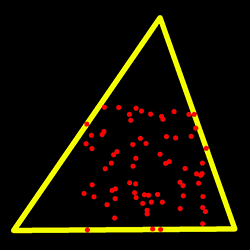
The implementation of the algorithm is based on O'Rourke's [ORourke86] and Klee and Laskowski's [KleeLaskowski85] papers. O'Rourke provides a \(\theta(n)\) algorithm for finding the minimal enclosing triangle of a 2D convex polygon with n vertices. Since the minEnclosingTriangle function takes a 2D point set as input an additional preprocessing step of computing the convex hull of the 2D point set is required. The complexity of the convexHull function is \(O(n log(n))\) which is higher than \(\theta(n)\). Thus the overall complexity of the function is \(O(n log(n))\).
- Parameters
-
points Input vector of 2D points with depth CV_32S or CV_32F, stored in std::vector<> or Mat triangle Output vector of three 2D points defining the vertices of the triangle. The depth of the OutputArray must be CV_32F.
◆ moments() [1/2]
Calculates all of the moments up to the third order of a polygon or rasterized shape.
The function computes moments, up to the 3rd order, of a vector shape or a rasterized shape. The results are returned in the structure cv::Moments.
- Parameters
-
array Single channel raster image (CV_8U, CV_16U, CV_16S, CV_32F, CV_64F) or an array ( \(1 \times N\) or \(N \times 1\) ) of 2D points (Point or Point2f). binaryImage If it is true, all non-zero image pixels are treated as 1's. The parameter is used for images only.
- Returns
- moments.
- Note
- Only applicable to contour moments calculations from Python bindings: Note that the numpy type for the input array should be either np.int32 or np.float32.
-
For contour-based moments, the zeroth-order moment
m00represents the contour area.
If the input contour is degenerate (for example, a single point or all points are collinear), the area is zero and therefore m00 == 0.
In this case, the centroid coordinates (m10/m00, m01/m00) are undefined and must be handled explicitly by the caller.
A common workaround is to compute the center using cv::boundingRect() or by averaging the input points.
- See also
- contourArea, arcLength
◆ moments() [2/2]
|
static |
Calculates all of the moments up to the third order of a polygon or rasterized shape.
The function computes moments, up to the 3rd order, of a vector shape or a rasterized shape. The results are returned in the structure cv::Moments.
- Parameters
-
array Single channel raster image (CV_8U, CV_16U, CV_16S, CV_32F, CV_64F) or an array ( \(1 \times N\) or \(N \times 1\) ) of 2D points (Point or Point2f). binaryImage If it is true, all non-zero image pixels are treated as 1's. The parameter is used for images only.
- Returns
- moments.
- Note
- Only applicable to contour moments calculations from Python bindings: Note that the numpy type for the input array should be either np.int32 or np.float32.
-
For contour-based moments, the zeroth-order moment
m00represents the contour area.
If the input contour is degenerate (for example, a single point or all points are collinear), the area is zero and therefore m00 == 0.
In this case, the centroid coordinates (m10/m00, m01/m00) are undefined and must be handled explicitly by the caller.
A common workaround is to compute the center using cv::boundingRect() or by averaging the input points.
- See also
- contourArea, arcLength
◆ momentsAsValueTuple() [1/2]
|
static |
◆ momentsAsValueTuple() [2/2]
|
static |
◆ momentsAsVec10d() [1/2]
Calculates all of the moments up to the third order of a polygon or rasterized shape.
The function computes moments, up to the 3rd order, of a vector shape or a rasterized shape. The results are returned in the structure cv::Moments.
- Parameters
-
array Single channel raster image (CV_8U, CV_16U, CV_16S, CV_32F, CV_64F) or an array ( \(1 \times N\) or \(N \times 1\) ) of 2D points (Point or Point2f). binaryImage If it is true, all non-zero image pixels are treated as 1's. The parameter is used for images only.
- Returns
- moments.
- Note
- Only applicable to contour moments calculations from Python bindings: Note that the numpy type for the input array should be either np.int32 or np.float32.
-
For contour-based moments, the zeroth-order moment
m00represents the contour area.
If the input contour is degenerate (for example, a single point or all points are collinear), the area is zero and therefore m00 == 0.
In this case, the centroid coordinates (m10/m00, m01/m00) are undefined and must be handled explicitly by the caller.
A common workaround is to compute the center using cv::boundingRect() or by averaging the input points.
- See also
- contourArea, arcLength
◆ momentsAsVec10d() [2/2]
|
static |
Calculates all of the moments up to the third order of a polygon or rasterized shape.
The function computes moments, up to the 3rd order, of a vector shape or a rasterized shape. The results are returned in the structure cv::Moments.
- Parameters
-
array Single channel raster image (CV_8U, CV_16U, CV_16S, CV_32F, CV_64F) or an array ( \(1 \times N\) or \(N \times 1\) ) of 2D points (Point or Point2f). binaryImage If it is true, all non-zero image pixels are treated as 1's. The parameter is used for images only.
- Returns
- moments.
- Note
- Only applicable to contour moments calculations from Python bindings: Note that the numpy type for the input array should be either np.int32 or np.float32.
-
For contour-based moments, the zeroth-order moment
m00represents the contour area.
If the input contour is degenerate (for example, a single point or all points are collinear), the area is zero and therefore m00 == 0.
In this case, the centroid coordinates (m10/m00, m01/m00) are undefined and must be handled explicitly by the caller.
A common workaround is to compute the center using cv::boundingRect() or by averaging the input points.
- See also
- contourArea, arcLength
◆ pointPolygonTest() [1/3]
|
static |
Performs a point-in-contour test.
The function determines whether the point is inside a contour, outside, or lies on an edge (or coincides with a vertex). It returns positive (inside), negative (outside), or zero (on an edge) value, correspondingly. When measureDist=false , the return value is +1, -1, and 0, respectively. Otherwise, the return value is a signed distance between the point and the nearest contour edge.
See below a sample output of the function where each image pixel is tested against the contour:
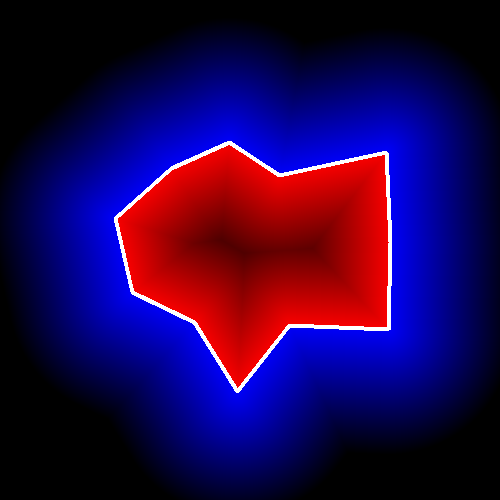
- Parameters
-
contour Input contour. pt Point tested against the contour. measureDist If true, the function estimates the signed distance from the point to the nearest contour edge. Otherwise, the function only checks if the point is inside a contour or not.
◆ pointPolygonTest() [2/3]
|
static |
Performs a point-in-contour test.
The function determines whether the point is inside a contour, outside, or lies on an edge (or coincides with a vertex). It returns positive (inside), negative (outside), or zero (on an edge) value, correspondingly. When measureDist=false , the return value is +1, -1, and 0, respectively. Otherwise, the return value is a signed distance between the point and the nearest contour edge.
See below a sample output of the function where each image pixel is tested against the contour:
- Parameters
-
contour Input contour. pt Point tested against the contour. measureDist If true, the function estimates the signed distance from the point to the nearest contour edge. Otherwise, the function only checks if the point is inside a contour or not.
◆ pointPolygonTest() [3/3]
|
static |
Performs a point-in-contour test.
The function determines whether the point is inside a contour, outside, or lies on an edge (or coincides with a vertex). It returns positive (inside), negative (outside), or zero (on an edge) value, correspondingly. When measureDist=false , the return value is +1, -1, and 0, respectively. Otherwise, the return value is a signed distance between the point and the nearest contour edge.
See below a sample output of the function where each image pixel is tested against the contour:
- Parameters
-
contour Input contour. pt Point tested against the contour. measureDist If true, the function estimates the signed distance from the point to the nearest contour edge. Otherwise, the function only checks if the point is inside a contour or not.
◆ projectPoints() [1/3]
|
static |
Projects 3D points to an image plane.
The function computes the 2D projections of 3D points to the image plane, given intrinsic and extrinsic camera parameters. Optionally, the function computes Jacobians -matrices of partial derivatives of image points coordinates (as functions of all the input parameters) with respect to the particular parameters, intrinsic and/or extrinsic. The Jacobians are used during the global optimization in calibrateCamera, solvePnP, and stereoCalibrate. The function itself can also be used to compute a re-projection error, given the current intrinsic and extrinsic parameters.
- Note
- Coordinate Systems:
- Input (
objectPoints): 3D points in the world coordinate frame. - Output (
imagePoints): 2D projections in pixel coordinates of the image plane, with distortion applied. The coordinates \((u, v)\) are measured in pixels from the top-left corner of the image.
- Input (
The transformation chain is: World coordinates → Camera coordinates (via rvec/tvec) → Normalized camera coordinates → Distortion applied → Pixel coordinates (via cameraMatrix).
- Parameters
-
objectPoints Array of object points expressed wrt. the world coordinate frame. A 3xN/Nx3 1-channel or 1xN/Nx1 3-channel (or vector<Point3f> ), where N is the number of points in the view. rvec The rotation vector (Rodrigues) that, together with tvec, performs a change of basis from world to camera coordinate system, see calibrateCamera for details. tvec The translation vector, see parameter description above. cameraMatrix Camera intrinsic matrix \(\cameramatrix{A}\) . distCoeffs Input vector of distortion coefficients \(\distcoeffs\) . If the vector is empty, the zero distortion coefficients are assumed. imagePoints Output array of image points in pixel coordinates, 1xN/Nx1 2-channel, or vector<Point2f> . jacobian Optional output 2Nx(10+<numDistCoeffs>) jacobian matrix of derivatives of image points with respect to components of the rotation vector, translation vector, focal lengths, coordinates of the principal point and the distortion coefficients. In the old interface different components of the jacobian are returned via different output parameters. aspectRatio Optional "fixed aspect ratio" parameter. If the parameter is not 0, the function assumes that the aspect ratio ( \(f_x / f_y\)) is fixed and correspondingly adjusts the jacobian matrix.
- Note
- By setting rvec = tvec = \([0, 0, 0]\), or by setting cameraMatrix to a 3x3 identity matrix, or by passing zero distortion coefficients, one can get various useful partial cases of the function. This means, one can compute the distorted coordinates for a sparse set of points or apply a perspective transformation (and also compute the derivatives) in the ideal zero-distortion setup.
◆ projectPoints() [2/3]
|
static |
Projects 3D points to an image plane.
The function computes the 2D projections of 3D points to the image plane, given intrinsic and extrinsic camera parameters. Optionally, the function computes Jacobians -matrices of partial derivatives of image points coordinates (as functions of all the input parameters) with respect to the particular parameters, intrinsic and/or extrinsic. The Jacobians are used during the global optimization in calibrateCamera, solvePnP, and stereoCalibrate. The function itself can also be used to compute a re-projection error, given the current intrinsic and extrinsic parameters.
- Note
- Coordinate Systems:
- Input (
objectPoints): 3D points in the world coordinate frame. - Output (
imagePoints): 2D projections in pixel coordinates of the image plane, with distortion applied. The coordinates \((u, v)\) are measured in pixels from the top-left corner of the image.
- Input (
The transformation chain is: World coordinates → Camera coordinates (via rvec/tvec) → Normalized camera coordinates → Distortion applied → Pixel coordinates (via cameraMatrix).
- Parameters
-
objectPoints Array of object points expressed wrt. the world coordinate frame. A 3xN/Nx3 1-channel or 1xN/Nx1 3-channel (or vector<Point3f> ), where N is the number of points in the view. rvec The rotation vector (Rodrigues) that, together with tvec, performs a change of basis from world to camera coordinate system, see calibrateCamera for details. tvec The translation vector, see parameter description above. cameraMatrix Camera intrinsic matrix \(\cameramatrix{A}\) . distCoeffs Input vector of distortion coefficients \(\distcoeffs\) . If the vector is empty, the zero distortion coefficients are assumed. imagePoints Output array of image points in pixel coordinates, 1xN/Nx1 2-channel, or vector<Point2f> . jacobian Optional output 2Nx(10+<numDistCoeffs>) jacobian matrix of derivatives of image points with respect to components of the rotation vector, translation vector, focal lengths, coordinates of the principal point and the distortion coefficients. In the old interface different components of the jacobian are returned via different output parameters. aspectRatio Optional "fixed aspect ratio" parameter. If the parameter is not 0, the function assumes that the aspect ratio ( \(f_x / f_y\)) is fixed and correspondingly adjusts the jacobian matrix.
- Note
- By setting rvec = tvec = \([0, 0, 0]\), or by setting cameraMatrix to a 3x3 identity matrix, or by passing zero distortion coefficients, one can get various useful partial cases of the function. This means, one can compute the distorted coordinates for a sparse set of points or apply a perspective transformation (and also compute the derivatives) in the ideal zero-distortion setup.
◆ projectPoints() [3/3]
|
static |
Projects 3D points to an image plane.
The function computes the 2D projections of 3D points to the image plane, given intrinsic and extrinsic camera parameters. Optionally, the function computes Jacobians -matrices of partial derivatives of image points coordinates (as functions of all the input parameters) with respect to the particular parameters, intrinsic and/or extrinsic. The Jacobians are used during the global optimization in calibrateCamera, solvePnP, and stereoCalibrate. The function itself can also be used to compute a re-projection error, given the current intrinsic and extrinsic parameters.
- Note
- Coordinate Systems:
- Input (
objectPoints): 3D points in the world coordinate frame. - Output (
imagePoints): 2D projections in pixel coordinates of the image plane, with distortion applied. The coordinates \((u, v)\) are measured in pixels from the top-left corner of the image.
- Input (
The transformation chain is: World coordinates → Camera coordinates (via rvec/tvec) → Normalized camera coordinates → Distortion applied → Pixel coordinates (via cameraMatrix).
- Parameters
-
objectPoints Array of object points expressed wrt. the world coordinate frame. A 3xN/Nx3 1-channel or 1xN/Nx1 3-channel (or vector<Point3f> ), where N is the number of points in the view. rvec The rotation vector (Rodrigues) that, together with tvec, performs a change of basis from world to camera coordinate system, see calibrateCamera for details. tvec The translation vector, see parameter description above. cameraMatrix Camera intrinsic matrix \(\cameramatrix{A}\) . distCoeffs Input vector of distortion coefficients \(\distcoeffs\) . If the vector is empty, the zero distortion coefficients are assumed. imagePoints Output array of image points in pixel coordinates, 1xN/Nx1 2-channel, or vector<Point2f> . jacobian Optional output 2Nx(10+<numDistCoeffs>) jacobian matrix of derivatives of image points with respect to components of the rotation vector, translation vector, focal lengths, coordinates of the principal point and the distortion coefficients. In the old interface different components of the jacobian are returned via different output parameters. aspectRatio Optional "fixed aspect ratio" parameter. If the parameter is not 0, the function assumes that the aspect ratio ( \(f_x / f_y\)) is fixed and correspondingly adjusts the jacobian matrix.
- Note
- By setting rvec = tvec = \([0, 0, 0]\), or by setting cameraMatrix to a 3x3 identity matrix, or by passing zero distortion coefficients, one can get various useful partial cases of the function. This means, one can compute the distorted coordinates for a sparse set of points or apply a perspective transformation (and also compute the derivatives) in the ideal zero-distortion setup.
◆ projectPointsSepJ() [1/6]
|
static |
This is an overloaded member function, provided for convenience. It differs from the above function only in what argument(s) it accepts.
◆ projectPointsSepJ() [2/6]
|
static |
This is an overloaded member function, provided for convenience. It differs from the above function only in what argument(s) it accepts.
◆ projectPointsSepJ() [3/6]
|
static |
This is an overloaded member function, provided for convenience. It differs from the above function only in what argument(s) it accepts.
◆ projectPointsSepJ() [4/6]
|
static |
This is an overloaded member function, provided for convenience. It differs from the above function only in what argument(s) it accepts.
◆ projectPointsSepJ() [5/6]
|
static |
This is an overloaded member function, provided for convenience. It differs from the above function only in what argument(s) it accepts.
◆ projectPointsSepJ() [6/6]
|
static |
This is an overloaded member function, provided for convenience. It differs from the above function only in what argument(s) it accepts.
◆ recoverPose() [1/18]
|
static |
Recovers the relative camera rotation and the translation from an estimated essential matrix and the corresponding points in two images, using chirality check. Returns the number of inliers that pass the check.
- Parameters
-
E The input essential matrix. points1 Array of N 2D points from the first image. The point coordinates should be floating-point (single or double precision). points2 Array of the second image points of the same size and format as points1 . cameraMatrix Camera intrinsic matrix \(\cameramatrix{A}\) . Note that this function assumes that points1 and points2 are feature points from cameras with the same camera intrinsic matrix. R Output rotation matrix. Together with the translation vector, this matrix makes up a tuple that performs a change of basis from the first camera's coordinate system to the second camera's coordinate system. Note that, in general, t can not be used for this tuple, see the parameter described below. t Output translation vector. This vector is obtained by decomposeEssentialMat and therefore is only known up to scale, i.e. t is the direction of the translation vector and has unit length. mask Input/output mask for inliers in points1 and points2. If it is not empty, then it marks inliers in points1 and points2 for the given essential matrix E. Only these inliers will be used to recover pose. In the output mask only inliers which pass the chirality check.
This function decomposes an essential matrix using decomposeEssentialMat and then verifies possible pose hypotheses by doing chirality check. The chirality check means that the triangulated 3D points should have positive depth. Some details can be found in [Nister03].
This function can be used to process the output E and mask from findEssentialMat. In this scenario, points1 and points2 are the same input for findEssentialMat :
◆ recoverPose() [2/18]
|
static |
This is an overloaded member function, provided for convenience. It differs from the above function only in what argument(s) it accepts.
- Parameters
-
E The input essential matrix. points1 Array of N 2D points from the first image. The point coordinates should be floating-point (single or double precision). points2 Array of the second image points of the same size and format as points1. cameraMatrix Camera intrinsic matrix \(\cameramatrix{A}\) . Note that this function assumes that points1 and points2 are feature points from cameras with the same camera intrinsic matrix. R Output rotation matrix. Together with the translation vector, this matrix makes up a tuple that performs a change of basis from the first camera's coordinate system to the second camera's coordinate system. Note that, in general, t can not be used for this tuple, see the parameter description below. t Output translation vector. This vector is obtained by decomposeEssentialMat and therefore is only known up to scale, i.e. t is the direction of the translation vector and has unit length. distanceThresh threshold distance which is used to filter out far away points (i.e. infinite points). mask Input/output mask for inliers in points1 and points2. If it is not empty, then it marks inliers in points1 and points2 for the given essential matrix E. Only these inliers will be used to recover pose. In the output mask only inliers which pass the chirality check. triangulatedPoints 3D points which were reconstructed by triangulation.
This function differs from the one above that it outputs the triangulated 3D point that are used for the chirality check.
◆ recoverPose() [3/18]
|
static |
This is an overloaded member function, provided for convenience. It differs from the above function only in what argument(s) it accepts.
- Parameters
-
E The input essential matrix. points1 Array of N 2D points from the first image. The point coordinates should be floating-point (single or double precision). points2 Array of the second image points of the same size and format as points1. cameraMatrix Camera intrinsic matrix \(\cameramatrix{A}\) . Note that this function assumes that points1 and points2 are feature points from cameras with the same camera intrinsic matrix. R Output rotation matrix. Together with the translation vector, this matrix makes up a tuple that performs a change of basis from the first camera's coordinate system to the second camera's coordinate system. Note that, in general, t can not be used for this tuple, see the parameter description below. t Output translation vector. This vector is obtained by decomposeEssentialMat and therefore is only known up to scale, i.e. t is the direction of the translation vector and has unit length. distanceThresh threshold distance which is used to filter out far away points (i.e. infinite points). mask Input/output mask for inliers in points1 and points2. If it is not empty, then it marks inliers in points1 and points2 for the given essential matrix E. Only these inliers will be used to recover pose. In the output mask only inliers which pass the chirality check. triangulatedPoints 3D points which were reconstructed by triangulation.
This function differs from the one above that it outputs the triangulated 3D point that are used for the chirality check.
◆ recoverPose() [4/18]
|
static |
This is an overloaded member function, provided for convenience. It differs from the above function only in what argument(s) it accepts.
- Parameters
-
E The input essential matrix. points1 Array of N 2D points from the first image. The point coordinates should be floating-point (single or double precision). points2 Array of the second image points of the same size and format as points1. cameraMatrix Camera intrinsic matrix \(\cameramatrix{A}\) . Note that this function assumes that points1 and points2 are feature points from cameras with the same camera intrinsic matrix. R Output rotation matrix. Together with the translation vector, this matrix makes up a tuple that performs a change of basis from the first camera's coordinate system to the second camera's coordinate system. Note that, in general, t can not be used for this tuple, see the parameter description below. t Output translation vector. This vector is obtained by decomposeEssentialMat and therefore is only known up to scale, i.e. t is the direction of the translation vector and has unit length. distanceThresh threshold distance which is used to filter out far away points (i.e. infinite points). mask Input/output mask for inliers in points1 and points2. If it is not empty, then it marks inliers in points1 and points2 for the given essential matrix E. Only these inliers will be used to recover pose. In the output mask only inliers which pass the chirality check. triangulatedPoints 3D points which were reconstructed by triangulation.
This function differs from the one above that it outputs the triangulated 3D point that are used for the chirality check.
◆ recoverPose() [5/18]
|
static |
Recovers the relative camera rotation and the translation from an estimated essential matrix and the corresponding points in two images, using chirality check. Returns the number of inliers that pass the check.
- Parameters
-
E The input essential matrix. points1 Array of N 2D points from the first image. The point coordinates should be floating-point (single or double precision). points2 Array of the second image points of the same size and format as points1 . cameraMatrix Camera intrinsic matrix \(\cameramatrix{A}\) . Note that this function assumes that points1 and points2 are feature points from cameras with the same camera intrinsic matrix. R Output rotation matrix. Together with the translation vector, this matrix makes up a tuple that performs a change of basis from the first camera's coordinate system to the second camera's coordinate system. Note that, in general, t can not be used for this tuple, see the parameter described below. t Output translation vector. This vector is obtained by decomposeEssentialMat and therefore is only known up to scale, i.e. t is the direction of the translation vector and has unit length. mask Input/output mask for inliers in points1 and points2. If it is not empty, then it marks inliers in points1 and points2 for the given essential matrix E. Only these inliers will be used to recover pose. In the output mask only inliers which pass the chirality check.
This function decomposes an essential matrix using decomposeEssentialMat and then verifies possible pose hypotheses by doing chirality check. The chirality check means that the triangulated 3D points should have positive depth. Some details can be found in [Nister03].
This function can be used to process the output E and mask from findEssentialMat. In this scenario, points1 and points2 are the same input for findEssentialMat :
◆ recoverPose() [6/18]
|
static |
This is an overloaded member function, provided for convenience. It differs from the above function only in what argument(s) it accepts.
- Parameters
-
E The input essential matrix. points1 Array of N 2D points from the first image. The point coordinates should be floating-point (single or double precision). points2 Array of the second image points of the same size and format as points1 . R Output rotation matrix. Together with the translation vector, this matrix makes up a tuple that performs a change of basis from the first camera's coordinate system to the second camera's coordinate system. Note that, in general, t can not be used for this tuple, see the parameter description below. t Output translation vector. This vector is obtained by decomposeEssentialMat and therefore is only known up to scale, i.e. t is the direction of the translation vector and has unit length. focal Focal length of the camera. Note that this function assumes that points1 and points2 are feature points from cameras with same focal length and principal point. pp principal point of the camera. mask Input/output mask for inliers in points1 and points2. If it is not empty, then it marks inliers in points1 and points2 for the given essential matrix E. Only these inliers will be used to recover pose. In the output mask only inliers which pass the chirality check.
This function differs from the one above that it computes camera intrinsic matrix from focal length and principal point:
\[A = \begin{bmatrix} f & 0 & x_{pp} \\ 0 & f & y_{pp} \\ 0 & 0 & 1 \end{bmatrix}\]
◆ recoverPose() [7/18]
|
static |
This is an overloaded member function, provided for convenience. It differs from the above function only in what argument(s) it accepts.
- Parameters
-
E The input essential matrix. points1 Array of N 2D points from the first image. The point coordinates should be floating-point (single or double precision). points2 Array of the second image points of the same size and format as points1 . R Output rotation matrix. Together with the translation vector, this matrix makes up a tuple that performs a change of basis from the first camera's coordinate system to the second camera's coordinate system. Note that, in general, t can not be used for this tuple, see the parameter description below. t Output translation vector. This vector is obtained by decomposeEssentialMat and therefore is only known up to scale, i.e. t is the direction of the translation vector and has unit length. focal Focal length of the camera. Note that this function assumes that points1 and points2 are feature points from cameras with same focal length and principal point. pp principal point of the camera. mask Input/output mask for inliers in points1 and points2. If it is not empty, then it marks inliers in points1 and points2 for the given essential matrix E. Only these inliers will be used to recover pose. In the output mask only inliers which pass the chirality check.
This function differs from the one above that it computes camera intrinsic matrix from focal length and principal point:
\[A = \begin{bmatrix} f & 0 & x_{pp} \\ 0 & f & y_{pp} \\ 0 & 0 & 1 \end{bmatrix}\]
◆ recoverPose() [8/18]
|
static |
This is an overloaded member function, provided for convenience. It differs from the above function only in what argument(s) it accepts.
- Parameters
-
E The input essential matrix. points1 Array of N 2D points from the first image. The point coordinates should be floating-point (single or double precision). points2 Array of the second image points of the same size and format as points1 . R Output rotation matrix. Together with the translation vector, this matrix makes up a tuple that performs a change of basis from the first camera's coordinate system to the second camera's coordinate system. Note that, in general, t can not be used for this tuple, see the parameter description below. t Output translation vector. This vector is obtained by decomposeEssentialMat and therefore is only known up to scale, i.e. t is the direction of the translation vector and has unit length. focal Focal length of the camera. Note that this function assumes that points1 and points2 are feature points from cameras with same focal length and principal point. pp principal point of the camera. mask Input/output mask for inliers in points1 and points2. If it is not empty, then it marks inliers in points1 and points2 for the given essential matrix E. Only these inliers will be used to recover pose. In the output mask only inliers which pass the chirality check.
This function differs from the one above that it computes camera intrinsic matrix from focal length and principal point:
\[A = \begin{bmatrix} f & 0 & x_{pp} \\ 0 & f & y_{pp} \\ 0 & 0 & 1 \end{bmatrix}\]
◆ recoverPose() [9/18]
|
static |
This is an overloaded member function, provided for convenience. It differs from the above function only in what argument(s) it accepts.
- Parameters
-
E The input essential matrix. points1 Array of N 2D points from the first image. The point coordinates should be floating-point (single or double precision). points2 Array of the second image points of the same size and format as points1 . R Output rotation matrix. Together with the translation vector, this matrix makes up a tuple that performs a change of basis from the first camera's coordinate system to the second camera's coordinate system. Note that, in general, t can not be used for this tuple, see the parameter description below. t Output translation vector. This vector is obtained by decomposeEssentialMat and therefore is only known up to scale, i.e. t is the direction of the translation vector and has unit length. focal Focal length of the camera. Note that this function assumes that points1 and points2 are feature points from cameras with same focal length and principal point. pp principal point of the camera. mask Input/output mask for inliers in points1 and points2. If it is not empty, then it marks inliers in points1 and points2 for the given essential matrix E. Only these inliers will be used to recover pose. In the output mask only inliers which pass the chirality check.
This function differs from the one above that it computes camera intrinsic matrix from focal length and principal point:
\[A = \begin{bmatrix} f & 0 & x_{pp} \\ 0 & f & y_{pp} \\ 0 & 0 & 1 \end{bmatrix}\]
◆ recoverPose() [10/18]
|
static |
This is an overloaded member function, provided for convenience. It differs from the above function only in what argument(s) it accepts.
- Parameters
-
E The input essential matrix. points1 Array of N 2D points from the first image. The point coordinates should be floating-point (single or double precision). points2 Array of the second image points of the same size and format as points1 . R Output rotation matrix. Together with the translation vector, this matrix makes up a tuple that performs a change of basis from the first camera's coordinate system to the second camera's coordinate system. Note that, in general, t can not be used for this tuple, see the parameter description below. t Output translation vector. This vector is obtained by decomposeEssentialMat and therefore is only known up to scale, i.e. t is the direction of the translation vector and has unit length. focal Focal length of the camera. Note that this function assumes that points1 and points2 are feature points from cameras with same focal length and principal point. pp principal point of the camera. mask Input/output mask for inliers in points1 and points2. If it is not empty, then it marks inliers in points1 and points2 for the given essential matrix E. Only these inliers will be used to recover pose. In the output mask only inliers which pass the chirality check.
This function differs from the one above that it computes camera intrinsic matrix from focal length and principal point:
\[A = \begin{bmatrix} f & 0 & x_{pp} \\ 0 & f & y_{pp} \\ 0 & 0 & 1 \end{bmatrix}\]
◆ recoverPose() [11/18]
|
static |
This is an overloaded member function, provided for convenience. It differs from the above function only in what argument(s) it accepts.
- Parameters
-
E The input essential matrix. points1 Array of N 2D points from the first image. The point coordinates should be floating-point (single or double precision). points2 Array of the second image points of the same size and format as points1 . R Output rotation matrix. Together with the translation vector, this matrix makes up a tuple that performs a change of basis from the first camera's coordinate system to the second camera's coordinate system. Note that, in general, t can not be used for this tuple, see the parameter description below. t Output translation vector. This vector is obtained by decomposeEssentialMat and therefore is only known up to scale, i.e. t is the direction of the translation vector and has unit length. focal Focal length of the camera. Note that this function assumes that points1 and points2 are feature points from cameras with same focal length and principal point. pp principal point of the camera. mask Input/output mask for inliers in points1 and points2. If it is not empty, then it marks inliers in points1 and points2 for the given essential matrix E. Only these inliers will be used to recover pose. In the output mask only inliers which pass the chirality check.
This function differs from the one above that it computes camera intrinsic matrix from focal length and principal point:
\[A = \begin{bmatrix} f & 0 & x_{pp} \\ 0 & f & y_{pp} \\ 0 & 0 & 1 \end{bmatrix}\]
◆ recoverPose() [12/18]
|
static |
This is an overloaded member function, provided for convenience. It differs from the above function only in what argument(s) it accepts.
- Parameters
-
E The input essential matrix. points1 Array of N 2D points from the first image. The point coordinates should be floating-point (single or double precision). points2 Array of the second image points of the same size and format as points1 . R Output rotation matrix. Together with the translation vector, this matrix makes up a tuple that performs a change of basis from the first camera's coordinate system to the second camera's coordinate system. Note that, in general, t can not be used for this tuple, see the parameter description below. t Output translation vector. This vector is obtained by decomposeEssentialMat and therefore is only known up to scale, i.e. t is the direction of the translation vector and has unit length. focal Focal length of the camera. Note that this function assumes that points1 and points2 are feature points from cameras with same focal length and principal point. pp principal point of the camera. mask Input/output mask for inliers in points1 and points2. If it is not empty, then it marks inliers in points1 and points2 for the given essential matrix E. Only these inliers will be used to recover pose. In the output mask only inliers which pass the chirality check.
This function differs from the one above that it computes camera intrinsic matrix from focal length and principal point:
\[A = \begin{bmatrix} f & 0 & x_{pp} \\ 0 & f & y_{pp} \\ 0 & 0 & 1 \end{bmatrix}\]
◆ recoverPose() [13/18]
|
static |
This is an overloaded member function, provided for convenience. It differs from the above function only in what argument(s) it accepts.
- Parameters
-
E The input essential matrix. points1 Array of N 2D points from the first image. The point coordinates should be floating-point (single or double precision). points2 Array of the second image points of the same size and format as points1 . R Output rotation matrix. Together with the translation vector, this matrix makes up a tuple that performs a change of basis from the first camera's coordinate system to the second camera's coordinate system. Note that, in general, t can not be used for this tuple, see the parameter description below. t Output translation vector. This vector is obtained by decomposeEssentialMat and therefore is only known up to scale, i.e. t is the direction of the translation vector and has unit length. focal Focal length of the camera. Note that this function assumes that points1 and points2 are feature points from cameras with same focal length and principal point. pp principal point of the camera. mask Input/output mask for inliers in points1 and points2. If it is not empty, then it marks inliers in points1 and points2 for the given essential matrix E. Only these inliers will be used to recover pose. In the output mask only inliers which pass the chirality check.
This function differs from the one above that it computes camera intrinsic matrix from focal length and principal point:
\[A = \begin{bmatrix} f & 0 & x_{pp} \\ 0 & f & y_{pp} \\ 0 & 0 & 1 \end{bmatrix}\]
◆ recoverPose() [14/18]
|
static |
Recovers the relative camera rotation and the translation from corresponding points in two images from two different cameras, using chirality check. Returns the number of inliers that pass the check.
- Parameters
-
points1 Array of N 2D points from the first image. The point coordinates should be floating-point (single or double precision). points2 Array of the second image points of the same size and format as points1 . cameraMatrix1 Input/output camera matrix for the first camera, the same as in calibrateCamera. Furthermore, for the stereo case, additional flags may be used, see below. distCoeffs1 Input/output vector of distortion coefficients, the same as in calibrateCamera. cameraMatrix2 Input/output camera matrix for the first camera, the same as in calibrateCamera. Furthermore, for the stereo case, additional flags may be used, see below. distCoeffs2 Input/output vector of distortion coefficients, the same as in calibrateCamera. E The output essential matrix. R Output rotation matrix. Together with the translation vector, this matrix makes up a tuple that performs a change of basis from the first camera's coordinate system to the second camera's coordinate system. Note that, in general, t can not be used for this tuple, see the parameter described below. t Output translation vector. This vector is obtained by decomposeEssentialMat and therefore is only known up to scale, i.e. t is the direction of the translation vector and has unit length. method Method for computing an essential matrix. prob Parameter used for the RANSAC or LMedS methods only. It specifies a desirable level of confidence (probability) that the estimated matrix is correct. threshold Parameter used for RANSAC. It is the maximum distance from a point to an epipolar line in pixels, beyond which the point is considered an outlier and is not used for computing the final fundamental matrix. It can be set to something like 1-3, depending on the accuracy of the point localization, image resolution, and the image noise. mask Input/output mask for inliers in points1 and points2. If it is not empty, then it marks inliers in points1 and points2 for the given essential matrix E. Only these inliers will be used to recover pose. In the output mask only inliers which pass the chirality check.
This function decomposes an essential matrix using decomposeEssentialMat and then verifies possible pose hypotheses by doing chirality check. The chirality check means that the triangulated 3D points should have positive depth. Some details can be found in [Nister03].
This function can be used to process the output E and mask from findEssentialMat. In this scenario, points1 and points2 are the same input for findEssentialMat.:
◆ recoverPose() [15/18]
|
static |
Recovers the relative camera rotation and the translation from corresponding points in two images from two different cameras, using chirality check. Returns the number of inliers that pass the check.
- Parameters
-
points1 Array of N 2D points from the first image. The point coordinates should be floating-point (single or double precision). points2 Array of the second image points of the same size and format as points1 . cameraMatrix1 Input/output camera matrix for the first camera, the same as in calibrateCamera. Furthermore, for the stereo case, additional flags may be used, see below. distCoeffs1 Input/output vector of distortion coefficients, the same as in calibrateCamera. cameraMatrix2 Input/output camera matrix for the first camera, the same as in calibrateCamera. Furthermore, for the stereo case, additional flags may be used, see below. distCoeffs2 Input/output vector of distortion coefficients, the same as in calibrateCamera. E The output essential matrix. R Output rotation matrix. Together with the translation vector, this matrix makes up a tuple that performs a change of basis from the first camera's coordinate system to the second camera's coordinate system. Note that, in general, t can not be used for this tuple, see the parameter described below. t Output translation vector. This vector is obtained by decomposeEssentialMat and therefore is only known up to scale, i.e. t is the direction of the translation vector and has unit length. method Method for computing an essential matrix. prob Parameter used for the RANSAC or LMedS methods only. It specifies a desirable level of confidence (probability) that the estimated matrix is correct. threshold Parameter used for RANSAC. It is the maximum distance from a point to an epipolar line in pixels, beyond which the point is considered an outlier and is not used for computing the final fundamental matrix. It can be set to something like 1-3, depending on the accuracy of the point localization, image resolution, and the image noise. mask Input/output mask for inliers in points1 and points2. If it is not empty, then it marks inliers in points1 and points2 for the given essential matrix E. Only these inliers will be used to recover pose. In the output mask only inliers which pass the chirality check.
This function decomposes an essential matrix using decomposeEssentialMat and then verifies possible pose hypotheses by doing chirality check. The chirality check means that the triangulated 3D points should have positive depth. Some details can be found in [Nister03].
This function can be used to process the output E and mask from findEssentialMat. In this scenario, points1 and points2 are the same input for findEssentialMat.:
◆ recoverPose() [16/18]
|
static |
Recovers the relative camera rotation and the translation from corresponding points in two images from two different cameras, using chirality check. Returns the number of inliers that pass the check.
- Parameters
-
points1 Array of N 2D points from the first image. The point coordinates should be floating-point (single or double precision). points2 Array of the second image points of the same size and format as points1 . cameraMatrix1 Input/output camera matrix for the first camera, the same as in calibrateCamera. Furthermore, for the stereo case, additional flags may be used, see below. distCoeffs1 Input/output vector of distortion coefficients, the same as in calibrateCamera. cameraMatrix2 Input/output camera matrix for the first camera, the same as in calibrateCamera. Furthermore, for the stereo case, additional flags may be used, see below. distCoeffs2 Input/output vector of distortion coefficients, the same as in calibrateCamera. E The output essential matrix. R Output rotation matrix. Together with the translation vector, this matrix makes up a tuple that performs a change of basis from the first camera's coordinate system to the second camera's coordinate system. Note that, in general, t can not be used for this tuple, see the parameter described below. t Output translation vector. This vector is obtained by decomposeEssentialMat and therefore is only known up to scale, i.e. t is the direction of the translation vector and has unit length. method Method for computing an essential matrix. prob Parameter used for the RANSAC or LMedS methods only. It specifies a desirable level of confidence (probability) that the estimated matrix is correct. threshold Parameter used for RANSAC. It is the maximum distance from a point to an epipolar line in pixels, beyond which the point is considered an outlier and is not used for computing the final fundamental matrix. It can be set to something like 1-3, depending on the accuracy of the point localization, image resolution, and the image noise. mask Input/output mask for inliers in points1 and points2. If it is not empty, then it marks inliers in points1 and points2 for the given essential matrix E. Only these inliers will be used to recover pose. In the output mask only inliers which pass the chirality check.
This function decomposes an essential matrix using decomposeEssentialMat and then verifies possible pose hypotheses by doing chirality check. The chirality check means that the triangulated 3D points should have positive depth. Some details can be found in [Nister03].
This function can be used to process the output E and mask from findEssentialMat. In this scenario, points1 and points2 are the same input for findEssentialMat.:
◆ recoverPose() [17/18]
|
static |
Recovers the relative camera rotation and the translation from corresponding points in two images from two different cameras, using chirality check. Returns the number of inliers that pass the check.
- Parameters
-
points1 Array of N 2D points from the first image. The point coordinates should be floating-point (single or double precision). points2 Array of the second image points of the same size and format as points1 . cameraMatrix1 Input/output camera matrix for the first camera, the same as in calibrateCamera. Furthermore, for the stereo case, additional flags may be used, see below. distCoeffs1 Input/output vector of distortion coefficients, the same as in calibrateCamera. cameraMatrix2 Input/output camera matrix for the first camera, the same as in calibrateCamera. Furthermore, for the stereo case, additional flags may be used, see below. distCoeffs2 Input/output vector of distortion coefficients, the same as in calibrateCamera. E The output essential matrix. R Output rotation matrix. Together with the translation vector, this matrix makes up a tuple that performs a change of basis from the first camera's coordinate system to the second camera's coordinate system. Note that, in general, t can not be used for this tuple, see the parameter described below. t Output translation vector. This vector is obtained by decomposeEssentialMat and therefore is only known up to scale, i.e. t is the direction of the translation vector and has unit length. method Method for computing an essential matrix. prob Parameter used for the RANSAC or LMedS methods only. It specifies a desirable level of confidence (probability) that the estimated matrix is correct. threshold Parameter used for RANSAC. It is the maximum distance from a point to an epipolar line in pixels, beyond which the point is considered an outlier and is not used for computing the final fundamental matrix. It can be set to something like 1-3, depending on the accuracy of the point localization, image resolution, and the image noise. mask Input/output mask for inliers in points1 and points2. If it is not empty, then it marks inliers in points1 and points2 for the given essential matrix E. Only these inliers will be used to recover pose. In the output mask only inliers which pass the chirality check.
This function decomposes an essential matrix using decomposeEssentialMat and then verifies possible pose hypotheses by doing chirality check. The chirality check means that the triangulated 3D points should have positive depth. Some details can be found in [Nister03].
This function can be used to process the output E and mask from findEssentialMat. In this scenario, points1 and points2 are the same input for findEssentialMat.:
◆ recoverPose() [18/18]
|
static |
Recovers the relative camera rotation and the translation from corresponding points in two images from two different cameras, using chirality check. Returns the number of inliers that pass the check.
- Parameters
-
points1 Array of N 2D points from the first image. The point coordinates should be floating-point (single or double precision). points2 Array of the second image points of the same size and format as points1 . cameraMatrix1 Input/output camera matrix for the first camera, the same as in calibrateCamera. Furthermore, for the stereo case, additional flags may be used, see below. distCoeffs1 Input/output vector of distortion coefficients, the same as in calibrateCamera. cameraMatrix2 Input/output camera matrix for the first camera, the same as in calibrateCamera. Furthermore, for the stereo case, additional flags may be used, see below. distCoeffs2 Input/output vector of distortion coefficients, the same as in calibrateCamera. E The output essential matrix. R Output rotation matrix. Together with the translation vector, this matrix makes up a tuple that performs a change of basis from the first camera's coordinate system to the second camera's coordinate system. Note that, in general, t can not be used for this tuple, see the parameter described below. t Output translation vector. This vector is obtained by decomposeEssentialMat and therefore is only known up to scale, i.e. t is the direction of the translation vector and has unit length. method Method for computing an essential matrix. prob Parameter used for the RANSAC or LMedS methods only. It specifies a desirable level of confidence (probability) that the estimated matrix is correct. threshold Parameter used for RANSAC. It is the maximum distance from a point to an epipolar line in pixels, beyond which the point is considered an outlier and is not used for computing the final fundamental matrix. It can be set to something like 1-3, depending on the accuracy of the point localization, image resolution, and the image noise. mask Input/output mask for inliers in points1 and points2. If it is not empty, then it marks inliers in points1 and points2 for the given essential matrix E. Only these inliers will be used to recover pose. In the output mask only inliers which pass the chirality check.
This function decomposes an essential matrix using decomposeEssentialMat and then verifies possible pose hypotheses by doing chirality check. The chirality check means that the triangulated 3D points should have positive depth. Some details can be found in [Nister03].
This function can be used to process the output E and mask from findEssentialMat. In this scenario, points1 and points2 are the same input for findEssentialMat.:
◆ Rodrigues() [1/2]
Converts a rotation matrix to a rotation vector or vice versa.
- Parameters
-
src Input rotation vector (3x1 or 1x3) or rotation matrix (3x3). dst Output rotation matrix (3x3) or rotation vector (3x1 or 1x3), respectively. jacobian Optional output Jacobian matrix, 3x9 or 9x3, which is a matrix of partial derivatives of the output array components with respect to the input array components.
\[\begin{array}{l} \theta \leftarrow norm(r) \\ r \leftarrow r/ \theta \\ R = \cos(\theta) I + (1- \cos{\theta} ) r r^T + \sin(\theta) \vecthreethree{0}{-r_z}{r_y}{r_z}{0}{-r_x}{-r_y}{r_x}{0} \end{array}\]
Inverse transformation can be also done easily, since
\[\sin ( \theta ) \vecthreethree{0}{-r_z}{r_y}{r_z}{0}{-r_x}{-r_y}{r_x}{0} = \frac{R - R^T}{2}\]
A rotation vector is a convenient and most compact representation of a rotation matrix (since any rotation matrix has just 3 degrees of freedom). The representation is used in the global 3D geometry optimization procedures like calibrateCamera, stereoCalibrate, or solvePnP .
- Note
- More information about the computation of the derivative of a 3D rotation matrix with respect to its exponential coordinate can be found in:
- A Compact Formula for the Derivative of a 3-D Rotation in Exponential Coordinates, Guillermo Gallego, Anthony J. Yezzi [Gallego2014ACF]
-
Useful information on SE(3) and Lie Groups can be found in:
- A tutorial on SE(3) transformation parameterizations and on-manifold optimization, Jose-Luis Blanco [blanco2010tutorial]
- Lie Groups for 2D and 3D Transformation, Ethan Eade [Eade17]
- A micro Lie theory for state estimation in robotics, Joan Solà, Jérémie Deray, Dinesh Atchuthan [Sol2018AML]
◆ Rodrigues() [2/2]
|
static |
Converts a rotation matrix to a rotation vector or vice versa.
- Parameters
-
src Input rotation vector (3x1 or 1x3) or rotation matrix (3x3). dst Output rotation matrix (3x3) or rotation vector (3x1 or 1x3), respectively. jacobian Optional output Jacobian matrix, 3x9 or 9x3, which is a matrix of partial derivatives of the output array components with respect to the input array components.
\[\begin{array}{l} \theta \leftarrow norm(r) \\ r \leftarrow r/ \theta \\ R = \cos(\theta) I + (1- \cos{\theta} ) r r^T + \sin(\theta) \vecthreethree{0}{-r_z}{r_y}{r_z}{0}{-r_x}{-r_y}{r_x}{0} \end{array}\]
Inverse transformation can be also done easily, since
\[\sin ( \theta ) \vecthreethree{0}{-r_z}{r_y}{r_z}{0}{-r_x}{-r_y}{r_x}{0} = \frac{R - R^T}{2}\]
A rotation vector is a convenient and most compact representation of a rotation matrix (since any rotation matrix has just 3 degrees of freedom). The representation is used in the global 3D geometry optimization procedures like calibrateCamera, stereoCalibrate, or solvePnP .
- Note
- More information about the computation of the derivative of a 3D rotation matrix with respect to its exponential coordinate can be found in:
- A Compact Formula for the Derivative of a 3-D Rotation in Exponential Coordinates, Guillermo Gallego, Anthony J. Yezzi [Gallego2014ACF]
-
Useful information on SE(3) and Lie Groups can be found in:
- A tutorial on SE(3) transformation parameterizations and on-manifold optimization, Jose-Luis Blanco [blanco2010tutorial]
- Lie Groups for 2D and 3D Transformation, Ethan Eade [Eade17]
- A micro Lie theory for state estimation in robotics, Joan Solà, Jérémie Deray, Dinesh Atchuthan [Sol2018AML]
◆ rotatedRectangleIntersection() [1/3]
|
static |
Finds out if there is any intersection between two rotated rectangles.
If there is then the vertices of the intersecting region are returned as well.
Below are some examples of intersection configurations. The hatched pattern indicates the intersecting region and the red vertices are returned by the function.
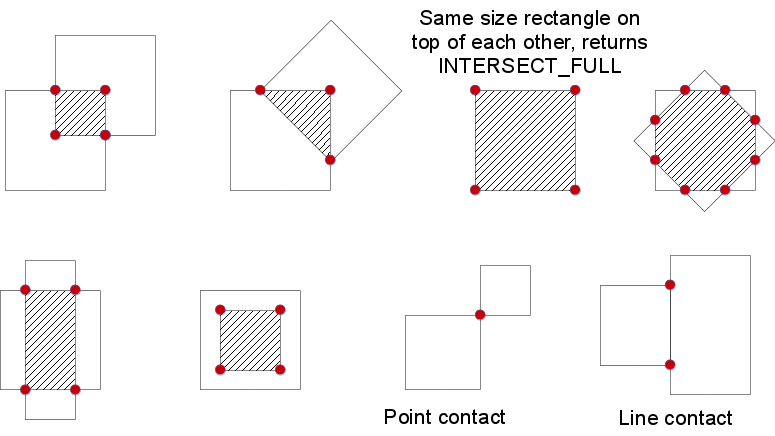
- Parameters
-
rect1 First rectangle rect2 Second rectangle intersectingRegion The output array of the vertices of the intersecting region. It returns at most 8 vertices. Stored as std::vector<cv::Point2f> or cv::Mat as Mx1 of type CV_32FC2.
- Returns
- One of #RectanglesIntersectTypes
◆ rotatedRectangleIntersection() [2/3]
|
static |
Finds out if there is any intersection between two rotated rectangles.
If there is then the vertices of the intersecting region are returned as well.
Below are some examples of intersection configurations. The hatched pattern indicates the intersecting region and the red vertices are returned by the function.
- Parameters
-
rect1 First rectangle rect2 Second rectangle intersectingRegion The output array of the vertices of the intersecting region. It returns at most 8 vertices. Stored as std::vector<cv::Point2f> or cv::Mat as Mx1 of type CV_32FC2.
- Returns
- One of #RectanglesIntersectTypes
◆ rotatedRectangleIntersection() [3/3]
|
static |
Finds out if there is any intersection between two rotated rectangles.
If there is then the vertices of the intersecting region are returned as well.
Below are some examples of intersection configurations. The hatched pattern indicates the intersecting region and the red vertices are returned by the function.
- Parameters
-
rect1 First rectangle rect2 Second rectangle intersectingRegion The output array of the vertices of the intersecting region. It returns at most 8 vertices. Stored as std::vector<cv::Point2f> or cv::Mat as Mx1 of type CV_32FC2.
- Returns
- One of #RectanglesIntersectTypes
◆ RQDecomp3x3() [1/4]
|
static |
Computes an RQ decomposition of 3x3 matrices.
- Parameters
-
src 3x3 input matrix. mtxR Output 3x3 upper-triangular matrix. mtxQ Output 3x3 orthogonal matrix. Qx Optional output 3x3 rotation matrix around x-axis. Qy Optional output 3x3 rotation matrix around y-axis. Qz Optional output 3x3 rotation matrix around z-axis.
The function computes a RQ decomposition using the given rotations. This function is used in decomposeProjectionMatrix to decompose the left 3x3 submatrix of a projection matrix into a camera and a rotation matrix.
It optionally returns three rotation matrices, one for each axis, and the three Euler angles in degrees (as the return value) that could be used in OpenGL. Note, there is always more than one sequence of rotations about the three principal axes that results in the same orientation of an object, e.g. see [Slabaugh] . Returned three rotation matrices and corresponding three Euler angles are only one of the possible solutions.
◆ RQDecomp3x3() [2/4]
|
static |
Computes an RQ decomposition of 3x3 matrices.
- Parameters
-
src 3x3 input matrix. mtxR Output 3x3 upper-triangular matrix. mtxQ Output 3x3 orthogonal matrix. Qx Optional output 3x3 rotation matrix around x-axis. Qy Optional output 3x3 rotation matrix around y-axis. Qz Optional output 3x3 rotation matrix around z-axis.
The function computes a RQ decomposition using the given rotations. This function is used in decomposeProjectionMatrix to decompose the left 3x3 submatrix of a projection matrix into a camera and a rotation matrix.
It optionally returns three rotation matrices, one for each axis, and the three Euler angles in degrees (as the return value) that could be used in OpenGL. Note, there is always more than one sequence of rotations about the three principal axes that results in the same orientation of an object, e.g. see [Slabaugh] . Returned three rotation matrices and corresponding three Euler angles are only one of the possible solutions.
◆ RQDecomp3x3() [3/4]
|
static |
Computes an RQ decomposition of 3x3 matrices.
- Parameters
-
src 3x3 input matrix. mtxR Output 3x3 upper-triangular matrix. mtxQ Output 3x3 orthogonal matrix. Qx Optional output 3x3 rotation matrix around x-axis. Qy Optional output 3x3 rotation matrix around y-axis. Qz Optional output 3x3 rotation matrix around z-axis.
The function computes a RQ decomposition using the given rotations. This function is used in decomposeProjectionMatrix to decompose the left 3x3 submatrix of a projection matrix into a camera and a rotation matrix.
It optionally returns three rotation matrices, one for each axis, and the three Euler angles in degrees (as the return value) that could be used in OpenGL. Note, there is always more than one sequence of rotations about the three principal axes that results in the same orientation of an object, e.g. see [Slabaugh] . Returned three rotation matrices and corresponding three Euler angles are only one of the possible solutions.
◆ RQDecomp3x3() [4/4]
|
static |
Computes an RQ decomposition of 3x3 matrices.
- Parameters
-
src 3x3 input matrix. mtxR Output 3x3 upper-triangular matrix. mtxQ Output 3x3 orthogonal matrix. Qx Optional output 3x3 rotation matrix around x-axis. Qy Optional output 3x3 rotation matrix around y-axis. Qz Optional output 3x3 rotation matrix around z-axis.
The function computes a RQ decomposition using the given rotations. This function is used in decomposeProjectionMatrix to decompose the left 3x3 submatrix of a projection matrix into a camera and a rotation matrix.
It optionally returns three rotation matrices, one for each axis, and the three Euler angles in degrees (as the return value) that could be used in OpenGL. Note, there is always more than one sequence of rotations about the three principal axes that results in the same orientation of an object, e.g. see [Slabaugh] . Returned three rotation matrices and corresponding three Euler angles are only one of the possible solutions.
◆ sampsonDistance()
|
static |
Calculates the Sampson Distance between two points.
The function cv::sampsonDistance calculates and returns the first order approximation of the geometric error as:
\[ sd( \texttt{pt1} , \texttt{pt2} )= \frac{(\texttt{pt2}^t \cdot \texttt{F} \cdot \texttt{pt1})^2} {((\texttt{F} \cdot \texttt{pt1})(0))^2 + ((\texttt{F} \cdot \texttt{pt1})(1))^2 + ((\texttt{F}^t \cdot \texttt{pt2})(0))^2 + ((\texttt{F}^t \cdot \texttt{pt2})(1))^2} \]
The fundamental matrix may be calculated using the findFundamentalMat function. See [HartleyZ00] 11.4.3 for details.
- Parameters
-
pt1 first homogeneous 2d point pt2 second homogeneous 2d point F fundamental matrix
- Returns
- The computed Sampson distance.
◆ solveP3P()
|
static |
Finds an object pose \( {}^{c}\mathbf{T}_o \) from 3 3D-2D point correspondences.
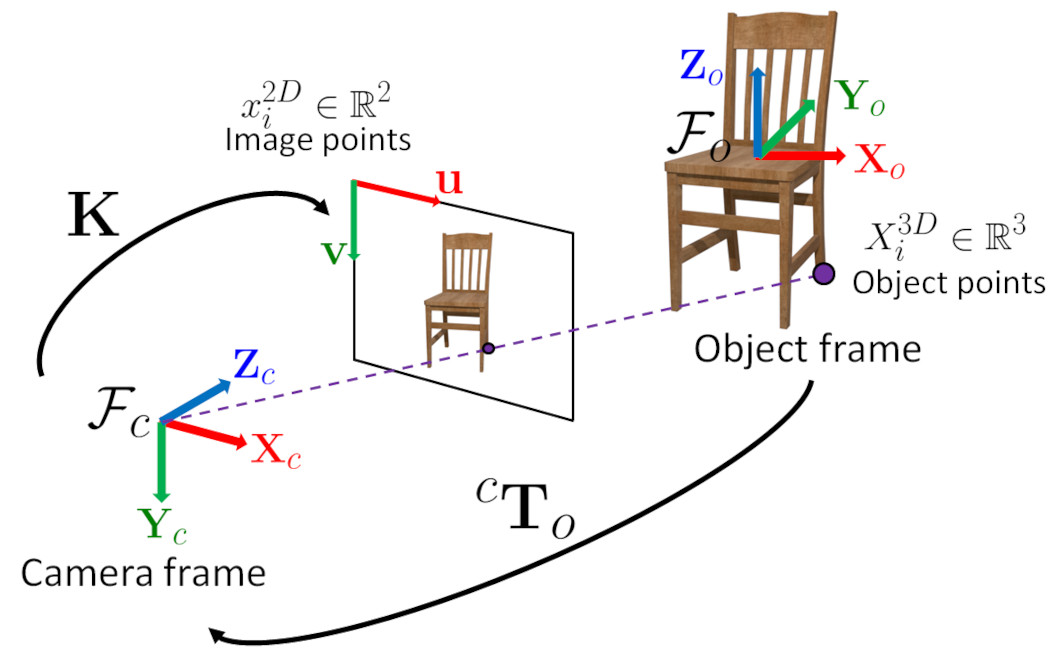
- See also
- calib3d_solvePnP
- Parameters
-
objectPoints Array of object points in the object coordinate space, 3x3 1-channel or 1x3/3x1 3-channel. vector<Point3f> can be also passed here. imagePoints Array of corresponding image points, 3x2 1-channel or 1x3/3x1 2-channel. vector<Point2f> can be also passed here. cameraMatrix Input camera intrinsic matrix \(\cameramatrix{A}\) . distCoeffs Input vector of distortion coefficients \(\distcoeffs\). If the vector is NULL/empty, the zero distortion coefficients are assumed. rvecs Output rotation vectors (see Rodrigues ) that, together with tvecs, brings points from the model coordinate system to the camera coordinate system. A P3P problem has up to 4 solutions. tvecs Output translation vectors. flags Method for solving a P3P problem: - SOLVEPNP_P3P Method is based on the paper of Ding, Y., Yang, J., Larsson, V., Olsson, C., & Åstrom, K. "Revisiting the P3P Problem" ([ding2023revisiting]).
- SOLVEPNP_AP3P Method is based on the paper of T. Ke and S. Roumeliotis. "An Efficient Algebraic Solution to the Perspective-Three-Point Problem" ([Ke17]).
The function estimates the object pose given 3 object points, their corresponding image projections, as well as the camera intrinsic matrix and the distortion coefficients.
- Note
- The solutions are sorted by reprojection errors (lowest to highest).
◆ solvePnP() [1/3]
|
static |
Finds an object pose \( {}^{c}\mathbf{T}_o \) from 3D-2D point correspondences:
- See also
- calib3d_solvePnP
This function returns the rotation and the translation vectors that transform a 3D point expressed in the object coordinate frame to the camera coordinate frame, using different methods:
- P3P methods (SOLVEPNP_P3P, SOLVEPNP_AP3P): need 4 input points to return a unique solution.
- SOLVEPNP_IPPE Input points must be >= 4 and object points must be coplanar.
- SOLVEPNP_IPPE_SQUARE Special case suitable for marker pose estimation. Number of input points must be 4. Object points must be defined in the following order:
- point 0: [-squareLength / 2, squareLength / 2, 0]
- point 1: [ squareLength / 2, squareLength / 2, 0]
- point 2: [ squareLength / 2, -squareLength / 2, 0]
- point 3: [-squareLength / 2, -squareLength / 2, 0]
- for all the other flags, number of input points must be >= 4 and object points can be in any configuration.
- Parameters
-
objectPoints Array of object points in the object coordinate space, Nx3 1-channel or 1xN/Nx1 3-channel, where N is the number of points. vector<Point3d> can be also passed here. imagePoints Array of corresponding image points, Nx2 1-channel or 1xN/Nx1 2-channel, where N is the number of points. vector<Point2d> can be also passed here. cameraMatrix Input camera intrinsic matrix \(\cameramatrix{A}\) . distCoeffs Input vector of distortion coefficients \(\distcoeffs\). If the vector is NULL/empty, the zero distortion coefficients are assumed. rvec Output rotation vector (see Rodrigues ) that, together with tvec, brings points from the model coordinate system to the camera coordinate system. tvec Output translation vector. useExtrinsicGuess Parameter used for SOLVEPNP_ITERATIVE. If true (1), the function uses the provided rvec and tvec values as initial approximations of the rotation and translation vectors, respectively, and further optimizes them. flags Method for solving a PnP problem: see calib3d_solvePnP_flags
More information about Perspective-n-Points is described in calib3d_solvePnP
- Note
- An example of how to use solvePnP for planar augmented reality can be found at opencv_source_code/samples/python/plane_ar.py
- If you are using Python:
- Numpy array slices won't work as input because solvePnP requires contiguous arrays (enforced by the assertion using cv::Mat::checkVector() around line 55 of modules/3d/src/solvepnp.cpp version 2.4.9)
- The P3P algorithm requires image points to be in an array of shape (N,1,2) due to its calling of undistortPoints (around line 75 of modules/3d/src/solvepnp.cpp version 2.4.9) which requires 2-channel information.
- Thus, given some data D = np.array(...) where D.shape = (N,M), in order to use a subset of it as, e.g., imagePoints, one must effectively copy it into a new array: imagePoints = np.ascontiguousarray(D[:,:2]).reshape((N,1,2))
- The minimum number of points is 4 in the general case. In the case of SOLVEPNP_P3P and SOLVEPNP_AP3P methods, it is required to use exactly 4 points (the first 3 points are used to estimate all the solutions of the P3P problem, the last one is used to retain the best solution that minimizes the reprojection error).
- With SOLVEPNP_ITERATIVE method and
useExtrinsicGuess=true, the minimum number of points is 3 (3 points are sufficient to compute a pose but there are up to 4 solutions). The initial solution should be close to the global solution to converge. The function returns true if some solution is found. User code is responsible for solution quality assessment. - With SOLVEPNP_IPPE input points must be >= 4 and object points must be coplanar.
- With SOLVEPNP_IPPE_SQUARE this is a special case suitable for marker pose estimation. Number of input points must be 4. Object points must be defined in the following order:
- point 0: [-squareLength / 2, squareLength / 2, 0]
- point 1: [ squareLength / 2, squareLength / 2, 0]
- point 2: [ squareLength / 2, -squareLength / 2, 0]
- point 3: [-squareLength / 2, -squareLength / 2, 0]
- With SOLVEPNP_SQPNP input points must be >= 3
◆ solvePnP() [2/3]
|
static |
Finds an object pose \( {}^{c}\mathbf{T}_o \) from 3D-2D point correspondences:
- See also
- calib3d_solvePnP
This function returns the rotation and the translation vectors that transform a 3D point expressed in the object coordinate frame to the camera coordinate frame, using different methods:
- P3P methods (SOLVEPNP_P3P, SOLVEPNP_AP3P): need 4 input points to return a unique solution.
- SOLVEPNP_IPPE Input points must be >= 4 and object points must be coplanar.
- SOLVEPNP_IPPE_SQUARE Special case suitable for marker pose estimation. Number of input points must be 4. Object points must be defined in the following order:
- point 0: [-squareLength / 2, squareLength / 2, 0]
- point 1: [ squareLength / 2, squareLength / 2, 0]
- point 2: [ squareLength / 2, -squareLength / 2, 0]
- point 3: [-squareLength / 2, -squareLength / 2, 0]
- for all the other flags, number of input points must be >= 4 and object points can be in any configuration.
- Parameters
-
objectPoints Array of object points in the object coordinate space, Nx3 1-channel or 1xN/Nx1 3-channel, where N is the number of points. vector<Point3d> can be also passed here. imagePoints Array of corresponding image points, Nx2 1-channel or 1xN/Nx1 2-channel, where N is the number of points. vector<Point2d> can be also passed here. cameraMatrix Input camera intrinsic matrix \(\cameramatrix{A}\) . distCoeffs Input vector of distortion coefficients \(\distcoeffs\). If the vector is NULL/empty, the zero distortion coefficients are assumed. rvec Output rotation vector (see Rodrigues ) that, together with tvec, brings points from the model coordinate system to the camera coordinate system. tvec Output translation vector. useExtrinsicGuess Parameter used for SOLVEPNP_ITERATIVE. If true (1), the function uses the provided rvec and tvec values as initial approximations of the rotation and translation vectors, respectively, and further optimizes them. flags Method for solving a PnP problem: see calib3d_solvePnP_flags
More information about Perspective-n-Points is described in calib3d_solvePnP
- Note
- An example of how to use solvePnP for planar augmented reality can be found at opencv_source_code/samples/python/plane_ar.py
- If you are using Python:
- Numpy array slices won't work as input because solvePnP requires contiguous arrays (enforced by the assertion using cv::Mat::checkVector() around line 55 of modules/3d/src/solvepnp.cpp version 2.4.9)
- The P3P algorithm requires image points to be in an array of shape (N,1,2) due to its calling of undistortPoints (around line 75 of modules/3d/src/solvepnp.cpp version 2.4.9) which requires 2-channel information.
- Thus, given some data D = np.array(...) where D.shape = (N,M), in order to use a subset of it as, e.g., imagePoints, one must effectively copy it into a new array: imagePoints = np.ascontiguousarray(D[:,:2]).reshape((N,1,2))
- The minimum number of points is 4 in the general case. In the case of SOLVEPNP_P3P and SOLVEPNP_AP3P methods, it is required to use exactly 4 points (the first 3 points are used to estimate all the solutions of the P3P problem, the last one is used to retain the best solution that minimizes the reprojection error).
- With SOLVEPNP_ITERATIVE method and
useExtrinsicGuess=true, the minimum number of points is 3 (3 points are sufficient to compute a pose but there are up to 4 solutions). The initial solution should be close to the global solution to converge. The function returns true if some solution is found. User code is responsible for solution quality assessment. - With SOLVEPNP_IPPE input points must be >= 4 and object points must be coplanar.
- With SOLVEPNP_IPPE_SQUARE this is a special case suitable for marker pose estimation. Number of input points must be 4. Object points must be defined in the following order:
- point 0: [-squareLength / 2, squareLength / 2, 0]
- point 1: [ squareLength / 2, squareLength / 2, 0]
- point 2: [ squareLength / 2, -squareLength / 2, 0]
- point 3: [-squareLength / 2, -squareLength / 2, 0]
- With SOLVEPNP_SQPNP input points must be >= 3
◆ solvePnP() [3/3]
|
static |
Finds an object pose \( {}^{c}\mathbf{T}_o \) from 3D-2D point correspondences:
- See also
- calib3d_solvePnP
This function returns the rotation and the translation vectors that transform a 3D point expressed in the object coordinate frame to the camera coordinate frame, using different methods:
- P3P methods (SOLVEPNP_P3P, SOLVEPNP_AP3P): need 4 input points to return a unique solution.
- SOLVEPNP_IPPE Input points must be >= 4 and object points must be coplanar.
- SOLVEPNP_IPPE_SQUARE Special case suitable for marker pose estimation. Number of input points must be 4. Object points must be defined in the following order:
- point 0: [-squareLength / 2, squareLength / 2, 0]
- point 1: [ squareLength / 2, squareLength / 2, 0]
- point 2: [ squareLength / 2, -squareLength / 2, 0]
- point 3: [-squareLength / 2, -squareLength / 2, 0]
- for all the other flags, number of input points must be >= 4 and object points can be in any configuration.
- Parameters
-
objectPoints Array of object points in the object coordinate space, Nx3 1-channel or 1xN/Nx1 3-channel, where N is the number of points. vector<Point3d> can be also passed here. imagePoints Array of corresponding image points, Nx2 1-channel or 1xN/Nx1 2-channel, where N is the number of points. vector<Point2d> can be also passed here. cameraMatrix Input camera intrinsic matrix \(\cameramatrix{A}\) . distCoeffs Input vector of distortion coefficients \(\distcoeffs\). If the vector is NULL/empty, the zero distortion coefficients are assumed. rvec Output rotation vector (see Rodrigues ) that, together with tvec, brings points from the model coordinate system to the camera coordinate system. tvec Output translation vector. useExtrinsicGuess Parameter used for SOLVEPNP_ITERATIVE. If true (1), the function uses the provided rvec and tvec values as initial approximations of the rotation and translation vectors, respectively, and further optimizes them. flags Method for solving a PnP problem: see calib3d_solvePnP_flags
More information about Perspective-n-Points is described in calib3d_solvePnP
- Note
- An example of how to use solvePnP for planar augmented reality can be found at opencv_source_code/samples/python/plane_ar.py
- If you are using Python:
- Numpy array slices won't work as input because solvePnP requires contiguous arrays (enforced by the assertion using cv::Mat::checkVector() around line 55 of modules/3d/src/solvepnp.cpp version 2.4.9)
- The P3P algorithm requires image points to be in an array of shape (N,1,2) due to its calling of undistortPoints (around line 75 of modules/3d/src/solvepnp.cpp version 2.4.9) which requires 2-channel information.
- Thus, given some data D = np.array(...) where D.shape = (N,M), in order to use a subset of it as, e.g., imagePoints, one must effectively copy it into a new array: imagePoints = np.ascontiguousarray(D[:,:2]).reshape((N,1,2))
- The minimum number of points is 4 in the general case. In the case of SOLVEPNP_P3P and SOLVEPNP_AP3P methods, it is required to use exactly 4 points (the first 3 points are used to estimate all the solutions of the P3P problem, the last one is used to retain the best solution that minimizes the reprojection error).
- With SOLVEPNP_ITERATIVE method and
useExtrinsicGuess=true, the minimum number of points is 3 (3 points are sufficient to compute a pose but there are up to 4 solutions). The initial solution should be close to the global solution to converge. The function returns true if some solution is found. User code is responsible for solution quality assessment. - With SOLVEPNP_IPPE input points must be >= 4 and object points must be coplanar.
- With SOLVEPNP_IPPE_SQUARE this is a special case suitable for marker pose estimation. Number of input points must be 4. Object points must be defined in the following order:
- point 0: [-squareLength / 2, squareLength / 2, 0]
- point 1: [ squareLength / 2, squareLength / 2, 0]
- point 2: [ squareLength / 2, -squareLength / 2, 0]
- point 3: [-squareLength / 2, -squareLength / 2, 0]
- With SOLVEPNP_SQPNP input points must be >= 3
◆ solvePnPGeneric() [1/6]
|
static |
Finds an object pose \( {}^{c}\mathbf{T}_o \) from 3D-2D point correspondences.
- See also
- calib3d_solvePnP
This function returns a list of all the possible solutions (a solution is a <rotation vector, translation vector> couple), depending on the number of input points and the chosen method:
- P3P methods (SOLVEPNP_P3P, SOLVEPNP_AP3P): 3 or 4 input points. Number of returned solutions can be between 0 and 4 with 3 input points.
- SOLVEPNP_IPPE Input points must be >= 4 and object points must be coplanar. Returns 2 solutions.
- SOLVEPNP_IPPE_SQUARE Special case suitable for marker pose estimation. Number of input points must be 4 and 2 solutions are returned. Object points must be defined in the following order:
- point 0: [-squareLength / 2, squareLength / 2, 0]
- point 1: [ squareLength / 2, squareLength / 2, 0]
- point 2: [ squareLength / 2, -squareLength / 2, 0]
- point 3: [-squareLength / 2, -squareLength / 2, 0]
- for all the other flags, number of input points must be >= 4 and object points can be in any configuration. Only 1 solution is returned.
- Parameters
-
objectPoints Array of object points in the object coordinate space, Nx3 1-channel or 1xN/Nx1 3-channel, where N is the number of points. vector<Point3d> can be also passed here. imagePoints Array of corresponding image points, Nx2 1-channel or 1xN/Nx1 2-channel, where N is the number of points. vector<Point2d> can be also passed here. cameraMatrix Input camera intrinsic matrix \(\cameramatrix{A}\) . distCoeffs Input vector of distortion coefficients \(\distcoeffs\). If the vector is NULL/empty, the zero distortion coefficients are assumed. rvecs Vector of output rotation vectors (see Rodrigues ) that, together with tvecs, brings points from the model coordinate system to the camera coordinate system. tvecs Vector of output translation vectors. useExtrinsicGuess Parameter used for SOLVEPNP_ITERATIVE. If true (1), the function uses the provided rvec and tvec values as initial approximations of the rotation and translation vectors, respectively, and further optimizes them. flags Method for solving a PnP problem: see calib3d_solvePnP_flags rvec Rotation vector used to initialize an iterative PnP refinement algorithm, when flag is SOLVEPNP_ITERATIVE and useExtrinsicGuess is set to true. tvec Translation vector used to initialize an iterative PnP refinement algorithm, when flag is SOLVEPNP_ITERATIVE and useExtrinsicGuess is set to true. reprojectionError Optional vector of reprojection error, that is the RMS error ( \( \text{RMSE} = \sqrt{\frac{\sum_{i}^{N} \left ( \hat{y_i} - y_i \right )^2}{N}} \)) between the input image points and the 3D object points projected with the estimated pose.
More information is described in calib3d_solvePnP
- Note
- An example of how to use solvePnP for planar augmented reality can be found at opencv_source_code/samples/python/plane_ar.py
- If you are using Python:
- Numpy array slices won't work as input because solvePnP requires contiguous arrays (enforced by the assertion using cv::Mat::checkVector() around line 55 of modules/3d/src/solvepnp.cpp version 2.4.9)
- The P3P algorithm requires image points to be in an array of shape (N,1,2) due to its calling of undistortPoints (around line 75 of modules/3d/src/solvepnp.cpp version 2.4.9) which requires 2-channel information.
- Thus, given some data D = np.array(...) where D.shape = (N,M), in order to use a subset of it as, e.g., imagePoints, one must effectively copy it into a new array: imagePoints = np.ascontiguousarray(D[:,:2]).reshape((N,1,2))
- The minimum number of points is 4 in the general case. In the case of SOLVEPNP_P3P and SOLVEPNP_AP3P methods, it is required to use exactly 4 points (the first 3 points are used to estimate all the solutions of the P3P problem, the last one is used to retain the best solution that minimizes the reprojection error).
- With SOLVEPNP_ITERATIVE method and
useExtrinsicGuess=true, the minimum number of points is 3 (3 points are sufficient to compute a pose but there are up to 4 solutions). The initial solution should be close to the global solution to converge. - With SOLVEPNP_IPPE input points must be >= 4 and object points must be coplanar.
- With SOLVEPNP_IPPE_SQUARE this is a special case suitable for marker pose estimation. Number of input points must be 4. Object points must be defined in the following order:
- point 0: [-squareLength / 2, squareLength / 2, 0]
- point 1: [ squareLength / 2, squareLength / 2, 0]
- point 2: [ squareLength / 2, -squareLength / 2, 0]
- point 3: [-squareLength / 2, -squareLength / 2, 0]
- With SOLVEPNP_SQPNP input points must be >= 3
◆ solvePnPGeneric() [2/6]
|
static |
Finds an object pose \( {}^{c}\mathbf{T}_o \) from 3D-2D point correspondences.
- See also
- calib3d_solvePnP
This function returns a list of all the possible solutions (a solution is a <rotation vector, translation vector> couple), depending on the number of input points and the chosen method:
- P3P methods (SOLVEPNP_P3P, SOLVEPNP_AP3P): 3 or 4 input points. Number of returned solutions can be between 0 and 4 with 3 input points.
- SOLVEPNP_IPPE Input points must be >= 4 and object points must be coplanar. Returns 2 solutions.
- SOLVEPNP_IPPE_SQUARE Special case suitable for marker pose estimation. Number of input points must be 4 and 2 solutions are returned. Object points must be defined in the following order:
- point 0: [-squareLength / 2, squareLength / 2, 0]
- point 1: [ squareLength / 2, squareLength / 2, 0]
- point 2: [ squareLength / 2, -squareLength / 2, 0]
- point 3: [-squareLength / 2, -squareLength / 2, 0]
- for all the other flags, number of input points must be >= 4 and object points can be in any configuration. Only 1 solution is returned.
- Parameters
-
objectPoints Array of object points in the object coordinate space, Nx3 1-channel or 1xN/Nx1 3-channel, where N is the number of points. vector<Point3d> can be also passed here. imagePoints Array of corresponding image points, Nx2 1-channel or 1xN/Nx1 2-channel, where N is the number of points. vector<Point2d> can be also passed here. cameraMatrix Input camera intrinsic matrix \(\cameramatrix{A}\) . distCoeffs Input vector of distortion coefficients \(\distcoeffs\). If the vector is NULL/empty, the zero distortion coefficients are assumed. rvecs Vector of output rotation vectors (see Rodrigues ) that, together with tvecs, brings points from the model coordinate system to the camera coordinate system. tvecs Vector of output translation vectors. useExtrinsicGuess Parameter used for SOLVEPNP_ITERATIVE. If true (1), the function uses the provided rvec and tvec values as initial approximations of the rotation and translation vectors, respectively, and further optimizes them. flags Method for solving a PnP problem: see calib3d_solvePnP_flags rvec Rotation vector used to initialize an iterative PnP refinement algorithm, when flag is SOLVEPNP_ITERATIVE and useExtrinsicGuess is set to true. tvec Translation vector used to initialize an iterative PnP refinement algorithm, when flag is SOLVEPNP_ITERATIVE and useExtrinsicGuess is set to true. reprojectionError Optional vector of reprojection error, that is the RMS error ( \( \text{RMSE} = \sqrt{\frac{\sum_{i}^{N} \left ( \hat{y_i} - y_i \right )^2}{N}} \)) between the input image points and the 3D object points projected with the estimated pose.
More information is described in calib3d_solvePnP
- Note
- An example of how to use solvePnP for planar augmented reality can be found at opencv_source_code/samples/python/plane_ar.py
- If you are using Python:
- Numpy array slices won't work as input because solvePnP requires contiguous arrays (enforced by the assertion using cv::Mat::checkVector() around line 55 of modules/3d/src/solvepnp.cpp version 2.4.9)
- The P3P algorithm requires image points to be in an array of shape (N,1,2) due to its calling of undistortPoints (around line 75 of modules/3d/src/solvepnp.cpp version 2.4.9) which requires 2-channel information.
- Thus, given some data D = np.array(...) where D.shape = (N,M), in order to use a subset of it as, e.g., imagePoints, one must effectively copy it into a new array: imagePoints = np.ascontiguousarray(D[:,:2]).reshape((N,1,2))
- The minimum number of points is 4 in the general case. In the case of SOLVEPNP_P3P and SOLVEPNP_AP3P methods, it is required to use exactly 4 points (the first 3 points are used to estimate all the solutions of the P3P problem, the last one is used to retain the best solution that minimizes the reprojection error).
- With SOLVEPNP_ITERATIVE method and
useExtrinsicGuess=true, the minimum number of points is 3 (3 points are sufficient to compute a pose but there are up to 4 solutions). The initial solution should be close to the global solution to converge. - With SOLVEPNP_IPPE input points must be >= 4 and object points must be coplanar.
- With SOLVEPNP_IPPE_SQUARE this is a special case suitable for marker pose estimation. Number of input points must be 4. Object points must be defined in the following order:
- point 0: [-squareLength / 2, squareLength / 2, 0]
- point 1: [ squareLength / 2, squareLength / 2, 0]
- point 2: [ squareLength / 2, -squareLength / 2, 0]
- point 3: [-squareLength / 2, -squareLength / 2, 0]
- With SOLVEPNP_SQPNP input points must be >= 3
◆ solvePnPGeneric() [3/6]
|
static |
Finds an object pose \( {}^{c}\mathbf{T}_o \) from 3D-2D point correspondences.
- See also
- calib3d_solvePnP
This function returns a list of all the possible solutions (a solution is a <rotation vector, translation vector> couple), depending on the number of input points and the chosen method:
- P3P methods (SOLVEPNP_P3P, SOLVEPNP_AP3P): 3 or 4 input points. Number of returned solutions can be between 0 and 4 with 3 input points.
- SOLVEPNP_IPPE Input points must be >= 4 and object points must be coplanar. Returns 2 solutions.
- SOLVEPNP_IPPE_SQUARE Special case suitable for marker pose estimation. Number of input points must be 4 and 2 solutions are returned. Object points must be defined in the following order:
- point 0: [-squareLength / 2, squareLength / 2, 0]
- point 1: [ squareLength / 2, squareLength / 2, 0]
- point 2: [ squareLength / 2, -squareLength / 2, 0]
- point 3: [-squareLength / 2, -squareLength / 2, 0]
- for all the other flags, number of input points must be >= 4 and object points can be in any configuration. Only 1 solution is returned.
- Parameters
-
objectPoints Array of object points in the object coordinate space, Nx3 1-channel or 1xN/Nx1 3-channel, where N is the number of points. vector<Point3d> can be also passed here. imagePoints Array of corresponding image points, Nx2 1-channel or 1xN/Nx1 2-channel, where N is the number of points. vector<Point2d> can be also passed here. cameraMatrix Input camera intrinsic matrix \(\cameramatrix{A}\) . distCoeffs Input vector of distortion coefficients \(\distcoeffs\). If the vector is NULL/empty, the zero distortion coefficients are assumed. rvecs Vector of output rotation vectors (see Rodrigues ) that, together with tvecs, brings points from the model coordinate system to the camera coordinate system. tvecs Vector of output translation vectors. useExtrinsicGuess Parameter used for SOLVEPNP_ITERATIVE. If true (1), the function uses the provided rvec and tvec values as initial approximations of the rotation and translation vectors, respectively, and further optimizes them. flags Method for solving a PnP problem: see calib3d_solvePnP_flags rvec Rotation vector used to initialize an iterative PnP refinement algorithm, when flag is SOLVEPNP_ITERATIVE and useExtrinsicGuess is set to true. tvec Translation vector used to initialize an iterative PnP refinement algorithm, when flag is SOLVEPNP_ITERATIVE and useExtrinsicGuess is set to true. reprojectionError Optional vector of reprojection error, that is the RMS error ( \( \text{RMSE} = \sqrt{\frac{\sum_{i}^{N} \left ( \hat{y_i} - y_i \right )^2}{N}} \)) between the input image points and the 3D object points projected with the estimated pose.
More information is described in calib3d_solvePnP
- Note
- An example of how to use solvePnP for planar augmented reality can be found at opencv_source_code/samples/python/plane_ar.py
- If you are using Python:
- Numpy array slices won't work as input because solvePnP requires contiguous arrays (enforced by the assertion using cv::Mat::checkVector() around line 55 of modules/3d/src/solvepnp.cpp version 2.4.9)
- The P3P algorithm requires image points to be in an array of shape (N,1,2) due to its calling of undistortPoints (around line 75 of modules/3d/src/solvepnp.cpp version 2.4.9) which requires 2-channel information.
- Thus, given some data D = np.array(...) where D.shape = (N,M), in order to use a subset of it as, e.g., imagePoints, one must effectively copy it into a new array: imagePoints = np.ascontiguousarray(D[:,:2]).reshape((N,1,2))
- The minimum number of points is 4 in the general case. In the case of SOLVEPNP_P3P and SOLVEPNP_AP3P methods, it is required to use exactly 4 points (the first 3 points are used to estimate all the solutions of the P3P problem, the last one is used to retain the best solution that minimizes the reprojection error).
- With SOLVEPNP_ITERATIVE method and
useExtrinsicGuess=true, the minimum number of points is 3 (3 points are sufficient to compute a pose but there are up to 4 solutions). The initial solution should be close to the global solution to converge. - With SOLVEPNP_IPPE input points must be >= 4 and object points must be coplanar.
- With SOLVEPNP_IPPE_SQUARE this is a special case suitable for marker pose estimation. Number of input points must be 4. Object points must be defined in the following order:
- point 0: [-squareLength / 2, squareLength / 2, 0]
- point 1: [ squareLength / 2, squareLength / 2, 0]
- point 2: [ squareLength / 2, -squareLength / 2, 0]
- point 3: [-squareLength / 2, -squareLength / 2, 0]
- With SOLVEPNP_SQPNP input points must be >= 3
◆ solvePnPGeneric() [4/6]
|
static |
Finds an object pose \( {}^{c}\mathbf{T}_o \) from 3D-2D point correspondences.
- See also
- calib3d_solvePnP
This function returns a list of all the possible solutions (a solution is a <rotation vector, translation vector> couple), depending on the number of input points and the chosen method:
- P3P methods (SOLVEPNP_P3P, SOLVEPNP_AP3P): 3 or 4 input points. Number of returned solutions can be between 0 and 4 with 3 input points.
- SOLVEPNP_IPPE Input points must be >= 4 and object points must be coplanar. Returns 2 solutions.
- SOLVEPNP_IPPE_SQUARE Special case suitable for marker pose estimation. Number of input points must be 4 and 2 solutions are returned. Object points must be defined in the following order:
- point 0: [-squareLength / 2, squareLength / 2, 0]
- point 1: [ squareLength / 2, squareLength / 2, 0]
- point 2: [ squareLength / 2, -squareLength / 2, 0]
- point 3: [-squareLength / 2, -squareLength / 2, 0]
- for all the other flags, number of input points must be >= 4 and object points can be in any configuration. Only 1 solution is returned.
- Parameters
-
objectPoints Array of object points in the object coordinate space, Nx3 1-channel or 1xN/Nx1 3-channel, where N is the number of points. vector<Point3d> can be also passed here. imagePoints Array of corresponding image points, Nx2 1-channel or 1xN/Nx1 2-channel, where N is the number of points. vector<Point2d> can be also passed here. cameraMatrix Input camera intrinsic matrix \(\cameramatrix{A}\) . distCoeffs Input vector of distortion coefficients \(\distcoeffs\). If the vector is NULL/empty, the zero distortion coefficients are assumed. rvecs Vector of output rotation vectors (see Rodrigues ) that, together with tvecs, brings points from the model coordinate system to the camera coordinate system. tvecs Vector of output translation vectors. useExtrinsicGuess Parameter used for SOLVEPNP_ITERATIVE. If true (1), the function uses the provided rvec and tvec values as initial approximations of the rotation and translation vectors, respectively, and further optimizes them. flags Method for solving a PnP problem: see calib3d_solvePnP_flags rvec Rotation vector used to initialize an iterative PnP refinement algorithm, when flag is SOLVEPNP_ITERATIVE and useExtrinsicGuess is set to true. tvec Translation vector used to initialize an iterative PnP refinement algorithm, when flag is SOLVEPNP_ITERATIVE and useExtrinsicGuess is set to true. reprojectionError Optional vector of reprojection error, that is the RMS error ( \( \text{RMSE} = \sqrt{\frac{\sum_{i}^{N} \left ( \hat{y_i} - y_i \right )^2}{N}} \)) between the input image points and the 3D object points projected with the estimated pose.
More information is described in calib3d_solvePnP
- Note
- An example of how to use solvePnP for planar augmented reality can be found at opencv_source_code/samples/python/plane_ar.py
- If you are using Python:
- Numpy array slices won't work as input because solvePnP requires contiguous arrays (enforced by the assertion using cv::Mat::checkVector() around line 55 of modules/3d/src/solvepnp.cpp version 2.4.9)
- The P3P algorithm requires image points to be in an array of shape (N,1,2) due to its calling of undistortPoints (around line 75 of modules/3d/src/solvepnp.cpp version 2.4.9) which requires 2-channel information.
- Thus, given some data D = np.array(...) where D.shape = (N,M), in order to use a subset of it as, e.g., imagePoints, one must effectively copy it into a new array: imagePoints = np.ascontiguousarray(D[:,:2]).reshape((N,1,2))
- The minimum number of points is 4 in the general case. In the case of SOLVEPNP_P3P and SOLVEPNP_AP3P methods, it is required to use exactly 4 points (the first 3 points are used to estimate all the solutions of the P3P problem, the last one is used to retain the best solution that minimizes the reprojection error).
- With SOLVEPNP_ITERATIVE method and
useExtrinsicGuess=true, the minimum number of points is 3 (3 points are sufficient to compute a pose but there are up to 4 solutions). The initial solution should be close to the global solution to converge. - With SOLVEPNP_IPPE input points must be >= 4 and object points must be coplanar.
- With SOLVEPNP_IPPE_SQUARE this is a special case suitable for marker pose estimation. Number of input points must be 4. Object points must be defined in the following order:
- point 0: [-squareLength / 2, squareLength / 2, 0]
- point 1: [ squareLength / 2, squareLength / 2, 0]
- point 2: [ squareLength / 2, -squareLength / 2, 0]
- point 3: [-squareLength / 2, -squareLength / 2, 0]
- With SOLVEPNP_SQPNP input points must be >= 3
◆ solvePnPGeneric() [5/6]
|
static |
Finds an object pose \( {}^{c}\mathbf{T}_o \) from 3D-2D point correspondences.
- See also
- calib3d_solvePnP
This function returns a list of all the possible solutions (a solution is a <rotation vector, translation vector> couple), depending on the number of input points and the chosen method:
- P3P methods (SOLVEPNP_P3P, SOLVEPNP_AP3P): 3 or 4 input points. Number of returned solutions can be between 0 and 4 with 3 input points.
- SOLVEPNP_IPPE Input points must be >= 4 and object points must be coplanar. Returns 2 solutions.
- SOLVEPNP_IPPE_SQUARE Special case suitable for marker pose estimation. Number of input points must be 4 and 2 solutions are returned. Object points must be defined in the following order:
- point 0: [-squareLength / 2, squareLength / 2, 0]
- point 1: [ squareLength / 2, squareLength / 2, 0]
- point 2: [ squareLength / 2, -squareLength / 2, 0]
- point 3: [-squareLength / 2, -squareLength / 2, 0]
- for all the other flags, number of input points must be >= 4 and object points can be in any configuration. Only 1 solution is returned.
- Parameters
-
objectPoints Array of object points in the object coordinate space, Nx3 1-channel or 1xN/Nx1 3-channel, where N is the number of points. vector<Point3d> can be also passed here. imagePoints Array of corresponding image points, Nx2 1-channel or 1xN/Nx1 2-channel, where N is the number of points. vector<Point2d> can be also passed here. cameraMatrix Input camera intrinsic matrix \(\cameramatrix{A}\) . distCoeffs Input vector of distortion coefficients \(\distcoeffs\). If the vector is NULL/empty, the zero distortion coefficients are assumed. rvecs Vector of output rotation vectors (see Rodrigues ) that, together with tvecs, brings points from the model coordinate system to the camera coordinate system. tvecs Vector of output translation vectors. useExtrinsicGuess Parameter used for SOLVEPNP_ITERATIVE. If true (1), the function uses the provided rvec and tvec values as initial approximations of the rotation and translation vectors, respectively, and further optimizes them. flags Method for solving a PnP problem: see calib3d_solvePnP_flags rvec Rotation vector used to initialize an iterative PnP refinement algorithm, when flag is SOLVEPNP_ITERATIVE and useExtrinsicGuess is set to true. tvec Translation vector used to initialize an iterative PnP refinement algorithm, when flag is SOLVEPNP_ITERATIVE and useExtrinsicGuess is set to true. reprojectionError Optional vector of reprojection error, that is the RMS error ( \( \text{RMSE} = \sqrt{\frac{\sum_{i}^{N} \left ( \hat{y_i} - y_i \right )^2}{N}} \)) between the input image points and the 3D object points projected with the estimated pose.
More information is described in calib3d_solvePnP
- Note
- An example of how to use solvePnP for planar augmented reality can be found at opencv_source_code/samples/python/plane_ar.py
- If you are using Python:
- Numpy array slices won't work as input because solvePnP requires contiguous arrays (enforced by the assertion using cv::Mat::checkVector() around line 55 of modules/3d/src/solvepnp.cpp version 2.4.9)
- The P3P algorithm requires image points to be in an array of shape (N,1,2) due to its calling of undistortPoints (around line 75 of modules/3d/src/solvepnp.cpp version 2.4.9) which requires 2-channel information.
- Thus, given some data D = np.array(...) where D.shape = (N,M), in order to use a subset of it as, e.g., imagePoints, one must effectively copy it into a new array: imagePoints = np.ascontiguousarray(D[:,:2]).reshape((N,1,2))
- The minimum number of points is 4 in the general case. In the case of SOLVEPNP_P3P and SOLVEPNP_AP3P methods, it is required to use exactly 4 points (the first 3 points are used to estimate all the solutions of the P3P problem, the last one is used to retain the best solution that minimizes the reprojection error).
- With SOLVEPNP_ITERATIVE method and
useExtrinsicGuess=true, the minimum number of points is 3 (3 points are sufficient to compute a pose but there are up to 4 solutions). The initial solution should be close to the global solution to converge. - With SOLVEPNP_IPPE input points must be >= 4 and object points must be coplanar.
- With SOLVEPNP_IPPE_SQUARE this is a special case suitable for marker pose estimation. Number of input points must be 4. Object points must be defined in the following order:
- point 0: [-squareLength / 2, squareLength / 2, 0]
- point 1: [ squareLength / 2, squareLength / 2, 0]
- point 2: [ squareLength / 2, -squareLength / 2, 0]
- point 3: [-squareLength / 2, -squareLength / 2, 0]
- With SOLVEPNP_SQPNP input points must be >= 3
◆ solvePnPGeneric() [6/6]
|
static |
Finds an object pose \( {}^{c}\mathbf{T}_o \) from 3D-2D point correspondences.
- See also
- calib3d_solvePnP
This function returns a list of all the possible solutions (a solution is a <rotation vector, translation vector> couple), depending on the number of input points and the chosen method:
- P3P methods (SOLVEPNP_P3P, SOLVEPNP_AP3P): 3 or 4 input points. Number of returned solutions can be between 0 and 4 with 3 input points.
- SOLVEPNP_IPPE Input points must be >= 4 and object points must be coplanar. Returns 2 solutions.
- SOLVEPNP_IPPE_SQUARE Special case suitable for marker pose estimation. Number of input points must be 4 and 2 solutions are returned. Object points must be defined in the following order:
- point 0: [-squareLength / 2, squareLength / 2, 0]
- point 1: [ squareLength / 2, squareLength / 2, 0]
- point 2: [ squareLength / 2, -squareLength / 2, 0]
- point 3: [-squareLength / 2, -squareLength / 2, 0]
- for all the other flags, number of input points must be >= 4 and object points can be in any configuration. Only 1 solution is returned.
- Parameters
-
objectPoints Array of object points in the object coordinate space, Nx3 1-channel or 1xN/Nx1 3-channel, where N is the number of points. vector<Point3d> can be also passed here. imagePoints Array of corresponding image points, Nx2 1-channel or 1xN/Nx1 2-channel, where N is the number of points. vector<Point2d> can be also passed here. cameraMatrix Input camera intrinsic matrix \(\cameramatrix{A}\) . distCoeffs Input vector of distortion coefficients \(\distcoeffs\). If the vector is NULL/empty, the zero distortion coefficients are assumed. rvecs Vector of output rotation vectors (see Rodrigues ) that, together with tvecs, brings points from the model coordinate system to the camera coordinate system. tvecs Vector of output translation vectors. useExtrinsicGuess Parameter used for SOLVEPNP_ITERATIVE. If true (1), the function uses the provided rvec and tvec values as initial approximations of the rotation and translation vectors, respectively, and further optimizes them. flags Method for solving a PnP problem: see calib3d_solvePnP_flags rvec Rotation vector used to initialize an iterative PnP refinement algorithm, when flag is SOLVEPNP_ITERATIVE and useExtrinsicGuess is set to true. tvec Translation vector used to initialize an iterative PnP refinement algorithm, when flag is SOLVEPNP_ITERATIVE and useExtrinsicGuess is set to true. reprojectionError Optional vector of reprojection error, that is the RMS error ( \( \text{RMSE} = \sqrt{\frac{\sum_{i}^{N} \left ( \hat{y_i} - y_i \right )^2}{N}} \)) between the input image points and the 3D object points projected with the estimated pose.
More information is described in calib3d_solvePnP
- Note
- An example of how to use solvePnP for planar augmented reality can be found at opencv_source_code/samples/python/plane_ar.py
- If you are using Python:
- Numpy array slices won't work as input because solvePnP requires contiguous arrays (enforced by the assertion using cv::Mat::checkVector() around line 55 of modules/3d/src/solvepnp.cpp version 2.4.9)
- The P3P algorithm requires image points to be in an array of shape (N,1,2) due to its calling of undistortPoints (around line 75 of modules/3d/src/solvepnp.cpp version 2.4.9) which requires 2-channel information.
- Thus, given some data D = np.array(...) where D.shape = (N,M), in order to use a subset of it as, e.g., imagePoints, one must effectively copy it into a new array: imagePoints = np.ascontiguousarray(D[:,:2]).reshape((N,1,2))
- The minimum number of points is 4 in the general case. In the case of SOLVEPNP_P3P and SOLVEPNP_AP3P methods, it is required to use exactly 4 points (the first 3 points are used to estimate all the solutions of the P3P problem, the last one is used to retain the best solution that minimizes the reprojection error).
- With SOLVEPNP_ITERATIVE method and
useExtrinsicGuess=true, the minimum number of points is 3 (3 points are sufficient to compute a pose but there are up to 4 solutions). The initial solution should be close to the global solution to converge. - With SOLVEPNP_IPPE input points must be >= 4 and object points must be coplanar.
- With SOLVEPNP_IPPE_SQUARE this is a special case suitable for marker pose estimation. Number of input points must be 4. Object points must be defined in the following order:
- point 0: [-squareLength / 2, squareLength / 2, 0]
- point 1: [ squareLength / 2, squareLength / 2, 0]
- point 2: [ squareLength / 2, -squareLength / 2, 0]
- point 3: [-squareLength / 2, -squareLength / 2, 0]
- With SOLVEPNP_SQPNP input points must be >= 3
◆ solvePnPRansac() [1/9]
|
static |
Finds an object pose \( {}^{c}\mathbf{T}_o \) from 3D-2D point correspondences using the RANSAC scheme to deal with bad matches.
- See also
- calib3d_solvePnP
- Parameters
-
objectPoints Array of object points in the object coordinate space, Nx3 1-channel or 1xN/Nx1 3-channel, where N is the number of points. vector<Point3d> can be also passed here. imagePoints Array of corresponding image points, Nx2 1-channel or 1xN/Nx1 2-channel, where N is the number of points. vector<Point2d> can be also passed here. cameraMatrix Input camera intrinsic matrix \(\cameramatrix{A}\) . distCoeffs Input vector of distortion coefficients \(\distcoeffs\). If the vector is NULL/empty, the zero distortion coefficients are assumed. rvec Output rotation vector (see Rodrigues ) that, together with tvec, brings points from the model coordinate system to the camera coordinate system. tvec Output translation vector. useExtrinsicGuess Parameter used for SOLVEPNP_ITERATIVE. If true (1), the function uses the provided rvec and tvec values as initial approximations of the rotation and translation vectors, respectively, and further optimizes them. iterationsCount Number of iterations. reprojectionError Inlier threshold value used by the RANSAC procedure. The parameter value is the maximum allowed distance between the observed and computed point projections to consider it an inlier. confidence The probability that the algorithm produces a useful result. inliers Output vector that contains indices of inliers in objectPoints and imagePoints . flags Method for solving a PnP problem (see solvePnP ).
The function estimates an object pose given a set of object points, their corresponding image projections, as well as the camera intrinsic matrix and the distortion coefficients. This function finds such a pose that minimizes reprojection error, that is, the sum of squared distances between the observed projections imagePoints and the projected (using projectPoints ) objectPoints. The use of RANSAC makes the function resistant to outliers.
- Note
- An example of how to use solvePnPRansac for object detection can be found at tutorial_real_time_pose
- The default method used to estimate the camera pose for the Minimal Sample Sets step is SOLVEPNP_EPNP. Exceptions are:
- if you choose SOLVEPNP_P3P or SOLVEPNP_AP3P, these methods will be used.
- if the number of input points is equal to 4, SOLVEPNP_P3P is used.
- The method used to estimate the camera pose using all the inliers is defined by the flags parameters unless it is equal to SOLVEPNP_P3P or SOLVEPNP_AP3P. In this case, the method SOLVEPNP_EPNP will be used instead.
◆ solvePnPRansac() [2/9]
|
static |
Finds an object pose \( {}^{c}\mathbf{T}_o \) from 3D-2D point correspondences using the RANSAC scheme to deal with bad matches.
- See also
- calib3d_solvePnP
- Parameters
-
objectPoints Array of object points in the object coordinate space, Nx3 1-channel or 1xN/Nx1 3-channel, where N is the number of points. vector<Point3d> can be also passed here. imagePoints Array of corresponding image points, Nx2 1-channel or 1xN/Nx1 2-channel, where N is the number of points. vector<Point2d> can be also passed here. cameraMatrix Input camera intrinsic matrix \(\cameramatrix{A}\) . distCoeffs Input vector of distortion coefficients \(\distcoeffs\). If the vector is NULL/empty, the zero distortion coefficients are assumed. rvec Output rotation vector (see Rodrigues ) that, together with tvec, brings points from the model coordinate system to the camera coordinate system. tvec Output translation vector. useExtrinsicGuess Parameter used for SOLVEPNP_ITERATIVE. If true (1), the function uses the provided rvec and tvec values as initial approximations of the rotation and translation vectors, respectively, and further optimizes them. iterationsCount Number of iterations. reprojectionError Inlier threshold value used by the RANSAC procedure. The parameter value is the maximum allowed distance between the observed and computed point projections to consider it an inlier. confidence The probability that the algorithm produces a useful result. inliers Output vector that contains indices of inliers in objectPoints and imagePoints . flags Method for solving a PnP problem (see solvePnP ).
The function estimates an object pose given a set of object points, their corresponding image projections, as well as the camera intrinsic matrix and the distortion coefficients. This function finds such a pose that minimizes reprojection error, that is, the sum of squared distances between the observed projections imagePoints and the projected (using projectPoints ) objectPoints. The use of RANSAC makes the function resistant to outliers.
- Note
- An example of how to use solvePnPRansac for object detection can be found at tutorial_real_time_pose
- The default method used to estimate the camera pose for the Minimal Sample Sets step is SOLVEPNP_EPNP. Exceptions are:
- if you choose SOLVEPNP_P3P or SOLVEPNP_AP3P, these methods will be used.
- if the number of input points is equal to 4, SOLVEPNP_P3P is used.
- The method used to estimate the camera pose using all the inliers is defined by the flags parameters unless it is equal to SOLVEPNP_P3P or SOLVEPNP_AP3P. In this case, the method SOLVEPNP_EPNP will be used instead.
◆ solvePnPRansac() [3/9]
|
static |
Finds an object pose \( {}^{c}\mathbf{T}_o \) from 3D-2D point correspondences using the RANSAC scheme to deal with bad matches.
- See also
- calib3d_solvePnP
- Parameters
-
objectPoints Array of object points in the object coordinate space, Nx3 1-channel or 1xN/Nx1 3-channel, where N is the number of points. vector<Point3d> can be also passed here. imagePoints Array of corresponding image points, Nx2 1-channel or 1xN/Nx1 2-channel, where N is the number of points. vector<Point2d> can be also passed here. cameraMatrix Input camera intrinsic matrix \(\cameramatrix{A}\) . distCoeffs Input vector of distortion coefficients \(\distcoeffs\). If the vector is NULL/empty, the zero distortion coefficients are assumed. rvec Output rotation vector (see Rodrigues ) that, together with tvec, brings points from the model coordinate system to the camera coordinate system. tvec Output translation vector. useExtrinsicGuess Parameter used for SOLVEPNP_ITERATIVE. If true (1), the function uses the provided rvec and tvec values as initial approximations of the rotation and translation vectors, respectively, and further optimizes them. iterationsCount Number of iterations. reprojectionError Inlier threshold value used by the RANSAC procedure. The parameter value is the maximum allowed distance between the observed and computed point projections to consider it an inlier. confidence The probability that the algorithm produces a useful result. inliers Output vector that contains indices of inliers in objectPoints and imagePoints . flags Method for solving a PnP problem (see solvePnP ).
The function estimates an object pose given a set of object points, their corresponding image projections, as well as the camera intrinsic matrix and the distortion coefficients. This function finds such a pose that minimizes reprojection error, that is, the sum of squared distances between the observed projections imagePoints and the projected (using projectPoints ) objectPoints. The use of RANSAC makes the function resistant to outliers.
- Note
- An example of how to use solvePnPRansac for object detection can be found at tutorial_real_time_pose
- The default method used to estimate the camera pose for the Minimal Sample Sets step is SOLVEPNP_EPNP. Exceptions are:
- if you choose SOLVEPNP_P3P or SOLVEPNP_AP3P, these methods will be used.
- if the number of input points is equal to 4, SOLVEPNP_P3P is used.
- The method used to estimate the camera pose using all the inliers is defined by the flags parameters unless it is equal to SOLVEPNP_P3P or SOLVEPNP_AP3P. In this case, the method SOLVEPNP_EPNP will be used instead.
◆ solvePnPRansac() [4/9]
|
static |
Finds an object pose \( {}^{c}\mathbf{T}_o \) from 3D-2D point correspondences using the RANSAC scheme to deal with bad matches.
- See also
- calib3d_solvePnP
- Parameters
-
objectPoints Array of object points in the object coordinate space, Nx3 1-channel or 1xN/Nx1 3-channel, where N is the number of points. vector<Point3d> can be also passed here. imagePoints Array of corresponding image points, Nx2 1-channel or 1xN/Nx1 2-channel, where N is the number of points. vector<Point2d> can be also passed here. cameraMatrix Input camera intrinsic matrix \(\cameramatrix{A}\) . distCoeffs Input vector of distortion coefficients \(\distcoeffs\). If the vector is NULL/empty, the zero distortion coefficients are assumed. rvec Output rotation vector (see Rodrigues ) that, together with tvec, brings points from the model coordinate system to the camera coordinate system. tvec Output translation vector. useExtrinsicGuess Parameter used for SOLVEPNP_ITERATIVE. If true (1), the function uses the provided rvec and tvec values as initial approximations of the rotation and translation vectors, respectively, and further optimizes them. iterationsCount Number of iterations. reprojectionError Inlier threshold value used by the RANSAC procedure. The parameter value is the maximum allowed distance between the observed and computed point projections to consider it an inlier. confidence The probability that the algorithm produces a useful result. inliers Output vector that contains indices of inliers in objectPoints and imagePoints . flags Method for solving a PnP problem (see solvePnP ).
The function estimates an object pose given a set of object points, their corresponding image projections, as well as the camera intrinsic matrix and the distortion coefficients. This function finds such a pose that minimizes reprojection error, that is, the sum of squared distances between the observed projections imagePoints and the projected (using projectPoints ) objectPoints. The use of RANSAC makes the function resistant to outliers.
- Note
- An example of how to use solvePnPRansac for object detection can be found at tutorial_real_time_pose
- The default method used to estimate the camera pose for the Minimal Sample Sets step is SOLVEPNP_EPNP. Exceptions are:
- if you choose SOLVEPNP_P3P or SOLVEPNP_AP3P, these methods will be used.
- if the number of input points is equal to 4, SOLVEPNP_P3P is used.
- The method used to estimate the camera pose using all the inliers is defined by the flags parameters unless it is equal to SOLVEPNP_P3P or SOLVEPNP_AP3P. In this case, the method SOLVEPNP_EPNP will be used instead.
◆ solvePnPRansac() [5/9]
|
static |
Finds an object pose \( {}^{c}\mathbf{T}_o \) from 3D-2D point correspondences using the RANSAC scheme to deal with bad matches.
- See also
- calib3d_solvePnP
- Parameters
-
objectPoints Array of object points in the object coordinate space, Nx3 1-channel or 1xN/Nx1 3-channel, where N is the number of points. vector<Point3d> can be also passed here. imagePoints Array of corresponding image points, Nx2 1-channel or 1xN/Nx1 2-channel, where N is the number of points. vector<Point2d> can be also passed here. cameraMatrix Input camera intrinsic matrix \(\cameramatrix{A}\) . distCoeffs Input vector of distortion coefficients \(\distcoeffs\). If the vector is NULL/empty, the zero distortion coefficients are assumed. rvec Output rotation vector (see Rodrigues ) that, together with tvec, brings points from the model coordinate system to the camera coordinate system. tvec Output translation vector. useExtrinsicGuess Parameter used for SOLVEPNP_ITERATIVE. If true (1), the function uses the provided rvec and tvec values as initial approximations of the rotation and translation vectors, respectively, and further optimizes them. iterationsCount Number of iterations. reprojectionError Inlier threshold value used by the RANSAC procedure. The parameter value is the maximum allowed distance between the observed and computed point projections to consider it an inlier. confidence The probability that the algorithm produces a useful result. inliers Output vector that contains indices of inliers in objectPoints and imagePoints . flags Method for solving a PnP problem (see solvePnP ).
The function estimates an object pose given a set of object points, their corresponding image projections, as well as the camera intrinsic matrix and the distortion coefficients. This function finds such a pose that minimizes reprojection error, that is, the sum of squared distances between the observed projections imagePoints and the projected (using projectPoints ) objectPoints. The use of RANSAC makes the function resistant to outliers.
- Note
- An example of how to use solvePnPRansac for object detection can be found at tutorial_real_time_pose
- The default method used to estimate the camera pose for the Minimal Sample Sets step is SOLVEPNP_EPNP. Exceptions are:
- if you choose SOLVEPNP_P3P or SOLVEPNP_AP3P, these methods will be used.
- if the number of input points is equal to 4, SOLVEPNP_P3P is used.
- The method used to estimate the camera pose using all the inliers is defined by the flags parameters unless it is equal to SOLVEPNP_P3P or SOLVEPNP_AP3P. In this case, the method SOLVEPNP_EPNP will be used instead.
◆ solvePnPRansac() [6/9]
|
static |
Finds an object pose \( {}^{c}\mathbf{T}_o \) from 3D-2D point correspondences using the RANSAC scheme to deal with bad matches.
- See also
- calib3d_solvePnP
- Parameters
-
objectPoints Array of object points in the object coordinate space, Nx3 1-channel or 1xN/Nx1 3-channel, where N is the number of points. vector<Point3d> can be also passed here. imagePoints Array of corresponding image points, Nx2 1-channel or 1xN/Nx1 2-channel, where N is the number of points. vector<Point2d> can be also passed here. cameraMatrix Input camera intrinsic matrix \(\cameramatrix{A}\) . distCoeffs Input vector of distortion coefficients \(\distcoeffs\). If the vector is NULL/empty, the zero distortion coefficients are assumed. rvec Output rotation vector (see Rodrigues ) that, together with tvec, brings points from the model coordinate system to the camera coordinate system. tvec Output translation vector. useExtrinsicGuess Parameter used for SOLVEPNP_ITERATIVE. If true (1), the function uses the provided rvec and tvec values as initial approximations of the rotation and translation vectors, respectively, and further optimizes them. iterationsCount Number of iterations. reprojectionError Inlier threshold value used by the RANSAC procedure. The parameter value is the maximum allowed distance between the observed and computed point projections to consider it an inlier. confidence The probability that the algorithm produces a useful result. inliers Output vector that contains indices of inliers in objectPoints and imagePoints . flags Method for solving a PnP problem (see solvePnP ).
The function estimates an object pose given a set of object points, their corresponding image projections, as well as the camera intrinsic matrix and the distortion coefficients. This function finds such a pose that minimizes reprojection error, that is, the sum of squared distances between the observed projections imagePoints and the projected (using projectPoints ) objectPoints. The use of RANSAC makes the function resistant to outliers.
- Note
- An example of how to use solvePnPRansac for object detection can be found at tutorial_real_time_pose
- The default method used to estimate the camera pose for the Minimal Sample Sets step is SOLVEPNP_EPNP. Exceptions are:
- if you choose SOLVEPNP_P3P or SOLVEPNP_AP3P, these methods will be used.
- if the number of input points is equal to 4, SOLVEPNP_P3P is used.
- The method used to estimate the camera pose using all the inliers is defined by the flags parameters unless it is equal to SOLVEPNP_P3P or SOLVEPNP_AP3P. In this case, the method SOLVEPNP_EPNP will be used instead.
◆ solvePnPRansac() [7/9]
|
static |
Finds an object pose \( {}^{c}\mathbf{T}_o \) from 3D-2D point correspondences using the RANSAC scheme to deal with bad matches.
- See also
- calib3d_solvePnP
- Parameters
-
objectPoints Array of object points in the object coordinate space, Nx3 1-channel or 1xN/Nx1 3-channel, where N is the number of points. vector<Point3d> can be also passed here. imagePoints Array of corresponding image points, Nx2 1-channel or 1xN/Nx1 2-channel, where N is the number of points. vector<Point2d> can be also passed here. cameraMatrix Input camera intrinsic matrix \(\cameramatrix{A}\) . distCoeffs Input vector of distortion coefficients \(\distcoeffs\). If the vector is NULL/empty, the zero distortion coefficients are assumed. rvec Output rotation vector (see Rodrigues ) that, together with tvec, brings points from the model coordinate system to the camera coordinate system. tvec Output translation vector. useExtrinsicGuess Parameter used for SOLVEPNP_ITERATIVE. If true (1), the function uses the provided rvec and tvec values as initial approximations of the rotation and translation vectors, respectively, and further optimizes them. iterationsCount Number of iterations. reprojectionError Inlier threshold value used by the RANSAC procedure. The parameter value is the maximum allowed distance between the observed and computed point projections to consider it an inlier. confidence The probability that the algorithm produces a useful result. inliers Output vector that contains indices of inliers in objectPoints and imagePoints . flags Method for solving a PnP problem (see solvePnP ).
The function estimates an object pose given a set of object points, their corresponding image projections, as well as the camera intrinsic matrix and the distortion coefficients. This function finds such a pose that minimizes reprojection error, that is, the sum of squared distances between the observed projections imagePoints and the projected (using projectPoints ) objectPoints. The use of RANSAC makes the function resistant to outliers.
- Note
- An example of how to use solvePnPRansac for object detection can be found at tutorial_real_time_pose
- The default method used to estimate the camera pose for the Minimal Sample Sets step is SOLVEPNP_EPNP. Exceptions are:
- if you choose SOLVEPNP_P3P or SOLVEPNP_AP3P, these methods will be used.
- if the number of input points is equal to 4, SOLVEPNP_P3P is used.
- The method used to estimate the camera pose using all the inliers is defined by the flags parameters unless it is equal to SOLVEPNP_P3P or SOLVEPNP_AP3P. In this case, the method SOLVEPNP_EPNP will be used instead.
◆ solvePnPRansac() [8/9]
|
static |
◆ solvePnPRansac() [9/9]
|
static |
◆ solvePnPRefineLM() [1/4]
|
static |
Refine a pose (the translation and the rotation that transform a 3D point expressed in the object coordinate frame to the camera coordinate frame) from a 3D-2D point correspondences and starting from an initial solution.
- See also
- calib3d_solvePnP
- Parameters
-
objectPoints Array of object points in the object coordinate space, Nx3 1-channel or 1xN/Nx1 3-channel, where N is the number of points. vector<Point3d> can also be passed here. imagePoints Array of corresponding image points, Nx2 1-channel or 1xN/Nx1 2-channel, where N is the number of points. vector<Point2d> can also be passed here. cameraMatrix Input camera intrinsic matrix \(\cameramatrix{A}\) . distCoeffs Input vector of distortion coefficients \(\distcoeffs\). If the vector is NULL/empty, the zero distortion coefficients are assumed. rvec Input/Output rotation vector (see Rodrigues ) that, together with tvec, brings points from the model coordinate system to the camera coordinate system. Input values are used as an initial solution. tvec Input/Output translation vector. Input values are used as an initial solution. criteria Criteria when to stop the Levenberg-Marquard iterative algorithm.
The function refines the object pose given at least 3 object points, their corresponding image projections, an initial solution for the rotation and translation vector, as well as the camera intrinsic matrix and the distortion coefficients. The function minimizes the projection error with respect to the rotation and the translation vectors, according to a Levenberg-Marquardt iterative minimization [Madsen04] [Eade13] process.
◆ solvePnPRefineLM() [2/4]
|
static |
Refine a pose (the translation and the rotation that transform a 3D point expressed in the object coordinate frame to the camera coordinate frame) from a 3D-2D point correspondences and starting from an initial solution.
- See also
- calib3d_solvePnP
- Parameters
-
objectPoints Array of object points in the object coordinate space, Nx3 1-channel or 1xN/Nx1 3-channel, where N is the number of points. vector<Point3d> can also be passed here. imagePoints Array of corresponding image points, Nx2 1-channel or 1xN/Nx1 2-channel, where N is the number of points. vector<Point2d> can also be passed here. cameraMatrix Input camera intrinsic matrix \(\cameramatrix{A}\) . distCoeffs Input vector of distortion coefficients \(\distcoeffs\). If the vector is NULL/empty, the zero distortion coefficients are assumed. rvec Input/Output rotation vector (see Rodrigues ) that, together with tvec, brings points from the model coordinate system to the camera coordinate system. Input values are used as an initial solution. tvec Input/Output translation vector. Input values are used as an initial solution. criteria Criteria when to stop the Levenberg-Marquard iterative algorithm.
The function refines the object pose given at least 3 object points, their corresponding image projections, an initial solution for the rotation and translation vector, as well as the camera intrinsic matrix and the distortion coefficients. The function minimizes the projection error with respect to the rotation and the translation vectors, according to a Levenberg-Marquardt iterative minimization [Madsen04] [Eade13] process.
◆ solvePnPRefineLM() [3/4]
|
static |
Refine a pose (the translation and the rotation that transform a 3D point expressed in the object coordinate frame to the camera coordinate frame) from a 3D-2D point correspondences and starting from an initial solution.
- See also
- calib3d_solvePnP
- Parameters
-
objectPoints Array of object points in the object coordinate space, Nx3 1-channel or 1xN/Nx1 3-channel, where N is the number of points. vector<Point3d> can also be passed here. imagePoints Array of corresponding image points, Nx2 1-channel or 1xN/Nx1 2-channel, where N is the number of points. vector<Point2d> can also be passed here. cameraMatrix Input camera intrinsic matrix \(\cameramatrix{A}\) . distCoeffs Input vector of distortion coefficients \(\distcoeffs\). If the vector is NULL/empty, the zero distortion coefficients are assumed. rvec Input/Output rotation vector (see Rodrigues ) that, together with tvec, brings points from the model coordinate system to the camera coordinate system. Input values are used as an initial solution. tvec Input/Output translation vector. Input values are used as an initial solution. criteria Criteria when to stop the Levenberg-Marquard iterative algorithm.
The function refines the object pose given at least 3 object points, their corresponding image projections, an initial solution for the rotation and translation vector, as well as the camera intrinsic matrix and the distortion coefficients. The function minimizes the projection error with respect to the rotation and the translation vectors, according to a Levenberg-Marquardt iterative minimization [Madsen04] [Eade13] process.
◆ solvePnPRefineLM() [4/4]
|
static |
Refine a pose (the translation and the rotation that transform a 3D point expressed in the object coordinate frame to the camera coordinate frame) from a 3D-2D point correspondences and starting from an initial solution.
- See also
- calib3d_solvePnP
- Parameters
-
objectPoints Array of object points in the object coordinate space, Nx3 1-channel or 1xN/Nx1 3-channel, where N is the number of points. vector<Point3d> can also be passed here. imagePoints Array of corresponding image points, Nx2 1-channel or 1xN/Nx1 2-channel, where N is the number of points. vector<Point2d> can also be passed here. cameraMatrix Input camera intrinsic matrix \(\cameramatrix{A}\) . distCoeffs Input vector of distortion coefficients \(\distcoeffs\). If the vector is NULL/empty, the zero distortion coefficients are assumed. rvec Input/Output rotation vector (see Rodrigues ) that, together with tvec, brings points from the model coordinate system to the camera coordinate system. Input values are used as an initial solution. tvec Input/Output translation vector. Input values are used as an initial solution. criteria Criteria when to stop the Levenberg-Marquard iterative algorithm.
The function refines the object pose given at least 3 object points, their corresponding image projections, an initial solution for the rotation and translation vector, as well as the camera intrinsic matrix and the distortion coefficients. The function minimizes the projection error with respect to the rotation and the translation vectors, according to a Levenberg-Marquardt iterative minimization [Madsen04] [Eade13] process.
◆ solvePnPRefineVVS() [1/7]
|
static |
Refine a pose (the translation and the rotation that transform a 3D point expressed in the object coordinate frame to the camera coordinate frame) from a 3D-2D point correspondences and starting from an initial solution.
- See also
- calib3d_solvePnP
- Parameters
-
objectPoints Array of object points in the object coordinate space, Nx3 1-channel or 1xN/Nx1 3-channel, where N is the number of points. vector<Point3d> can also be passed here. imagePoints Array of corresponding image points, Nx2 1-channel or 1xN/Nx1 2-channel, where N is the number of points. vector<Point2d> can also be passed here. cameraMatrix Input camera intrinsic matrix \(\cameramatrix{A}\) . distCoeffs Input vector of distortion coefficients \(\distcoeffs\). If the vector is NULL/empty, the zero distortion coefficients are assumed. rvec Input/Output rotation vector (see Rodrigues ) that, together with tvec, brings points from the model coordinate system to the camera coordinate system. Input values are used as an initial solution. tvec Input/Output translation vector. Input values are used as an initial solution. criteria Criteria when to stop the Levenberg-Marquard iterative algorithm. VVSlambda Gain for the virtual visual servoing control law, equivalent to the \(\alpha\) gain in the Damped Gauss-Newton formulation.
The function refines the object pose given at least 3 object points, their corresponding image projections, an initial solution for the rotation and translation vector, as well as the camera intrinsic matrix and the distortion coefficients. The function minimizes the projection error with respect to the rotation and the translation vectors, using a virtual visual servoing (VVS) [Chaumette06] [Marchand16] scheme.
◆ solvePnPRefineVVS() [2/7]
|
static |
Refine a pose (the translation and the rotation that transform a 3D point expressed in the object coordinate frame to the camera coordinate frame) from a 3D-2D point correspondences and starting from an initial solution.
- See also
- calib3d_solvePnP
- Parameters
-
objectPoints Array of object points in the object coordinate space, Nx3 1-channel or 1xN/Nx1 3-channel, where N is the number of points. vector<Point3d> can also be passed here. imagePoints Array of corresponding image points, Nx2 1-channel or 1xN/Nx1 2-channel, where N is the number of points. vector<Point2d> can also be passed here. cameraMatrix Input camera intrinsic matrix \(\cameramatrix{A}\) . distCoeffs Input vector of distortion coefficients \(\distcoeffs\). If the vector is NULL/empty, the zero distortion coefficients are assumed. rvec Input/Output rotation vector (see Rodrigues ) that, together with tvec, brings points from the model coordinate system to the camera coordinate system. Input values are used as an initial solution. tvec Input/Output translation vector. Input values are used as an initial solution. criteria Criteria when to stop the Levenberg-Marquard iterative algorithm. VVSlambda Gain for the virtual visual servoing control law, equivalent to the \(\alpha\) gain in the Damped Gauss-Newton formulation.
The function refines the object pose given at least 3 object points, their corresponding image projections, an initial solution for the rotation and translation vector, as well as the camera intrinsic matrix and the distortion coefficients. The function minimizes the projection error with respect to the rotation and the translation vectors, using a virtual visual servoing (VVS) [Chaumette06] [Marchand16] scheme.
◆ solvePnPRefineVVS() [3/7]
|
static |
Refine a pose (the translation and the rotation that transform a 3D point expressed in the object coordinate frame to the camera coordinate frame) from a 3D-2D point correspondences and starting from an initial solution.
- See also
- calib3d_solvePnP
- Parameters
-
objectPoints Array of object points in the object coordinate space, Nx3 1-channel or 1xN/Nx1 3-channel, where N is the number of points. vector<Point3d> can also be passed here. imagePoints Array of corresponding image points, Nx2 1-channel or 1xN/Nx1 2-channel, where N is the number of points. vector<Point2d> can also be passed here. cameraMatrix Input camera intrinsic matrix \(\cameramatrix{A}\) . distCoeffs Input vector of distortion coefficients \(\distcoeffs\). If the vector is NULL/empty, the zero distortion coefficients are assumed. rvec Input/Output rotation vector (see Rodrigues ) that, together with tvec, brings points from the model coordinate system to the camera coordinate system. Input values are used as an initial solution. tvec Input/Output translation vector. Input values are used as an initial solution. criteria Criteria when to stop the Levenberg-Marquard iterative algorithm. VVSlambda Gain for the virtual visual servoing control law, equivalent to the \(\alpha\) gain in the Damped Gauss-Newton formulation.
The function refines the object pose given at least 3 object points, their corresponding image projections, an initial solution for the rotation and translation vector, as well as the camera intrinsic matrix and the distortion coefficients. The function minimizes the projection error with respect to the rotation and the translation vectors, using a virtual visual servoing (VVS) [Chaumette06] [Marchand16] scheme.
◆ solvePnPRefineVVS() [4/7]
|
static |
Refine a pose (the translation and the rotation that transform a 3D point expressed in the object coordinate frame to the camera coordinate frame) from a 3D-2D point correspondences and starting from an initial solution.
- See also
- calib3d_solvePnP
- Parameters
-
objectPoints Array of object points in the object coordinate space, Nx3 1-channel or 1xN/Nx1 3-channel, where N is the number of points. vector<Point3d> can also be passed here. imagePoints Array of corresponding image points, Nx2 1-channel or 1xN/Nx1 2-channel, where N is the number of points. vector<Point2d> can also be passed here. cameraMatrix Input camera intrinsic matrix \(\cameramatrix{A}\) . distCoeffs Input vector of distortion coefficients \(\distcoeffs\). If the vector is NULL/empty, the zero distortion coefficients are assumed. rvec Input/Output rotation vector (see Rodrigues ) that, together with tvec, brings points from the model coordinate system to the camera coordinate system. Input values are used as an initial solution. tvec Input/Output translation vector. Input values are used as an initial solution. criteria Criteria when to stop the Levenberg-Marquard iterative algorithm. VVSlambda Gain for the virtual visual servoing control law, equivalent to the \(\alpha\) gain in the Damped Gauss-Newton formulation.
The function refines the object pose given at least 3 object points, their corresponding image projections, an initial solution for the rotation and translation vector, as well as the camera intrinsic matrix and the distortion coefficients. The function minimizes the projection error with respect to the rotation and the translation vectors, using a virtual visual servoing (VVS) [Chaumette06] [Marchand16] scheme.
◆ solvePnPRefineVVS() [5/7]
|
static |
Refine a pose (the translation and the rotation that transform a 3D point expressed in the object coordinate frame to the camera coordinate frame) from a 3D-2D point correspondences and starting from an initial solution.
- See also
- calib3d_solvePnP
- Parameters
-
objectPoints Array of object points in the object coordinate space, Nx3 1-channel or 1xN/Nx1 3-channel, where N is the number of points. vector<Point3d> can also be passed here. imagePoints Array of corresponding image points, Nx2 1-channel or 1xN/Nx1 2-channel, where N is the number of points. vector<Point2d> can also be passed here. cameraMatrix Input camera intrinsic matrix \(\cameramatrix{A}\) . distCoeffs Input vector of distortion coefficients \(\distcoeffs\). If the vector is NULL/empty, the zero distortion coefficients are assumed. rvec Input/Output rotation vector (see Rodrigues ) that, together with tvec, brings points from the model coordinate system to the camera coordinate system. Input values are used as an initial solution. tvec Input/Output translation vector. Input values are used as an initial solution. criteria Criteria when to stop the Levenberg-Marquard iterative algorithm. VVSlambda Gain for the virtual visual servoing control law, equivalent to the \(\alpha\) gain in the Damped Gauss-Newton formulation.
The function refines the object pose given at least 3 object points, their corresponding image projections, an initial solution for the rotation and translation vector, as well as the camera intrinsic matrix and the distortion coefficients. The function minimizes the projection error with respect to the rotation and the translation vectors, using a virtual visual servoing (VVS) [Chaumette06] [Marchand16] scheme.
◆ solvePnPRefineVVS() [6/7]
|
static |
Refine a pose (the translation and the rotation that transform a 3D point expressed in the object coordinate frame to the camera coordinate frame) from a 3D-2D point correspondences and starting from an initial solution.
- See also
- calib3d_solvePnP
- Parameters
-
objectPoints Array of object points in the object coordinate space, Nx3 1-channel or 1xN/Nx1 3-channel, where N is the number of points. vector<Point3d> can also be passed here. imagePoints Array of corresponding image points, Nx2 1-channel or 1xN/Nx1 2-channel, where N is the number of points. vector<Point2d> can also be passed here. cameraMatrix Input camera intrinsic matrix \(\cameramatrix{A}\) . distCoeffs Input vector of distortion coefficients \(\distcoeffs\). If the vector is NULL/empty, the zero distortion coefficients are assumed. rvec Input/Output rotation vector (see Rodrigues ) that, together with tvec, brings points from the model coordinate system to the camera coordinate system. Input values are used as an initial solution. tvec Input/Output translation vector. Input values are used as an initial solution. criteria Criteria when to stop the Levenberg-Marquard iterative algorithm. VVSlambda Gain for the virtual visual servoing control law, equivalent to the \(\alpha\) gain in the Damped Gauss-Newton formulation.
The function refines the object pose given at least 3 object points, their corresponding image projections, an initial solution for the rotation and translation vector, as well as the camera intrinsic matrix and the distortion coefficients. The function minimizes the projection error with respect to the rotation and the translation vectors, using a virtual visual servoing (VVS) [Chaumette06] [Marchand16] scheme.
◆ solvePnPRefineVVS() [7/7]
|
static |
Refine a pose (the translation and the rotation that transform a 3D point expressed in the object coordinate frame to the camera coordinate frame) from a 3D-2D point correspondences and starting from an initial solution.
- See also
- calib3d_solvePnP
- Parameters
-
objectPoints Array of object points in the object coordinate space, Nx3 1-channel or 1xN/Nx1 3-channel, where N is the number of points. vector<Point3d> can also be passed here. imagePoints Array of corresponding image points, Nx2 1-channel or 1xN/Nx1 2-channel, where N is the number of points. vector<Point2d> can also be passed here. cameraMatrix Input camera intrinsic matrix \(\cameramatrix{A}\) . distCoeffs Input vector of distortion coefficients \(\distcoeffs\). If the vector is NULL/empty, the zero distortion coefficients are assumed. rvec Input/Output rotation vector (see Rodrigues ) that, together with tvec, brings points from the model coordinate system to the camera coordinate system. Input values are used as an initial solution. tvec Input/Output translation vector. Input values are used as an initial solution. criteria Criteria when to stop the Levenberg-Marquard iterative algorithm. VVSlambda Gain for the virtual visual servoing control law, equivalent to the \(\alpha\) gain in the Damped Gauss-Newton formulation.
The function refines the object pose given at least 3 object points, their corresponding image projections, an initial solution for the rotation and translation vector, as well as the camera intrinsic matrix and the distortion coefficients. The function minimizes the projection error with respect to the rotation and the translation vectors, using a virtual visual servoing (VVS) [Chaumette06] [Marchand16] scheme.
◆ triangulatePoints()
|
static |
This function reconstructs 3-dimensional points (in homogeneous coordinates) by using their observations with a stereo camera.
- Parameters
-
projMatr1 3x4 projection matrix of the first camera, i.e. this matrix projects 3D points given in the world's coordinate system into the first image. projMatr2 3x4 projection matrix of the second camera, i.e. this matrix projects 3D points given in the world's coordinate system into the second image. projPoints1 2xN array of feature points in the first image. In the case of the c++ version, it can be also a vector of feature points or two-channel matrix of size 1xN or Nx1. projPoints2 2xN array of corresponding points in the second image. In the case of the c++ version, it can be also a vector of feature points or two-channel matrix of size 1xN or Nx1. points4D 4xN array of reconstructed points in homogeneous coordinates. These points are returned in the world's coordinate system.
- Note
- Keep in mind that all input data should be of float type in order for this function to work.
- If the projection matrices from stereoRectify are used, then the returned points are represented in the first camera's rectified coordinate system.
- See also
- reprojectImageTo3D
◆ undistortImagePoints() [1/4]
|
static |
Compute undistorted image points position.
- Parameters
-
src Observed points position, 2xN/Nx2 1-channel or 1xN/Nx1 2-channel (CV_32FC2 or CV_64FC2) (or vector<Point2f> ). dst Output undistorted points position (1xN/Nx1 2-channel or vector<Point2f> ). cameraMatrix Camera matrix \(\vecthreethree{f_x}{0}{c_x}{0}{f_y}{c_y}{0}{0}{1}\) . distCoeffs Distortion coefficients
◆ undistortImagePoints() [2/4]
|
static |
Compute undistorted image points position.
- Parameters
-
src Observed points position, 2xN/Nx2 1-channel or 1xN/Nx1 2-channel (CV_32FC2 or CV_64FC2) (or vector<Point2f> ). dst Output undistorted points position (1xN/Nx1 2-channel or vector<Point2f> ). cameraMatrix Camera matrix \(\vecthreethree{f_x}{0}{c_x}{0}{f_y}{c_y}{0}{0}{1}\) . distCoeffs Distortion coefficients
◆ undistortImagePoints() [3/4]
|
static |
Compute undistorted image points position.
- Parameters
-
src Observed points position, 2xN/Nx2 1-channel or 1xN/Nx1 2-channel (CV_32FC2 or CV_64FC2) (or vector<Point2f> ). dst Output undistorted points position (1xN/Nx1 2-channel or vector<Point2f> ). cameraMatrix Camera matrix \(\vecthreethree{f_x}{0}{c_x}{0}{f_y}{c_y}{0}{0}{1}\) . distCoeffs Distortion coefficients
◆ undistortImagePoints() [4/4]
|
static |
Compute undistorted image points position.
- Parameters
-
src Observed points position, 2xN/Nx2 1-channel or 1xN/Nx1 2-channel (CV_32FC2 or CV_64FC2) (or vector<Point2f> ). dst Output undistorted points position (1xN/Nx1 2-channel or vector<Point2f> ). cameraMatrix Camera matrix \(\vecthreethree{f_x}{0}{c_x}{0}{f_y}{c_y}{0}{0}{1}\) . distCoeffs Distortion coefficients
◆ undistortPoints() [1/6]
|
static |
Computes the ideal point coordinates from the observed point coordinates.
The function is similar to #undistort and #initUndistortRectifyMap but it operates on a sparse set of points instead of a raster image. Also the function performs a reverse transformation to projectPoints. In case of a 3D object, it does not reconstruct its 3D coordinates, but for a planar object, it does, up to a translation vector, if the proper R is specified.
For each observed point coordinate \((u, v)\) the function computes:
\[ \begin{array}{l} x^{"} \leftarrow (u - c_x)/f_x \\ y^{"} \leftarrow (v - c_y)/f_y \\ (x',y') = undistort(x^{"},y^{"}, \texttt{distCoeffs}) \\ {[X\,Y\,W]} ^T \leftarrow R*[x' \, y' \, 1]^T \\ x \leftarrow X/W \\ y \leftarrow Y/W \\ \text{only performed if P is specified:} \\ u' \leftarrow x {f'}_x + {c'}_x \\ v' \leftarrow y {f'}_y + {c'}_y \end{array} \]
where undistort is an approximate iterative algorithm that estimates the normalized original point coordinates out of the normalized distorted point coordinates ("normalized" means that the coordinates do not depend on the camera matrix).
The function can be used for both a stereo camera head or a monocular camera (when R is empty).
- Note
- Coordinate Systems:
- Input (
src): Points are expected in pixel coordinates of the distorted image, i.e., coordinates \((u, v)\) measured in pixels from the top-left corner of the image. - Output (
dst): The coordinate system of output points depends on parameterP:- If
Pis provided (not empty): Output points are in pixel coordinates of the rectified/undistorted image plane, using the camera matrixP. - If
Pis empty or identity: Output points are in normalized camera coordinates (also called "normalized image coordinates"), which are dimensionless coordinates \((x, y)\) in the camera's focal plane, related to pixel coordinates by: \(x = (u - c_x) / f_x\) and \(y = (v - c_y) / f_y\). These normalized coordinates are independent of the camera's intrinsic parameters and are useful for 3D reconstruction or epipolar geometry.
- If
- Input (
- Parameters
-
src Observed point coordinates in pixel coordinates of the distorted image, 2xN/Nx2 1-channel or 1xN/Nx1 2-channel (CV_32FC2 or CV_64FC2) (or vector<Point2f> ). dst Output ideal point coordinates (1xN/Nx1 2-channel or vector<Point2f> ) after undistortion and reverse perspective transformation. If matrix P is identity or omitted, dst will contain normalized point coordinates. cameraMatrix Camera matrix \(\vecthreethree{f_x}{0}{c_x}{0}{f_y}{c_y}{0}{0}{1}\) . distCoeffs Input vector of distortion coefficients \((k_1, k_2, p_1, p_2[, k_3[, k_4, k_5, k_6[, s_1, s_2, s_3, s_4[, \tau_x, \tau_y]]]])\) of 4, 5, 8, 12 or 14 elements. If the vector is NULL/empty, the zero distortion coefficients are assumed. R Rectification transformation in the object space (3x3 matrix). R1 or R2 computed by #stereoRectify can be passed here. If the matrix is empty, the identity transformation is used. P New camera matrix (3x3) or new projection matrix (3x4) \(\begin{bmatrix} {f'}_x & 0 & {c'}_x & t_x \\ 0 & {f'}_y & {c'}_y & t_y \\ 0 & 0 & 1 & t_z \end{bmatrix}\). P1 or P2 computed by #stereoRectify can be passed here. If the matrix is empty, the identity new camera matrix is used and output will be in normalized coordinates. criteria termination criteria for the iterative point undistortion algorithm
◆ undistortPoints() [2/6]
|
static |
Computes the ideal point coordinates from the observed point coordinates.
The function is similar to #undistort and #initUndistortRectifyMap but it operates on a sparse set of points instead of a raster image. Also the function performs a reverse transformation to projectPoints. In case of a 3D object, it does not reconstruct its 3D coordinates, but for a planar object, it does, up to a translation vector, if the proper R is specified.
For each observed point coordinate \((u, v)\) the function computes:
\[ \begin{array}{l} x^{"} \leftarrow (u - c_x)/f_x \\ y^{"} \leftarrow (v - c_y)/f_y \\ (x',y') = undistort(x^{"},y^{"}, \texttt{distCoeffs}) \\ {[X\,Y\,W]} ^T \leftarrow R*[x' \, y' \, 1]^T \\ x \leftarrow X/W \\ y \leftarrow Y/W \\ \text{only performed if P is specified:} \\ u' \leftarrow x {f'}_x + {c'}_x \\ v' \leftarrow y {f'}_y + {c'}_y \end{array} \]
where undistort is an approximate iterative algorithm that estimates the normalized original point coordinates out of the normalized distorted point coordinates ("normalized" means that the coordinates do not depend on the camera matrix).
The function can be used for both a stereo camera head or a monocular camera (when R is empty).
- Note
- Coordinate Systems:
- Input (
src): Points are expected in pixel coordinates of the distorted image, i.e., coordinates \((u, v)\) measured in pixels from the top-left corner of the image. - Output (
dst): The coordinate system of output points depends on parameterP:- If
Pis provided (not empty): Output points are in pixel coordinates of the rectified/undistorted image plane, using the camera matrixP. - If
Pis empty or identity: Output points are in normalized camera coordinates (also called "normalized image coordinates"), which are dimensionless coordinates \((x, y)\) in the camera's focal plane, related to pixel coordinates by: \(x = (u - c_x) / f_x\) and \(y = (v - c_y) / f_y\). These normalized coordinates are independent of the camera's intrinsic parameters and are useful for 3D reconstruction or epipolar geometry.
- If
- Input (
- Parameters
-
src Observed point coordinates in pixel coordinates of the distorted image, 2xN/Nx2 1-channel or 1xN/Nx1 2-channel (CV_32FC2 or CV_64FC2) (or vector<Point2f> ). dst Output ideal point coordinates (1xN/Nx1 2-channel or vector<Point2f> ) after undistortion and reverse perspective transformation. If matrix P is identity or omitted, dst will contain normalized point coordinates. cameraMatrix Camera matrix \(\vecthreethree{f_x}{0}{c_x}{0}{f_y}{c_y}{0}{0}{1}\) . distCoeffs Input vector of distortion coefficients \((k_1, k_2, p_1, p_2[, k_3[, k_4, k_5, k_6[, s_1, s_2, s_3, s_4[, \tau_x, \tau_y]]]])\) of 4, 5, 8, 12 or 14 elements. If the vector is NULL/empty, the zero distortion coefficients are assumed. R Rectification transformation in the object space (3x3 matrix). R1 or R2 computed by #stereoRectify can be passed here. If the matrix is empty, the identity transformation is used. P New camera matrix (3x3) or new projection matrix (3x4) \(\begin{bmatrix} {f'}_x & 0 & {c'}_x & t_x \\ 0 & {f'}_y & {c'}_y & t_y \\ 0 & 0 & 1 & t_z \end{bmatrix}\). P1 or P2 computed by #stereoRectify can be passed here. If the matrix is empty, the identity new camera matrix is used and output will be in normalized coordinates. criteria termination criteria for the iterative point undistortion algorithm
◆ undistortPoints() [3/6]
|
static |
Computes the ideal point coordinates from the observed point coordinates.
The function is similar to #undistort and #initUndistortRectifyMap but it operates on a sparse set of points instead of a raster image. Also the function performs a reverse transformation to projectPoints. In case of a 3D object, it does not reconstruct its 3D coordinates, but for a planar object, it does, up to a translation vector, if the proper R is specified.
For each observed point coordinate \((u, v)\) the function computes:
\[ \begin{array}{l} x^{"} \leftarrow (u - c_x)/f_x \\ y^{"} \leftarrow (v - c_y)/f_y \\ (x',y') = undistort(x^{"},y^{"}, \texttt{distCoeffs}) \\ {[X\,Y\,W]} ^T \leftarrow R*[x' \, y' \, 1]^T \\ x \leftarrow X/W \\ y \leftarrow Y/W \\ \text{only performed if P is specified:} \\ u' \leftarrow x {f'}_x + {c'}_x \\ v' \leftarrow y {f'}_y + {c'}_y \end{array} \]
where undistort is an approximate iterative algorithm that estimates the normalized original point coordinates out of the normalized distorted point coordinates ("normalized" means that the coordinates do not depend on the camera matrix).
The function can be used for both a stereo camera head or a monocular camera (when R is empty).
- Note
- Coordinate Systems:
- Input (
src): Points are expected in pixel coordinates of the distorted image, i.e., coordinates \((u, v)\) measured in pixels from the top-left corner of the image. - Output (
dst): The coordinate system of output points depends on parameterP:- If
Pis provided (not empty): Output points are in pixel coordinates of the rectified/undistorted image plane, using the camera matrixP. - If
Pis empty or identity: Output points are in normalized camera coordinates (also called "normalized image coordinates"), which are dimensionless coordinates \((x, y)\) in the camera's focal plane, related to pixel coordinates by: \(x = (u - c_x) / f_x\) and \(y = (v - c_y) / f_y\). These normalized coordinates are independent of the camera's intrinsic parameters and are useful for 3D reconstruction or epipolar geometry.
- If
- Input (
- Parameters
-
src Observed point coordinates in pixel coordinates of the distorted image, 2xN/Nx2 1-channel or 1xN/Nx1 2-channel (CV_32FC2 or CV_64FC2) (or vector<Point2f> ). dst Output ideal point coordinates (1xN/Nx1 2-channel or vector<Point2f> ) after undistortion and reverse perspective transformation. If matrix P is identity or omitted, dst will contain normalized point coordinates. cameraMatrix Camera matrix \(\vecthreethree{f_x}{0}{c_x}{0}{f_y}{c_y}{0}{0}{1}\) . distCoeffs Input vector of distortion coefficients \((k_1, k_2, p_1, p_2[, k_3[, k_4, k_5, k_6[, s_1, s_2, s_3, s_4[, \tau_x, \tau_y]]]])\) of 4, 5, 8, 12 or 14 elements. If the vector is NULL/empty, the zero distortion coefficients are assumed. R Rectification transformation in the object space (3x3 matrix). R1 or R2 computed by #stereoRectify can be passed here. If the matrix is empty, the identity transformation is used. P New camera matrix (3x3) or new projection matrix (3x4) \(\begin{bmatrix} {f'}_x & 0 & {c'}_x & t_x \\ 0 & {f'}_y & {c'}_y & t_y \\ 0 & 0 & 1 & t_z \end{bmatrix}\). P1 or P2 computed by #stereoRectify can be passed here. If the matrix is empty, the identity new camera matrix is used and output will be in normalized coordinates. criteria termination criteria for the iterative point undistortion algorithm
◆ undistortPoints() [4/6]
|
static |
Computes the ideal point coordinates from the observed point coordinates.
The function is similar to #undistort and #initUndistortRectifyMap but it operates on a sparse set of points instead of a raster image. Also the function performs a reverse transformation to projectPoints. In case of a 3D object, it does not reconstruct its 3D coordinates, but for a planar object, it does, up to a translation vector, if the proper R is specified.
For each observed point coordinate \((u, v)\) the function computes:
\[ \begin{array}{l} x^{"} \leftarrow (u - c_x)/f_x \\ y^{"} \leftarrow (v - c_y)/f_y \\ (x',y') = undistort(x^{"},y^{"}, \texttt{distCoeffs}) \\ {[X\,Y\,W]} ^T \leftarrow R*[x' \, y' \, 1]^T \\ x \leftarrow X/W \\ y \leftarrow Y/W \\ \text{only performed if P is specified:} \\ u' \leftarrow x {f'}_x + {c'}_x \\ v' \leftarrow y {f'}_y + {c'}_y \end{array} \]
where undistort is an approximate iterative algorithm that estimates the normalized original point coordinates out of the normalized distorted point coordinates ("normalized" means that the coordinates do not depend on the camera matrix).
The function can be used for both a stereo camera head or a monocular camera (when R is empty).
- Note
- Coordinate Systems:
- Input (
src): Points are expected in pixel coordinates of the distorted image, i.e., coordinates \((u, v)\) measured in pixels from the top-left corner of the image. - Output (
dst): The coordinate system of output points depends on parameterP:- If
Pis provided (not empty): Output points are in pixel coordinates of the rectified/undistorted image plane, using the camera matrixP. - If
Pis empty or identity: Output points are in normalized camera coordinates (also called "normalized image coordinates"), which are dimensionless coordinates \((x, y)\) in the camera's focal plane, related to pixel coordinates by: \(x = (u - c_x) / f_x\) and \(y = (v - c_y) / f_y\). These normalized coordinates are independent of the camera's intrinsic parameters and are useful for 3D reconstruction or epipolar geometry.
- If
- Input (
- Parameters
-
src Observed point coordinates in pixel coordinates of the distorted image, 2xN/Nx2 1-channel or 1xN/Nx1 2-channel (CV_32FC2 or CV_64FC2) (or vector<Point2f> ). dst Output ideal point coordinates (1xN/Nx1 2-channel or vector<Point2f> ) after undistortion and reverse perspective transformation. If matrix P is identity or omitted, dst will contain normalized point coordinates. cameraMatrix Camera matrix \(\vecthreethree{f_x}{0}{c_x}{0}{f_y}{c_y}{0}{0}{1}\) . distCoeffs Input vector of distortion coefficients \((k_1, k_2, p_1, p_2[, k_3[, k_4, k_5, k_6[, s_1, s_2, s_3, s_4[, \tau_x, \tau_y]]]])\) of 4, 5, 8, 12 or 14 elements. If the vector is NULL/empty, the zero distortion coefficients are assumed. R Rectification transformation in the object space (3x3 matrix). R1 or R2 computed by #stereoRectify can be passed here. If the matrix is empty, the identity transformation is used. P New camera matrix (3x3) or new projection matrix (3x4) \(\begin{bmatrix} {f'}_x & 0 & {c'}_x & t_x \\ 0 & {f'}_y & {c'}_y & t_y \\ 0 & 0 & 1 & t_z \end{bmatrix}\). P1 or P2 computed by #stereoRectify can be passed here. If the matrix is empty, the identity new camera matrix is used and output will be in normalized coordinates. criteria termination criteria for the iterative point undistortion algorithm
◆ undistortPoints() [5/6]
|
static |
Computes the ideal point coordinates from the observed point coordinates.
The function is similar to #undistort and #initUndistortRectifyMap but it operates on a sparse set of points instead of a raster image. Also the function performs a reverse transformation to projectPoints. In case of a 3D object, it does not reconstruct its 3D coordinates, but for a planar object, it does, up to a translation vector, if the proper R is specified.
For each observed point coordinate \((u, v)\) the function computes:
\[ \begin{array}{l} x^{"} \leftarrow (u - c_x)/f_x \\ y^{"} \leftarrow (v - c_y)/f_y \\ (x',y') = undistort(x^{"},y^{"}, \texttt{distCoeffs}) \\ {[X\,Y\,W]} ^T \leftarrow R*[x' \, y' \, 1]^T \\ x \leftarrow X/W \\ y \leftarrow Y/W \\ \text{only performed if P is specified:} \\ u' \leftarrow x {f'}_x + {c'}_x \\ v' \leftarrow y {f'}_y + {c'}_y \end{array} \]
where undistort is an approximate iterative algorithm that estimates the normalized original point coordinates out of the normalized distorted point coordinates ("normalized" means that the coordinates do not depend on the camera matrix).
The function can be used for both a stereo camera head or a monocular camera (when R is empty).
- Note
- Coordinate Systems:
- Input (
src): Points are expected in pixel coordinates of the distorted image, i.e., coordinates \((u, v)\) measured in pixels from the top-left corner of the image. - Output (
dst): The coordinate system of output points depends on parameterP:- If
Pis provided (not empty): Output points are in pixel coordinates of the rectified/undistorted image plane, using the camera matrixP. - If
Pis empty or identity: Output points are in normalized camera coordinates (also called "normalized image coordinates"), which are dimensionless coordinates \((x, y)\) in the camera's focal plane, related to pixel coordinates by: \(x = (u - c_x) / f_x\) and \(y = (v - c_y) / f_y\). These normalized coordinates are independent of the camera's intrinsic parameters and are useful for 3D reconstruction or epipolar geometry.
- If
- Input (
- Parameters
-
src Observed point coordinates in pixel coordinates of the distorted image, 2xN/Nx2 1-channel or 1xN/Nx1 2-channel (CV_32FC2 or CV_64FC2) (or vector<Point2f> ). dst Output ideal point coordinates (1xN/Nx1 2-channel or vector<Point2f> ) after undistortion and reverse perspective transformation. If matrix P is identity or omitted, dst will contain normalized point coordinates. cameraMatrix Camera matrix \(\vecthreethree{f_x}{0}{c_x}{0}{f_y}{c_y}{0}{0}{1}\) . distCoeffs Input vector of distortion coefficients \((k_1, k_2, p_1, p_2[, k_3[, k_4, k_5, k_6[, s_1, s_2, s_3, s_4[, \tau_x, \tau_y]]]])\) of 4, 5, 8, 12 or 14 elements. If the vector is NULL/empty, the zero distortion coefficients are assumed. R Rectification transformation in the object space (3x3 matrix). R1 or R2 computed by #stereoRectify can be passed here. If the matrix is empty, the identity transformation is used. P New camera matrix (3x3) or new projection matrix (3x4) \(\begin{bmatrix} {f'}_x & 0 & {c'}_x & t_x \\ 0 & {f'}_y & {c'}_y & t_y \\ 0 & 0 & 1 & t_z \end{bmatrix}\). P1 or P2 computed by #stereoRectify can be passed here. If the matrix is empty, the identity new camera matrix is used and output will be in normalized coordinates. criteria termination criteria for the iterative point undistortion algorithm
◆ undistortPoints() [6/6]
|
static |
Computes the ideal point coordinates from the observed point coordinates.
The function is similar to #undistort and #initUndistortRectifyMap but it operates on a sparse set of points instead of a raster image. Also the function performs a reverse transformation to projectPoints. In case of a 3D object, it does not reconstruct its 3D coordinates, but for a planar object, it does, up to a translation vector, if the proper R is specified.
For each observed point coordinate \((u, v)\) the function computes:
\[ \begin{array}{l} x^{"} \leftarrow (u - c_x)/f_x \\ y^{"} \leftarrow (v - c_y)/f_y \\ (x',y') = undistort(x^{"},y^{"}, \texttt{distCoeffs}) \\ {[X\,Y\,W]} ^T \leftarrow R*[x' \, y' \, 1]^T \\ x \leftarrow X/W \\ y \leftarrow Y/W \\ \text{only performed if P is specified:} \\ u' \leftarrow x {f'}_x + {c'}_x \\ v' \leftarrow y {f'}_y + {c'}_y \end{array} \]
where undistort is an approximate iterative algorithm that estimates the normalized original point coordinates out of the normalized distorted point coordinates ("normalized" means that the coordinates do not depend on the camera matrix).
The function can be used for both a stereo camera head or a monocular camera (when R is empty).
- Note
- Coordinate Systems:
- Input (
src): Points are expected in pixel coordinates of the distorted image, i.e., coordinates \((u, v)\) measured in pixels from the top-left corner of the image. - Output (
dst): The coordinate system of output points depends on parameterP:- If
Pis provided (not empty): Output points are in pixel coordinates of the rectified/undistorted image plane, using the camera matrixP. - If
Pis empty or identity: Output points are in normalized camera coordinates (also called "normalized image coordinates"), which are dimensionless coordinates \((x, y)\) in the camera's focal plane, related to pixel coordinates by: \(x = (u - c_x) / f_x\) and \(y = (v - c_y) / f_y\). These normalized coordinates are independent of the camera's intrinsic parameters and are useful for 3D reconstruction or epipolar geometry.
- If
- Input (
- Parameters
-
src Observed point coordinates in pixel coordinates of the distorted image, 2xN/Nx2 1-channel or 1xN/Nx1 2-channel (CV_32FC2 or CV_64FC2) (or vector<Point2f> ). dst Output ideal point coordinates (1xN/Nx1 2-channel or vector<Point2f> ) after undistortion and reverse perspective transformation. If matrix P is identity or omitted, dst will contain normalized point coordinates. cameraMatrix Camera matrix \(\vecthreethree{f_x}{0}{c_x}{0}{f_y}{c_y}{0}{0}{1}\) . distCoeffs Input vector of distortion coefficients \((k_1, k_2, p_1, p_2[, k_3[, k_4, k_5, k_6[, s_1, s_2, s_3, s_4[, \tau_x, \tau_y]]]])\) of 4, 5, 8, 12 or 14 elements. If the vector is NULL/empty, the zero distortion coefficients are assumed. R Rectification transformation in the object space (3x3 matrix). R1 or R2 computed by #stereoRectify can be passed here. If the matrix is empty, the identity transformation is used. P New camera matrix (3x3) or new projection matrix (3x4) \(\begin{bmatrix} {f'}_x & 0 & {c'}_x & t_x \\ 0 & {f'}_y & {c'}_y & t_y \\ 0 & 0 & 1 & t_z \end{bmatrix}\). P1 or P2 computed by #stereoRectify can be passed here. If the matrix is empty, the identity new camera matrix is used and output will be in normalized coordinates. criteria termination criteria for the iterative point undistortion algorithm
Member Data Documentation
◆ COV_POLISHER
|
static |
C++: enum PolishingMethod (cv.PolishingMethod)
◆ DIST_C
|
static |
C++: enum DistanceTypes (cv.DistanceTypes)
◆ DIST_FAIR
|
static |
C++: enum DistanceTypes (cv.DistanceTypes)
◆ DIST_HUBER
|
static |
C++: enum DistanceTypes (cv.DistanceTypes)
◆ DIST_L1
|
static |
C++: enum DistanceTypes (cv.DistanceTypes)
◆ DIST_L12
|
static |
C++: enum DistanceTypes (cv.DistanceTypes)
◆ DIST_L2
|
static |
C++: enum DistanceTypes (cv.DistanceTypes)
◆ DIST_USER
|
static |
C++: enum DistanceTypes (cv.DistanceTypes)
◆ DIST_WELSCH
|
static |
C++: enum DistanceTypes (cv.DistanceTypes)
◆ FM_7POINT
|
static |
C++: enum <unnamed>
◆ FM_8POINT
|
static |
C++: enum <unnamed>
◆ FM_LMEDS
|
static |
C++: enum <unnamed>
◆ FM_RANSAC
|
static |
C++: enum <unnamed>
◆ height
|
static |
◆ INTERSECT_FULL
|
static |
C++: enum RectanglesIntersectTypes (cv.RectanglesIntersectTypes)
◆ INTERSECT_NONE
|
static |
C++: enum RectanglesIntersectTypes (cv.RectanglesIntersectTypes)
◆ INTERSECT_PARTIAL
|
static |
C++: enum RectanglesIntersectTypes (cv.RectanglesIntersectTypes)
◆ LMEDS
|
static |
C++: enum <unnamed>
◆ LOCAL_OPTIM_GC
|
static |
C++: enum LocalOptimMethod (cv.LocalOptimMethod)
◆ LOCAL_OPTIM_INNER_AND_ITER_LO
|
static |
C++: enum LocalOptimMethod (cv.LocalOptimMethod)
◆ LOCAL_OPTIM_INNER_LO
|
static |
C++: enum LocalOptimMethod (cv.LocalOptimMethod)
◆ LOCAL_OPTIM_NULL
|
static |
C++: enum LocalOptimMethod (cv.LocalOptimMethod)
◆ LOCAL_OPTIM_SIGMA
|
static |
C++: enum LocalOptimMethod (cv.LocalOptimMethod)
◆ LSQ_POLISHER
|
static |
C++: enum PolishingMethod (cv.PolishingMethod)
◆ m00
|
static |
Calculates all of the moments up to the third order of a polygon or rasterized shape.
The function computes moments, up to the 3rd order, of a vector shape or a rasterized shape. The results are returned in the structure cv::Moments.
- Parameters
-
array Single channel raster image (CV_8U, CV_16U, CV_16S, CV_32F, CV_64F) or an array ( \(1 \times N\) or \(N \times 1\) ) of 2D points (Point or Point2f). binaryImage If it is true, all non-zero image pixels are treated as 1's. The parameter is used for images only.
- Returns
- moments.
- Note
- Only applicable to contour moments calculations from Python bindings: Note that the numpy type for the input array should be either np.int32 or np.float32.
-
For contour-based moments, the zeroth-order moment
m00represents the contour area.
If the input contour is degenerate (for example, a single point or all points are collinear), the area is zero and therefore m00 == 0.
In this case, the centroid coordinates (m10/m00, m01/m00) are undefined and must be handled explicitly by the caller.
A common workaround is to compute the center using cv::boundingRect() or by averaging the input points.
- See also
- contourArea, arcLength
◆ m01
|
static |
◆ m02
|
static |
◆ m10
|
static |
◆ m11
|
static |
◆ m12
|
static |
◆ m20
|
static |
◆ m21
|
static |
◆ m30
|
static |
◆ MAGSAC
|
static |
C++: enum PolishingMethod (cv.PolishingMethod)
◆ MatrixType_AUTO
|
static |
C++: enum MatrixType (cv.MatrixType)
◆ MatrixType_DENSE
|
static |
C++: enum MatrixType (cv.MatrixType)
◆ MatrixType_SPARSE
|
static |
C++: enum MatrixType (cv.MatrixType)
◆ MST_KRUSKAL
|
static |
C++: enum MSTAlgorithm (cv.MSTAlgorithm)
◆ MST_PRIM
|
static |
C++: enum MSTAlgorithm (cv.MSTAlgorithm)
◆ NEIGH_FLANN_KNN
|
static |
C++: enum NeighborSearchMethod (cv.NeighborSearchMethod)
◆ NEIGH_FLANN_RADIUS
|
static |
C++: enum NeighborSearchMethod (cv.NeighborSearchMethod)
◆ NEIGH_GRID
|
static |
C++: enum NeighborSearchMethod (cv.NeighborSearchMethod)
◆ NONE_POLISHER
|
static |
C++: enum PolishingMethod (cv.PolishingMethod)
◆ RANSAC
|
static |
C++: enum <unnamed>
◆ RHO
|
static |
C++: enum <unnamed>
◆ SAC_METHOD_RANSAC
|
static |
C++: enum SacMethod (cv.SacMethod)
◆ SAC_MODEL_PLANE
|
static |
C++: enum SacModelType (cv.SacModelType)
◆ SAC_MODEL_SPHERE
|
static |
C++: enum SacModelType (cv.SacModelType)
◆ SAMPLING_NAPSAC
|
static |
C++: enum SamplingMethod (cv.SamplingMethod)
◆ SAMPLING_PROGRESSIVE_NAPSAC
|
static |
C++: enum SamplingMethod (cv.SamplingMethod)
◆ SAMPLING_PROSAC
|
static |
C++: enum SamplingMethod (cv.SamplingMethod)
◆ SAMPLING_UNIFORM
|
static |
C++: enum SamplingMethod (cv.SamplingMethod)
◆ SCORE_METHOD_LMEDS
|
static |
C++: enum ScoreMethod (cv.ScoreMethod)
◆ SCORE_METHOD_MAGSAC
|
static |
C++: enum ScoreMethod (cv.ScoreMethod)
◆ SCORE_METHOD_MSAC
|
static |
C++: enum ScoreMethod (cv.ScoreMethod)
◆ SCORE_METHOD_RANSAC
|
static |
C++: enum ScoreMethod (cv.ScoreMethod)
◆ SOLVEPNP_AP3P
|
static |
C++: enum SolvePnPMethod (cv.SolvePnPMethod)
◆ SOLVEPNP_EPNP
|
static |
C++: enum SolvePnPMethod (cv.SolvePnPMethod)
◆ SOLVEPNP_IPPE
|
static |
C++: enum SolvePnPMethod (cv.SolvePnPMethod)
◆ SOLVEPNP_IPPE_SQUARE
|
static |
C++: enum SolvePnPMethod (cv.SolvePnPMethod)
◆ SOLVEPNP_ITERATIVE
|
static |
C++: enum SolvePnPMethod (cv.SolvePnPMethod)
◆ SOLVEPNP_MAX_COUNT
|
static |
C++: enum SolvePnPMethod (cv.SolvePnPMethod)
◆ SOLVEPNP_P3P
|
static |
C++: enum SolvePnPMethod (cv.SolvePnPMethod)
◆ SOLVEPNP_SQPNP
|
static |
C++: enum SolvePnPMethod (cv.SolvePnPMethod)
◆ USAC_ACCURATE
|
static |
C++: enum <unnamed>
◆ USAC_DEFAULT
|
static |
C++: enum <unnamed>
◆ USAC_FAST
|
static |
C++: enum <unnamed>
◆ USAC_FM_8PTS
|
static |
C++: enum <unnamed>
◆ USAC_MAGSAC
|
static |
C++: enum <unnamed>
◆ USAC_PARALLEL
|
static |
C++: enum <unnamed>
◆ USAC_PROSAC
|
static |
C++: enum <unnamed>
◆ VariableType_LINEAR
|
static |
C++: enum VariableType (cv.VariableType)
◆ VariableType_SE3
|
static |
C++: enum VariableType (cv.VariableType)
◆ VariableType_SO3
|
static |
C++: enum VariableType (cv.VariableType)
◆ width [1/2]
|
static |
◆ width [2/2]
|
static |
◆ x [1/2]
|
static |
Finds a rotated rectangle of the minimum area enclosing the input 2D point set.
Fits an ellipse around a set of 2D points.
The function calculates and returns the minimum-area bounding rectangle (possibly rotated) for a specified point set. The angle of rotation represents the angle between the line connecting the starting and ending points (based on the clockwise order with greatest index for the corner with greatest \(y\)) and the horizontal axis. This angle always falls between \([-90, 0)\) because, if the object rotates more than a rect angle, the next edge is used to measure the angle. The starting and ending points change as the object rotates.Developer should keep in mind that the returned RotatedRect can contain negative indices when data is close to the containing Mat element boundary.
- Parameters
-
points Input vector of 2D points, stored in std::vector<> or Mat
The function calculates the ellipse that fits (in a least-squares sense) a set of 2D points best of all. It returns the rotated rectangle in which the ellipse is inscribed. The first algorithm described by [Fitzgibbon95] is used. Developer should keep in mind that it is possible that the returned ellipse/rotatedRect data contains negative indices, due to the data points being close to the border of the containing Mat element.
- Parameters
-
points Input 2D point set, stored in std::vector<> or Mat
- Note
- Input point types are Point2i or Point2f and at least 5 points are required.
- getClosestEllipsePoints function can be used to compute the ellipse fitting error.
The function calculates the ellipse that fits a set of 2D points. It returns the rotated rectangle in which the ellipse is inscribed. The Approximate Mean Square (AMS) proposed by [Taubin1991] is used.
For an ellipse, this basis set is \( \chi= \left(x^2, x y, y^2, x, y, 1\right) \), which is a set of six free coefficients \( A^T=\left\{A_{\text{xx}},A_{\text{xy}},A_{\text{yy}},A_x,A_y,A_0\right\} \). However, to specify an ellipse, all that is needed is five numbers; the major and minor axes lengths \( (a,b) \), the position \( (x_0,y_0) \), and the orientation \( \theta \). This is because the basis set includes lines, quadratics, parabolic and hyperbolic functions as well as elliptical functions as possible fits. If the fit is found to be a parabolic or hyperbolic function then the standard fitEllipse method is used. The AMS method restricts the fit to parabolic, hyperbolic and elliptical curves by imposing the condition that \( A^T ( D_x^T D_x + D_y^T D_y) A = 1 \) where the matrices \( Dx \) and \( Dy \) are the partial derivatives of the design matrix \( D \) with respect to x and y. The matrices are formed row by row applying the following to each of the points in the set:
\begin{align*} D(i,:)&=\left\{x_i^2, x_i y_i, y_i^2, x_i, y_i, 1\right\} & D_x(i,:)&=\left\{2 x_i,y_i,0,1,0,0\right\} & D_y(i,:)&=\left\{0,x_i,2 y_i,0,1,0\right\} \end{align*}
The AMS method minimizes the cost function
\begin{equation*} \epsilon ^2=\frac{ A^T D^T D A }{ A^T (D_x^T D_x + D_y^T D_y) A^T } \end{equation*}
The minimum cost is found by solving the generalized eigenvalue problem.
\begin{equation*} D^T D A = \lambda \left( D_x^T D_x + D_y^T D_y\right) A \end{equation*}
- Parameters
-
points Input 2D point set, stored in std::vector<> or Mat
- Note
- Input point types are Point2i or Point2f and at least 5 points are required.
- getClosestEllipsePoints function can be used to compute the ellipse fitting error.
The function calculates the ellipse that fits a set of 2D points. It returns the rotated rectangle in which the ellipse is inscribed. The Direct least square (Direct) method by [oy1998NumericallySD] is used.
For an ellipse, this basis set is \( \chi= \left(x^2, x y, y^2, x, y, 1\right) \), which is a set of six free coefficients \( A^T=\left\{A_{\text{xx}},A_{\text{xy}},A_{\text{yy}},A_x,A_y,A_0\right\} \). However, to specify an ellipse, all that is needed is five numbers; the major and minor axes lengths \( (a,b) \), the position \( (x_0,y_0) \), and the orientation \( \theta \). This is because the basis set includes lines, quadratics, parabolic and hyperbolic functions as well as elliptical functions as possible fits. The Direct method confines the fit to ellipses by ensuring that \( 4 A_{xx} A_{yy}- A_{xy}^2 > 0 \). The condition imposed is that \( 4 A_{xx} A_{yy}- A_{xy}^2=1 \) which satisfies the inequality and as the coefficients can be arbitrarily scaled is not overly restrictive.
\begin{equation*} \epsilon ^2= A^T D^T D A \quad \text{with} \quad A^T C A =1 \quad \text{and} \quad C=\left(\begin{matrix} 0 & 0 & 2 & 0 & 0 & 0 \\ 0 & -1 & 0 & 0 & 0 & 0 \\ 2 & 0 & 0 & 0 & 0 & 0 \\ 0 & 0 & 0 & 0 & 0 & 0 \\ 0 & 0 & 0 & 0 & 0 & 0 \\ 0 & 0 & 0 & 0 & 0 & 0 \end{matrix} \right) \end{equation*}
The minimum cost is found by solving the generalized eigenvalue problem.
\begin{equation*} D^T D A = \lambda \left( C\right) A \end{equation*}
The system produces only one positive eigenvalue \( \lambda\) which is chosen as the solution with its eigenvector \(\mathbf{u}\). These are used to find the coefficients
\begin{equation*} A = \sqrt{\frac{1}{\mathbf{u}^T C \mathbf{u}}} \mathbf{u} \end{equation*}
The scaling factor guarantees that \(A^T C A =1\).
- Parameters
-
points Input 2D point set, stored in std::vector<> or Mat
- Note
- Input point types are Point2i or Point2f and at least 5 points are required.
- getClosestEllipsePoints function can be used to compute the ellipse fitting error.
◆ x [2/2]
|
static |
Calculates the up-right bounding rectangle of a point set or non-zero pixels of gray-scale image.
The function calculates and returns the minimal up-right bounding rectangle for the specified point set or non-zero pixels of gray-scale image.
- Parameters
-
array Input gray-scale image or 2D point set, stored in std::vector or Mat.
◆ y [1/2]
|
static |
◆ y [2/2]
|
static |
The documentation for this class was generated from the following files:
- OpenCVForUnity/Assets/OpenCVForUnity/Scripts/Core/org/opencv/geometry/Geometry.cs
- OpenCVForUnity/Assets/OpenCVForUnity/Scripts/Extensions/org/opencv/geometry/Geometry_Struct.cs
- OpenCVForUnity/Assets/OpenCVForUnity/Scripts/Extensions/org/opencv/geometry/Geometry_ValueTuple.cs
Generated by
 1.12.0